TwoRedCells/STM32 Toolbox
STM32 Toolbox (aka stm32-toolbox) is a collection of C++ classes intended to support rapid development of firmware for STM32 microcontrollers.
0
Components
Hardware components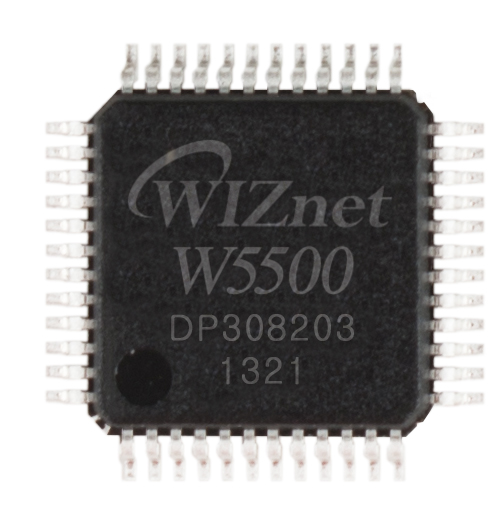
WIZnet - W5500
x 1

Project description
STM32 Toolbox
Executive Summary
STM32 Toolbox (aka stm32-toolbox) is a collection of C++ classes intended to support rapid development of firmware for STM32 microcontrollers. Its focus is on keeping code as small as possible to allow sophisticated functionality on MCUs with limited ROM and RAM resources. It also includes C++ wrappers for commonly used features allowing programmers to focus on functionality instead of constantly referencing HAL documentation.
Overview
STM32 Toolbox (aka stm32-toolbox) is a collection of C++ classes intended to support rapid development of firmware for STM32 microcontrollers. Its focus is on keeping code as small as possible to allow sophisticated functionality on MCUs with limited ROM and RAM resources. It does this by
- minimizing the number of dependencies on standard libraries that can add significant bloat. For example, including printf, especially with floating-point support can add 10kB or more to the binary footprint.
- offering reduced functionality by excluding features that are less used or require significant resources.
- not enrolling the Arduino ecosystem, with its many mandatory dependencies.
Almost all classes run on bare metal, but are compatible with FreeRTOS, and probably other RTOS'.
The functionality offered by the toolbox is quite varied, and increasing everyday. At the same time, the maturity of each class is directly proportional to how often it was used by the author, since for the most part these have been developed for specific projects with the hope of future reuse.
Since the risk that dynamic memory allocation (malloc, new) is unacceptable for many applications, it is easy to completely exclude classes depending on malloc or to offer alternative functionality that uses user-supplied buffers.
Classes build upon the STM32 HAL library, and typically assume that you have preconfigured devices. Often a device handle is passed to the constructor of a class; for example the CanBus class expects an hcan instance handle.
(Almost) all of the classes are based around the C++ concept of inlining, basically each class lives entirely in a header file, with functionality implemented by methods inside the class. While many purists will turn up their noses, I chose this strategy because:
- One file is easier to handle/digest/understand than two for someone trying to understand what a class does and how it works.
- The argument for two files was to keep the header "clean" for declaration and the implementation in a separate file. My background as a C# programmer biases me toward thinking you can do everything in a single file and still keep it clean.
- Code is only compiled if you use (#include) it. You don't have to manage a directory of files and hope that if you missed something, the compiler will optimize out any unused code.
Usage
You can copy individual classes to your project, but they easiest way it to git submodule add <repo-url>. This allows you to easily keep the libraries up-to-date.
Some classes refer to toolbox.h for configuration parameters.
Classes
Each of the classes is listed here by category. In time, each class will get its own documentation that includes usage, example, and dependencies.
Utility
PrintLite is an abstract class for adding printf-style functionality to classes that output text, such as serial communications, LED and LCD displays, logging, HTTP output, etc.
Rtc abstracts the system real-time clock, allowing it to be read and set, either as a date or time structure or as a UNIX timestamp.
Timer is a general purpose microsecond timer for timing how long something takes to execute, executing code at regular intervals, and returning to execution after an amount of time. By using the processor's DWT (data watchpoint timer), it does not require configuration or use of one of the system's timers.
Tokenism enables searching of strings for tokens. For example given a string and one or more delimiters it can return the 5th token, the token following the "filename" token, whether the 3rd token is "goat", or whether the token "ugly" is present at all.
StringBuilder allows you to build a string in steps or stages with printf-like functionaity.
Generics
List implements a list of a specified type. You can add items, request an item at a specific index, and iterate through the list.
Queue implements a FIFO queue of a specified type. You can add items to the end of the queue, dequeue them from the front of the queue, and peek at members of the queue.
Ring implements a ring buffer of a specified type. It maintains state, so you can used previous(), current(), and next() syntax to navigate the items in the ring.
Diagnostics
Watchdog is an easy-to-use implementation of a watchdog that thinly veils the controllers IWDG (independent watchdog).
Log allows logging to Serial device using printf-style notation and priority assignment. It can optionally be completely excluded from release builds.
Fault allows firmware to enumerate all possible faults, and have its code maintain and report fault states. Optionally an Led can be associated with the class and be illuminated when a fault is present.
Communications
Serial is a UART abstraction, offering printf-style syntax.
SPI is an SPI abstraction, allowing simple reading and writing with most devices.
OneWire implements the Dallas Semiconduction 1-wire interface.
CanBus is a CAN abstraction allowing the programmer to quickly be in communication with CAN devices.
CanOpen leverages CanBus to implement an interface with devices implementing CanOpen (CiA) protocols, including nmt, pdo, sdo, and tpdo. Classes can implement ICanOpenCallback to implement asychronous message handling without polling.
ethernet/* is a large collection of classes to implement a TCP/IP stack on top of W5500 hardware. This is all borrowed from Arduino-land, except I have gone though and removed most of the dependencies on the Arduino ecosystem. I fully intend to rewrite all of this to make it leaner and fix the messy confusion of OSI layers in which concepts including PHY, sockets, ICMP, TCP/IP, TCP and UDP, Ethernet, IP addressing, and application layer are all interwoven. Sure the W5500 implements a TCP/IP stack but, especially in C++, one can still keep the OSI layers mostly distinct.
http/* is my implementation of an HttpServer and HttpHandler which makes it easy to implement an application or API layer based on URI query string parsing.
Basic Devices
devices/basic/Pwm aids configuration of a PWM timer and is inherited by some other classes.
devices/basic/Led is a simple LED abstraction. It knows whether your logic is inverted (false state is ON). You can set() the device's state, turn it on() or off(), or flip() it's state.
devices/basic/Relay is a simple relay abstraction, however it is particularly useful for contactors or relays in which you want to monitor secondary contacts for feedback.
devices/basic/Encoder implements a simple pushbutton/rotary encoder device.
Batteries
devices/batteries/Nec12V35i interfaces with an NEC 12V35i battery that communicates using CANOpen. This is probably broken.
devices/batteries/Inventus interfaces the the PROTRXion line of batteries from Inventus.
Internal Memory Devices
devices/flash/internal/FlashMemory is an abstract class for reading and writing the FLASH memory that is embedded into STM32 MCUs.
devices/flash/internal/Sector is implementation of FlashMemory specifically for those MCUs that organize memory into sectors.
devices/flash/internal/FlashFileSystem is an abstract class for organizing FLASH memory into a simple filesystem, using Directory, DirectoryEntry, and DirectoryHeader.
devices/flash/internal/SectorFlashFileSystem is an implementation of a filesystem for MCUs that organize FLASH memory into sectors.
devices/flash/internal/OneTimeProgrammable is an interface to read and write one-time programmable memory.
External Memory Devices
devices/flash/external/SpiFlashMemory is an interface to read and write commodity SPI NOR FLASH memory. devices/flash/external/SpiFlashMemoryFileSystem allows SPI flash memory to be used like a filesystem.
Displays
devices/displays/Hd44780 is an interface to write to commodity Hitachi 2-line or 4-line alphanumeric displays.
devices/displays/OledSsd1306 is an interface to write to commodity 320x240 pixel displays.
devices/displays/NeoPixel is an interface to output to addressible RGB and RGBW LEDs.
devices/displays/Ili9488 is an interface to write to 3 to 4 inch RGB TFT LCD panels. It includes some basic drawing functionality, but is intended to be used with the PicoGFX class.
Graphics
PicoFGX is a minimalist graphics drawing library for drawing lines, rectangles, circles, text, etc. to a dot matrix display. It is designed to be hardware agnostic. As long as you can write an interface that turns on a pixel for any hardware, you can hook it up to PicoGFX and draw to that canvas.
Class Summary
This table lists the classes included in the library, the last time they were updated, and their subjective maturity.

