Building a Cloud-Free Solar Energy Controller with ESP32-S3 and W5500
Zendure SolarFlow 2400 Pro — lokale Regelung (ESP32-S3 + W5500) (미국, 태양광 하이브리드 에너지, 제어시스템)
0
Components
Hardware components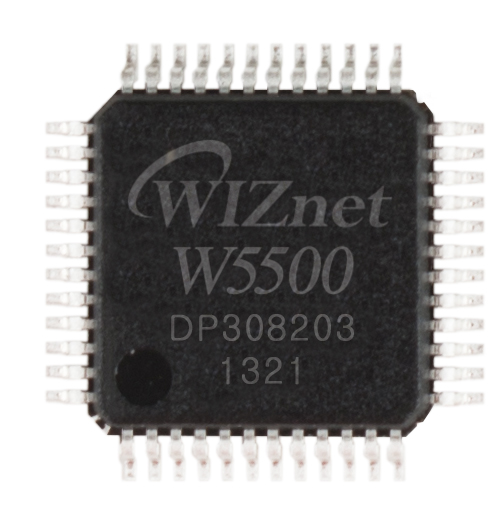
WIZnet - W5500
x 1

Espressif - ESP32
x 1
Project description
Building a Cloud-Free Solar Energy Controller with ESP32-S3 and W5500
Overview
Can a home solar energy system manage battery charging and discharging without depending on cloud services?
This open-source project demonstrates a local energy control system for the Zendure SolarFlow 2400 Pro, built using two ESP32-S3 boards equipped with WIZnet W5500 Ethernet controllers.
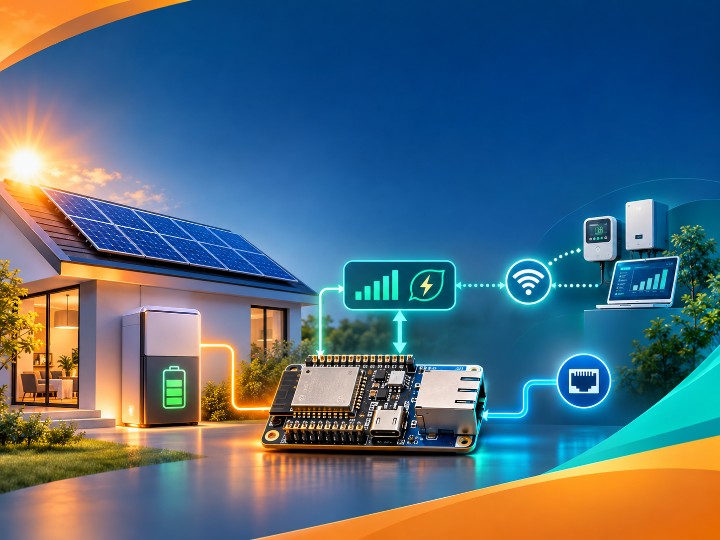
By combining wired Ethernet, Wi-Fi-connected energy devices, and MQTT communication, the developer created a control architecture that operates within a local network.
The goal is to adjust battery charging and discharging according to household power consumption and solar energy availability, reducing unwanted grid feed-in.
How the System Works
The system connects four main components:
Shelly Pro 3EM: Measures household grid power consumption and export.
ESP32-S3 + W5500 Controller: Reads power data and calculates the required charging or discharging power.
ESP32-S3 + W5500 MQTT Broker: Relays MQTT commands and telemetry between the controller and energy storage device.
Zendure SolarFlow 2400 Pro: Adjusts battery operation according to the received commands.
The controller and MQTT broker use wired Ethernet through W5500, while the Shelly and Zendure devices connect to the same local network over Wi-Fi.
Communication Flow
Shelly Pro 3EM → Controller → MQTT Broker → Zendure SolarFlow 2400 Pro
Telemetry from the Zendure device returns through the MQTT broker to the controller, completing the feedback loop.
This architecture allows the control logic to operate locally without requiring a cloud-based control service.
Hardware and Software
| Component | Specification | Function |
|---|---|---|
| Controller board | Waveshare ESP32-S3-ETH | Energy control logic |
| MQTT broker board | Waveshare ESP32-S3-ETH | Local MQTT messaging |
| Ethernet controller | WIZnet W5500 (2 units) | Wired Ethernet connectivity |
| Energy meter | Shelly Pro 3EM | Grid power measurements |
| Battery system | Zendure SolarFlow 2400 Pro | Battery charging and discharging |
| Communication | Ethernet, Wi-Fi, MQTT | Local network integration |
Each Waveshare ESP32-S3-ETH board includes an ESP32-S3R8 MCU, onboard W5500, and a 10/100 Mbps RJ45 Ethernet port.
The developer also documents the W5500 SPI pin assignments:
SCK: GPIO13
MISO: GPIO12
MOSI: GPIO11
CS: GPIO14
IRQ: GPIO10
RST: GPIO9
The implementation uses the ESP32 Arduino core's ETH.h interface for W5500 connectivity, with PubSubClient for MQTT client communication and PicoMQTT for the broker.
Why W5500 Matters
The W5500 provides the wired network interfaces for both ESP32-S3 control devices.
While the Shelly energy meter and Zendure battery system communicate over Wi-Fi, the controller and broker remain connected through Ethernet.
This creates a hybrid network architecture in which wired and wireless devices work together within the same local control system.
The W5500's hardware TCP/IP capabilities provide network connectivity while the ESP32-S3 microcontrollers handle MQTT messaging, control calculations, and application-level safety logic.
Separating the controller and MQTT broker also allows the developer to implement independent checks rather than relying on a single microcontroller for every control decision.
Local Control and Safety Features
According to the developer, the system has been tested in operation with bidirectional battery control.
The software includes several mechanisms intended to support controlled operation:
A PI controller that adjusts charging and discharging according to grid power measurements.
Battery state-of-charge limits to reduce the risk of excessive charging or discharging.
Watchdog and stale-data checks to detect missing communication or control updates.
Independent command validation by the MQTT broker before forwarding control values.
Read-only JSON status endpoints at GET /status for monitoring and diagnostics.
The developer reports approximately 1.5 W combined operating power consumption for the two ESP32-S3 Ethernet boards.
However, the project is still evolving. External alarm functionality remains under development, and the author specifically recommends verifying safe-state behavior before unattended operation.
The broker also uses anonymous MQTT access for compatibility with the Zendure implementation, so the system should be evaluated within an appropriately isolated and trusted local network.
Why This Project Is Interesting
As solar power and residential battery storage become more common, local energy management is an increasingly relevant application for embedded networking.
This project demonstrates that a W5500-based Ethernet connection can be part of a distributed energy control system involving multiple devices and communication technologies.
It also provides an example of hybrid networking: wired Ethernet supports the local control devices, while Wi-Fi connects the existing energy equipment.
For developers building energy monitoring, building automation, or industrial IoT applications, the project offers a practical reference for combining embedded Ethernet, MQTT, and local control logic.
Project Resources
Original project: https://github.com/ReinhardJesolowitz24/zendure-regler-broker
Controller source: https://github.com/ReinhardJesolowitz24/zendure-regler-broker/tree/main/regler
MQTT broker source: https://github.com/ReinhardJesolowitz24/zendure-regler-broker/tree/main/mqtt_broker
W5500 documentation: https://docs.wiznet.io/Product/iEthernet/W5500/overview

