How to Build a Secure Industrial IoT Edge Device with W5500 and Local AES Encryption?
A resource-constrained microcontroller can use the WIZnet W5500 for wired TCP/IP communication while keeping sensitive records encrypted in external storage.
0
Project description
How to Build a Secure Industrial IoT Edge Device with W5500 and Local AES Encryption?
Summary
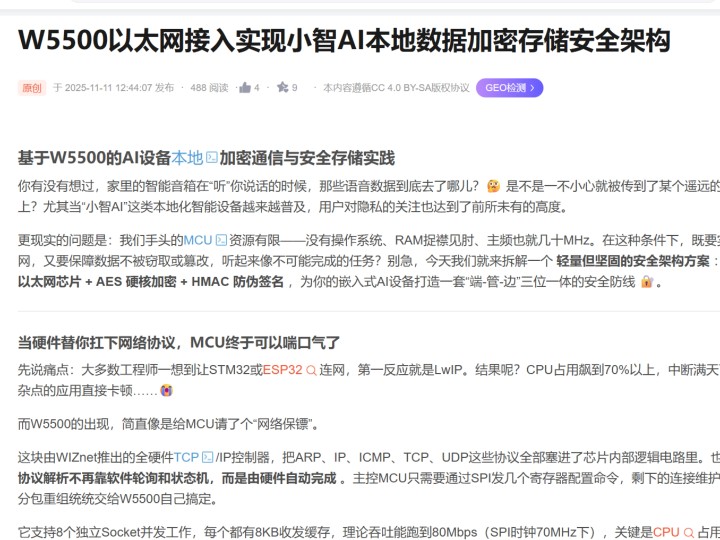
A resource-constrained microcontroller can use the WIZnet W5500 for wired TCP/IP communication while keeping sensitive records encrypted in external storage. The original CSDN article presents an architecture for an Xiaozhi AI-style embedded device combining W5500 Ethernet, MCU-side AES encryption, HMAC-SHA256 integrity checking, and SPI Flash. For industrial IoT, the same separation of networking, application processing, and protected storage is relevant to sensor logs and configuration records. The article illustrates a design approach; it does not publish a complete tested industrial firmware project.
What the Project Does
The original CSDN article addresses two concerns for a small AI-enabled device: maintaining an Ethernet connection without a large software TCP/IP stack, and preventing sensitive locally stored data from being read or altered without detection.
Its described data path is:
Voice or device data
        |
        v
MCU application
        |
        +--> AES encryption + HMAC integrity tag
        |         |
        |         v
        |    External SPI Flash
        |
        +--> W5500 TCP socket --> Wired LAN --> Remote service
The source uses voice features and user behavior records as its example inputs. In an industrial adaptation, the corresponding inputs could be machine measurements, event logs, device configuration, or maintenance records. That industrial use is an architectural extension, not a documented deployment in the source.
The source describes data verification at startup and a response to failed integrity checks. It does not provide a repository, schematics, a complete data-storage format, a complete HMAC implementation, or measured reliability results.
Where WIZnet Fits
The WIZnet W5500 is the wired Ethernet interface. It connects to the host MCU over SPI and performs conventional IPv4 TCP/IP processing in hardware. The W5500 supports eight hardware sockets and 32 KB of total internal TX/RX packet memory. That memory is shared and configurable; it is not eight independent 8 KB receive/transmit buffers, as one statement in the source might suggest.
The division of responsibility is important:
| Component | System responsibility |
|---|---|
| MCU / STM32-class host | Application logic, key handling, encryption, authentication, storage management |
| W5500 | Wired Ethernet MAC/PHY and hardware TCP/IP sockets |
| External SPI Flash | Storage of encrypted records and associated metadata |
| Remote application | Receives authorized network messages and independently authenticates their contents |
W5500 hardware TCP/IP offload can reduce host-side networking complexity compared with maintaining a software IP stack. It does not encrypt payloads, establish a trusted peer, or implement TLS. The blog's specific CPU-utilization and throughput claims lack reproducible test details and should not be treated as measured project results.
Implementation Notes
1. W5500 configuration shown in the original article
The original page contains the following real excerpt. Source location: CSDN article 154712503, section discussing basic initialization; no repository file path or source-code line numbers are supplied.
uint8_t mac[6] = {0x00, 0x08, 0xDC, 0x1A, 0x2B, 0x3C};
uint8_t ip[4]  = {192, 168, 1, 100};
uint8_t sn[4]  = {255, 255, 255, 0};
uint8_t gw[4]  = {192, 168, 1, 1};
The same source then shows these W5500 calls:
setSHAR(mac);
setSIPR(ip);
setSUBR(sn);
setGAR(gw);
socket(0, Sn_MR_TCP, 5000, 0);
connect(0, remote_ip, 5001);
The addresses configure a static IPv4 endpoint; the socket calls illustrate opening a TCP client toward a remote service. These are excerpts, not a complete buildable program: board-specific SPI callbacks, reset handling, status checks, and the declaration of remote_ip are not provided. The function names also reflect the library interface used in the article; developers should check compatibility with their selected WIZnet ioLibrary version.
2. Local encryption and integrity
The article separately presents an AES-CBC example and describes adding an HMAC-SHA256 tag before writing a protected record. Conceptually, the stored record needs identifiable fields such as:
record version | key identifier | IV | ciphertext | authentication tagThis is a conceptual storage format, not a structure extracted from its firmware.
A secure implementation must use an appropriate cryptographic library, unique unpredictable IVs where required, non-extractable or carefully protected device keys, and authentication of the record metadata as well as the encrypted data. Verify authentication before releasing decrypted contents. For a new product design, an authenticated-encryption mode such as AES-GCM can reduce the risks of combining encryption and integrity primitives incorrectly.
The CSDN text inconsistently discusses AES-128-CBC and a 256-bit key setting, and its example decryption call does not show proper IV handling. These omissions prevent the snippet from being treated as verified working cryptographic code. Its claimed storage protection also does not automatically imply secure boot or firmware-tamper resistance.
3. Industrial IoT integration
An industrial edge logger could sample measurements into RAM, package them with timestamps and sequence numbers, authenticate/encrypt records, and commit them to Flash with a power-loss-safe update procedure. The device could then use the W5500 to upload permitted records to a trusted on-premises service.
The network channel also needs explicit peer authentication and replay protection. Depending on the application, use a vetted TLS stack over W5500 TCP sockets or a reviewed application-layer secure protocol. Never assume that Ethernet cabling or W5500's hardware TCP/IP engine provides confidentiality.
Practical Tips / Pitfalls
Wire SPI carefully: Verify voltage compatibility, SCK/MOSI/MISO/CS connections, reset timing, a reliable Ethernet magnetics/RJ45 path, and board-specific interrupt handling.
Check link and addressing: Monitor PHY link state and distinguish a physical link failure from DHCP, static-IP, or server-connectivity problems.
Allocate sockets and buffers deliberately: W5500 has eight hardware sockets and shared configurable packet memory; do not assume each socket owns the entire buffer.
Protect keys separately from logs: Prefer hardware-protected key storage or a secure element; a public MCU unique ID is not itself a secret.
Authenticate before decrypting or trusting: Use established authenticated encryption or correctly reviewed encrypt-then-MAC handling; include counters or nonces for replay defense.
Make Flash updates recoverable: Define record versioning, CRC or integrity checks as appropriate, and power-failure-safe commit/recovery behavior.
Test industrial conditions: Measure upload jitter, dropped connections, watchdog recovery, storage wear, ESD/EMI tolerance, and power-loss behavior with the chosen MCU and network.
FAQ
Q1. Why use W5500 for this secure embedded device rather than a software TCP/IP stack?
W5500 implements TCP/IP sockets in hardware and connects over SPI, which can simplify conventional IPv4 networking on a resource-constrained MCU. The MCU can focus more of its resources on application processing, cryptography, and storage. Actual CPU savings depend on the firmware and traffic; the source provides no repeatable benchmarks.
Q2. How is W5500 connected to the STM32-class host?
The interface uses SPI signals SCK, MOSI, MISO, and chip select, typically with reset and optionally interrupt wiring. The host initializes SPI, configures the W5500 network registers, then opens its TCP socket. Exact pins and signal levels depend on the board.
Q3. Does W5500 encrypt the stored records or network traffic?
No. In this architecture, W5500 supplies Ethernet and TCP/IP transport. The host MCU and its cryptographic library encrypt and authenticate Flash records. Network security requires an additional authenticated protocol such as properly configured TLS or a reviewed secure message format.
Q4. Can a beginner reproduce the source article?
A developer with basic embedded C, SPI, static IPv4 networking, and WIZnet socket API knowledge can follow its Ethernet concepts. A secure product requires stronger prerequisites: cryptographic API usage, IV/nonce handling, key provisioning, power-failure-safe Flash storage, and security testing. The source is not a complete plug-and-play firmware project.
Q5. How does W5500 wired Ethernet compare with Wi-Fi for this application?
Wired Ethernet avoids radio contention and Wi-Fi association/reconnection complexity, which can help in fixed industrial installations with reliable cabling. Wi-Fi provides installation flexibility and mobility but introduces wireless coverage, interference, and credential-management considerations. Neither transport alone provides encryption of application data; both need proper security controls. No project-specific latency or reliability comparison was published.
Source
Original article: CSDN — W5500 Ethernet Access for Xiaozhi AI Local Encrypted Storage Security Architecture
Product and APIs: WIZnet ioLibrary_Driver
W5500 technical specification: WIZnet W5500 Datasheet
Original article license: CC BY-SA 4.0, as stated by its author. Attribution and the original-source link must be retained where its material is reused.
Evidence scope: The original source is an illustrative article and notes AI-assisted authorship. No linked buildable repository, complete hardware design, or independently verified industrial test results were established.
Tags
#W5500 #IndustrialIoT #Ethernet #STM32 #AES #HMAC #SecureStorage #SPIFlash #EdgeComputing #XiaozhiAI #WiFiComparison
W5500과 로컬 AES 암호화를 사용하여 보안 산업용 IoT 엣지 장치를 구축하는 방법
요약
자원이 제한된 MCU에서도 WIZnet W5500을 사용하면 유선 TCP/IP 통신을 처리하면서 민감한 데이터를 외부 저장장치에 암호화하여 보관하는 구조를 설계할 수 있습니다. 원본 CSDN 글은 샤오즈(Xiaozhi) AI 유형의 임베디드 장치에 W5500 이더넷, MCU의 AES 암호화, HMAC-SHA256 무결성 확인, SPI Flash를 결합하는 방식을 소개합니다. 산업용 IoT에서는 이와 같은 구성 요소 분리를 센서 로그 및 설정 기록의 보호에 적용할 수 있습니다. 다만 원문은 구현 방향과 예제 코드를 제시하며, 완전하게 시험된 산업용 펌웨어 프로젝트를 공개한 것은 아닙니다.
프로젝트 개요
해결하려는 문제
원본 CSDN 글은 소형 AI 장치에서 큰 소프트웨어 TCP/IP 스택 없이 이더넷 연결을 유지하는 문제와, 로컬에 저장한 민감 데이터를 무단으로 읽거나 변경하는 문제를 다룹니다.
설명된 데이터 흐름은 다음과 같습니다.
음성 또는 장치 데이터
          |
          v
MCU 애플리케이션
          |
          +--> AES 암호화 + HMAC 무결성 태그
          |                  |
          |                  v
          |              외부 SPI Flash
          |
          +--> W5500 TCP 소켓 --> 유선 LAN --> 원격 서비스
원문에서는 음성 특징과 사용자 행동 기록을 입력 예시로 사용합니다. 산업용 장치에서는 센서 계측값, 이벤트 로그, 장치 설정 또는 유지보수 기록으로 대체할 수 있습니다. 그러나 이 산업용 활용은 원문에서 검증한 배포 사례가 아닌 아키텍처 확장 제안입니다.
원문은 부팅 시 데이터 검증과 무결성 오류 대응을 설명하지만 저장소, 회로도, 완전한 저장 형식, HMAC 구현 코드 또는 재현 가능한 신뢰성 측정값은 제공하지 않습니다.
WIZnet 제품의 역할
WIZnet W5500은 유선 이더넷 인터페이스를 담당합니다. MCU와 SPI로 연결되며 일반 IPv4 TCP/IP 통신을 하드웨어로 처리합니다. W5500에는 하드웨어 소켓 8개와 총 32 KB의 송수신 패킷 메모리가 있습니다. 이 메모리는 설정에 따라 공유·할당되므로 소켓마다 독립적인 8 KB 송수신 버퍼가 있다는 의미는 아닙니다.
| 구성 요소 | 역할 |
|---|---|
| MCU / STM32 계열 호스트 | 애플리케이션, 키 관리, 암호화, 인증, 저장장치 관리 |
| W5500 | 유선 Ethernet MAC/PHY 및 TCP/IP 소켓 |
| 외부 SPI Flash | 암호화된 기록과 관련 메타데이터 저장 |
| 원격 애플리케이션 | 승인된 메시지를 수신하고 별도로 인증 |
W5500 하드웨어 TCP/IP 오프로드는 소프트웨어 IP 스택보다 호스트의 네트워크 처리 부담을 낮출 수 있습니다. 그러나 W5500이 데이터를 암호화하거나 TLS 및 상대방 인증을 자동으로 제공하는 것은 아닙니다. 원문에 기재된 CPU 점유율과 처리량 수치는 재현 가능한 시험 조건이 없어 해당 프로젝트의 측정 결과로 간주하기 어렵습니다.
구현 노트
1. 원문에 등장하는 W5500 네트워크 설정
아래 코드는 실제 CSDN 게시물에서 발췌한 것입니다. 출처 위치: 게시물 154712503의 기본 초기화 설명 부분. 원본 저장소 파일 경로와 줄 번호는 제공되지 않습니다.
uint8_t mac[6] = {0x00, 0x08, 0xDC, 0x1A, 0x2B, 0x3C};
uint8_t ip[4]  = {192, 168, 1, 100};
uint8_t sn[4]  = {255, 255, 255, 0};
uint8_t gw[4]  = {192, 168, 1, 1};
같은 원문에 다음 호출도 포함됩니다.
setSHAR(mac);
setSIPR(ip);
setSUBR(sn);
setGAR(gw);
socket(0, Sn_MR_TCP, 5000, 0);
connect(0, remote_ip, 5001);
주소 배열은 고정 IPv4 환경을 설정하고, 소켓 호출은 원격 서비스에 연결하는 TCP 클라이언트를 나타냅니다. 이는 전체 컴파일 가능 프로그램이 아닌 실제 코드 발췌입니다. 보드별 SPI 콜백, 리셋 절차, 오류 처리 및 remote_ip 선언은 제시되지 않습니다. 사용 중인 WIZnet ioLibrary 버전과 API 호환성도 확인해야 합니다.
2. 로컬 암호화와 무결성 확인
원문은 AES-CBC 예제와 함께 HMAC-SHA256 태그를 저장 기록에 추가하는 구조를 설명합니다. 개념적으로 저장 레코드에는 다음 정보가 포함될 수 있습니다.
레코드 버전 | 키 식별자 | IV | 암호문 | 인증 태그이는 개념적 저장 형식이며 원본 펌웨어에서 추출한 구조체가 아닙니다.
보안 구현에는 검증된 암호 라이브러리, 필요한 경우 예측 불가능하고 재사용되지 않는 IV, 안전하게 관리되는 장치별 키, 메타데이터를 포함한 인증이 필요합니다. 복호화된 정보를 사용하기 전에 인증 여부를 먼저 확인해야 합니다. 신규 개발에서는 AES-GCM과 같은 인증된 암호화 방식을 고려할 수 있습니다.
원문에는 AES-128-CBC 설명과 256비트 키 설정이 혼재하며, 복호화 호출에서 IV 처리가 완전하게 나타나지 않습니다. 따라서 예제 암호 코드를 실제 검증된 구현으로 간주할 수 없습니다. 저장 데이터의 무결성 검증만으로 보안 부팅이나 펌웨어 변조 방지가 제공되는 것도 아닙니다.
3. 산업용 IoT 적용 구조
산업용 엣지 로거는 계측값을 RAM에서 수집하고 타임스탬프와 시퀀스 번호를 추가한 뒤, 암호화·인증하여 전원 장애 복구를 고려한 방식으로 Flash에 저장할 수 있습니다. 이후 W5500을 통해 허가된 기록만 신뢰할 수 있는 온프레미스 서버에 전송할 수 있습니다.
네트워크 전송에는 상대방 인증과 재전송 공격 방지 기능이 필요합니다. 애플리케이션에 따라 W5500 TCP 소켓 위에서 검증된 TLS 스택 또는 적절히 검토된 애플리케이션 보안 프로토콜을 사용해야 합니다. 유선 이더넷 자체가 기밀성을 제공한다고 가정해서는 안 됩니다.
실무 팁 및 주의사항
SPI 배선 확인: 전압 호환성, SCK/MOSI/MISO/CS, 리셋 타이밍, 이더넷 마그네틱/RJ45, 인터럽트 연결을 점검합니다.
링크와 IP 설정 구분: PHY 링크 상태를 확인하고 케이블 문제, DHCP/고정 IP 문제, 서버 접속 실패를 분리해 진단합니다.
소켓과 버퍼 계획: W5500은 소켓 8개와 설정 가능한 공유 패킷 메모리를 갖습니다. 개별 소켓이 전체 메모리를 사용한다고 가정하지 않습니다.
키와 로그 분리: 하드웨어 보호 저장소 또는 보안 소자를 고려합니다. 공개적으로 읽을 수 있는 MCU 고유 ID 자체는 비밀키가 아닙니다.
인증을 우선 적용: 검증된 인증 암호화 또는 적절히 검토한 Encrypt-then-MAC 처리를 사용하고, 재전송 방지를 위한 카운터·논스를 관리합니다.
Flash 전원 장애 대응: 기록 버전, 무결성 검증 및 중단된 기록의 복구 절차를 설계합니다.
산업 환경 시험: 전송 지연 편차, 연결 손실, 워치독 복구, Flash 마모, ESD/EMI, 전원 차단 동작을 실제 장비에서 측정합니다.
FAQ
Q1. 이 장치에서 소프트웨어 TCP/IP 스택 대신 W5500을 사용하는 이유는 무엇인가요?
W5500은 TCP/IP 소켓을 하드웨어로 처리하고 SPI로 연결되므로 자원이 제한된 MCU에서 일반적인 IPv4 네트워킹 구현을 단순화할 수 있습니다. MCU는 애플리케이션, 암호화 및 저장장치 작업에 더 많은 자원을 배분할 수 있지만 실제 CPU 절감량은 펌웨어와 트래픽에 따라 달라집니다. 원문에는 재현 가능한 성능 측정이 없습니다.
Q2. W5500을 STM32 계열 호스트와 어떻게 연결하나요?
SCK, MOSI, MISO, CS를 사용하는 SPI로 연결하며 리셋 신호와 선택적인 인터럽트 연결도 고려합니다. 호스트는 SPI와 W5500 네트워크 레지스터를 초기화한 뒤 TCP 소켓을 엽니다. 구체적인 핀 배치는 보드에 따라 다릅니다.
Q3. W5500이 저장 기록이나 네트워크 트래픽을 직접 암호화하나요?
아닙니다. W5500은 Ethernet과 TCP/IP 전송을 담당합니다. Flash 기록의 암호화와 인증은 MCU 및 암호 라이브러리가 수행합니다. 네트워크 보안을 위해서는 적절히 구성된 TLS 또는 검증된 보안 메시지 형식이 별도로 필요합니다.
Q4. 초보자도 원문을 따라 구현할 수 있나요?
임베디드 C, SPI, 고정 IPv4 설정 및 WIZnet 소켓 API를 이해한다면 이더넷 설정 개념은 따라갈 수 있습니다. 하지만 실제 보안 제품에는 암호 API, IV/논스, 키 프로비저닝, 전원 장애에 안전한 Flash 저장 및 보안 시험 지식이 필요합니다. 원문은 즉시 빌드 가능한 전체 펌웨어가 아닙니다.
Q5. 이 프로젝트에서 W5500 유선 이더넷과 Wi-Fi의 차이는 무엇인가요?
유선 이더넷은 무선 간섭과 Wi-Fi 연결 재설정 과정을 피할 수 있어 케이블 설치가 가능한 고정형 산업 설비에 적합합니다. Wi-Fi는 설치와 이동의 유연성을 제공하지만 전파 환경, 간섭 및 무선 인증정보 관리가 중요합니다. 어느 전송 방식도 애플리케이션 데이터를 자동으로 암호화하지 않으며 원문에 두 방식의 실측 비교는 없습니다.
출처
원본 게시물: CSDN — W5500 이더넷을 활용한 샤오즈 AI 로컬 암호화 저장 구조
제품 및 API: WIZnet ioLibrary_Driver
W5500 기술 문서: WIZnet W5500 Datasheet
원문 라이선스: 게시물에 명시된 CC BY-SA 4.0. 원문의 자료를 재사용할 경우 저작자 표시와 원문 링크 및 해당 라이선스 조건을 준수해야 합니다.
근거 범위: 원문은 AI 작성 보조 사실을 표기한 설명형 게시물입니다. 빌드 가능한 전체 저장소, 하드웨어 회로도 또는 독립적으로 검증된 산업용 시험 결과는 확인되지 않았습니다.
태그
#W5500 #IndustrialIoT #Ethernet #STM32 #AES #HMAC #SecureStorage #SPIFlash #EdgeComputing #XiaozhiAI #WiFiComparison

