SLB-EXT Closed-Loop Controller
SLB-EXT: Why a Closed-Loop CNC Controller Moved Its Drivers Off the Board but Kept W5500 Ethernet
0
Components
Hardware components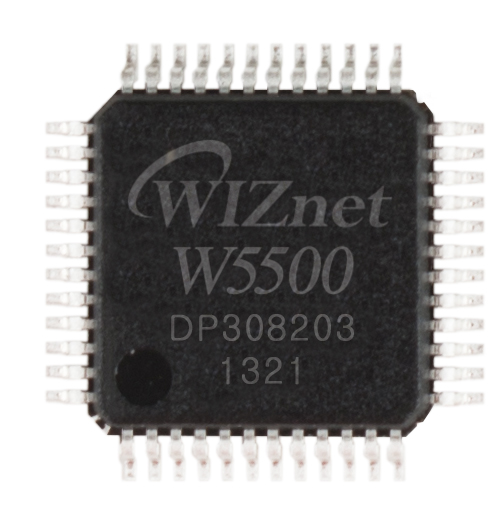
WIZnet - W5500
x 1

Project description
Summary
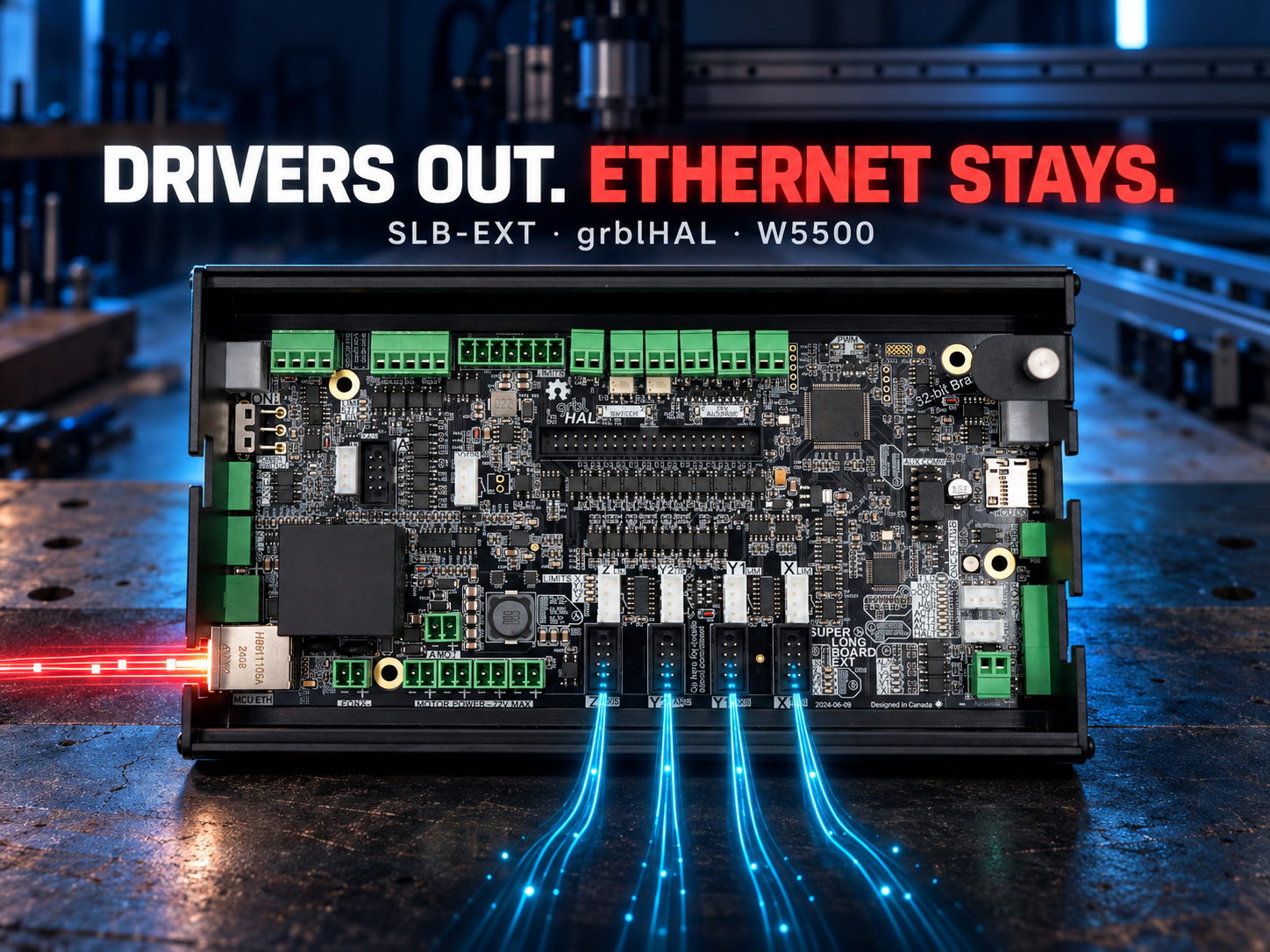
SLB-EXT is a $240 grblHAL CNC controller from Sienci Labs in Canada. It takes the SuperLongBoard (SLB), removes the onboard stepper drivers, and instead drives the external drivers of closed-loop steppers over differential signals. The MCU (STM32F412), the firmware, and the W5500 Ethernet design are the same as on the SLB. The W5500 runs in MACRAW mode as the MCU's MAC+PHY, while the MCU's lwIP stack handles TCP/IP. This article looks at a design that changed the drivers, voltage, and signaling for larger machines but left the path to the PC untouched.

Overview
Sienci Labs builds the LongMill desktop CNC and the larger AltMill. The SLB, designed for the LongMill, drives open-loop NEMA 23 motors directly with a 24V supply and onboard TMC2660C drivers. The AltMill, however, uses closed-loop steppers with a driver and encoder mounted on the back of each motor and runs at 48V, so the SLB cannot be used as is.
SLB-EXT is the variant built to close that gap. The drivers come off the board, and in their place are differential STEP/DIR outputs plus an ENABLE output, along with ALARM inputs that come back from the drivers. Target machines are the AltMill, LongMills converted to closed-loop motors, and hobby CNCs that use closed-loop NEMA 23 motors.
→ Product page: https://sienci.com/product/slb-ext-closed-loop-controller/
How It Differs from the SLB
| Item | SLB | SLB-EXT |
|---|---|---|
| Motor drivers | Onboard TMC2660C | None — drives external drivers (built into closed-loop motors) |
| Supported motors | Open-loop NEMA 23 | Closed-loop; open-loop also works with compatible external drivers |
| Power | 24V 10A | 48V (product page: 48V 10A, manual recommends 48V 12.5A) |
| Motor signals | N/A (drivers onboard) | Differential S±/D± + E−/5V and AL−/GD, 2×4 IDC ribbon |
| Driver alarm | — | Per-axis ALARM inputs |
| Y-axis dual homing | Not supported by default | Supported (Y_AUTO_SQUARE=1) |
| MCU · Ethernet | STM32F412 · W5500 | Same |
In firmware, the two boards are one branch of the same board map file. boards/longboard32_map.h in the upstream grblHAL STM32F4xx repository defines both. When BOARD_LONGBOARD32_EXT is set, the board name becomes "SuperLongBoard Ext" and the Trinamic driver path is blocked (#error "SLB EXT does not have Trinamic drivers!"). The env:sienci_slb_ext build target also lives in the upstream platformio.ini.
→ Board map: https://github.com/grblHAL/STM32F4xx/blob/master/boards/longboard32_map.h
Architecture

The block diagram in Sienci's published schematic shows the same structure. The Ethernet_Interface block connects to the MCU through SPI plus W5500_INTn and W5500_RSTn, and RS485, USB, limit and auxiliary I/O blocks sit around the MCU. The schematic is released under CERN-OHL-S v2.


Technology Background
Closed-Loop Steppers and Alarm Feedback
A closed-loop stepper adds an encoder and a dedicated driver to a regular stepper motor. The driver compares the commanded position with the actual position and corrects the difference on its own. With an open-loop stepper, the controller never learns about a missed step when the load exceeds the motor's torque. A closed-loop driver raises an ALARM signal when the error goes beyond its tolerance.
On the SLB-EXT, these alarms come back per axis. The board map defines X/Y/Z/M3/M4_MOTOR_FAULT input pins. The SLB-EXT build sets DEFAULT_MOTOR_FAULT_SIGNALS_ENABLE=15 and DEFAULT_MOTOR_FAULT_SIGNALS_INVERT=15, so the X, Y, Z and A fault inputs are enabled and inverted by default. The manual describes the alarm as an active-low signal. The grblHAL core treats a motor fault as a blocking signal, just like E-stop, and raises Alarm 17 (Alarm_MotorFault). Instead of cutting on after a missed step, the machine stops and tells the user.
→ grblHAL core protocol.c: https://github.com/grblHAL/core/blob/master/protocol.c
Differential STEP/DIR Signals
Differential signaling sends one signal on two wires in opposite phase. The receiver reads only the voltage difference between them. Noise that couples equally onto both wires cancels out in the subtraction, so differential lines hold up better than single-ended ones over long cables and near high currents.
Each SLB-EXT motor connector groups S± (STEP), D± (DIR), E−/5V (ENABLE) and AL−/GD (ALARM) on a single 2×4 IDC ribbon. The manual calls these differential signals on twisted-pair cable. That choice matters on a large machine where signal wires ride along the gantry next to 48V motor current.

→ SLB technical manual: https://resources.sienci.com/view/slb-manual
Modbus RTU over RS485
Modbus RTU is an industrial serial protocol. A master sends a frame with a slave address, function code and register, then reads the reply. It runs on the differential RS485 bus and is widely used to control VFDs (inverters).
The SLB-EXT controls the rotation and speed of a VFD spindle through its RS485 port. The build uses MODBUS_ENABLE=3 (RTU plus a direction-control pin). The manual lists Huanyang v1 and P2A, Yalang YL620, H-100 and GS20 as supported VFDs. Because spindle control travels as serial commands rather than an analog 0–10V level, status values such as spindle speed can also be read back from the VFD [Inferred].
→ Modbus specifications: https://modbus.org/modbus-specifications
Technical Highlights
- Independent per-axis alarm inputs — each axis has its own pin. The firmware raises a single
Alarm_MotorFault, so whether the UI shows which axis tripped is not confirmed - Simultaneous 4-axis cutting — an independent A axis (rotary) output. Build defaults are
N_AXIS=4andDEFAULT_AXIS_ROTATIONAL_MASK=8 - Dual-motor Y auto-squaring — Y1 and Y2 home separately to square the gantry (
Y_AUTO_SQUARE=1) - Direct 48V distribution — board terminals feed power to five motors (silkscreen reads 72V MAX)
- Noise countermeasures — the product page cites shielding and onboard ferrites on USB-C and Ethernet, and the manual says USB and Ethernet are isolated for noise
- Stock upstream firmware —
env:sienci_slb_extbuilds Telnet, WebSocket, FTP, three macro buttons, RGB status lights and Sienci's ATC interface plugin - Open hardware — schematics, connector list and pinout are downloadable from the product page
Where WIZnet Fits — MAC+PHY with lwIP on Top
Bottom line: the W5500 on the SLB-EXT is not used as a TOE (hardware TCP/IP engine). grblHAL's WIZnet network driver (Plugin_networking/wiznet) opens W5500 socket 0 in MACRAW mode (#define SOCKET_MACRAW 0) and hands received Ethernet frames straight to an lwIP netif. ARP, IP, TCP and retransmission all run in lwIP on the STM32F412.
The STM32F412 has no built-in Ethernet MAC. That is likely why the designers chose the W5500, which provides both MAC and PHY over a single SPI bus [Inferred]. The board map assumes this chip and refuses to compile if another one is configured ("Board has a WZ5500 ethernet chip"). The reasoning behind that choice is covered in the SLB article, so this section follows the data path on the SLB-EXT itself.
→ SuperLongBoard article: https://maker.wiznet.io/scott/resellers/superlongboard/
How one line of G-code from gSender reaches the motors
- gSender on the PC sends
G1 X100 F3000over a Telnet (or WebSocket) connection to192.168.5.1 - The W5500 receives the frame through its PHY and MAC, stores it in the MACRAW receive buffer, and pulls
INT(PA10) low. The socket is opened without the MAC filter (socket()flag 0), so it accepts every incoming frame regardless of destination address. The MCU checks for received data both on this interrupt and through periodic systick polling - The STM32F412 reads the whole frame over SPI1 and passes it to lwIP
- lwIP unpacks the IP and TCP headers, handles ordering, acknowledgments (ACK) and retransmission, then passes only the payload bytes to the Telnet daemon
- grblHAL takes those bytes as an input stream and feeds them to the G-code parser and motion planner
- STEP/DIR pulses from the planner leave through the differential drivers to the closed-loop motors. Status reports (the
?response) travel the same path in reverse back to gSender
Think of the W5500 as the board's "post office counter." The counter takes every envelope that arrives and passes it inside unopened. Everything else is done by the clerk in the back office (lwIP on the STM32F412) — checking whether the envelope is addressed to this building, opening it, counting which letter it is, and writing back to ask for missing ones (TCP). In TOE mode the counter would open the letters and put them in order itself. This board chose to leave that work to the clerk.
The SLB-EXT build sets the size of the clerk's desk explicitly:
| lwIP setting | Value | Meaning |
|---|---|---|
TCP_MSS |
1460 | Largest TCP payload that fits in one Ethernet frame |
TCP_SND_BUF |
5840 | Send buffer = 4 × MSS |
MEM_SIZE |
16384 | 16 KB lwIP heap |
NETWORK_IPMODE |
0 | Static IP by default |
Without the W5500, the STM32F412 has no built-in MAC, so wired Ethernet would be impossible without an external Ethernet chip. The alternatives are a MAC-equipped MCU (STM32F407/F429, etc.) with a separate RMII PHY, or another SPI Ethernet chip. The W5500 solves the problem with just 4 SPI lines plus INT and RST, without changing the MCU. In exchange, the MCU carries the TCP processing load and the lwIP memory.
→ grblHAL networking plugin (WIZnet driver): https://github.com/grblHAL/Plugin_networking/tree/master/wiznet
→ W5500 datasheet: https://docs.wiznet.io/Product/Chip/Ethernet/W5500/datasheet
Similar Projects on WIZnet Makers
- SuperLongBoard — same company, same STM32F412, same board map, same W5500 MACRAW + lwIP design. The only difference is the output stage: the SLB carries TMC2660C drivers on the board, while the SLB-EXT moves them off it
→ Project link: https://maker.wiznet.io/scott/resellers/superlongboard/ - FlexiHAL 2350 — a grblHAL + W5500 controller that, like the SLB-EXT, drives external drivers over RS-422 differential Step/Dir. It differs in using an RP2350 whose PIO generates the pulses, and in offering 6 axes and isolated outputs
→ Project link: https://maker.wiznet.io/scott/resellers/flexihal-2350-cnc-controller/ - Ooznest Motion Control Core — an unreleased ESP32-S3 board that Ooznest, the UK CNC company behind the WorkBee, added to grblHAL. It uses the W5500 as a MAC+PHY under lwIP. It differs in going through ESP-IDF's
esp_ethlayer and in not being a shipping product yet
→ Project link: https://maker.wiznet.io/Benjamin/projects/why-did-cnc-vendor-ooznest-choose-w5500-ethernet-for-its-grblhal-esp32-s3-board/
All three are grblHAL controllers that solve wired Ethernet with a single W5500. Two commercial CNC companies (Sienci and Ooznest) made the same choice of placing the W5500 under lwIP, even with different MCUs.
| Item | SLB-EXT | SuperLongBoard | FlexiHAL 2350 | Ooznest MCC |
|---|---|---|---|---|
| MCU | STM32F412 | STM32F412 | RP2350 | ESP32-S3 |
| Motor drivers | External (closed-loop) | Onboard TMC2660C | External | Unknown |
| Step/Dir signals | Differential | N/A | Differential (RS-422) | Unknown |
| Driver alarm input | Per axis | One shared (for A axis, conditional) | Unknown | Unknown |
| W5500 usage | MACRAW + lwIP | MACRAW + lwIP | Unknown (original article describes TOE) | MAC+PHY + lwIP |
| Power | 48V | 24V | Unknown | Unknown |
| Price | $240 | $165 | Unknown | Not disclosed |
What sets the SLB family apart is releasing two product lines that keep the same MCU and network path and change only the output stage. In effect, the machine size could grow without rewriting the network code [Inferred].
Where It Fits
- Large gantry CNCs — machines like the AltMill with more than 1 m of travel (SLB-EXT build defaults: X 1260 mm, Y 1248 mm). Long motor power and signal runs make differential signaling and a direct Ethernet link work together
- Open-loop to closed-loop conversions — when adding closed-loop NEMA 23 motors to an existing LongMill or similar, the stock upstream grblHAL build works without custom firmware
- 4-axis rotary work — the independent A-axis output turns a rotary axis together with X, Y and Z
- Noisy workshops — stream over a direct Ethernet link instead of USB where VFD spindles and dust collectors run. In May 2025, Sienci support answered a mid-job disconnect question by suggesting an Ethernet connection first
→ Sienci forum "Continuous disconnect": https://forum.sienci.com/t/continuous-disconnect/17344
Limitations and Future Improvements
The SLB-EXT is a well-built product that ties a large closed-loop machine to open firmware. Forum threads and documentation still point to a few areas for improvement.
- Ethernet link loss report — in April 2026, a user reported the controller going offline after idle periods with the RJ45 link LEDs turned off. USB came back after a power cycle, and Ethernet stayed down for a while before reconnecting later the same day. The cause was not determined, and the user ordered a new controller
→ Sienci forum "Failure of SLB-EXT": https://forum.sienci.com/t/failure-of-slb-ext/26159 - No firmware updates over Ethernet — the manual notes that the STM32 does not support flashing over Ethernet and advises keeping a USB-C cable handy. A bootloader extension on the firmware side could address this [Inferred]
- Point-to-point link recommended — the manual recommends connecting the PC directly to the board rather than through a router or plant network. Putting several machines on one network needs separate validation
- SD card and ATC support timing — in September 2025, a user relayed that Sienci support told them SD cards were not supported. The current upstream build includes
SDCARD_ENABLE=2,FTP_ENABLE=1and the ATC interface plugin, so once gSender support follows, uploading G-code files over Ethernet becomes possible [Inferred]
→ Sienci forum "SLB-EXT and the ATC": https://forum.sienci.com/t/slb-ext-ant-the-atc/22098 - Documentation mismatch — the product page said "not compatible with open-loop" while the resources page said open-loop is supported. In December 2025, Sienci clarified that open-loop works with compatible external drivers. The power spec also differs between the product page (48V 10A) and the manual (48V 12.5A), so the manual value is the safer baseline
→ Sienci forum "SLB vs. SLB-EXT": https://forum.sienci.com/t/slb-vs-slb-ext/24865
FAQ
Q. Can I use it with open-loop stepper motors? A. Yes, if each motor has a compatible external driver. The SLB-EXT only outputs STEP/DIR signals, so it does not matter whether the driver is built into a closed-loop motor or mounted separately.
Q. Can I connect it through a router? A. It works, but the manual recommends a direct link to the PC. The default is the static IP 192.168.5.1/24, so set the PC adapter to the same subnet (for example, 192.168.5.2).
Q. Should I use USB or Ethernet? A. In a noisy workshop, use Ethernet. Firmware updates only work over USB-C, though, so keep both paths available.
Q. Doesn't the W5500 handle TCP, leaving no load on the MCU? A. No. On this board the W5500 runs in MACRAW mode and only moves frames. TCP/IP runs in lwIP on the STM32F412, which is why the build tunes the lwIP buffer sizes separately.
Q. Where do I start if I want to modify the firmware?
A. Start with the env:sienci_slb_ext build target and boards/longboard32_map.h in the upstream grblHAL STM32F4xx repository. Sienci's fork (Sienci-Labs/sienciHAL) is also public.
→ sienciHAL: https://github.com/Sienci-Labs/sienciHAL
요약
SLB-EXT 는 캐나다 Sienci Labs 의 $240 grblHAL CNC 컨트롤러로, 형제 제품 SuperLongBoard(SLB) 에서 온보드 스테퍼 드라이버를 빼고 폐루프(closed-loop) 스테퍼의 외부 드라이버를 차동 신호로 구동하도록 바꾼 보드입니다. MCU(STM32F412)와 펌웨어, W5500 Ethernet 구성은 SLB 와 같고, W5500 은 MACRAW 모드로 MCU 에 MAC+PHY 를 제공하며 TCP/IP 는 MCU 의 lwIP 가 처리합니다. 드라이버·전압·신호 방식은 대형 기계에 맞춰 전부 바꾸면서도 PC 와 잇는 경로는 그대로 둔 설계라는 점이 이 글의 관심사입니다.