W5500_Get (with Kendryte-K210)
A project that sets up the K210's SPI to communicate with the W5500 and transfer images using TCP between server and client.
0
Components
Hardware components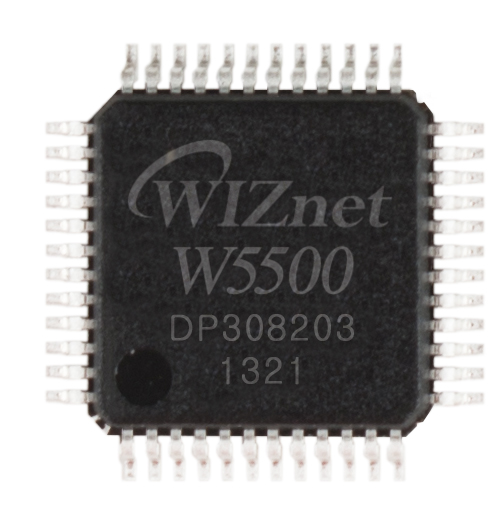
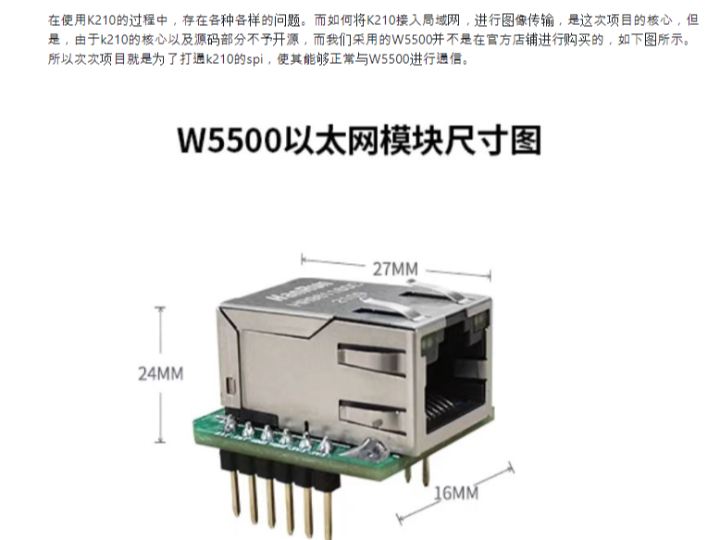
WIZnet - W5500
x 1

Kendryte - Kendryte K210
x 1

Python - Python
x 1
Project description
This project is about using a K210 microcontroller to communicate with a W5500 Ethernet module. The goal of the project is to connect the K210 to a local network and perform image transfer.
The project consists of the following main steps
1. Set up the SPI on the K210 so that it can communicate normally with the W5500.
2. Transfer images using TCP. In the current mode, the frame rate is about 10 frames.
3. The project consists of three main parts: img (screenshots of the development process), inc (material files), and src (core code).
4. The final goal of the project is to transfer images between a server and a client. The server requires Python and Python-OpenCV, and the client runs Maixpy in a K210 environment.
This project can be a useful reference for developers who want to use the K210 and W5500 to perform network communication.
The K210 is a high-performance, low-power, RISC-V-based microcontroller developed by Kendryte. The chip is specialized for AI and machine learning applications, and is particularly suited for image and audio processing in edge computing devices.
Key features of the K210 include
1. Based on RISC-V: RISC-V is an open-source hardware instruction set architecture, which can be freely used and modified by developers, and is especially suitable for IoT and edge computing devices. 2.
2. AI and machine learning support: The K210 has a built-in neural network processor called the Kendryte Processing Unit (KPU). This enables it to run machine learning models such as convolutional neural networks (CNNs).
3. Image and audio processing: The K210 supports high-resolution camera and microphone interfaces and can perform real-time image and audio processing.
4. Low power consumption: The K210 realizes low power consumption while maintaining high performance. This is ideal for battery-powered IoT devices.
5. Multiple communication interfaces: The K210 supports multiple communication interfaces, including SPI, I2C, and UART. This allows it to communicate with a variety of sensors, or communicate with other devices.
Because of these features, the K210 is used in a variety of AI-powered devices, including drones, robots, security cameras, and smart home devices.

