warp-core
warp-core: A Hybrid Rocket Launch Controller Built on an 8-bit AVR and the W5500
0
Components
Hardware components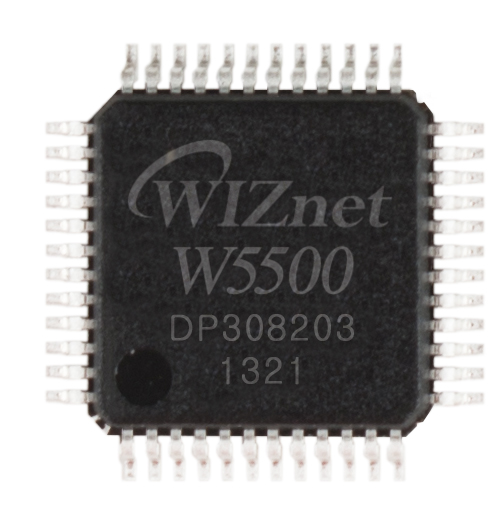
WIZnet - W5500
x 1

Project description
Summary
warp-core is the launch control firmware that an ECE capstone team built for the Oregon State University (OSU) hybrid rocket team. It receives JSON commands from a mission control PC over the hardware TCP socket of the WIZnet W5500 and hands them to FreeRTOS tasks running on an ATmega1284p. It is a useful reference because it shows that an 8-bit MCU with 16 KB of SRAM can run a remote control link in a small amount of code, with no TCP/IP stack of its own.

Overview
A hybrid rocket uses a solid fuel together with a liquid or gaseous oxidizer. The oxidizer is usually loaded at the pad shortly before launch. Once filling starts, people must stay far from the rocket and operate the valves and ignition remotely.
warp-core is the pad-side brain of that remote operation. Its README names two challenges unique to hybrid rockets: pre-flight remote oxidizer filling and ignition timing matched to oxidizer injection.
- Developers: Quinn Handley, Thomas Prihoda
- Timeline: first commit 2019-10-22, last commit 2020-03-08, 48 commits
- Environment: custom AVR controller, FreeRTOS AVR port, avr-gcc 5.4.0
→ GitHub: https://github.com/qhandley/warp-core
Why Remote Control Is Required
How the Repository Was Actually Used
- Confirmed: According to the capstone page, the subscale system (T3st Core) supported many fuel grain tests
- Full-scale launch not completed: The phase 3 full-scale launch was postponed due to COVID-19. Spaceport America Cup 2020, planned for the same year, was also canceled in March 2020
- Activity: 1 star, 1 fork. The repository was created for a university capstone and has not been updated since
→ Capstone project page: https://sites.google.com/oregonstate.edu/ece44x201932/home
→ Competition cancellation notice (ESRA, 2020-03-24, archived copy): http://web.archive.org/web/20250914092355/https://www.soundingrocket.org/news1/2020-spaceport-america-cup-cancelled
What the Competition Rules Require
The Design, Test & Evaluation Guide (DTEG) from ESRA, which runs the student rocketry competition, sets these requirements for hybrid propulsion and launch equipment.
| Section | Requirement |
|---|---|
| 5.2.2.3 | Nitrous oxide (N₂O) is the only allowed hybrid oxidizer |
| 5.10.1 | Hybrid and liquid systems must be able to remotely vent all propellants |
| 11.3.4 | Hybrid launch controllers must include oxidizer fill level instrumentation |
| 11.5.1 | Launch control systems must be single fault tolerant (key or jumper interlock) |
| 11.5.3 | Hybrid launch controllers must automatically vent oxidizer if power or communication is lost during fill |
In other words, remote operation itself is mandatory, and what happens when the link drops is an explicit requirement. We come back to this in "Limitations and Future Improvements."
The edition cited here is the 2024 revision (Rev 2024 V1.1.3). We could not confirm the section numbers or wording of the edition in force in 2020, when warp-core was written.
→ ESRA IREC DTEG (2024 V1.1.3): https://www.soundingrocket.org/uploads/9/0/6/4/9064598/2025_irec_dteg_v1.1.3_10-22-24.pdf
Architecture
The full system designed by the capstone team consists of an MCU board, FPGA board, I/O board, power board, and a C# GUI. The warp-core repository contains the firmware for the MCU board.

- Covered by the code: mission control → W5500 → TCP task → queue → control task
- Described only on the capstone page: the FPGA gateway between the MCU and the I/O board with its failsafe, the RS232 link to the rocket avionics, and the C# GUI
Technology Background
Filling and Igniting a Hybrid Rocket
A hybrid rocket stores its fuel (a solid grain) and its oxidizer (a fluid such as N₂O) separately. Combustion starts only when the oxidizer flows into the combustion chamber. Unlike a solid motor, the oxidizer valve can start and stop combustion.
- Fill: N₂O flows from a supply tank at the pad into the rocket's tank. From this point the rocket carries a pressure vessel
- Vent: If the launch is scrubbed, the oxidizer must be dumped remotely (DTEG 5.10.1)
- Ignite: The igniter heats the fuel grain surface, then the main oxidizer valve opens. The order and spacing of these two steps decide whether ignition is clean
This is why warp-core lists "ignition timing matched to oxidizer injection" as a core challenge. Every command from mission control acts on high-pressure oxidizer, so the reliability of the command link is a safety issue.
FreeRTOS Tasks and Queues
FreeRTOS is a real-time kernel for small MCUs. A program is split into tasks, and the kernel shares the CPU among them by priority. Tasks exchange data through queues, which decouple the sender from the receiver in time.
warp-core uses this structure directly.
- vTCPServerTask (priority +2): handles only the network. It wakes every 10 ticks (100 ms at a 100 Hz tick) through
vTaskDelayUntil()and checks the socket - vControlTask (priority +1): only takes commands from the queue and drives the output
- xControlCmdQueue: a 10-entry queue that connects the two tasks
The benefit of this split is that the control task's code path stays the same even when the network side slows down or reconnects.
→ FreeRTOS queue documentation: https://www.freertos.org/Documentation/02-Kernel/02-Kernel-features/02-Queues-mutexes-and-semaphores/01-Queues
Knowing When a TCP Connection Is Gone
TCP is connection-oriented, but it does not always tell you that the peer has disappeared.
| Situation | Does the server know? |
|---|---|
| The mission control program exits normally | Yes — the peer sends a FIN to close the connection |
| The mission control PC loses power, or the cable is cut | No — no packet arrives, so the connection still looks alive |
There are two ways to catch the second case.
- TCP keep-alive: after a period with no data, send an empty probe to ask whether the peer is still there (RFC 1122)
- Application-level heartbeat: mission control sends an "alive" message at a fixed interval, and the pad side enters a safe state if it misses them for too long
To meet the "automatic venting on communication loss" rule in DTEG 11.5.3 in software, you need at least one of these.
→ RFC 1122 (4.2.3.6 TCP Keep-Alives): https://www.rfc-editor.org/rfc/rfc1122
Technical Highlights
- Communication and control are separated: the TCP task only receives and parses, and the control task on the other side of the queue drives the output. Communication (+2) runs at a higher priority than control (+1)
- A command is a single integer: from
{"cmd": 5}, only the value of thecmdkey is extracted and converted withatoi(). The parser is jsmn (MIT license), a single header file that uses no dynamic memory - Bare-metal port without Arduino: the firmware brings in WIZnet ioLibrary and fills in the hardware-dependent functions in
wizchip_conf.c— SPI chip select and byte read/write — with AVR registers. Burst read/write calls these byte functions in a loop - Debug output: the
_TCP_DEBUG_macro prints received data, the chip version, and the IP settings to USART1 - Signs of iterative development: the commit log includes "Fixed memory bug causing reset loop" and "Protected wizchip recv with critical section," and the README FAQ explains how to check RTOS reset causes (stack overflow, heap settings, watchdog)
Where WIZnet Fits
TOE in Use: Yes
warp-core uses the W5500 as a hardware TCP/IP offload engine (TOE). The evidence is in the code.
socket(sn, Sn_MR_TCP, tcpPORT, 0x00)— opens an ioLibrary hardware socket in TCP modegetSn_SR()reads the socket status register inside the chip to drive the state machine- The firmware build (the source list in the makefile) does not include a software TCP/IP stack such as lwIP. The repository does contain the demo lwIP and uIP sources that ship with FreeRTOS, but they are not built
Configuration
| Item | Value | Location |
|---|---|---|
| Chip | W5500 (_WIZCHIP_ W5500) |
lib/Ethernet/wizchip_conf.h |
| Sockets used | Socket 0 only | tcp_server.c |
| Socket buffers | TX 16 KB, RX 16 KB, all assigned to socket 0 | tcp_server.c |
| Address | Static IP 10.0.0.10, gateway 10.0.0.1 | tcp_server.h |
| Port | 8080 | tcp_server.h |
| SPI chip select | PB3 | wizchip_conf.c |
The W5500's 8 sockets share an internal buffer of 16 KB TX and 16 KB RX. Because warp-core accepts only one connection, it gives the entire buffer to socket 0.
→ W5500 datasheet: https://docs.wiznet.io/Product/Chip/Ethernet/W5500/datasheet
How One Command Is Processed
- Open the socket — if socket 0 is closed (
SOCK_CLOSED), the MCU opens it in TCP mode withsocket(). When the chip reachesSOCK_INIT, the MCU callslisten() - Connect — when the mission control PC connects to
10.0.0.10:8080, the W5500 handles the SYN/SYN-ACK/ACK handshake and the state changes toSOCK_ESTABLISHED. The MCU sees this when it reads the status register every 100 ms - Receive — when the PC sends
{"cmd": 3}, the W5500 receives the TCP segment, returns the ACK, and stores the payload in its internal RX buffer - Fetch — the MCU reads the number of waiting bytes with
getSn_RX_RSR(0)and pulls up to 64 bytes over SPI withrecv() - Parse and forward — the MCU extracts the
cmdvalue3with jsmn and passes it to the control task withxQueueSend() - Close — when mission control closes the connection, the W5500 receives the FIN and moves to
SOCK_CLOSE_WAIT. The MCU finishes withdisconnect()and returns to step 1
What the MCU does not do: ARP replies, the TCP handshake, ACKs, retransmission, buffering received data
What the MCU does: check the status register, read 64 bytes, parse JSON, forward to the queue
Analogy: The Radio Operator at the Pad
The W5500 is the radio operator in the pad bunker. Tuning the radio, answering calls, and asking for repeats when a message is garbled are all the operator's job. The commander (ATmega1284p) only asks the operator every 100 ms, "Any orders?", reads the one line the operator wrote down, and hands it to a subordinate (the control task). The commander never needs to learn radio procedure.
What If the Chip Were Not There [Inferred]
The ATmega1284p has 16 KB of SRAM. warp-core reserves 10,000 bytes of it as the FreeRTOS heap and allocates 2,048 (bytes, in the AVR port) from that heap for the TCP task stack.
- With a MAC/PHY-only Ethernet chip and a software TCP/IP stack (uIP, lwIP, etc.), packet buffers, connection state, and retransmission timers compete with the RTOS for the same SRAM
- The MCU would have to keep retransmission timing, so TCP handling would be tied to task scheduling
- In the current design, received data stays in the chip's 16 KB buffer, and the MCU uses a single 64-byte array for incoming data
Similar Projects on WIZnet Makers
Several university rocket teams already use the W5500 in their ground equipment. They solve the same problem in different ways, which makes them worth reading side by side.
- Hybrid PCC — the hybrid rocket pad control box from the CU InSpace team at Carleton University in Canada. It is also hybrid rocket ground control, but it is built on an RP2040 + W5500-EVB-Pico board, in contrast to warp-core's custom PCB
→ Project link: https://maker.wiznet.io/Sunny_/projects/hybrid-pcc/ - phoenix-gs (Phoenix Ground Station) — the liquid rocket ground station from RPL at UC San Diego. Like warp-core, it sends valve commands and receives sensor data. But it opens the W5500 in MACRAW mode and talks in custom Layer-2 frames with no TCP/IP, the opposite choice to warp-core's TOE approach
→ Project link: https://maker.wiznet.io/matthew/projects/phoenix-gs-phoenix-ground-station/ - PSPL CMS — the liquid rocket avionics from the Purdue Space Program Liquids team. Built on RP2040 + W5500, it splits commands into TCP request-response (CommandNet) and sensor data into UDP multicast (SensorNet). Commands get a reply, which is the difference from warp-core (Hybrid PCC also reports command results by design)
→ Project link: https://maker.wiznet.io/Aimee0/projects/cms--rocket-developed-by-the-purdue-space-program-liquids-team/
All four projects build their wired Ethernet segment with a W5500 attached over SPI. Hybrid PCC, however, relies on a separate wireless bridge for the long link between mission control and the pad, and PSPL CMS uses Ethernet as a backbone between the rocket's flight computers and ground equipment. What differs is how much of the chip each one uses.
| Item | warp-core (OSU) | Hybrid PCC (Carleton) | phoenix-gs (UCSD) | PSPL CMS (Purdue) |
|---|---|---|---|---|
| Propulsion | Hybrid | Hybrid | Liquid | Liquid |
| MCU | ATmega1284p (8-bit) | RP2040 | Arduino-compatible (model unknown) | RP2040 |
| W5500 mode | TOE | Unknown | MACRAW | Unknown |
| Command transport | TCP, JSON | Unknown | Layer-2 frame, 1 byte | TCP, MessagePack |
| Command reply | No | Yes (reports results by design) | No | Yes (request-response) |
| RTOS | FreeRTOS | Apache NuttX | Unknown | FreeRTOS |
Of these, warp-core is the only one confirmed to run on an 8-bit MCU, and it leans on the chip's TCP engine to build its remote control link. Placed next to phoenix-gs, which builds raw frames over MACRAW, it shows clearly that the same chip can serve as either "a finished TCP socket" or "a bare Ethernet port."
Use Cases
- Remote valve and ignition links for student rocket teams and engine test stands — a minimal skeleton that connects mission control and the pad with a single wired TCP link. The communication-loss handling described under "Limitations" must be added first
- Adding wired remote control to 8-bit equipment — an example of attaching one W5500 over SPI to existing AVR-based equipment to create a TCP command port
- Porting ioLibrary to bare-metal AVR — a minimal port that changes only the chip select and SPI read/write functions in
wizchip_conf.c, without the Arduino library - Practicing the network/control split on an RTOS — the structure that links a communication task and a control task through a queue fits in about 260 lines of non-comment code (
tcp_server,control), which makes it good teaching material
Limitations and Future Improvements
In roughly one capstone cycle, warp-core got a hardware socket state machine, RTOS task separation, and JSON command parsing working. When the full-scale launch stopped because of COVID, some parts were left unpolished. Teams that want to build on it should address the following first.
1. Communication Loss Goes Undetected — The Most Important Improvement
- Today: keep-alive is not configured, and there is no application-level heartbeat. If the mission control PC shuts off or a cable is pulled, no FIN arrives, so the socket stays in
SOCK_ESTABLISHED - Why it matters: DTEG 11.5.3 requires automatic oxidizer venting on communication loss during fill. If the firmware cannot detect the loss, it cannot meet that rule in software (we could not confirm whether the FPGA failsafe in the capstone design covered this)
- Improvements:
- Use the W5500 keep-alive — the W5500 has a per-socket keep-alive timer register,
Sn_KPALVTR. Writing a value above 0 (in 5-second units) makes the chip send keep-alive packets on its own. If the peer does not respond, the chip drops the connection and raises a timeout interrupt. The MCU only needs to watchgetSn_SR()change toSOCK_CLOSED. Setup is one line:setSn_KPALVTR(). Note that keep-alive starts only after data has been sent or received at least once followingSOCK_ESTABLISHED, so this alone cannot catch a loss right after connecting, before any command arrives - Application-level heartbeat — mission control sends, for example,
{"cmd": 0}every second. The control task uses a queue timeout and, if no command arrives within the limit, enters a safe state that opens the vent valve. This can detect a loss faster than keep-alive
- Use the W5500 keep-alive — the W5500 has a per-socket keep-alive timer register,
→ W5500 datasheet PDF v1.1.0 (Sn_KPALVTR, p. 56): https://docs.wiznet.io/img/products/w5500/W5500_ds_v110e.pdf
2. Commands Get No Reply
- Today: the server code never calls
send(). Mission control cannot tell whether a command arrived or ran - Improvement: send back the result and the current valve state. The request-response structure in PSPL CMS is a good reference
3. The Control Task Is Still a Skeleton
- Today: it toggles an LED regardless of the command value. The real valve and ignition outputs are not in the repository
- Improvement: add a per-command output map, an interlock check before ignition, and sequence validation (fill → ignite) to the control task
4. Small Code Defects
- Received string boundary: if exactly 64 bytes arrive, there is no NUL terminator, so
strlen()can read past the buffer. Sizing the buffer at 65 bytes and keeping the last byte 0 fixes it - Queue type mismatch: an
int8_tcommand goes into a queue sized forBaseType_t, and the receiver reads it into aBaseType_t *variable. Making the three types match is safer - Busy waiting: the control task polls the queue with a timeout of 0, leaving no time for lower-priority tasks. Giving the queue a wait time lets the CPU rest, and the same timeout can serve as the heartbeat monitor
5. Operational Notes
- One client, static IP, no authentication — the design assumes a closed launch site network
- The repository has no LICENSE file. Check with the authors before reuse (the bundled jsmn and the FreeRTOS kernel are each MIT-licensed)
FAQ
Q1. Can it be moved to an MCU other than the ATmega1284p?
The README says to first check whether a FreeRTOS port exists for the target MCU. On the W5500 side, only four ioLibrary functions (chip select and SPI read/write) need to be rewritten for the new MCU, so most of the porting effort is on the RTOS side.
Q2. Why TCP instead of UDP?
The repository does not say. [Inferred] Valve and ignition commands must not be lost but are small in volume, so TCP, with retransmission and ordering handled by the chip, was probably the simpler choice. For high-volume data where only the latest value matters, such as sensor readings, some designs add a separate UDP channel, as PSPL CMS does.
Q3. Can several mission control PCs connect at once?
The current code uses only socket 0. The W5500 has 8 hardware sockets, so calling listen() on the same port for each socket would accept multiple clients. The 16 KB buffers would need to be split across those sockets, though, and you first need logic that decides who holds command authority.
Q4. What does it add to the parts list?
On the MCU board, roughly a W5500, a 25 MHz crystal, and an RJ45 jack with integrated magnetics (MagJack). [Inferred] The README links to the OSU team's schematic on Google Drive for the actual parts, but the link would not open as of October 2026, so we could not confirm them.
요약
warp-core는 오리건주립대(OSU) 하이브리드 로켓 팀을 위해 ECE 캡스톤 팀이 만든 발사 제어 펌웨어입니다. 관제 PC가 보낸 JSON 명령을 WIZnet W5500의 하드웨어 TCP 소켓으로 받아, ATmega1284p 위의 FreeRTOS 태스크로 넘깁니다. SRAM 16KB짜리 8비트 MCU에서도 TCP/IP 스택 없이 원격 제어 링크를 짧은 코드로 구성할 수 있다는 점에서 참고할 만한 사례입니다.
개요
하이브리드 로켓은 고체 연료와 액체·기체 산화제를 함께 씁니다. 산화제는 보통 발사 직전 발사대에서 충전하므로, 충전이 시작되면 사람은 로켓에서 멀리 떨어진 채로 밸브와 점화를 조작해야 합니다.
warp-core는 이 원격 조작의 발사대 쪽 두뇌입니다. README는 이 프로그램이 다루는 하이브리드 로켓 고유의 과제로 발사 전 원격 산화제 충전과 산화제 주입에 맞춘 점화 타이밍을 꼽습니다.
- 개발: Quinn Handley, Thomas Prihoda
- 기간: 2019-10-22 첫 커밋 ~ 2020-03-08 마지막 커밋, 커밋 48개
- 환경: 맞춤 제작한 AVR 컨트롤러, FreeRTOS AVR 포트, avr-gcc 5.4.0
→ GitHub: https://github.com/qhandley/warp-core
왜 원격 제어가 필요한가
저장소의 실제 사용
- 확인됨: 캡스톤 페이지에 따르면 서브스케일 시스템(T3st Core)이 연료 그레인 시험을 여러 차례 지원했습니다
- 실물 크기 발사는 미완료: 3단계 실물 크기 발사는 COVID-19로 연기됐습니다. 같은 해 열릴 예정이던 Spaceport America Cup 2020도 2020년 3월 취소됐습니다
- 활동 지표: Star 1, Fork 1. 대학 캡스톤 과제로 만들어진 저장소이며, 이후 업데이트는 없습니다
→ 캡스톤 프로젝트 페이지: https://sites.google.com/oregonstate.edu/ece44x201932/home
→ 대회 취소 공지(ESRA, 2020-03-24, 보관본): http://web.archive.org/web/20250914092355/https://www.soundingrocket.org/news1/2020-spaceport-america-cup-cancelled
대회 규정이 요구하는 것
학생 로켓 대회를 주관하는 ESRA의 설계·시험·평가 지침(DTEG)은 하이브리드 추진계와 발사 장비에 다음을 요구합니다.
| 조항 | 요구 내용 |
|---|---|
| 5.2.2.3 | 하이브리드 산화제는 아산화질소(N₂O)만 허용 |
| 5.10.1 | 하이브리드·액체 추진은 모든 추진제를 원격으로 배출(venting) 할 수단을 갖출 것 |
| 11.3.4 | 하이브리드 발사 제어기는 산화제 충전량 계측을 포함할 것 |
| 11.5.1 | 발사 제어 시스템은 단일 고장 허용(키·점퍼 인터록)일 것 |
| 11.5.3 | 충전 중 전원 또는 통신이 끊기면 산화제를 자동 배출하는 페일세이프를 갖출 것 |
즉 원격 조작 자체가 규정상 필수이고, 특히 통신 링크가 끊겼을 때 어떻게 되는가가 명시적 요구사항입니다. 이 점은 아래 「한계와 개선 방향」에서 다시 다룹니다.
인용한 판본은 2024년판(Rev 2024 V1.1.3) 이며, warp-core가 개발된 2020년 당시 판본의 조항 번호와 문구는 확인하지 못했습니다.
→ ESRA IREC DTEG (2024 V1.1.3): https://www.soundingrocket.org/uploads/9/0/6/4/9064598/2025_irec_dteg_v1.1.3_10-22-24.pdf
시스템 구성
캡스톤 팀이 설계한 전체 시스템은 MCU 보드, FPGA 보드, I/O 보드, 전원 보드, C# GUI로 이뤄집니다. 그중 warp-core 저장소가 담고 있는 것은 MCU 보드의 펌웨어입니다.