AC-EDC / AC / OCPP Module Charging Pile Controller Series
AUPINS AC-EDC connects EV chargers to OCPP management systems via W5500 Ethernet, Wi-Fi, or 4G. Explore its features, network options, and integration needs.
0
Project description
AUPINS AC-EDC OCPP Module: Connecting EV Chargers Through W5500 Ethernet
Overview
An EV charging service needs more than a power connection to a vehicle. Operators also need charging status, usage records, fault reports, and a way to manage equipment remotely. OCPP provides a common protocol for exchanging this information between chargers and their management systems.
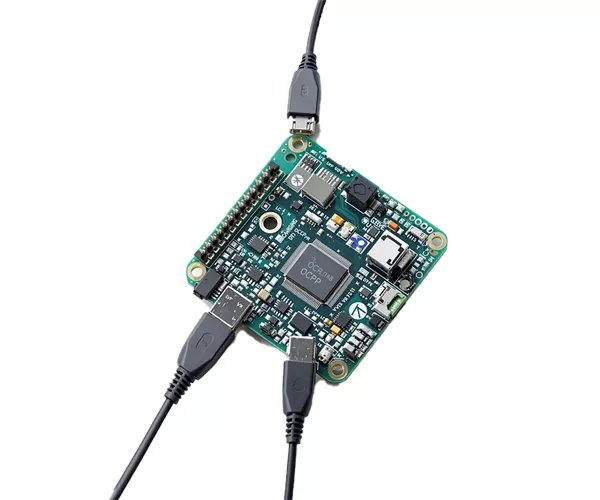
The AUPINS AC-EDC / AC / OCPP controller series provides this connection as a board-level module for integration into charging equipment. It is relevant to charger manufacturers and system integrators building connected products. Manufacturer product page.
Components
Hardware Component: WIZnet W5500
Provides the module's wired Ethernet interface. AUPINS explicitly identifies W5500 in its product specifications; the Ethernet driver and operating mode are not disclosed.
WIZnet part: W5500 product documentation · Datasheet
About AUPINS
AUPINS Technology Co., Ltd. is an EV charging equipment and components supplier based in Nanjing, Jiangsu, China. Its company materials date the business to 2019. Its catalog includes chargers, charging cables and adapters, sockets, connector pins, wiring harnesses, control boards, operating platforms, energy-storage connectors, and electrical protection products. AUPINS website.
The company also describes an OEM/ODM process covering requirements, design, samples, production, and delivery. Within this wider product range, the OCPP module connects charging equipment to an operating network. OEM/ODM services.
Published Specifications
| Item | Manufacturer-published information |
|---|---|
| Application | AC and DC charging systems |
| OCPP versions | 1.6J and 2.0.1 |
| Ethernet | WIZnet W5500 |
| Wi-Fi | ESP32; 802.11 b/g/n |
| Cellular | 4G LTE; EC25 or other models |
| Interfaces | RS-485, CAN, Ethernet |
| Supply voltage | 12 V DC |
| Operating temperature | −40 to +70 °C |
| Software and management | AC/DC charging protocol stack, cloud integration, remote OTA updates |
| Security statement | Encrypted data transmission |
| Compliance markings listed | CE, FCC, RoHS |
These are vendor-published specifications. The security and compliance statements have not been independently validated against model-specific certificates or test reports. Specification source.
Where the Module Fits in an EV Charging System
OCPP Connects the Charger to Its Management System
OCPP stands for Open Charge Point Protocol. It defines communication between a charge point and a charging station management system (CSMS). Typical functions include user authorization, charging-session management, meter and status reporting, remote commands, and device management. The functions available in a particular product depend on its implementation. Open Charge Alliance: OCPP.
In a typical service, the charger exchanges authorization and session information with the management system, reports meter readings and status during use, and receives supported remote commands or configuration changes. This describes OCPP's general role; the module's supported messages and hardware integrations should be checked in its firmware and interface documentation.
Power Delivery and Operating Data Follow Different Paths
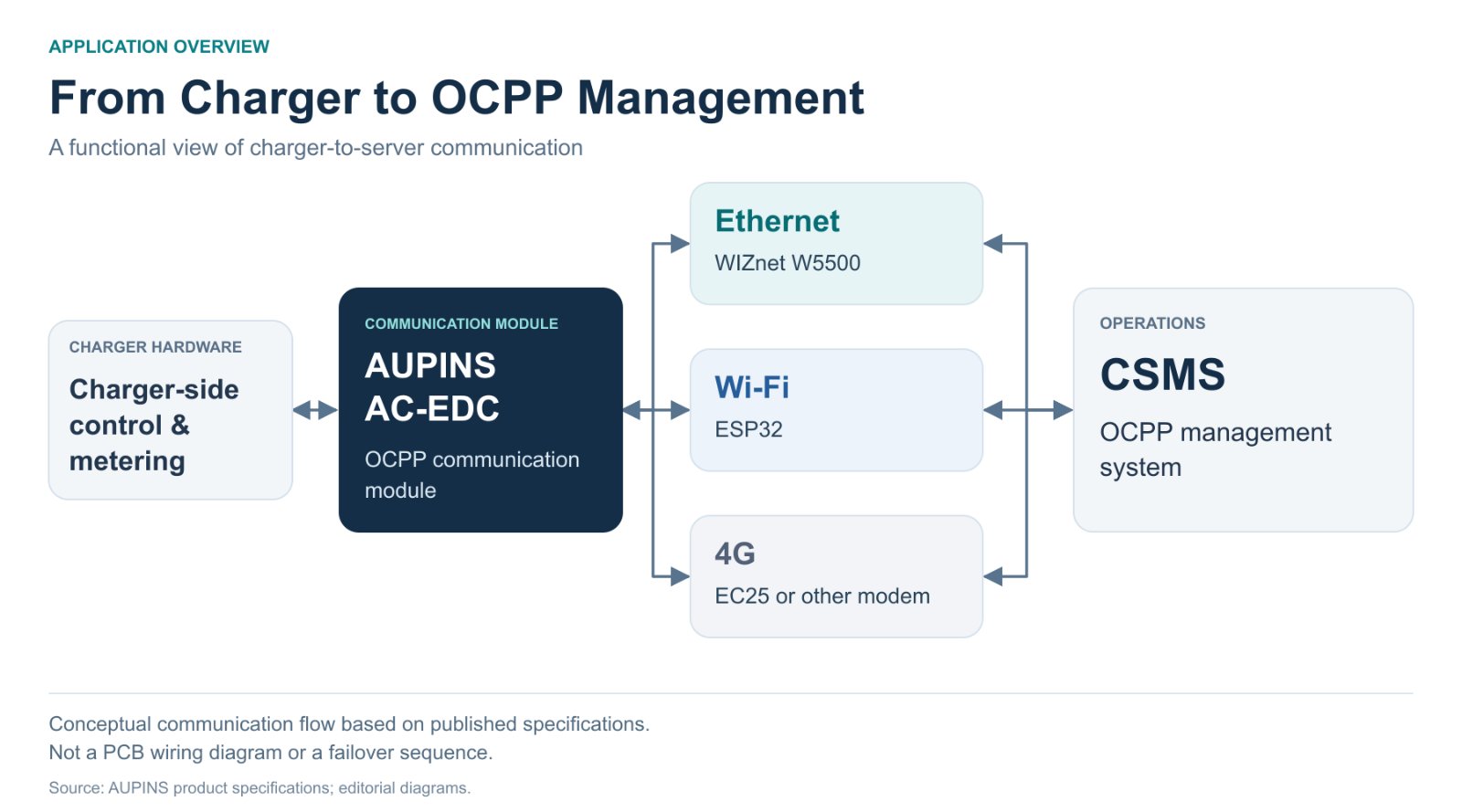
AUPINS' system overview distinguishes vehicle-side communication, charger-side control, and the OCPP connection to an operating platform. It describes the OCPP module as the charger-to-platform communication unit. AUPINS communication architecture overview.
The electrical path delivering energy to the vehicle is separate from the data path carrying operating information to the server. The module's 12 V supply specification should therefore not be read as a vehicle charging output or a charging-power rating.
WIZnet W5500: Evidence and Role
The Manufacturer Names W5500 Directly
The official product description states:
“WiFi (ESP32), 4G (EC25 or other models), Ethernet (W5500)”
This supports describing the product as a commercial OCPP module with W5500 Ethernet identified by its manufacturer. The evidence comes from the product specification, rather than an inference from a photograph or a library repository. W5500 adoption evidence.
Chip Capabilities and Firmware Use Are Separate Questions
W5500 integrates a 10/100 Ethernet MAC and PHY, an SPI host interface, and hardware TCP/IP functionality. It supports eight hardware sockets and 32 KB of internal buffer memory. These capabilities can be useful when adding wired networking to an embedded product. WIZnet W5500 documentation.
However, using W5500 does not establish how a specific firmware implements its network stack. Espressif's ESP-IDF v5.0.5 documentation, for example, describes a W5500 driver using RAW MAC mode with a software TCP/IP stack. This is an implementation example, not evidence that AUPINS uses that driver. Espressif W5500 configuration.
AUPINS' public materials do not disclose the operating mode. Claims about TCP/IP offload or measured CPU and memory savings therefore require firmware-level evidence.
Choosing Between Ethernet, Wi-Fi, and 4G
At fixed installations with LAN cabling, Ethernet provides a connection that does not depend on Wi-Fi reception or cellular coverage. Wi-Fi and cellular offer other deployment options when local cabling or network access is constrained. The useful comparison is what the site can install and maintain.
| Connection | Deployment perspective | What to check |
|---|---|---|
| Ethernet | Fixed installations with a wired LAN | Cabling, switches and routers, IP configuration, server access |
| Wi-Fi | Sites with a managed wireless network | Coverage at the installed location, authentication, credential changes |
| 4G | Sites using a cellular connection | Regional and carrier support, SIM and data plan, antenna configuration |
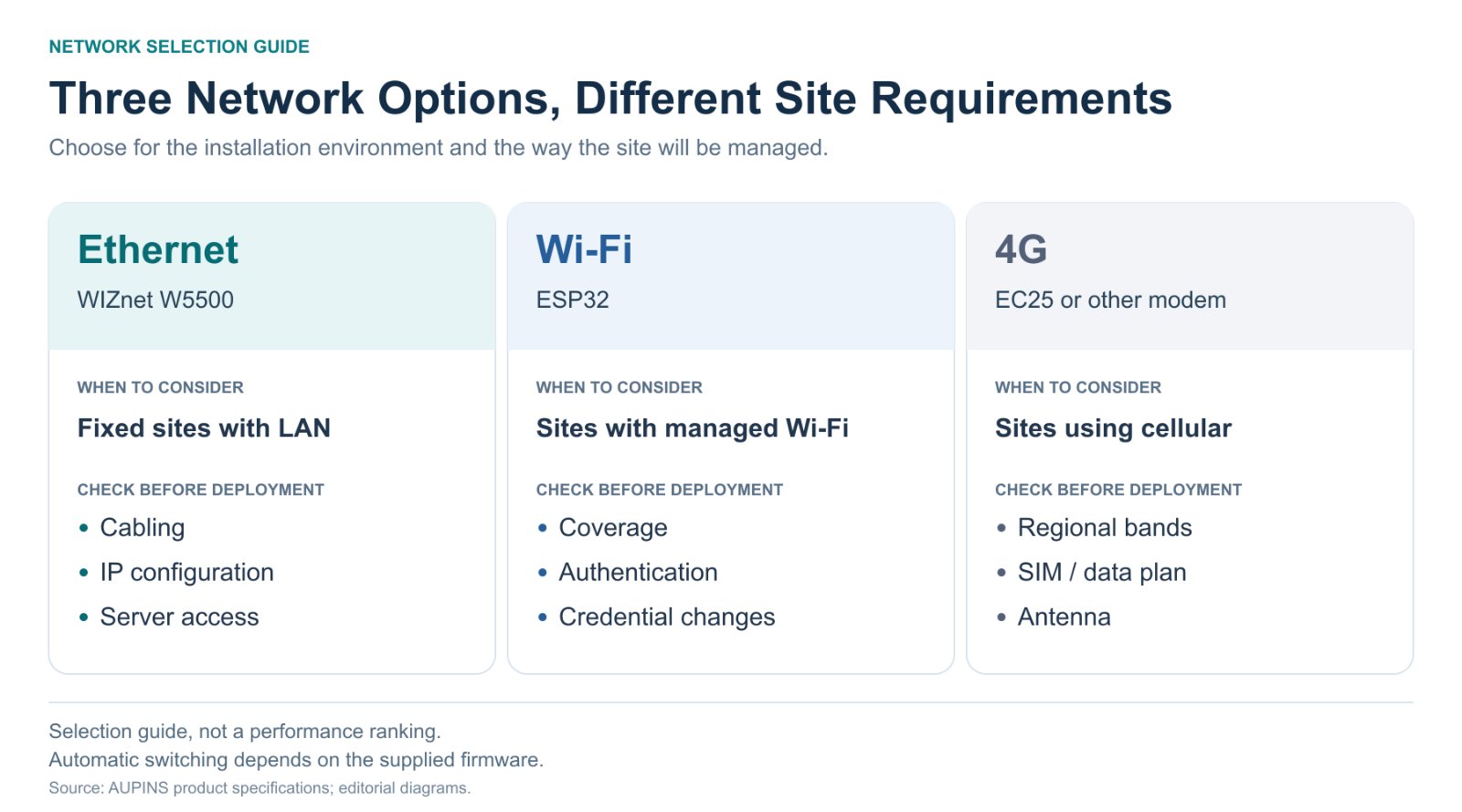
Support for multiple connections does not, by itself, establish automatic failover. Network priority, switching behavior, and recovery policies should be confirmed for the supplied firmware.
Applications
The module is relevant wherever charging equipment needs to exchange operating information with a management system:
| Potential environment | Why connectivity matters |
|---|---|
| Public parking, retail, and hospitality | Central visibility of charger status and usage |
| Workplaces and residential sites | Integration with the site's network and operating policies |
| Fleet depots and logistics facilities | Coordination of charging equipment with vehicle operations |
| Charger manufacturers and integrators | Adding OCPP management connectivity to charging hardware |
AUPINS lists commercial, workplace, and fleet charging among its broader solution areas. These are potential application environments, not verified AC-EDC customer installations. AUPINS solutions.
Availability, Pricing, and Contact
The product page uses a request-a-quote sales process. A public unit price, exact minimum order quantity, and lead time were not established from the reviewed materials. Product and quotation page.
| Supplier | AUPINS Technology Co., Ltd. |
|---|---|
| Location | Nanjing, Jiangsu, China |
| felixxu@aupins.com | |
| Telephone | +86-25-52353393 |
| Mobile / WhatsApp / WeChat | +86-18512525557 |
Source: AUPINS contact page.
When comparing quotations, clarify firmware licensing, server-integration support, update availability, and whether the modem, antenna, and other accessories are included. Any customization should be agreed for the specific supply configuration. OEM/ODM process.
Market Context and Deployment Evidence
The IEA's Global EV Outlook 2026 reports that the worldwide stock of public charging points exceeded 7 million at the end of 2025, with nearly 1.8 million added during 2025. This describes the broader expansion of charging infrastructure. IEA: Electric vehicle charging.
Those figures cannot be converted into AUPINS module sales or W5500 shipments. The reviewed public materials did not establish AC-EDC cumulative sales, annual shipments, or named customer installations. Market growth and product-specific deployment evidence should be assessed separately.
Vendor Content and Technical Resources
LinkedIn: Connecting Parts to the Procurement Process
AUPINS CONNECT's public posts introduce connector products alongside custom drawings, sample production, delivery planning, and OEM/ODM orders. This gives prospective buyers both a product explanation and a route into development and purchasing. Customization and sampling post.
This is an example of company-wide communication, rather than a verified AC-EDC campaign or evidence of marketing conversion.
Technical Articles: Explaining the System Role
The company's EVCC, SECC, and OCPP architecture article explains how communication components fit between a vehicle, charging equipment, and an operating platform. This system-level context helps buyers understand what kind of module they need. Its broader discussion should not be treated as a feature list for every AC-EDC configuration. Technical architecture article.
What to Check Before Integration
| Area | Questions for the supplier |
|---|---|
| OCPP and CSMS | Required version, supported messages and features, tested management systems |
| Charger-side interfaces | RS-485/CAN protocols, pinout, supported meters, control boards, and authorization devices |
| Network operation | Priority, automatic switching, offline behavior, buffering, and retransmission |
| Security and updates | Encryption method, certificate management, failed-update recovery, support period |
| Supply configuration | Board revision, processor and modem options, included accessories, support scope |
| Documentation | Model-specific compliance evidence and any applicable OCPP certification |
The Open Charge Alliance states that OCPP 1.6 and 2.0.1 are not compatible. Support for both does not remove the need to configure and test the selected version against the intended CSMS. An OCPP support statement should also be distinguished from OCA certification. OCPP versions · OCA certification information.
Related WIZnet Maker Projects
| Related project | What to compare |
|---|---|
| Full-featured OCPP Module | Another commercial charger-side OCPP module. Compare connection options, logging, updates, offline operation, documentation, and support. |
| Pazzk EVSE | An AC charging reference-hardware and firmware example. Compare a commercial communication module with a broader charger-development platform. |
Pazzk's official documentation distinguishes reference hardware and community firmware from separately contracted support, and describes network and recovery policies. These are useful examples of the operational documentation to look for when evaluating connectivity. They do not establish the same behavior in the AUPINS module. Pazzk development board · Network architecture.
What This Example Shows
Connected charging requires the hardware interfaces, OCPP software, and operating policies to work together. A useful module evaluation therefore looks beyond the presence of an Ethernet port to the documentation, firmware behavior, and integration support behind it.
AUPINS AC-EDC illustrates a commercial board-level approach to this problem. From a WIZnet perspective, the key evidence is the manufacturer's explicit identification of W5500 for Ethernet. From an integrator's perspective, the next step is matching the supplied configuration to the charger hardware and intended management system.
FAQ
Is this a complete EV charger?No. It is a module for integration into charging equipment. Vehicle connections, power and protection hardware, and the required control functions must be provided by the complete system.
Which OCPP versions are listed?AUPINS lists OCPP 1.6J and 2.0.1. Confirm the version, features, and settings required by the intended CSMS.
How is W5500 adoption established?The manufacturer explicitly lists Ethernet (W5500) in the product description. This is specification-based evidence; it is not an independent teardown of a shipped unit.
Does the firmware use W5500 hardware TCP/IP offload?The chip supports that capability, but the module's operating mode is not disclosed in the reviewed materials.
Does Ethernet automatically switch to 4G if the link fails?The available connections do not establish an automatic-switching policy. Confirm this behavior for the supplied firmware.
Where can I obtain pricing?Use the product quotation page or official contact channel to request a configuration-specific quotation.
Sources and Verification Scope
Materials reviewed: October 26, 2026.
WIZnet adoption evidence: the manufacturer's explicit Ethernet (W5500) specification.
Review scope: public documentation. It does not include independent inspection of a shipped unit, firmware analysis, or verification of product-specific sales volumes.
| Source | Information reviewed |
|---|---|
| AUPINS product page | Specifications, network components, product photo, quotation route |
| AUPINS website | Company background, product and solution range |
| OEM/ODM · Contact | Customization process and published business contacts |
| AUPINS architecture article | Roles of charging-system communication components |
| WIZnet W5500 documentation | Chip capabilities |
| Espressif documentation | RAW MAC implementation example |
| Open Charge Alliance | OCPP's role, versions, and certification distinction |
| IEA Global EV Outlook 2026 | Public charging infrastructure context |
| AUPINS CONNECT post | Customization and sampling communication |

