dcplaya_w5500: Bringing IPTV Streaming to Sega Dreamcast
The dcplaya_w5500 project demonstrates how the WIZnet W5500 Ethernet controller can bring modern network connectivity to the Sega Dreamcast
0
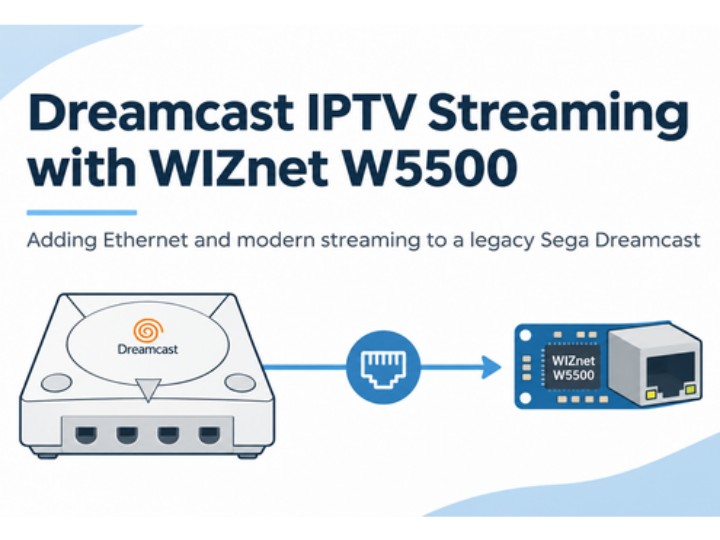
Components
Hardware components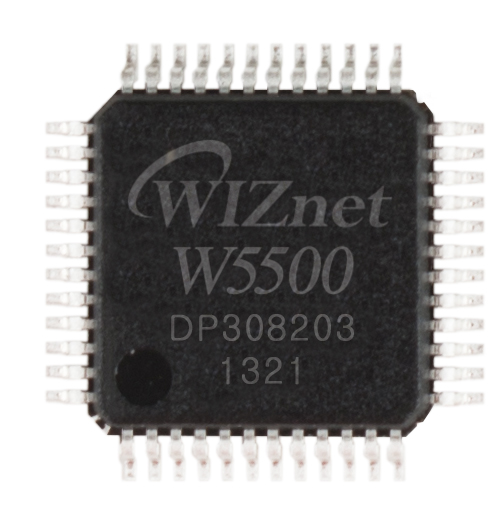
WIZnet - W5500
x 1

Project description
Bringing IPTV Streaming to Sega Dreamcast with WIZnet W5500
Project Overview
Can a game console from the late 1990s stream modern IPTV channels and online videos?
The dcplaya_w5500 project demonstrates how the WIZnet W5500 Ethernet controller can bring modern network connectivity to the Sega Dreamcast, extending the capabilities of its classic multimedia player, dcplaya 2.0 beta 2.
Originally released in 2004, dcplaya was designed for the hardware and media formats available at the time. Its networking capabilities were primarily built around the Dreamcast Broadband Adapter (BBA), while modern streaming services rely on video formats and delivery methods that the original software cannot handle directly.
To address these limitations, developer rpf16rj created a custom W5500 Ethernet driver, integrated DHCP support, improved playlist handling, and developed a server-side transcoding solution.
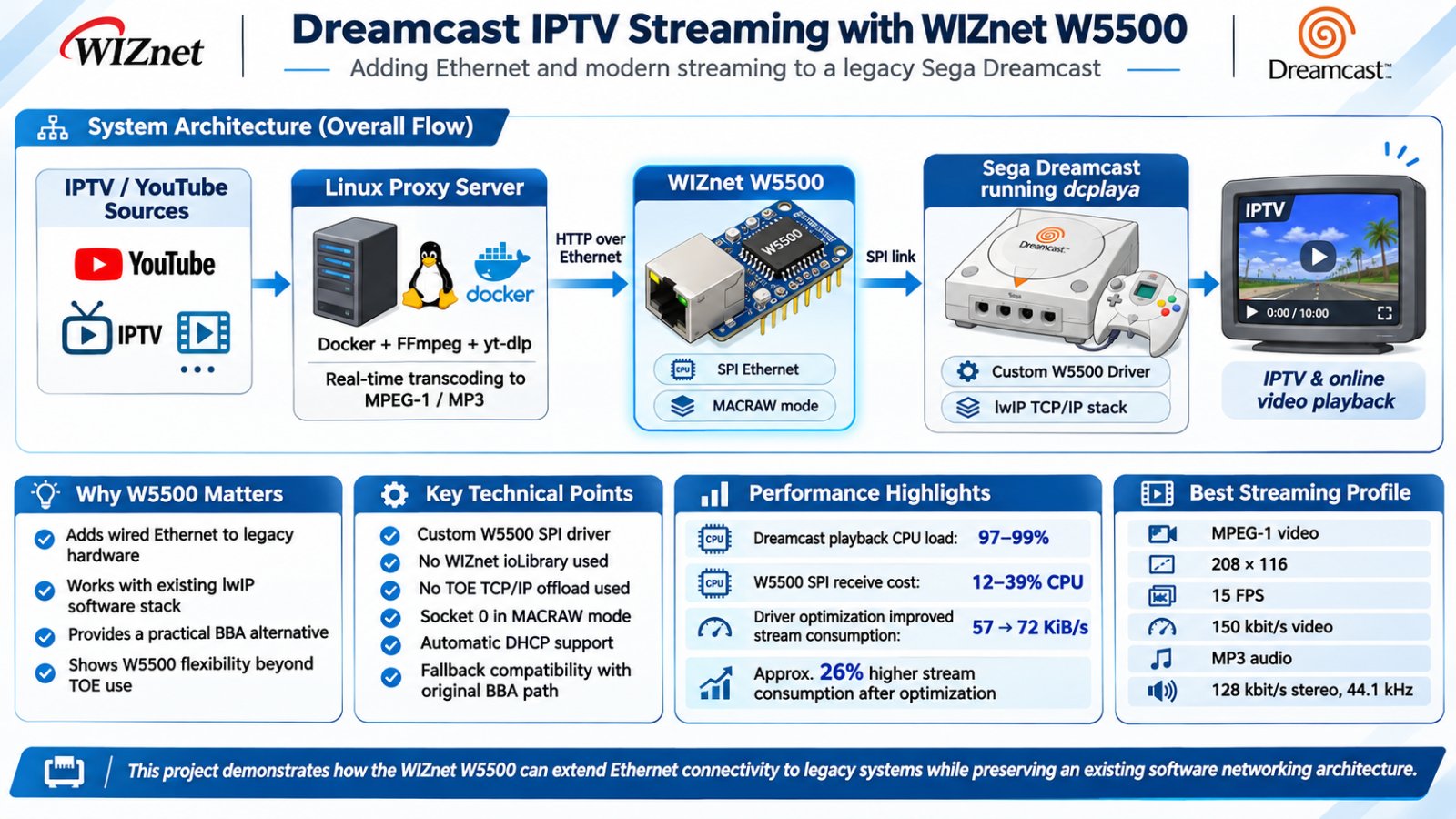
The result is a system that allows a Dreamcast equipped with a W5500 Ethernet adapter to access IPTV channels and selected online video content through an external streaming proxy.
Beyond retro gaming, the project demonstrates an interesting application of W5500: extending Ethernet connectivity to legacy hardware while preserving its existing software networking architecture.
Key Features
1. W5500 Ethernet Connectivity for Legacy Hardware
The project integrates the WIZnet W5500 into the Dreamcast through its SPI-compatible serial interfaces.
Instead of requiring major changes to the existing media player, the custom driver exposes the W5500 as a Broadband Adapter-compatible network interface.
This allows dcplaya to communicate over Ethernet using its existing networking software.
The driver automatically detects the W5500 and falls back to the original RTL8139-based BBA driver when the W5500 is not available.
2. Compatibility with the Existing lwIP Stack
One of the most interesting design choices is the use of the W5500's MACRAW mode.
Although the W5500 provides hardware TCP/IP offloading capabilities, this implementation uses the controller to exchange raw Ethernet frames.
TCP/IP processing remains on the Dreamcast through its existing lwIP software stack.
This approach avoids replacing the application's networking architecture and demonstrates the flexibility of the W5500 for embedded systems that already have a software TCP/IP stack.
3. DHCP Network Configuration
The project adds a lightweight DHCP client to the original dcplaya environment.
Users can obtain network settings automatically instead of manually configuring the IP address, subnet mask, gateway, and DNS server.
The DHCP functionality also works with the original Broadband Adapter.
4. IPTV and Online Video Streaming
A Docker-based streaming proxy enables the Dreamcast to access modern video sources.
The proxy uses FFmpeg to transcode modern H.264/H.265 streams into MPEG-1 video and MP3 audio, formats that the legacy dcplaya software can decode.
It also provides dynamically updated playlists and a web administration interface for managing IPTV and selected YouTube channels.
5. Improved Playback Reliability
The developer implemented background HTTP availability checks to prevent unreachable streaming links from freezing the playlist interface.
Network connection timeouts were reduced, and the playback controls were updated to support more convenient pause, resume, and stop operations.
Hardware Setup
The system uses the following main components:
- WIZnet W5500 Ethernet Controller: Provides the physical Ethernet connection and MACRAW frame communication.
- Sega Dreamcast: Runs the modified dcplaya multimedia player.
- SPI Interface Connection: Connects the W5500 to the Dreamcast through SCI or SCIF.
- External Linux Server: Hosts the Docker-based transcoding proxy.
- CD-R or Optical Drive Emulator: Boots the patched dcplaya image.
The driver supports two hardware communication paths:
| Interface | Implementation |
|---|---|
| SCI | Hardware synchronous SPI at 12.5 MHz, using PA7 for chip select |
| SCIF | Software SPI using serial-port signals |
The driver first attempts to detect the W5500 through SCI, then SCIF. If neither interface detects the controller, the original BBA driver can be loaded.
This design allows the W5500 to function as an alternative Ethernet interface without removing support for existing Dreamcast networking hardware.
Software Implementation
Custom W5500 Ethernet Driver
The project's primary hardware integration is implemented in driver/w5500_bba.c.
The driver communicates directly with W5500 registers over SPI and configures Socket 0 for MACRAW operation.
Rather than exposing the W5500's hardware TCP/UDP socket interface, it connects Ethernet frame transmission and reception to dcplaya's existing network subsystem.
A particularly important implementation detail is the interface registration:
w5500_if.name = "bba";
w5500_if.descr =
    "WIZnet W5500 Ethernet (SPI) as BBA";
By presenting the W5500 under the existing bba interface name, the project maintains compatibility with dcplaya's original network integration.
The implementation does not depend on the official WIZnet ioLibrary. Instead, it uses a custom driver with W5500 register-control logic adapted from KallistiOS.
DHCP and Network Handling
The driver/dhcp.c module implements DHCP functionality for the legacy networking environment.
It exchanges DHCP messages, obtains network configuration parameters, and passes the configuration to the existing system.
The project also introduces background network availability checking to improve the handling of remote playlists and unavailable servers.
Real-Time Media Conversion
Modern IPTV streams and YouTube videos often use codecs that are too computationally demanding for the original Dreamcast media player.
The external streaming proxy addresses this problem by performing video and audio conversion before transmission.
The Dreamcast receives a lower-resolution, compatible MPEG-1 and MP3 stream rather than decoding modern codecs directly.
This architecture separates computationally expensive media conversion from playback on the legacy device.
Network Architecture
The complete system follows a client-server architecture:
IPTV Provider / Online Video Source
                  |
                  v
       Linux Streaming Server
       Docker + FFmpeg + yt-dlp
                  |
          MPEG-1 / MP3
                  |
               HTTP
                  |
                  v
           WIZnet W5500
          Ethernet / MACRAW
                  |
                 SPI
                  |
                  v
            Sega Dreamcast
          Custom W5500 Driver
                  |
                 lwIP
                  |
                 dcplaya
                  |
                  v
           Video Playback
In this architecture, the W5500 is responsible for Ethernet connectivity, while lwIP handles the TCP/IP stack on the Dreamcast.
The external proxy handles media conversion and playlist management.
This division of responsibilities makes it possible to integrate modern streaming functionality without completely redesigning the legacy playback application.
Performance Results
The developer conducted performance tests on a physical Sega Dreamcast equipped with a W5500 adapter.
The most suitable streaming configuration reported in the project was:
| Parameter | Configuration |
|---|---|
| Video Codec | MPEG-1 |
| Resolution | 208 × 116 |
| Frame Rate | 15 FPS |
| Video Bitrate | 150 kbit/s |
| Audio Codec | MP3 |
| Audio Bitrate | 128 kbit/s |
| Audio Sample Rate | 44.1 kHz |
| Audio Channels | Stereo |
W5500 Driver Optimization
Performance measurements showed that video playback occupied approximately 97–99% of the Dreamcast CPU.
Reading data from the W5500 over SPI accounted for approximately 12–39% of CPU utilization, depending on the workload.
To reduce this overhead, the developer optimized the SPI driver by reducing status-register operations and implementing table-based bit reversal.
According to the project's reported measurements:
SPI processing cost per byte decreased by approximately 20%.
Stream consumption increased from approximately 57 KiB/s to 72 KiB/s.
The resulting improvement in stream consumption was approximately 26%.
These results demonstrate the importance of low-level driver optimization when integrating SPI Ethernet controllers into resource-constrained systems.
However, the project also identifies a tradeoff: the original DMA-capable Broadband Adapter can impose less CPU overhead than the SPI-connected W5500.
Therefore, the main achievement is not superior network throughput but successful Ethernet integration and practical streaming functionality on legacy hardware.
Video Quality Improvements
The developer also optimized server-side video scaling.
In one reported comparison involving 451 video frames, changing the scaling and filtering approach reduced the number of frames with visible blocking artifacts from 107 to 4.
This result highlights how server-side processing can improve multimedia playback on devices with limited decoding capabilities.
Future Improvements
- Potential areas for further development include:
- Additional SPI transfer optimizations to reduce CPU overhead.
- Extended testing with different W5500 adapter configurations.
- Improved error recovery and long-duration streaming stability.
- Additional server-side video profiles optimized for Dreamcast playback.
- Better documentation of wiring, compatibility, and performance measurements.
- These are potential engineering directions rather than an announced project roadmap.

