How to Build an Industrial LoRa-to-Ethernet Gateway with WIZnet W5500 on STM32?
An STM32-based industrial IoT gateway can combine long-range LoRa communication with the WIZnet W5500 Ethernet controller to transfer remote sensor measurements
0
Project description
How to Build an Industrial LoRa-to-Ethernet Gateway with WIZnet W5500 on STM32?
1. Summary
An STM32-based industrial IoT gateway can combine long-range LoRa communication with the WIZnet W5500 Ethernet controller to transfer remote sensor measurements into a wired IP network. LoRa provides wireless connectivity for distributed field devices, while the W5500 supplies SPI-based Ethernet communication and hardware TCP/IP processing. This architecture separates low-bandwidth wireless data acquisition from Ethernet-based monitoring, making it suitable for industrial telemetry, environmental monitoring, and distributed sensor networks.
Source status: The supplied CSDN article could not be retrieved through the available web reader, and no matching source code or circuit schematic was independently located. Therefore, this article describes a technically supported integration architecture rather than a verified reproduction of the author's implementation. The original project's MCU, LoRa module, wiring, firmware, and actual use of WIZnet products remain unconfirmed.
2. What the Project Does
Industrial monitoring systems frequently need to collect measurements from equipment distributed across large areas, including remote tanks, outdoor installations, storage facilities, and factory infrastructure.
Running Ethernet cables to every sensor may be impractical. LoRa provides an alternative for field devices that transmit relatively small amounts of data over long distances.
A gateway can bridge these two communication environments.
Proposed industrial gateway architecture
Remote LoRa Sensor Nodes
Temperature, pressure, equipment status
STM32 Industrial Gateway
LoRa Transceiver
SPI radio interface
W5500
SPI Ethernet interface
MCU validates, buffers, and forwards sensor data
Industrial Monitoring Server
SCADA, MQTT broker, or local data collector
The proposed processing sequence is:
A remote sensor node measures its configured physical parameter.
Its LoRa transceiver sends a compact packet to the gateway.
The STM32 receives and validates the packet.
The firmware extracts the node identifier, measurement, and sequence information.
The W5500 provides the Ethernet interface through which the MCU forwards the data to the monitoring server.
The server stores measurements, displays trends, or generates alerts.
The architecture supports multiple remote sensors, subject to the LoRa network's airtime, collision behavior, and addressing scheme.
An important distinction is that LoRa and Ethernet operate at different layers. A basic LoRa radio link does not automatically provide IP connectivity, and a W5500 cannot directly receive LoRa radio signals. The STM32 performs the necessary application-level translation between them.
3. Where WIZnet Fits
WIZnet W5500
The W5500 provides the wired network interface between the STM32 gateway and the industrial Ethernet network. It implements TCP/IP protocol functions in hardware and communicates with the host MCU through SPI.
WIZnet's official documentation confirms the following capabilities.
WIZnet Document System+1
| W5500 capability | Relevance to the gateway |
|---|---|
| Hardware TCP/IP processing | Reduces the MCU's protocol-processing workload |
| SPI interface, up to 80 MHz | Connects to the STM32 without a parallel bus |
| 8 hardware sockets | Supports multiple TCP/UDP connections |
| 32 KB internal TX/RX memory | Buffers Ethernet traffic inside the controller |
| Integrated 10/100 Ethernet MAC and PHY | Supports connection to a wired Ethernet network |
For a LoRa gateway, the W5500 is not responsible for radio reception, LoRa packet decoding, or sensor identification. Those functions remain with the LoRa transceiver and STM32 firmware.
The W5500 is particularly relevant when a relatively resource-constrained MCU must handle radio interrupts, packet validation, application logic, and Ethernet traffic concurrently. Its socket engine can reduce software networking overhead.
However, the hardware TCP/IP engine does not automatically provide MQTT processing, TLS encryption, LoRaWAN functionality, or gateway application logic.
4. Implementation Notes
Hardware wiring
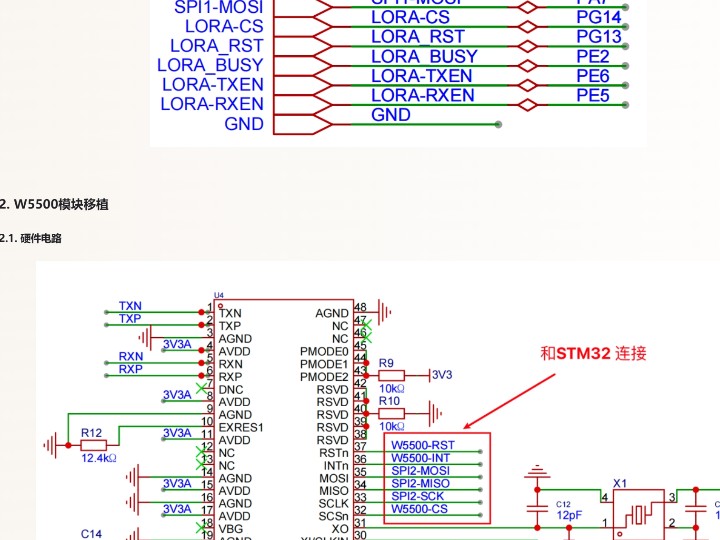
A practical implementation can use an STM32 development board, an SPI LoRa transceiver, and a W5500 Ethernet module.
The following table represents a proposed signal-level wiring arrangement, not a verified pinout from the source article.
| W5500 signal | STM32 connection | Function |
|---|---|---|
| SCLK | SPI SCK | Serial clock |
| MOSI | SPI MOSI | MCU-to-W5500 data |
| MISO | SPI MISO | W5500-to-MCU data |
| CSn | GPIO output | Active-low chip selection |
| RSTn | GPIO output | Hardware reset |
| INTn | GPIO input, optional | Interrupt notification |
| 3.3V | Regulated 3.3 V | Module power |
| GND | Common ground | Signal reference |
The LoRa transceiver can connect to another SPI peripheral, or share the same SPI bus using a separate chip-select signal. Most SX127x-based modules also need reset and radio interrupt connections.
When both devices share SPI, firmware must use device-specific SPI modes, frequencies, and chip-select control. The W5500 supports SPI modes 0 and 3; the LoRa transceiver's requirements must be checked separately.
The W5500 chip includes an Ethernet PHY, but a complete physical connection also requires correctly implemented Ethernet magnetics and an RJ45 interface. A module with integrated magnetics simplifies this aspect of the design.
WIZnet Document System+1
Firmware organization
A suitable STM32 firmware design separates the radio receiver, packet processing, and Ethernet transmission functions.
| Firmware module | Responsibility |
|---|---|
| SPI/GPIO initialization | Configure clocks, chip-selects, and interrupts |
| LoRa driver | Configure radio frequency, bandwidth, spreading factor, and packet reception |
| Packet parser | Validate length, identifier, and application payload |
| Gateway queue | Buffer decoded measurements |
| W5500 driver | Initialize Ethernet controller and network settings |
| TCP/UDP application | Connect to a collector and transmit data |
| Recovery handler | Manage radio errors, link loss, socket errors, and reconnects |
A representative firmware sequence is:
Initialize STM32 peripherals
Configure LoRa receiver
Initialize W5500 and network settings
Receive and validate LoRa packet
Queue measurement and forward over Ethernet
Monitor link, sockets, and recovery
This is a proposed implementation sequence. The original CSDN article's firmware initialization calls, interrupt assignments, network protocol, and project file paths could not be verified, so no source-code snippets are attributed to it.
For a new implementation, WIZnet's official ioLibrary_Driver provides the driver foundation for controller initialization, network configuration, and socket communication. Application-level radio handling and packet translation would be developed separately.
LoRa versus Ethernet
LoRa and Ethernet should generally be treated as complementary links in this design, rather than interchangeable technologies.
| Characteristic | LoRa | W5500 Ethernet |
|---|---|---|
| Communication medium | Wireless radio | Copper Ethernet |
| Typical role | Remote sensor access | Gateway backhaul |
| Throughput | Low | 10/100 Mb/s Ethernet link |
| Coverage | Long-distance wireless, environment-dependent | Standard copper Ethernet segment, typically up to 100 m |
| Power characteristics | Supports low-power sensor designs | More suitable for continuously powered gateways |
| Latency | Airtime and contention dependent | Lower link-layer latency under normal conditions |
| Network protocol | LoRa PHY, optionally LoRaWAN | IPv4, TCP, UDP in W5500 hardware |
These are technology-level characteristics, not measurements from the supplied project.
For example, a temperature sensor reporting once every several minutes may benefit from LoRa's wireless coverage and low-power operation. The central gateway, however, may need a continuously available connection to an industrial server. This is where the W5500 Ethernet interface is useful.
Ethernet still requires proper network infrastructure and cannot guarantee deterministic end-to-end delivery on its own. Likewise, LoRa reliability depends on RF conditions, spreading factor, payload size, interference, and duty-cycle restrictions.
5. Practical Tips / Pitfalls
Check the 3.3 V power budget. Supply the W5500 and LoRa transceiver from suitable regulators. Account for radio transmit-current peaks and module-specific power requirements.
Manage shared SPI access. Give the W5500 and LoRa transceiver independent chip-select signals and protect shared SPI transactions against concurrent firmware access.
Verify Ethernet link status before transmission. Establish whether the physical link is active, then initialize the IP configuration and application sockets.
Plan IP address assignment. Industrial installations may use reserved DHCP leases or static IP addresses. Ensure the gateway, subnet, and server routes are consistent.
Size packet buffers deliberately. The W5500 has 32 KB of internal TX/RX memory shared across its sockets. This does not replace the application's LoRa packet queue.
Implement recovery and data-integrity checks. Use packet sequence numbers, bounded queues, socket timeouts, reconnect logic, and a watchdog. Define how measurements are handled when Ethernet is unavailable.
Consider industrial EMI and security. Provide appropriate grounding, surge protection, Ethernet isolation, and RF antenna placement. Use authenticated communication and suitable TLS-capable software or a protected network architecture when transmitting sensitive operational data.
6. FAQ
Q1. Why choose the WIZnet W5500 for an industrial LoRa gateway?
The W5500 provides wired IPv4 connectivity with hardware TCP/IP processing. This allows an STM32 to devote more processing time and memory to LoRa packet reception, validation, and application logic instead of maintaining an entirely software-based TCP/IP stack. It also provides eight hardware sockets and internal Ethernet buffers, which are useful for embedded gateway applications.
Q2. How does the W5500 connect to an STM32 alongside a LoRa module?
The W5500 connects through SPI using SCLK, MOSI, MISO, and an active-low chip-select, plus power and optional reset/interrupt signals. An SPI LoRa transceiver can use another SPI peripheral or share the bus with its own chip-select. If the bus is shared, the firmware must serialize transfers and apply the correct per-device settings.
Q3. What exactly does the W5500 do in this industrial IoT architecture?
The W5500 supplies the wired Ethernet transport for forwarding measurements received from remote LoRa nodes. The STM32 interprets the LoRa payload and packages the resulting data for an application protocol such as TCP, UDP, or MQTT. The W5500 processes the supported network transport functions, while the STM32 remains responsible for the gateway's application behavior.
Q4. Can beginners implement a LoRa-to-Ethernet gateway using W5500?
Developers familiar with MCU GPIO, SPI, interrupts, and basic TCP/IP can implement a prototype. An industrial-grade system is more demanding because it also requires RF configuration, packet validation, networking recovery, power-supply design, and hardware protection. A sensible development sequence is to test LoRa reception and Ethernet communication independently before combining them.
Q5. Is W5500 Ethernet better than LoRa for industrial sensor communication?
Neither is universally better. LoRa is suitable for distant, low-data-rate sensors where wiring is difficult and low power is important. W5500 Ethernet is suitable for a fixed gateway with wired network infrastructure, higher throughput requirements, and continuous IP connectivity. Combining LoRa on the sensor side with W5500 Ethernet on the gateway side addresses both requirements without forcing one technology to perform the other's role.
7. Source
Original reference: CSDN article by Shylock_Mister
Original implementation: Not independently verified. The referenced page was inaccessible through the available reader, and no corresponding source repository or schematic was confirmed.
Original article license: Not confirmed.
Supporting technical references:
WIZnet W5500 official documentation — Ethernet controller characteristics, supported protocols, SPI interface, and internal resources.
WIZnet Document System
WIZnet W5500-io documentation — module signals, reset, SPI connections, and hardware considerations.
WIZnet Document System
WIZnet ioLibrary_Driver — official driver reference for developing WIZnet network applications.
The architecture presented here is a prospective industrial design. Its functional suitability follows from the documented capabilities of the components, but it should not be interpreted as evidence that the original CSDN author built or tested this exact configuration.
8. Tags
#W5500 #WIZnet #STM32 #LoRa #Ethernet #IndustrialIoT #IoTGateway #SPI #EmbeddedSystems #TCPIP #WirelessSensors
STM32에서 WIZnet W5500을 활용한 산업용 LoRa-to-Ethernet 게이트웨이는 어떻게 구현할까?
1. 프로젝트 개요 (Summary)
STM32 기반 산업용 IoT 게이트웨이는 장거리 무선 통신 기술인 LoRa와 WIZnet W5500 이더넷 컨트롤러를 결합하여 원격 센서 데이터를 유선 IP 네트워크로 전달할 수 있습니다. LoRa는 분산된 현장 센서의 무선 연결을 담당하고, W5500은 SPI 인터페이스와 하드웨어 TCP/IP 스택을 통해 이더넷 통신을 처리합니다. 이러한 구조는 저속·장거리 무선 데이터 수집과 안정적인 유선 네트워크 연결을 분리하므로 산업용 원격 계측, 환경 모니터링, 분산 센서 네트워크에 적합합니다.
원문 확인 상태: 제공된 CSDN 게시글은 웹 열람 도구로 원문을 확인할 수 없었으며, 관련 소스 코드나 회로도도 독립적으로 확보하지 못했습니다. 따라서 이 글은 원작자의 구현을 검증한 분석이 아니라, W5500의 공식 기술 사양을 바탕으로 작성한 통합 아키텍처 설명입니다. 원문의 MCU 모델, LoRa 모듈, 배선, 펌웨어 및 실제 WIZnet 제품 사용 여부는 확인되지 않았습니다.
2. 프로젝트의 주요 기능 (What the Project Does)
산업용 모니터링 시스템에서는 넓은 지역에 분산된 설비의 데이터를 수집해야 하는 경우가 많습니다.
대표적인 예시는 다음과 같습니다.
공장 외부에 설치된 온도 및 압력 센서
원격 저장 탱크의 수위 모니터링
대규모 창고의 환경 데이터 수집
산업 설비의 작동 상태 및 이상 신호 감지
접근하기 어려운 시설의 원격 계측
이러한 환경에서는 모든 센서에 이더넷 케이블을 연결하기 어려울 수 있습니다.
LoRa는 비교적 적은 양의 데이터를 장거리로 전송할 수 있으므로 원격 센서 연결에 적합합니다. 반면, 중앙 게이트웨이는 수집한 데이터를 서버에 지속적으로 전달할 수 있는 IP 네트워크 연결이 필요합니다.
여기서 W5500을 활용할 수 있습니다.
시스템 아키텍처
원격 LoRa 센서 노드
온도, 압력, 설비 상태 데이터
STM32 산업용 게이트웨이
LoRa 모듈
무선 데이터 수신
W5500
하드웨어 TCP/IP
STM32: 패킷 검증, 데이터 처리, 전송 제어
산업용 모니터링 서버
SCADA / MQTT Broker / 데이터 수집 서버
이는 원문에서 확인된 회로가 아니라 제안 아키텍처입니다.
데이터 처리 과정은 다음과 같습니다.
원격 센서 노드에서 온도, 압력 등의 데이터를 측정합니다.
LoRa 무선 패킷을 통해 게이트웨이로 전송합니다.
STM32가 LoRa 패킷을 수신하고 유효성을 검사합니다.
센서 ID, 측정값, 패킷 순서 등의 정보를 추출합니다.
STM32가 W5500을 이용해 이더넷 네트워크로 데이터를 전송합니다.
산업용 서버에서 데이터를 저장하고 모니터링하거나 경보를 생성합니다.
여기서 중요한 점은 LoRa와 W5500이 직접 통신하는 것이 아니라, STM32가 두 통신 방식 사이에서 데이터를 변환하고 전달한다는 것입니다.
일반적인 LoRa 무선 통신에는 IP 네트워크 기능이 내장되어 있지 않습니다. W5500 역시 LoRa 무선 신호를 직접 처리하지 않습니다.
3. WIZnet W5500의 역할 (Where WIZnet Fits)
WIZnet W5500
W5500은 STM32와 산업용 이더넷 네트워크 사이의 유선 통신을 담당합니다. 하드웨어 TCP/IP 스택을 내장하고 있어 MCU의 네트워크 프로토콜 처리 부담을 줄일 수 있습니다.
W5500의 주요 기술적 특징
| 항목 | 사양 | 게이트웨이에서의 의미 |
|---|---|---|
| TCP/IP | 하드웨어 처리 | MCU 네트워크 부하 감소 |
| 인터페이스 | SPI, 최대 80 MHz | STM32와 간단한 연결 |
| 소켓 | 최대 8개 | 복수 TCP/UDP 연결 지원 |
| 내부 메모리 | TX/RX 합계 32 KB | 네트워크 데이터 버퍼링 |
| Ethernet | 10/100 Mbps MAC/PHY | 유선 네트워크 연결 |
W5500의 역할은 단순히 데이터를 전송하는 것만은 아닙니다.
일반적인 소프트웨어 TCP/IP 구조에서는 MCU가 IP, TCP, UDP 프로토콜을 직접 처리해야 합니다.
반면 W5500은 이러한 기능 중 지원되는 부분을 하드웨어에서 처리합니다. 따라서 STM32는 LoRa 패킷 처리, 센서 데이터 검증, 게이트웨이의 응용 로직에 더 많은 자원을 사용할 수 있습니다.
다만 MQTT 메시지 구성, TLS 암호화, LoRaWAN 처리 및 애플리케이션 로직까지 W5500이 자동으로 처리하는 것은 아닙니다.
산업용 IoT에서의 기술적 의미
LoRa 센서 시스템은 대체로 개별 데이터 패킷의 크기가 작고 전송 주기가 깁니다.
하지만 게이트웨이는 여러 센서의 데이터를 동시에 관리하면서 서버와 통신해야 합니다.
W5500을 활용하면 무선 통신 처리와 유선 네트워크 처리를 기능적으로 분리할 수 있습니다.
이는 특히 MCU의 RAM과 처리 성능에 제약이 있는 환경에서 유용합니다.
다만 W5500을 사용한다는 사실만으로 실시간성이나 무중단 네트워크 연결이 보장되는 것은 아닙니다. 실제 안정성은 펌웨어 구조, 네트워크 상태, 버퍼링 방식 및 오류 복구 설계에 영향을 받습니다.
4. 하드웨어 및 펌웨어 구현 (Implementation Notes)
4.1 하드웨어 구성
제안하는 구현에는 STM32 개발보드, SPI 기반 LoRa 트랜시버, W5500 이더넷 모듈이 필요합니다.
4.2 STM32와 W5500의 SPI 연결
아래는 신호 기준의 제안 연결 방식이며, 원본 프로젝트에서 확인된 핀맵은 아닙니다.
| W5500 핀 | STM32 연결 | 설명 |
|---|---|---|
| SCLK | SPI SCK | SPI 클록 |
| MOSI | SPI MOSI | MCU → W5500 |
| MISO | SPI MISO | W5500 → MCU |
| CSn | GPIO 출력 | Chip Select |
| RSTn | GPIO 출력 | 하드웨어 리셋 |
| INTn | GPIO 입력, 선택 | 인터럽트 신호 |
| VCC | 모듈 사양에 맞는 전원 | 전원 공급 |
| GND | GND | 공통 접지 |
W5500 칩은 3.3V 전원으로 동작하지만, 완제품 모듈의 전원 입력 조건은 별도로 확인해야 합니다.
LoRa 트랜시버도 일반적으로 SPI 인터페이스를 사용합니다.
따라서 STM32에서 두 개의 SPI 주변장치를 각각 사용하거나, 하나의 SPI 버스를 공유하도록 구성할 수 있습니다.
SPI 버스를 공유할 경우 각 장치에 독립적인 CS 신호가 필요하며, 펌웨어에서 SPI 통신 충돌을 방지해야 합니다.
W5500은 SPI Mode 0과 Mode 3을 지원합니다. LoRa 트랜시버의 SPI 요구 사항도 별도로 확인해야 합니다.
4.3 펌웨어 구성
게이트웨이 펌웨어는 다음 기능으로 나누어 설계하는 것이 적절합니다.
| 기능 | 주요 처리 |
|---|---|
| SPI/GPIO 초기화 | SPI, CS, 인터럽트 설정 |
| LoRa 드라이버 | 주파수, 대역폭, 수신 모드 설정 |
| 패킷 처리 | 패킷 길이, ID, 데이터 검증 |
| 데이터 큐 | 수신된 센서 데이터 임시 저장 |
| W5500 드라이버 | 이더넷 초기화, IP 설정 |
| TCP/UDP 통신 | 서버 연결 및 데이터 전송 |
| 오류 복구 | 재연결, 타임아웃, Watchdog |
펌웨어 동작 흐름
STM32 주변장치 초기화
LoRa 수신 모드 설정
W5500 초기화 및 IP 설정
LoRa 패킷 수신 및 유효성 검사
측정 데이터 큐 저장 및 Ethernet 전송
네트워크 상태 감시 및 오류 복구
위 과정은 설계 예시입니다. 원문에 사용된 펌웨어 함수, 실제 초기화 코드, 인터럽트 핀 및 파일 경로는 확인되지 않았습니다.
실제 구현 시에는 WIZnet에서 제공하는 ioLibrary_Driver를 이용할 수 있습니다.
이 라이브러리는 W5500의 초기화, 네트워크 설정 및 TCP/UDP 소켓 통신을 구현하는 기반을 제공합니다.
LoRa 수신과 패킷 변환을 담당하는 애플리케이션 코드는 별도로 개발해야 합니다.
5. LoRa와 Ethernet의 기술적 비교
LoRa와 Ethernet은 같은 용도의 통신 기술이 아닙니다.
LoRa는 넓은 지역에 설치된 저전력 센서의 데이터를 수집하는 데 적합하고, Ethernet은 고정된 게이트웨이를 서버 네트워크에 연결하는 데 적합합니다.
| 비교 항목 | LoRa | W5500 Ethernet |
|---|---|---|
| 통신 매체 | 무선 RF | 유선 Ethernet |
| 주요 목적 | 원격 센서 통신 | 게이트웨이와 서버 연결 |
| 전송 속도 | 저속 | 10/100 Mbps |
| 통신 거리 | 환경에 따라 장거리 가능 | 일반적인 구리선 Ethernet 구간은 최대 약 100m |
| 소비전력 특성 | 저전력 센서에 적합 | 상시 전원 게이트웨이에 적합 |
| 지연 특성 | 무선 점유 시간과 간섭에 영향 | 일반적으로 낮은 링크 지연 |
| 프로토콜 | LoRa PHY, 선택적으로 LoRaWAN | IPv4, TCP, UDP |
이 비교는 기술 자체의 일반적인 특성을 설명하며, 원본 프로젝트에서 측정한 결과는 아닙니다.
예를 들어 온도를 5분마다 전송하는 원격 센서는 LoRa를 사용하는 것이 합리적일 수 있습니다.
반면 수집된 센서 데이터를 모니터링 서버로 지속적으로 전달해야 하는 게이트웨이는 Ethernet을 사용하는 것이 적합할 수 있습니다.
따라서 이 구조의 핵심은 LoRa를 Ethernet으로 대체하는 것이 아니라, LoRa의 무선 연결 범위와 W5500의 유선 IP 네트워크 기능을 결합하는 것입니다.
6. 실제 구현 시 주의사항 (Practical Tips / Pitfalls)
전원 공급 설계: W5500과 LoRa 모듈에 적합한 전압과 충분한 전류를 공급해야 합니다. 특히 LoRa 송신 시 순간 소비전력을 고려해야 합니다.
SPI 충돌 방지: 두 장치가 동일한 SPI 버스를 사용할 경우 CS 신호와 통신 순서를 명확히 제어해야 합니다.
Ethernet 링크 확인: 데이터를 전송하기 전에 PHY 링크 상태와 IP 설정을 확인해야 합니다.
DHCP 또는 고정 IP: 산업용 네트워크 정책에 맞추어 DHCP 예약 주소나 고정 IP를 선택해야 합니다.
소켓 및 버퍼 관리: W5500의 내부 TX/RX 메모리는 소켓에 할당되므로 연결 수와 패킷 크기를 고려해야 합니다.
통신 오류 복구: LoRa 패킷 누락, Ethernet 연결 해제, 소켓 타임아웃에 대비한 재시도 로직과 Watchdog이 필요합니다.
산업 환경 대응: EMI, 서지, 접지, Ethernet 절연 및 안테나 배치를 고려하고, 필요한 경우 인증과 암호화 기능을 추가해야 합니다.
7. FAQ
Q1. 산업용 LoRa 게이트웨이에서 W5500을 사용하는 이유는 무엇인가요?
W5500은 하드웨어 TCP/IP 스택을 통해 STM32의 네트워크 프로토콜 처리 부담을 줄일 수 있습니다. 따라서 MCU가 LoRa 패킷 수신과 데이터 검증, 게이트웨이 애플리케이션 로직에 더 많은 자원을 사용할 수 있습니다. 또한 8개의 하드웨어 소켓과 내부 버퍼를 제공하므로 임베디드 네트워크 구현에 적합합니다.
Q2. STM32에 W5500과 LoRa 모듈을 동시에 연결하려면 어떻게 해야 하나요?
W5500은 SPI 인터페이스를 사용하며 SCLK, MOSI, MISO, CS 신호가 필요합니다. LoRa 트랜시버도 SPI를 사용하는 경우 별도의 SPI 주변장치에 연결하거나 하나의 버스를 공유할 수 있습니다. 동일한 버스를 공유할 때는 독립적인 CS 핀과 SPI 접근 제어가 필요하며, 장치별 통신 설정도 확인해야 합니다.
Q3. 이 게이트웨이에서 W5500은 구체적으로 어떤 역할을 하나요?
W5500은 LoRa로 수집한 데이터를 산업용 서버로 전달하는 유선 Ethernet 통신을 담당합니다. STM32는 LoRa 데이터를 해석하고 TCP, UDP 또는 MQTT와 같은 응용 프로토콜에 맞게 데이터를 구성합니다. W5500은 지원되는 네트워크 프로토콜을 하드웨어에서 처리하지만, MQTT 메시지 생성과 게이트웨이의 응용 로직은 MCU가 담당합니다.
Q4. 초보자도 STM32와 W5500을 이용한 LoRa-to-Ethernet 게이트웨이를 구현할 수 있나요?
SPI, GPIO, 인터럽트, TCP/IP의 기본 개념을 이해하고 있다면 프로토타입 제작이 가능합니다. 다만 산업용 수준의 시스템을 구현하려면 무선 통신 설정, 패킷 오류 처리, 네트워크 재연결, 전원 설계 및 하드웨어 보호에 대한 추가 지식이 필요합니다. LoRa 수신과 W5500 Ethernet 통신을 각각 검증한 후 하나의 펌웨어로 통합하는 것이 효과적입니다.
Q5. 산업용 센서 통신에서는 W5500 Ethernet이 LoRa보다 유리한가요?
두 기술은 서로 다른 요구 사항을 해결합니다. LoRa는 유선 설치가 어렵고 저전력·장거리 통신이 필요한 센서에 적합합니다. W5500 Ethernet은 고정된 게이트웨이에서 높은 데이터 전송 속도와 지속적인 IP 네트워크 연결이 필요한 경우에 적합합니다. LoRa를 센서 측 통신에 사용하고 W5500을 게이트웨이의 서버 연결에 사용하면 두 기술의 장점을 함께 활용할 수 있습니다.
8. 원문 및 참고 자료 (Source)
원본 게시글
원본 구현 여부는 독립적으로 확인되지 않았습니다. 따라서 원작자가 실제로 STM32, W5500 또는 본문에서 제안한 LoRa-to-Ethernet 구조를 사용했다고 단정할 수 없습니다.
라이선스: 원본 게시글의 라이선스는 확인되지 않았습니다.
기술 참고 자료
WIZnet W5500 공식 제품 문서 — 하드웨어 TCP/IP, SPI, 소켓, 내부 메모리 사양
WIZnet W5500-io 문서 — W5500 모듈 인터페이스 및 하드웨어 연결
WIZnet ioLibrary_Driver GitHub — WIZnet 이더넷 컨트롤러용 공식 드라이버
이 글의 아키텍처는 W5500의 공식 기술 특성을 기반으로 제안한 산업용 IoT 구현 방식이며, 원본 프로젝트에서 실제로 구현하거나 측정한 결과를 의미하지 않습니다.
9. 태그 (Tags)
#W5500 #WIZnet #STM32 #LoRa #Ethernet #IndustrialIoT #IoTGateway #SPI #EmbeddedSystems #TCPIP #WirelessSensors

