O-Nexus NetManager
O-Nexus NetManager
0
Components
Hardware components
WIZnet - W5500
x 1

Espressif - ESP32
x 1
Project description
What the Project Does
이미지 출처 : AI 생성
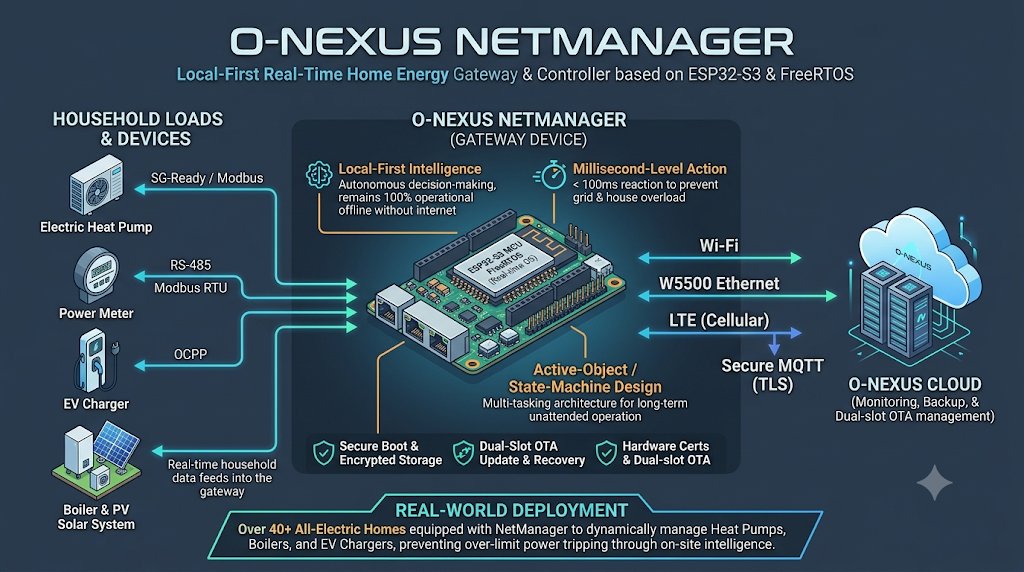
O-Nexus NetManager는 ESP32-S3와 FreeRTOS를 기반으로 주택의 전력 사용량을 실시간 관리하는 로컬 우선(Local-first) 에너지 관리 장치입니다. 전기 히트펌프, 보일러, EV 충전기, 태양광 설비 등이 동시에 동작할 때 주택의 전력 한도를 넘지 않도록 각 부하를 조정합니다.
이 제품의 가장 큰 특징은 클라우드에 의존하지 않고 현장에서 직접 판단한다는 점입니다. NetManager는 수백 ms 단위로 전력 상태를 확인하고 필요한 제어를 수행하며, 인터넷 연결이 끊겨도 핵심 에너지 관리 기능은 계속 동작합니다.
또한 다양한 에너지 장치를 하나의 게이트웨이에서 처리하도록 설계되었습니다.
히트펌프: SG-Ready / Modbus
전력 계량기: RS-485 Modbus RTU
EV 충전기: OCPP
외부 연결: Wi-Fi / W5500 Ethernet / LTE
클라우드 통신: secure MQTT
전체 구조는 다음과 같이 볼 수 있습니다.
전력 계량기·히트펌프·EV 충전기 → ESP32-S3 / FreeRTOS → W5500 Ethernet → secure MQTT → O-Nexus Cloud
제품 설계에서도 장기간 무인 운용을 고려했습니다. FreeRTOS 기반 Active-Object / state-machine 구조를 사용하고, secure boot, encrypted storage, 장치별 인증서 등록, dual-slot OTA를 적용해 현장 설치 후에도 보안 업데이트와 복구가 가능하도록 구성했습니다.
실제 적용 사례에서는 40개의 all-electric 주택에 NetManager를 설치해 제한된 전력 연결 환경에서도 히트펌프, 보일러, EV 충전기 등의 부하를 자동으로 관리하도록 했습니다. 즉, O-Nexus의 특징은 단순한 IoT 모니터링이 아니라 현장에서 직접 판단하고 제어하는 에너지 게이트웨이라는 점입니다.
About C4Micro
이미지 출처 : https://www.c4micro.com/index.html#services
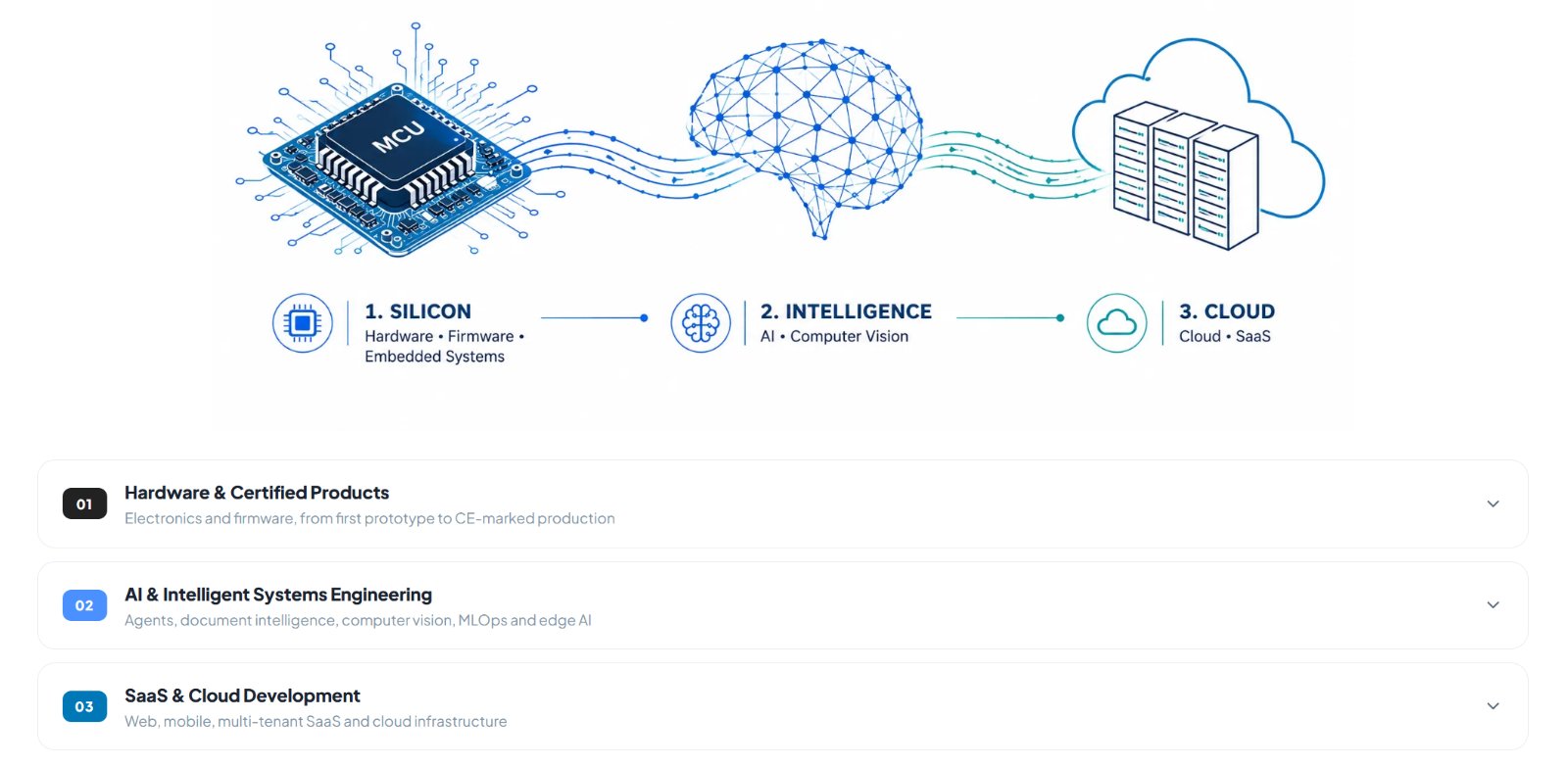
C4Micro는 connected product를 위한 end-to-end engineering 파트너로, 하드웨어부터 embedded firmware, AI/Edge AI, IoT 플랫폼, SaaS와 cloud까지 하나의 개발 흐름으로 제공하는 회사입니다. 의료, 에너지, 농업, 로보틱스와 같은 분야에서 실제 현장에 배포되는 connected device를 개발하고 있습니다.
주요 솔루션은 크게 세 영역으로 나뉩니다.
Embedded & Hardware Engineering: PCB 설계, C/C++ firmware, FreeRTOS·Zephyr·Embedded Linux, secure boot, OTA, 실시간 제어
AI & Intelligent Systems: Edge AI, computer vision, TinyML, AI agent, signal processing 및 on-device inference
SaaS & Cloud Development: IoT backend, API, web/mobile application, multi-tenant SaaS, cloud infrastructure 및 DevOps
O-Nexus 프로젝트에서는 이 가운데 embedded firmware와 IoT platform을 함께 개발했습니다. ESP32-S3 기반 NetManager의 실시간 제어 firmware뿐 아니라 Cumulocity IoT 위에 device onboarding, X.509 인증서 관리, 원격 설정, 진단, installer dashboard, 장기 데이터 저장 및 alert management 기능까지 구축했습니다.
Where WIZnet Fits
이 프로젝트에서 사용된 WIZnet 제품은 W5500 Ethernet Controller입니다.
W5500은 ESP32-S3와 외부 Ethernet 네트워크 사이에 위치하며 NetManager에 유선 IP 연결을 제공합니다. 히트펌프나 EV 충전기를 직접 제어하는 장치가 아니라, NetManager가 secure MQTT를 통해 O-Nexus 플랫폼과 통신할 때 사용하는 northbound Ethernet interface입니다.
W5500은 하드웨어 TCP/IP 엔진을 내장하며 최대 8개의 hardware socket, 32 KB 내부 TX/RX buffer와 SPI 기반 MCU 인터페이스를 제공합니다. TCP/IP 처리를 별도의 Ethernet controller에서 담당할 수 있어 FreeRTOS 기반 gateway에서 애플리케이션과 네트워크 기능을 분리하기에 적합합니다.
ESP32-S3는 전력 제어, 여러 field protocol, 상태 관리, 보안과 OTA를 동시에 처리합니다. 이러한 환경에서 W5500은 Ethernet 통신을 독립된 네트워크 블록으로 구성할 수 있게 해줍니다.
다만 C4Micro는 W5500을 선택한 이유를 CPU 부하 감소나 성능 향상으로 명시하지 않았습니다. 따라서 해당 부분은 W5500의 기술적 특성과 O-Nexus 구조가 잘 맞는다는 수준으로 해석하는 것이 적절합니다.
Implementation Notes
O-Nexus의 실제 firmware repository는 공개되어 있지 않아 ESP32-S3의 SPI GPIO, W5500 초기화 코드, socket allocation, DHCP 설정 등은 확인할 수 없습니다. 따라서 검증되지 않은 코드를 실제 O-Nexus 구현처럼 제시하지 않습니다.
Field Device Layer
히트펌프, 보일러, EV 충전기, 전력 계량기 등을 SG-Ready, Modbus, RS-485 Modbus RTU, OCPP로 연결합니다.
Local Control Layer
ESP32-S3와 FreeRTOS가 전력 상태를 판단하고 각 장치를 제어합니다. 네트워크와 관계없이 동작해야 하는 시스템의 핵심 계층입니다.
Ethernet Layer
W5500이 ESP32-S3에 wired Ethernet을 제공합니다. MCU와 W5500 사이의 구체적인 SPI 설정은 공개 자료에서 확인되지 않습니다.
MQTT & Cloud Layer
NetManager는 외부 네트워크가 연결되면 secure MQTT를 통해 O-Nexus 플랫폼과 데이터를 교환합니다.
Cumulocity IoT 기반 cloud에서는 X.509 device onboarding, 원격 설정, 진단, 장기 데이터 저장, installer dashboard와 alert management 등을 처리합니다.
Practical Tips / Pitfalls
제어와 네트워크 task를 분리해야 합니다. MQTT reconnect나 Ethernet 장애가 로컬 전력 제어 주기를 지연시켜서는 안 됩니다.
SPI 공유 자원을 관리해야 합니다. 다른 peripheral과 bus를 공유한다면 FreeRTOS mutex와 task priority를 함께 고려해야 합니다.
네트워크 상태를 단계별로 관리해야 합니다. PHY link, IP 획득, broker 연결, MQTT session은 서로 다른 상태입니다.
DHCP 및 네트워크 장애 정책이 필요합니다. 현장 장비에서는 재시도, static IP, reconnect 정책을 사전에 정의하는 것이 좋습니다.
OTA rollback을 고려해야 합니다. 업데이트 중 네트워크가 끊겨도 정상 firmware로 복구할 수 있어야 합니다.
EMI와 전원 품질을 함께 검토해야 합니다. 배전반 환경에서는 Ethernet, SPI, RS-485, 전원과 접지 설계가 시스템 안정성에 직접 영향을 줍니다.
FAQ
Q: O-Nexus NetManager에서 왜 W5500을 사용하나요?
A: W5500은 ESP32-S3에 wired Ethernet 연결을 제공합니다. 하드웨어 TCP/IP 엔진과 내부 socket buffer를 갖고 있어 FreeRTOS 기반 gateway에서 Ethernet 기능을 별도의 네트워크 블록으로 구성하기에 적합합니다. 다만 C4Micro가 구체적인 선정 이유를 공개한 것은 아닙니다.
Q: W5500은 ESP32-S3와 어떻게 연결되나요?
A: W5500은 SPI를 사용합니다. 일반적으로 SCLK, MOSI, MISO, CS를 사용하며 INT와 RESET 신호를 추가할 수 있습니다. O-Nexus의 실제 GPIO 배치는 공개되어 있지 않습니다.
Q: W5500은 이 프로젝트에서 어떤 역할을 하나요?
A: NetManager의 wired Ethernet interface입니다. ESP32-S3가 에너지 제어를 담당하고 W5500은 secure MQTT 기반 클라우드 통신에 필요한 IP 네트워크 연결을 제공합니다.
Q: 초보자도 비슷한 시스템을 구현할 수 있나요?
A: ESP32-S3와 W5500의 기본 Ethernet 통신은 비교적 접근하기 쉽지만 O-Nexus 수준의 시스템에는 FreeRTOS, MQTT, Modbus, RS-485, X.509 인증, OTA와 장애 복구에 대한 이해가 필요합니다. 전체 시스템은 중급 이상의 난이도입니다.
Q: O-Nexus에서 W5500 Ethernet과 Wi-Fi는 어떤 관계인가요?
A: O-Nexus는 Wi-Fi, W5500 Ethernet, LTE를 connectivity 옵션으로 사용합니다. W5500은 유선 IP 경로를 제공하지만 핵심 에너지 제어는 네트워크 종류와 관계없이 로컬에서 수행됩니다.
What the Project Does
Image source: AI-generated
O-Nexus NetManager is a local-first energy management device built around the ESP32-S3 and FreeRTOS. It manages residential power consumption in real time, coordinating loads such as electric heat pumps, boilers, EV chargers, and solar energy systems to prevent total power demand from exceeding the household's available electrical capacity.
The key characteristic of the product is that control decisions are made locally without depending on the cloud. NetManager monitors power conditions at intervals of several hundred milliseconds and performs the necessary control actions on site. Core energy management functions continue to operate even if the Internet connection is lost.
It is also designed to manage multiple types of energy equipment through a single gateway.
Heat pumps: SG-Ready / Modbus
Power meters: RS-485 Modbus RTU
EV chargers: OCPP
External connectivity: Wi-Fi / W5500 Ethernet / LTE
Cloud communication: Secure MQTT
The overall architecture can be represented as follows:
Power Meter · Heat Pump · EV Charger → ESP32-S3 / FreeRTOS → W5500 Ethernet → Secure MQTT → O-Nexus Cloud
The product is also designed for long-term unattended operation. It uses a FreeRTOS-based Active-Object / state-machine architecture and incorporates secure boot, encrypted storage, per-device certificate provisioning, and dual-slot OTA to support secure updates and recovery after field deployment.
In a real-world deployment, NetManager units were installed in 40 all-electric homes to automatically manage loads such as heat pumps, boilers, and EV chargers under limited grid connection capacity. In other words, O-Nexus is not simply an IoT monitoring solution. Its defining feature is that it functions as an energy gateway that makes control decisions locally and acts on them directly in the field.
About C4Micro
Image source: https://www.c4micro.com/index.html#services
C4Micro is an end-to-end engineering partner for connected products, covering the full development flow from hardware and embedded firmware to AI / Edge AI, IoT platforms, SaaS, and cloud services. The company develops connected devices intended for real-world deployment across sectors including healthcare, energy, agriculture, and robotics.
Its main solutions can be divided into three areas:
Embedded & Hardware Engineering: PCB design, C/C++ firmware, FreeRTOS, Zephyr, Embedded Linux, secure boot, OTA, and real-time control
AI & Intelligent Systems: Edge AI, computer vision, TinyML, AI agents, signal processing, and on-device inference
SaaS & Cloud Development: IoT backends, APIs, web/mobile applications, multi-tenant SaaS, cloud infrastructure, and DevOps
For the O-Nexus project, C4Micro developed both the embedded firmware and the IoT platform. In addition to the real-time control firmware for the ESP32-S3-based NetManager, the company implemented device onboarding, X.509 certificate management, remote configuration, diagnostics, an installer dashboard, long-term data storage, and alert management on top of Cumulocity IoT.
Where WIZnet Fits
The WIZnet product used in this project is the W5500 Ethernet Controller.
The W5500 sits between the ESP32-S3 and the external Ethernet network, providing NetManager with wired IP connectivity. It does not directly control devices such as heat pumps or EV chargers. Instead, it serves as the northbound Ethernet interface used when NetManager communicates with the O-Nexus platform over secure MQTT.
The W5500 integrates a hardware TCP/IP engine and provides up to eight hardware sockets, 32 KB of internal TX/RX buffer memory, and an SPI-based MCU interface. Because TCP/IP processing can be handled by a dedicated Ethernet controller, it is well suited to separating application logic from networking functions in a FreeRTOS-based gateway.
The ESP32-S3 simultaneously handles power control, multiple field protocols, state management, security, and OTA functionality. In this environment, the W5500 allows Ethernet communication to be implemented as an independent network block.
However, C4Micro does not state that the W5500 was selected specifically to reduce CPU load or improve performance. It is therefore more appropriate to say that the technical characteristics of the W5500 align well with the O-Nexus architecture, rather than attributing a specific design motivation that has not been disclosed.
Implementation Notes
The actual O-Nexus firmware repository is not publicly available, so details such as the ESP32-S3 SPI GPIO assignments, W5500 initialization code, socket allocation, and DHCP configuration cannot be verified. Therefore, unverified code should not be presented as if it were part of the actual O-Nexus implementation.
Field Device Layer
Heat pumps, boilers, EV chargers, and power meters are connected using interfaces and protocols such as SG-Ready, Modbus, RS-485 Modbus RTU, and OCPP.
Local Control Layer
The ESP32-S3 and FreeRTOS evaluate power conditions and control connected devices. This is the core system layer that must continue operating independently of network availability.
Ethernet Layer
The W5500 provides wired Ethernet connectivity to the ESP32-S3. The specific SPI configuration between the MCU and the W5500 is not disclosed in the publicly available material.
MQTT & Cloud Layer
When an external network connection is available, NetManager exchanges data with the O-Nexus platform using secure MQTT.
The Cumulocity IoT-based cloud handles X.509 device onboarding, remote configuration, diagnostics, long-term data storage, installer dashboards, and alert management.
Practical Tips / Pitfalls
Separate control tasks from network tasks. MQTT reconnection attempts or Ethernet failures should not delay the local power-control cycle.
Manage shared SPI resources carefully. If the W5500 shares the bus with other peripherals, FreeRTOS mutexes and task priorities should be considered as part of the system design.
Manage network states separately. PHY link status, IP acquisition, broker connectivity, and MQTT sessions are different states and should be handled independently.
Define DHCP and network-failure policies. Field-deployed equipment should have predefined policies for retries, static IP configuration, and reconnection behavior.
Plan for OTA rollback. The device should be able to recover to a known-good firmware image if the network connection is lost during an update.
Consider EMI and power quality together. In electrical distribution environments, Ethernet, SPI, RS-485, power, and grounding design can directly affect overall system reliability.
FAQ
Q: Why is the W5500 used in the O-Nexus NetManager?
A: The W5500 provides wired Ethernet connectivity to the ESP32-S3. Its hardware TCP/IP engine and internal socket buffers make it suitable for implementing Ethernet as a separate networking block in a FreeRTOS-based gateway. However, C4Micro has not publicly disclosed the specific reasons behind selecting the W5500.
Q: How is the W5500 connected to the ESP32-S3?
A: The W5500 uses SPI. A typical connection includes SCLK, MOSI, MISO, and CS, with optional INT and RESET signals. The actual GPIO assignments used in the O-Nexus hardware have not been publicly disclosed.
Q: What role does the W5500 play in this project?
A: It serves as NetManager's wired Ethernet interface. The ESP32-S3 handles energy control, while the W5500 provides the IP network connection required for secure MQTT-based cloud communication.
Q: Can beginners build a similar system?
A: Basic Ethernet communication between an ESP32-S3 and W5500 is relatively approachable. However, a system at the level of O-Nexus requires knowledge of FreeRTOS, MQTT, Modbus, RS-485, X.509 authentication, OTA updates, and fault recovery. The overall project is best suited to developers with intermediate or higher-level embedded systems experience.
Q: How are W5500 Ethernet and Wi-Fi used in O-Nexus?
A: O-Nexus supports Wi-Fi, W5500 Ethernet, and LTE as connectivity options. The W5500 provides a wired IP path, while the core energy-control functions are performed locally regardless of which external network connection is used.

