Luciferin Intelligent Light Systems
The growing demands of energy have forced us to turn to alternate sources of energy or make better use of
existing resources.
4
Components
Hardware components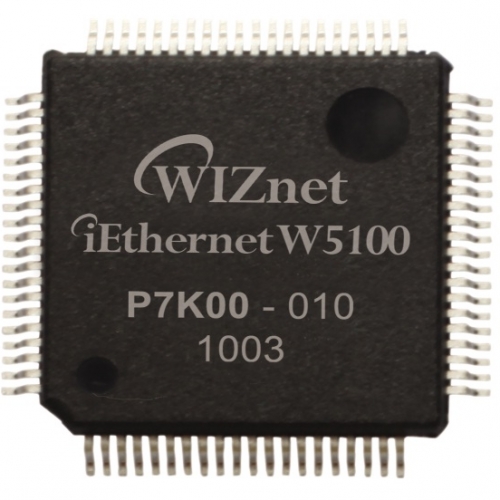
WIZnet - W5100
x 1

Project description
I. INTRODUCTION1 The human race from its very inception has survived on one or other form of energy. The gradual progress made over the years has made us dependent on energy for meeting our day to day needs as well as our existence. But the increasing over exploitation of resources has lead to a sharp crisis as far availability is concerned. This has in turn forced us to turn to alternate sources of energy or make efficient use of the existing resources. As there is still research and development of technology that can make use sustainable use of alternate energy sources, the immediate aim to tackle the problem must be to make efficient use of the existing resources and the aim of this project is to implement the same. Electricity consumption has been on par with ever increasing demand. But this has also lead to too much wastage which instead could be applied to alternate departments. Modern lights system are a major consumer of electric energy ,our project aims at developing a model which will ensure that the waste of energy in reduced to the least and the objective of existing system is also not compromised[1][3]. Traditionally used systems have studied and their characteristics analyzed for better understanding and application. Our system intends to make use of sensors, processing units and LEDS to design an apparatus that will save electricity. When needed this apparatus will work at full power i.e. but when not in use it will reduce to minimum of the total intensity [4]. Sensors will detect different scenarios and return an output correspondingly; the processing unit will then order the LEDs to react correspondingly. The entire apparatus will be enclosed within a case.
A. Need The growing demands of energy either have forced us to turn to sources that are truly sustainable or make efficient use of the existing energy resources which is sensible option as there aren‘t any sources that are truly sustainable e.g. nuclear energy has its own demerits, Wind energy requires large scale infrastructure and has low outputs. Therefore we decided to make a model that achieves the objective of conservation of energy, since energy saved is energy earned. Efficient use of energy not only results in saving but also makes energy available to other applications. Apart from monetary benefits, conservation is also aimed at reduction in pollution arising from energy generation e.g. energy generated from coal burning or nuclear disaster. The amount of energy generation can be reduced if some mount of energy is conserved from already generated values or proper analysis is done of the demand and subsequently the amount is produced with respect to the demand [2].
II. BACKGROUND LEDs have been taking to the streets since the 1990s, when cities throughout the U.S. and Europe began replacing incandescent-based traffic lights with highly energy-efficient solid state fixtures. Today‘s power LEDs are poised to cross the next municipal frontier and tackle the challenge of street lighting. If the mass adoption of solid state traffic signals is any indication, high pressure sodium, and high intensity discharge (mercury vapor) street lamps may soon lose their luster as the dominant sources of road and sidewalk illumination. The first LED street light installations are already being tested around the world, and in some cases implemented, in China, North America and Europe, as governments, municipalities and utilities strive to replicate the energy and maintenance savings of LED traffic lights elsewhere within their borders [5].
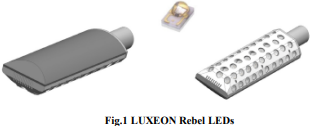
A. Design To examine the performance benefits of using LEDs for street lamp illumination, let‘s look at a demonstration lamp built with LUXEON Rebel LEDs .In this design, 50 cool white (6500K) LEDs are placed in rows and installed at varying angles to achieve the desired light coverage. Each LED is driven at 350mA, has a light output of roughly 90 lumens, and uses a secondary collimating optic for maximum efficiency and uniformity
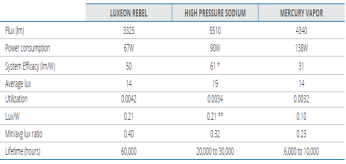
B. Performance Benefits The chart below shows how the solid-state street light demonstration design produced with LUXEON Rebel LEDs stacks up against the two dominant lighting technologies used for street lighting. The performance benefits of the LED scenario are striking. Highlights include: • Lower power consumption (67W) slashing energy use by 52% over Mercury Vapor (138W) and 26% over a high pressure sodium fixture (90W)
Lower Total Cost of Ownership: Beyond performance, one of the most compelling arguments in favor of LED street lamps is the cost advantage of operating and maintaining the fixtures. In part, this comes from reduced energy usage that can cut electricity bills in half. In part, it comes from the longer replacement cycle made possible by longer LED life. Increasing the interval between bulb replacements from three to five years to 10 or 15 means fewer truck runs, less fuel, and less overhead for work crews. This in turn accelerates the return on investment. Even with the higher initial cost of a solid state luminaire, municipalities can recoup the costs of an LED-based street lighting installation in four to six years (The ROI will be even faster as power costs increase and technology advances increase LED light output, making it possible to deliver more lumens per watt for
Reduced Light Pollution: Another virtue of LED-based street lighting is the ability to all but eliminate hot spots and wasted light. This degree of control over the light distribution — a byproduct of the LED form factor itself — not only improves safety and visibility but also reduces the lumen requirements of the luminaire. Consequently, the use of LEDs delivers energy savings above and beyond that made possible by their low power demands. A traditional filament emits light from a single source. Shields, reflectors and/or lenses are used to point the beam in the desired direction, but engineers have limited control. Some light spills over to neighboring buildings or bounces skyward (wasting energy and creating light pollution), the light is brighter in the middle and dimmer at the edges, and the light concentration in the center creates hot spots that can cause eye strain for drivers and pedestrians.
III. PRESENT INVESTIGATION
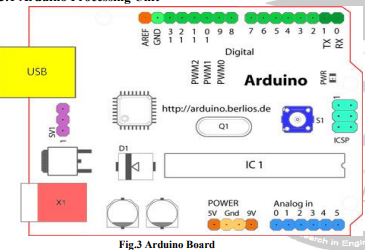
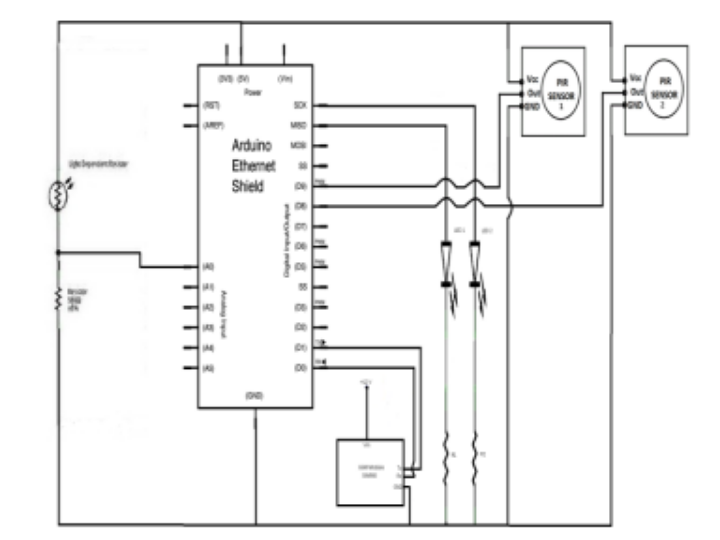
The processing unit used for our project is the Arduino Uno which has the following pin configuration: Analog Reference pin (orange) Digital Ground (light green) Digital Pins 2-13 (green) Digital Pins 0-1/Serial In/Out – TX/RX (dark green) – These pins cannot be used for digital i/o (digital Read and digital Write) if you are also using serial communication (e.g. Serial.begin). Reset Button – S1 (dark blue) In-circuit Serial Programmer (blue-green) Analog In Pins 0-5 (light blue) Power and Ground Pins (power: orange, grounds: light orange) External Power Supply In (9-12VDC) – X1 (pink) Toggles External Power and USB Power (place jumper on
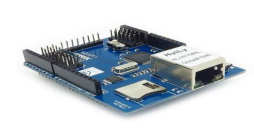
ETHERNET SHIELD W5100 Ethernet shield V1.0 is a WIZ net W5100 breakout board with POE and Micro-SD designed for Arduino platform. 5V/3.3V compatible operation voltage level makes it compatible with Arduino boards, leaf maple, and other Arduino compatible boards except Mega boards. FEATURES With Micro SD interface 5V/3.3V double operational voltage level 10Mb/100Mb Ethernet socket with POE All electronic brick interface are broken out Operation temperature: -40℃ ~ +85℃
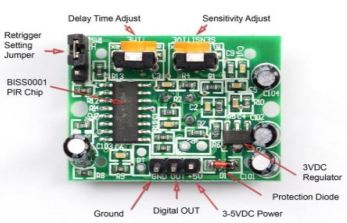
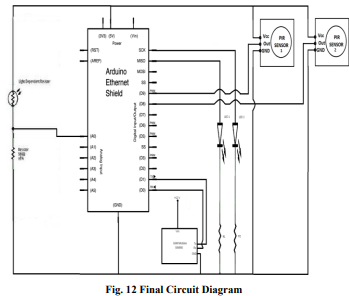
3.2 METHODOLOGY The first step would be to design LDR circuit using breadboard, LDR, resistors, wire and Arduino. GND, 5V and A0 pins of Arduino is used for connection. A0 pin convert the analog signal to digital and send the output to the LED to glow if resistance is increases. Resistors are used to adjust the value of LDR. The next step would be to design the Sensor circuit. It will require PIR sensors and wires. It will be connected by 3 pins of Arduino 5v, GND and D2 pin which is digital pin. It will produce the PWM signals which will be given to the LED to adjust the intensity of it. This circuit also will be created on breadboard.
IV. RESULTS AND DISCUSSION In our attempts to conserve energy by making efficient use of the it we have designed an apparatus which has shown that its more than capable of saving energy and achieving this objective. The comparison of values of LED output as studied and highlighted in earlier chapter show the effectiveness it has achieved in comparison to traditional lighting systems. The study of the different sensors used such as PIR and LDR allowed us to make better use of them .The values in terms, of their output, provided by them, was used by the arduino processing unit to make better decisions. The overall analysis of LEDs has given tit an upper hand as compared combined with with all the sensors it has made it possible to achieve the objective of saving energy achievable. The wifi module comprising of GSM900 and W5100 Ethernet shield have made it possible to make calls and send messages. All these results have been specified in the screenshot given below.
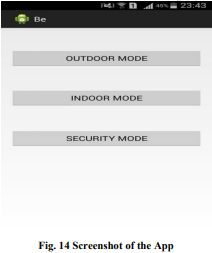
V. CONCLUSION The main objective of designing this apparatus was to make efficient use of energy by saving it at the same time provide basic security mechanism. The study of sensors such as PIR, LDR have allowed us to understand their working then apply them in and efficient and useful manner for our apparatus. Their values have been studied and analyzed according to the environment we were working in and subsequently the code has been modified to adjust to those values. The Arduino processing unit has shown that it‘s more than capable of carrying out processing actions such as receiving inputs from LDR and PIR and then comparing their outputs. The coding language provided by Arduino has made it possible to create complex code with much ease then apply the values of different sensors in the comparison process to carry out the decision making. The security mechanism has been handled by the GSM900 WIFI module which has made it possible to make calls or send text over wifi to a fixed. All these action have been controlled by an android app which makes the system all together smart. In the app we have provided three basic modes of operation which allow the \user the decide depending upon his requirements.

