Which Interfaces Does the W5100-Based HT1040-U01 Industrial Board Combine?
Umezawa HT1040-U01 combines H8/3069, W5100 Ethernet and VNC2 USB hosting in a PC/104 industrial board for custom logging and I/O systems.
0
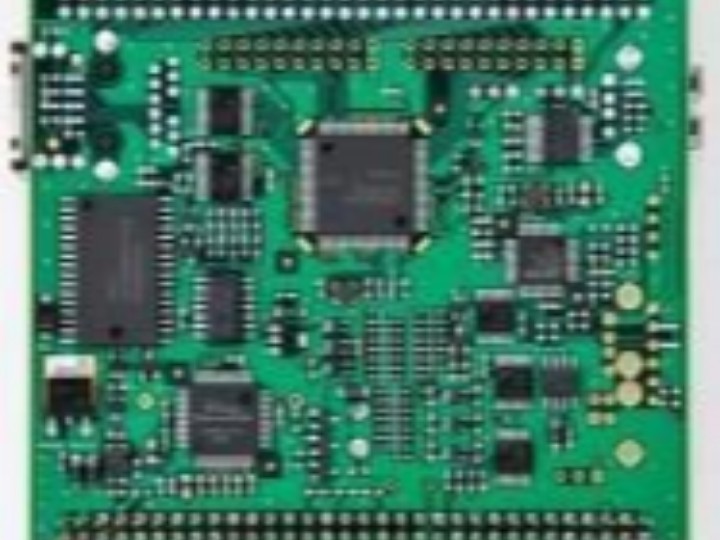
Components
Hardware components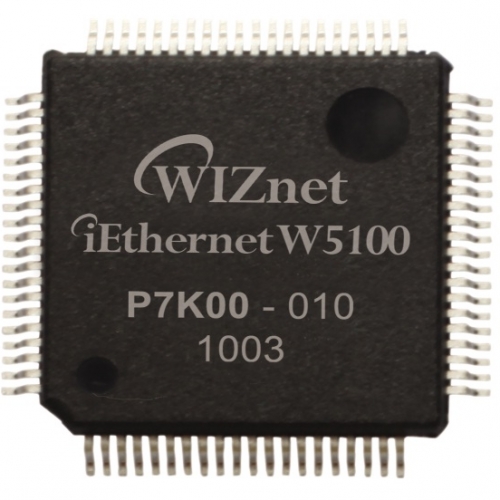
WIZnet - W5100
x 1

Standard onboard Ethernet and hardware TCP/IP controller connected to the H8/3069 MCU.
Project description
Ethernet, USB and Equipment Control on One Board
Umezawa Musen Denki, a Japanese industrial computer and electronics manufacturer, sells the HT1040-U01 as a CPU board for integration into equipment. It combines a Renesas H8/3069 microcontroller, WIZnet W5100 Ethernet, an FTDI VNC2 USB controller and connectors for stackable expansion boards. Umezawa presents the combination as a basis for data logging and networked input/output systems.
A logger needs several different operations: acquiring a measurement, attaching a time, keeping a local record and communicating with another computer. HT1040 provides hardware for those operations, while the equipment developer supplies the application that connects them. This distinction matters when ordering: the product is a programmable industrial board that still needs a power supply, application software and the appropriate connections to the equipment.
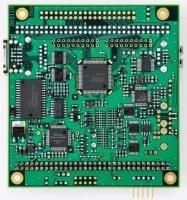
Current HT1040-U01, from the official shop listing. Photo: Umezawa Musen Denki.
Three Controllers with Different Jobs
The H8/3069 runs the application and operates the local inputs and outputs. The current specification includes eight 10-bit analog input channels, two 8-bit analog outputs and general digital I/O. Some pins share functions, so the available channels depend on the selected configuration. An application that samples an analog signal must account for that pin assignment as well as the external signal-conditioning circuit.
The W5100 handles the Ethernet connection and TCP/IP processing in hardware. Umezawa describes network operation without adding an operating system or a software TCP/IP stack. The H8 issues commands, checks controller status and exchanges data through the W5100 buffers. Four hardware sockets provide separate communication endpoints, with 16 KB of internal communication memory shared across transmit and receive buffering.
The VNC2 handles USB. Its firmware manages USB communication and file operations, while the H8 exchanges commands through its SCI2 serial interface. This arrangement gives the application a command interface to both network communication and USB peripherals. For a custom logger, the H8 could collect readings, the VNC2 could write files to USB memory, and the W5100 could send records over Ethernet. That sequence is an application design enabled by the board.
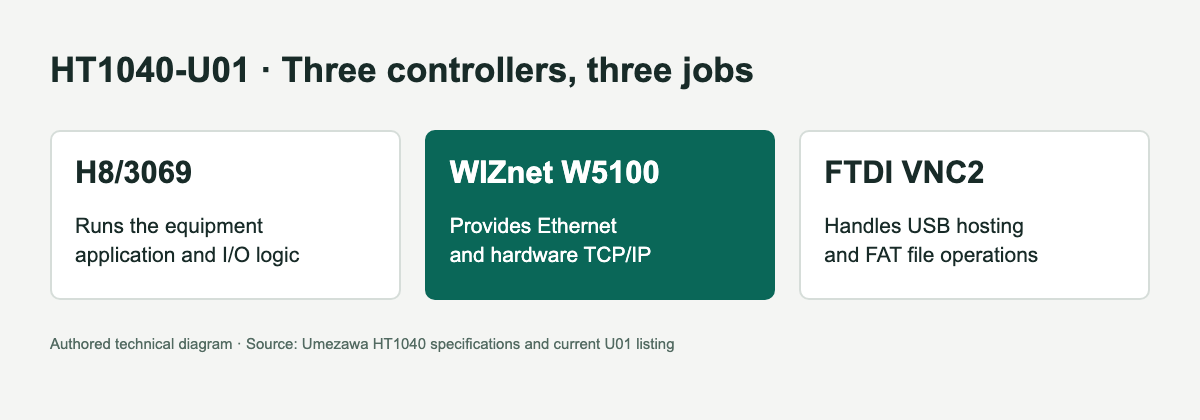
Authored technical diagram based on Umezawa specifications.
How the W5100 Socket Interface Works
The HT1040 programming manual makes the software interface concrete. Printed page 76 identifies a WIZnet library port for HT1040. The following pages document functions for opening sockets, establishing connections, transferring bytes and checking status. The manual also describes W5100 registers in the H8 memory map, so this board integrates the controller through the processor bus.
A socket is a numbered endpoint that the application uses to communicate. The documented socket() call selects one of four socket numbers, a protocol and a local port. A TCP client then uses connect() with the destination address and port. A TCP server uses listen() to wait for a connection. Once connected, send() and recv() transfer the application data. The application still decides what those bytes mean and when to exchange them.
One useful detail is that this library documents recv() as a call that does not wait for incoming data. The program should check whether data is available and determine its length before reading. The neighboring packet_available() and received_length() functions provide those checks. UDP communication uses sendto() and recvfrom(), with address and port information supplied for each exchange.
This is a practical division of work: hardware manages the network protocol, and the H8 program manages equipment behavior, data formatting and the communication sequence. Four sockets remain a finite resource that an application must allocate deliberately.
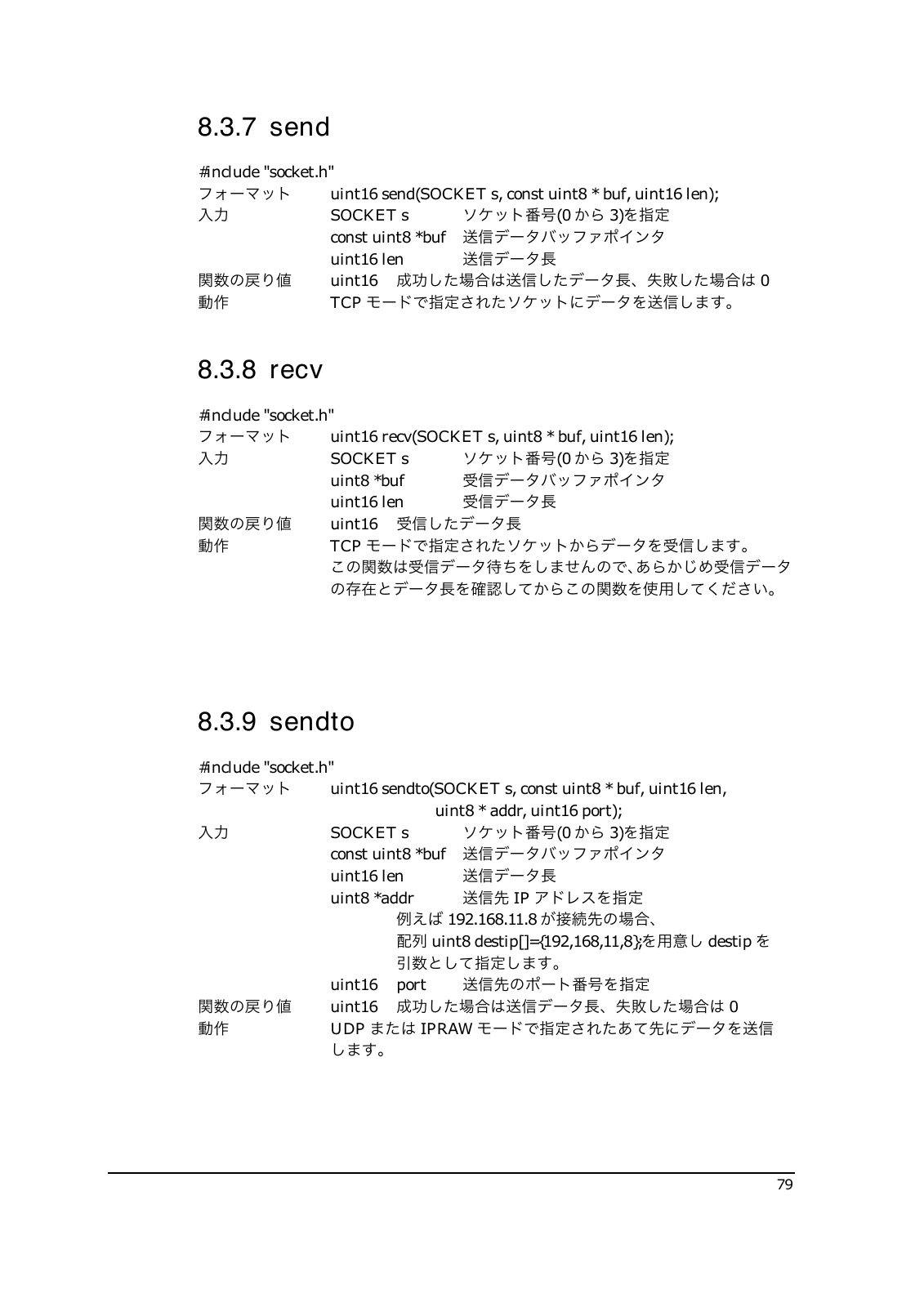
Official HT1040 manual, printed page 79. The API descriptions distinguish TCP transfer from UDP addressing and explain the receive behavior. Source: Umezawa Musen Denki.
From a Browser Button to an Output Pin
The manual includes two examples that show what this interface is for. Its portrw example configures the board address and subnet mask, opens TCP port 80 and waits for a browser. The displayed page shows the states of H8 port 4 and port A. Port 4 is configured as output, and changing a value in the browser changes that output. Port A supplies the input state shown on the page.
The resulting path is easy to follow: a browser request reaches W5100 Ethernet, the H8 application interprets it, and the application reads or changes local I/O. The network controller carries the exchange; the application gives the request its equipment-specific meaning.
The tcpclient example reverses the direction of initiation. The board connects to a server and sends a date-and-time string every 15 seconds. The documented sample package includes a PC server program that displays the received text. Both examples use address settings that the developer must adapt to the local network. They are programming examples described by the manufacturer, rather than a preconfigured monitoring service supplied with every board.
USB Storage and the U01 Revision
The current U01 contains VNC2. The older U00 contains VNC1L and is marked as sales suspended on the product page. The published manual describes VNC1L in its USB chapter, so current U01 USB firmware and software-package details should be confirmed with Umezawa when planning an integration.
The current product specification describes two USB ports. The controller can host USB devices, or support a USB device on one port and an FT232B-equivalent PC interface on the other. Connector population is more specific: port 2 has a Type-A connector fitted, while port 1 supports fitting a Type-A or Type-B connector. Two controller ports therefore do not imply two identical, ready-to-use sockets on the purchased board.
FAT12, FAT16 and FAT32 file handling lets the H8 application request file operations through commands. The product footnote excludes long filenames, which affects how a logger names its records. The board also has a real-time clock and a 0.1 F backup capacitor covering the clock and external 512 KB SRAM. These features provide useful building blocks for time-stamped records; recording intervals, file rotation and recovery behavior belong to the application.
PC/104 Expansion and Mechanical Integration
PC/104 is the stacking arrangement behind the board connectors. Umezawa specifically describes a PC/104-compatible signal layout and supports compatible HT-series expansion modules, including optoisolated I/O and pulse-motor controllers. Isolation separates the equipment-side electrical signals from the control side. The expansion board chosen for an installation determines the actual field interface.
Some modules require an 8 MHz system clock, while the HT1040 specification lists a 16 MHz oscillator with clock division. That condition should be checked alongside connector assignment and power requirements. The CPU board measures approximately 90.2 by 95.9 mm excluding protrusions, and its stated supply is 5 V, with typical board current of 250 mA. Added modules and USB devices must be included when sizing the complete system supply.
The surrounding product family also supports custom connections. The HT9030 prototyping set includes a universal board, stack-through connectors and mounting hardware. Umezawa explicitly lists it for bringing out HT1040 I/O signals or prototyping an 8-bit PC/104 expansion module. This gives a developer a documented route for adapting the standard CPU board to a particular connector or circuit.
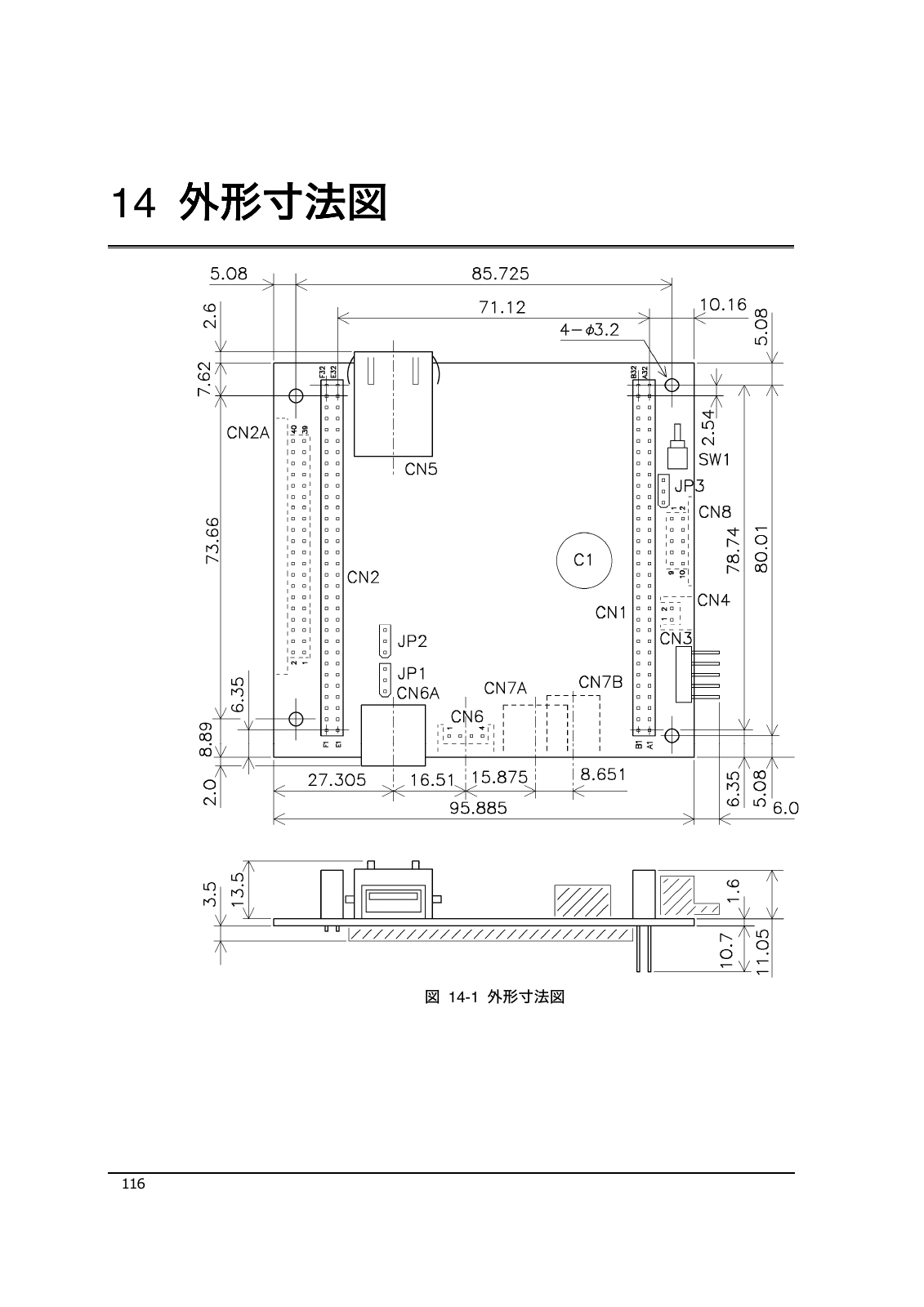
HT1040 family outline drawing, printed page 116 of the published manual. This is the manufacturer drawing, not a photograph of the current U01 revision. Source: Umezawa Musen Denki.
Development Route and Ordering
The manual describes HT1040.LIB packages for YellowIDE6 and HEW4, along with a source directory for adapting the library to another toolchain. Its sample workflow covers loading a program into RAM and preparing a release for flash memory. These are established H8 development tools; buyers should confirm the currently supplied files and compatibility with their development computer.
A related design is the Technowave LANM3069D-S, another H8 and W5100 board organized around a PC-side remote-I/O API. HT1040 instead documents an onboard application workflow, with USB hosting and the HT expansion stack. The useful choice is where the equipment logic should run and which local interfaces it needs.
On October 12, 2026, the official Umezawa shop listed HT1040-U01 for JPY 27,500 including tax. The page offers quantity and cart controls and labels the board as a special-order item. It states neither a stock count nor a delivery estimate. The product family separately lists the HT1030-03 PC connection cable and SKA/SKB development models with ICE sockets for debugging equipment. Confirm the intended U01 configuration, required accessories and delivery schedule with the manufacturer before ordering.
FAQ
Q. Is HT1040-U01 a finished data logger? It is a CPU board for building equipment. The developer supplies the logging application, signal connections, power arrangement and enclosure appropriate to the installation.
Q. Is W5100 optional, and what does it handle? W5100 is a standard onboard component. It provides Ethernet and hardware TCP/IP processing, while the H8 application controls local I/O and the data exchanged through its sockets.
Q. How does U01 differ from U00? U01 uses the FTDI VNC2 USB controller. U00 uses VNC1L and is listed as sales suspended. The older manual remains useful for the documented H8 and W5100 interface, with USB revision details to confirm for U01.
Q. Does PC/104 compatibility mean any expansion board can be fitted? Umezawa specifies the connector signal layout and compatible HT modules. Clock settings, signals, power and mechanical clearance still need checking for the intended stack.
Q. Where can developers find a starting point? The official manual documents the HT1040 library and browser I/O and TCP-client examples. Ask Umezawa for the current U01 software package and toolchain requirements when arranging the order.
Documents
-
Umezawa HT1040 product and variant specifications
Manufacturer specifications, W5100, HT expansion stack and U00/U01 USB-controller distinction.
-
HT1040-U01 official order page and product photo
Current U01 with W5100 and VNC2; special-order price of JPY 27,500 including tax observed October 12, 2026. Photo credit: Umezawa Musen Denki.
-
HT1040 catalog
U00/U01 production models, ICE development models, board dimensions and PC/104 clock conditions. Current U01 uses VNC2.
-
HT1040 hardware and programming manual
Board-specific WIZnet library and socket API (printed pp76-86), browser I/O and TCP-client examples (pp96-97), and dimensions (p116). USB chapter describes VNC1L; confirm current U01 software with Ume
-
Umezawa company profile
Original manufacturer, Japanese headquarters and HT-series history.
-
Umezawa product inquiries
Official vendor contact for integration and delivery inquiries.
-
HT9030 prototyping and I/O breakout set
Manufacturer describes the universal PCB, stack-through connectors and hardware for HT1040 signal breakout or 8-bit PC/104 expansion prototyping.


