Wiznet makers

josephsr

Published January 14, 2026 ©

143 UCC

13 WCC

13 VAR

0 Contests

0 Followers

0 Following

Original Link

High-Speed Ethernet-Based Voltage Acquisition Architecture for Long-Distance Industrial Testing

Ethernet-based DAQ samples multi-channel 0–5V signals at 10 kHz, compresses on MCU, and sends UDP packets via W5500 up to 100 m.

COMPONENTS
PROJECT DESCRIPTION

Overview

This system addresses a common limitation in industrial test environments where high-speed analog signals must be acquired over distances that exceed the practical limits of USB or direct analog transmission. By digitizing signals near the sensor, compressing them in real time, and transmitting them over Ethernet, the design prioritizes signal integrity, timing determinism, and scalability.

Main Content

At the core of the system is a multi-channel SAR ADC that samples pressure sensor voltages at rates far exceeding the required 10 kHz per channel. Rather than relying on high-bandwidth local interfaces such as USB, the design converts analog signals into digital form at the source and treats the network as a deterministic transport layer rather than a raw data pipe.

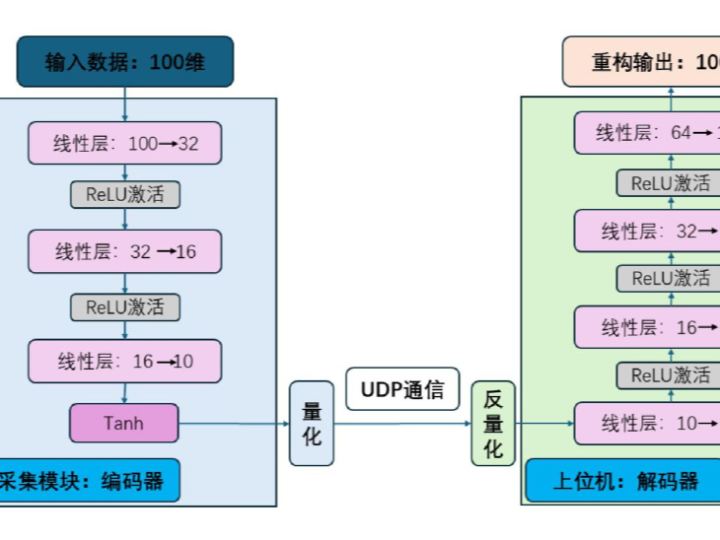
A microcontroller reads ADC data using a software-implemented SPI timing scheme, allowing fine-grained control over acquisition timing. Raw samples are temporarily buffered, then compressed before transmission to reduce bandwidth pressure and avoid interference between acquisition and communication tasks.

System Context

The system is designed for industrial test benches, such as explosion-proof valve testing, where transient pressure behavior must be captured accurately. These environments impose constraints on cable length, electromagnetic interference, and timing reliability that make direct analog transmission impractical.

Ethernet is used not as a convenience interface, but as a deliberate architectural boundary separating real-time acquisition from higher-level analysis.

Architecture / Design Considerations

A WIZnet Ethernet product, specifically the W5500, is used to offload TCP/IP and UDP handling from the MCU. This choice reduces firmware complexity and ensures predictable transmission timing under a fixed 10 ms data packet schedule.

UDP is selected over TCP to minimize protocol overhead and eliminate retransmission-induced latency. To compensate, the system enforces strict packet framing, checksums, and timing discipline.

A key architectural decision is the use of lightweight data compression at the acquisition node. By compressing buffered samples before transmission, the system prevents SPI-based Ethernet transfers from blocking ADC sampling.

Possible Implications

This architecture demonstrates how Ethernet can be used as a real-time-capable transport when paired with deterministic scheduling and bounded packet sizes. It also shows that local signal intelligence, even in constrained MCUs, can significantly extend system capability without increasing raw bandwidth.

The design implicitly treats the acquisition node as a preprocessing stage rather than a passive data forwarder.

Conclusion

By combining near-sensor digitization, buffered compression, and Ethernet-based UDP transmission via a dedicated network controller, the system achieves reliable high-speed voltage acquisition over distances up to 100 meters. The result is a scalable and interference-resistant alternative to traditional short-range data acquisition approaches.


전체 개요

본 기술은 “고속 샘플링” 자체보다, 고속 샘플링을 깨뜨리지 않고 멀리 보내는 방법에 초점을 둔 구조입니다. 핵심은 ADC 성능이 아니라, 수집·처리·전송이 서로 발목을 잡지 않도록 역할을 분리한 점에 있습니다.

문제의식과 기술적 맥락 재구성

폭발 방지 밸브 시험과 같은 산업 환경에서는 압력 변화의 순간 응답이 중요합니다.
문제는 10 kHz 급 아날로그 신호를 수십 미터 이상 떨어진 위치로 보내는 순간, USB나 아날로그 케이블 모두 한계에 부딪힌다는 점입니다.

직접 아날로그를 보내면 EMI와 감쇠가 문제고, USB 기반 DAQ는 거리 자체가 막힙니다.
이 특허는 이 지점을 “전송 방식”이 아니라 시스템 경계 재설정 문제로 봅니다.

기술 흐름 설명 (신호 중심)

  1. 압력 센서에서 1–5V 아날로그 신호 출력
  2. 센서 근처에서 ADC가 즉시 디지털 변환
  3. MCU가 다채널 데이터를 짧은 주기로 수집
  4. 수집 데이터는 큐에 저장 후 일정 시간 단위로 압축
  5. 압축된 데이터만 Ethernet을 통해 상위 시스템으로 전송
  6. 상위 시스템에서 복원 및 저장

이 흐름에서 중요한 점은 네트워크가 실시간 샘플링 루프에 직접 개입하지 않는다는 것입니다.

왜 이런 구조가 나왔는지에 대한 해설

핵심 병목은 SPI 기반 Ethernet 전송이 ADC 수집 타이밍을 깨뜨릴 수 있다는 점입니다.
이를 피하기 위해 “수집 → 큐 → 압축 → 전송”이라는 완충 구조가 도입되었습니다.

추론임:
이 구조는 MCU를 단순 제어 장치가 아니라, 시간 보호 장치로 취급한 설계로 보입니다. MCU의 역할은 데이터를 많이 보내는 것이 아니라, 절대 놓치지 않는 것입니다.

설계 선택의 배경과 제약

  • UDP 선택 이유: 재전송보다 시간 결정성이 더 중요
  • W5500 사용 이유: 네트워크 스택을 MCU에서 제거해 타이밍 예측 가능성 확보
  • 압축 도입 이유: 대역폭 절감보다 SPI 전송 블로킹 방지 목적이 큼

이 시스템에서 가장 실패 비용이 큰 지점은 압축·전송이 수집 주기를 침범하는 순간입니다. 이 지점이 무너지면 전체 구조의 의미가 사라집니다.

보조 수단으로서의 위치

이 장치는 센서나 시험 시스템을 대체하지 않습니다.
기존 시험 장비의 신호 획득 경로를 보조적으로 치환하는 역할에 가깝습니다.

ADC나 Ethernet 모듈을 제거하면 시스템은 다시 짧은 거리·저속 수집기로 퇴화합니다.

내부 관점에서의 시사점

  • Ethernet은 제어용이 아니라 경계 분리 수단으로 사용될 수 있음
  • 고속 DAQ에서 문제는 “얼마나 빠른가”보다 “어디서 멈추지 않는가”
  • 경량 연산을 활용한 전처리는 MCU의 한계를 확장하는 현실적 수단

FAQ (KR)

Q1. 기존 USB 기반 DAQ와 가장 큰 차이는 무엇입니까?
USB는 대역폭은 충분하지만 거리와 타이밍 결정성에서 제약이 큽니다. 본 구조는 네트워크를 사용하지만, 실시간 수집 루프를 네트워크와 분리했습니다.

Q2. 왜 TCP가 아니라 UDP를 선택했습니까?
재전송으로 인한 지연이 샘플 손실보다 더 큰 문제가 되기 때문입니다. 시간 예측 가능성이 최우선이었습니다.

Q3. W5500의 역할은 단순 Ethernet 변환입니까?
아닙니다. MCU에서 네트워크 스택을 제거해 수집 타이밍을 보호하는 역할이 핵심입니다.

Q4. 압축이 필수적인 이유는 무엇입니까?
대역폭 절감보다 SPI 전송이 ADC 수집을 방해하지 않도록 하기 위함입니다.

Q5. 이 시스템에서 가장 위험한 실패 지점은 어디입니까?
데이터 전송이 수집 주기를 침범하는 순간입니다. 이 경우 고속 수집의 의미가 사라집니다.


저자 정보 (Author Information)

본 특허는 상하이이공대학교 소속 연구진에 의해 출원된 것으로 공개된 정보상 산업 자동화 및 계측 시스템 관련 연구 배경을 가진 것으로 보입니다.
세부 개인 이력은 공개된 정보가 제한적이며, 연구진의 구체적인 역할 분담은 정보 제한으로 확인되지 않습니다.

Documents
Comments Write