Ethernet compliance test (100base-T)
Ethernet compliance test (100base-T) item
3
Project description
Ethernet Physical Layer compliance test is test if the physical layer meets the IEEE 802.3 standard.
Below are the items to be tested.
1. 100 Base-TX, UTP +Vout Differential Output Voltage
2. 100 Base-TX, UTP -Vout Differential Output Voltage
3. 100 Base-TX, UTP Signal Amplitude Symmetry
4. 100 Base-TX, +Vout Overshoot
5. 100 Base-TX, -Vout Overshoot
6. 100 Base-TX, UTP AOI Template
7. 100 Base-TX, AOI +Vout Rise Time
8. 100 Base-TX, AOI +Vout Fall Time
9. 100 Base-TX, AOI +Vout Rise/Fall Symmetry
10. 100 Base-TX, AOI -Vout Rise Time
11. 100 Base-TX, AOI -Vout Fall Time
12. 100 Base-TX, AOI -Vout Rise/Fall Symmetry
13. 100 Base-TX, AOI Overall Rise/Fall Symmetry
14. 100 Base-TX, Transmit Jitter
15. 100 Base-TX, Duty Cycle Distortion
16. Transmitter Return Loss
17. Receiver Return Loss
these test items for 100Base-T.
I will explain each test item by referring to the test example.
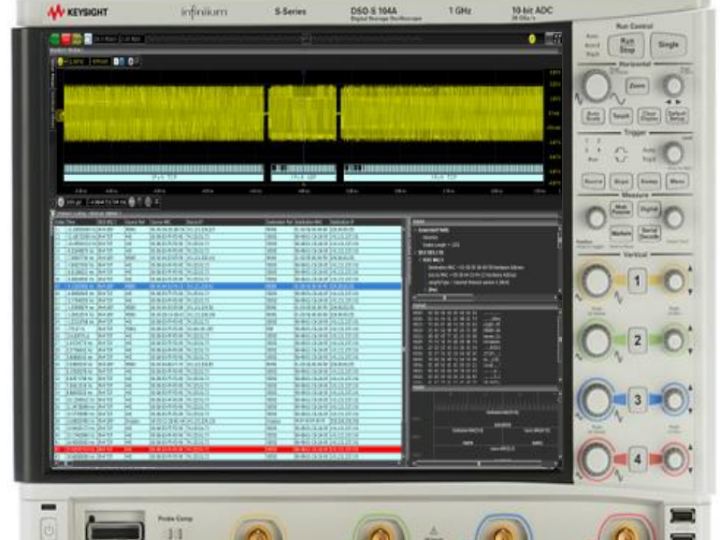
I used MSOS104A keysight.
1. 100 Base-TX, UTP +Vout Differential Output Voltage
2. 100 Base-TX, UTP -Vout Differential Output Voltage
This two tests measures the TX+/- voltage and verifies that it is within 950 mV to 1.05 V.
IEEE 802.3 (ANSI X3.263-1995, Section 9.1.2.2) define +/-V output differential output voltage 950mV <= Vout <= 1050mV

3. 100 Base-TX, UTP Signal Amplitude Symmetry
This test check how symmetrical the amplitude of the TX+ signal and the TX-signal are.
Pass criteria are defined in IEEE Std. 802.3 (ANSI X3.263-1995, Section 9.1.4).

4. 100 Base-TX, +Vout Overshoot
5. 100 Base-TX, -Vout Overshoot
These are testing, how much overshoot of TX+ and TX- occurs.
The calculated value of (Vpeak - Vout)/Vout*100 must not exceed 5.0%.
Vpeak represents the highest Vout measured at 8.0 ns from the 50% point of Vout.

6. 100 Base-TX, UTP AOI Template
This is a test that verifies the overall signal stability of TX+ and TX- using eye diagrams defined in IEEE Std. 802.3 (ANSIX3.263-1995, Annex J).

7. 100 Base-TX, AOI +Vout Rise Time
8. 100 Base-TX, AOI +Vout Fall Time
Assuming that the change from the reference voltage (usually 0V) to +Vout is 100%, the test is to determine how long it took for the TX+ waveform to change from 10% to 90%.
The pass criterion is defined as 3.0ns<=t<=5.0ns in IEEE Std. 802.3 (ANSI X3.263-1995, Section 9.1.6).


9. 100 Base-TX, AOI +Vout Rise/Fall Symmetry
this test to check whether the difference between Min Max is less then 0.5ns the results obtained by measuring items 7 and 8 more than 100 times.
10. 100 Base-TX, AOI -Vout Rise Time
11. 100 Base-TX, AOI -Vout Fall Time
It's same with item 7, 8.
12. 100 Base-TX, AOI -Vout Rise/Fall Symmetry
It's same with item 9
13. 100 Base-TX, AOI Overall Rise/Fall Symmetry
This is a test to check whether the difference between Min Max is less then 0.5ns the results obtained by measuring items 7, 8, 10, and 11 more than 100 times.
14. 100 Base-TX, Transmit Jitter
This test measure the total jitter to ensure that it is less than 1.4ns, which is the Pass criterion.

15. 100 Base-TX, Duty Cycle Distortion
Measure the Duty Cycle Distortion (DCD) Jitter to determine if it is measured below 0.5ns.

16. Transmitter Return Loss
17. Receiver Return Loss
Measure the transmitter and receiver return loss to determine if it is in the Pass range.
The Ethernet compliance test is measured using a high-performance oscilloscope and measurement software, with measurement methods and pass criteria.
f you want to make a reliable product, I recommend that you conduct an Ethernet compliance test to ensure that your product meets the IEEE 802.3 standard.

