Kinokawa Strawberry Greenhouse — Five UECS Nodes on W5100 Ethernet
A strawberry greenhouse trial in Kinokawa, Japan networked five Arduino UECS node types over W5100 Ethernet and reported about six months without a stop.
0
Components
Hardware components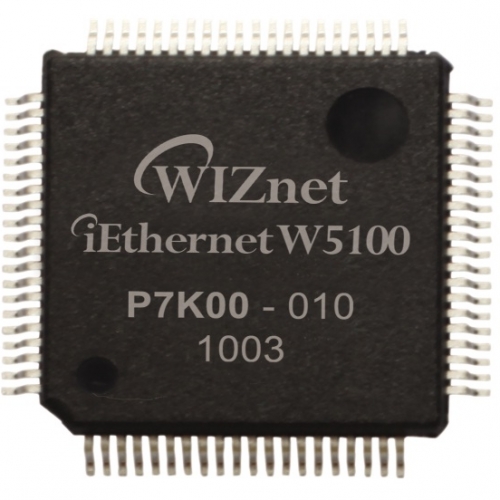
WIZnet - W5100
x 5

Arduino Ethernet Shield R3 uses the W5100. The field report documents five UECS node types.
Project description
English
In Kinokawa, Wakayama, Japan, a research team installed a distributed environmental control system in a working strawberry trial greenhouse. It cultivated 432 plants and linked five types of Arduino-based sensor and control nodes over wired Ethernet. The 2018 field report specifies Arduino Mega 2560 R3 boards paired with Arduino Ethernet Shield R3, which is based on the WIZnet W5100. Kindai University’s record of the trial
01 — The greenhouse and the purpose of the deployment
The team evaluated whether a small greenhouse could use affordable, modular controllers to coordinate the equipment needed for raised-bed hydroponic cultivation. The actual trial house was 8 × 15 m. It contained elevated beds, a roll-up roof vent, two curtain layers, a warm-air heater, CO₂ supply and drip feeding equipment. The researchers planted the 432 Marihime strawberry plants on September 30, 2017.
UECS stands for Ubiquitous Environment Control System. Its architecture gives each measurement or control function its own node. In this installation, the nodes exchanged the information they needed and the control nodes used it in their respective functions. The research team reported the installation at the May 2018 annual meeting of the Japanese Society of Agricultural Informatics. Original field presentation · University presentation record
02 — The five nodes and the installed LAN
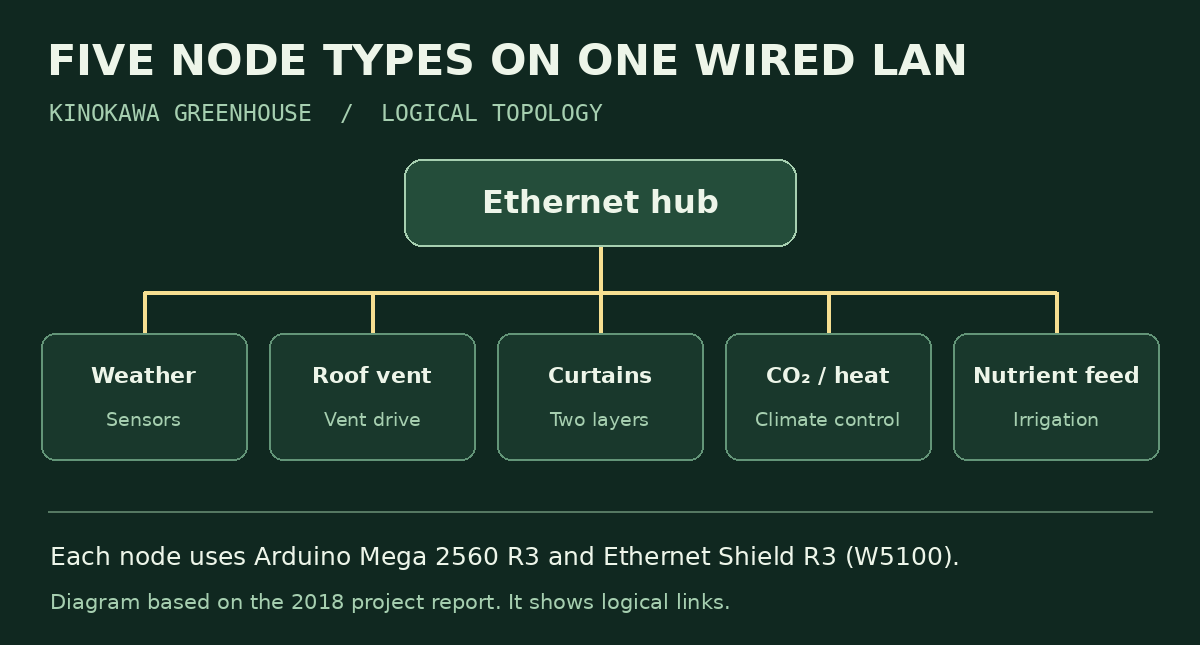
The field report says the nodes were wired to an Ethernet hub in the greenhouse. An example of why they need to share data is curtain operation. The curtain controller combines time, air temperature and solar radiation, and the weather node makes the environmental readings available on the LAN. The CO₂ and heating node can also use the vent opening as one condition in its dosing logic. The table follows the authors’ system configuration and estimated materials costs.
Node or network component | Role at the greenhouse | Estimated parts cost |
|---|---|---|
Weather measurement | Indoor temperature, humidity, CO₂ and substrate temperature. Also outdoor temperature and solar radiation. | ¥54,470 |
Roof vent | Staged temperature control, with indoor/outdoor temperature difference considered and a rain input. | ¥40,925 |
Curtains | Two layers with separate drives. Control uses solar radiation, air temperature and time. | ¥31,070 |
CO₂ and heating | Staged heating control and CO₂ dosing informed by radiation, temperature and vent opening. | ¥31,070 |
Nutrient supply | Adjusts the interval between nutrient solution doses according to solar radiation. | ¥37,195 |
Ethernet hub and cabling | Wired interconnection for the five node types. | ¥5,000 |
Total | Parts and materials estimate in the 2018 report. | ¥199,730 |
03 — Where the W5100 fits
The field team identifies the Arduino Mega 2560 R3 and Ethernet Shield R3 combination. The shield specification identifies the W5100 as the Ethernet controller and documents its SPI link to the Arduino. The Arduino gathers sensor readings and executes the UARDECS logic. The W5100 provides the 10/100 Ethernet interface and includes hardware sockets for TCP and UDP. A W5100-based interface and a measurement or control shield serve different functions in the stack. The control shield kit described by the team has four relay-contact outputs and four isolated digital inputs for connecting field equipment.
For this deployment the report identifies UARDECS ver. 08 beta, released in February 2017, and Arduino SDK 1.7.8. Later research-team manuals also describe Ethernet Shield 2. The 2018 field report specifically names Ethernet Shield R3, which is the basis for identifying W5100 in this entry. Ethernet Shield R3 hardware · W5100 documentation · UARDECS project
04 — What the nodes exchange
In the UECS protocol, a Common Correspondence Message (CCM) represents data such as a measurement, setting or status as XML carried in UDP. The reference specification assigns UDP 16520 to ordinary data transfer and request messages. A controller can subscribe to relevant readings on the same local network. The field report describes the nodes exchanging information and gives the software stack used. The exact messages, unit addresses, transmission intervals and any packet capture from the Kinokawa LAN are not in the public report. UECS application protocol
The distinction matters when interpreting the network architecture. The protocol supplies a common way for devices to exchange values. Decisions such as how far to open a vent or when to deliver a dose belong to each node’s control logic. The Ethernet hub joins the nodes physically, while W5100-equipped shields connect each Arduino to that network.
05 — What the field record establishes
The report states that the system ran without a stop from planting on September 30, 2017, to the reporting cutoff on March 25, 2018, about six months. That is a report of the integrated greenhouse system’s operation, with no separate measurement of packet loss, latency or W5100 availability. The cost of ¥199,730 is an estimated parts and materials total for the reported configuration. The team separately discussed a possible assembled price of about ¥600,000 excluding installation. The later project casebook identifies Toa Seisakusho as a supplier of assembly kits. Field trial, results and costs · 2019 project casebook · Toa Seisakusho UECS kits
06 — Curator’s take
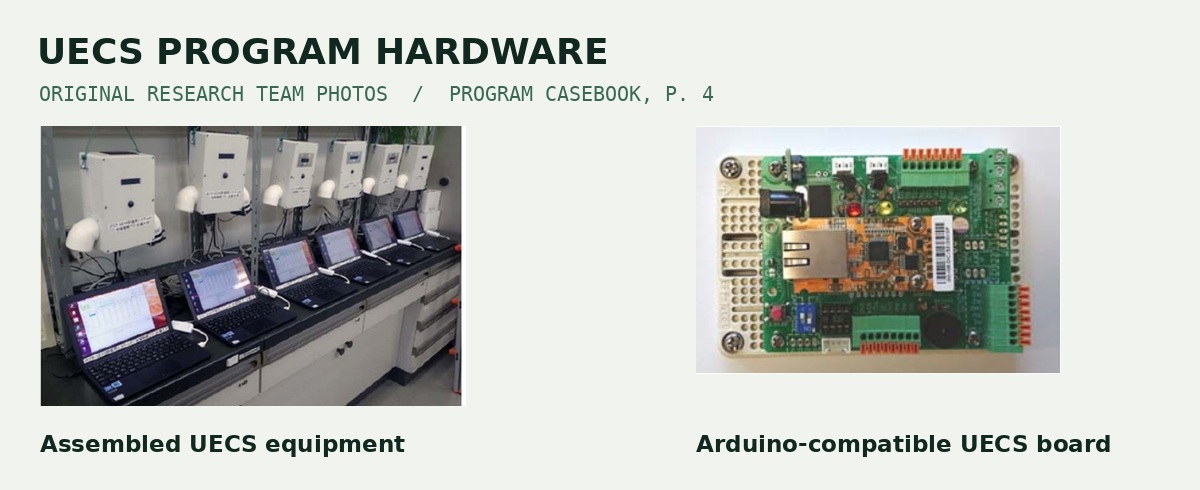
The valuable detail here is the linkage from a named W5100-based shield to five distinct jobs in one greenhouse. The field record shows devices exchanging data while controlling real equipment during a crop cycle. The later program hardware photos help explain how the nodes were built. For a closer look at nutrient management, the team’s 2021 paper provides additional context on inlet and drain measurements using a later Ethernet Shield 2 configuration. Follow-up study
Quick answers
- Which chip is in the 2018 field configuration? The field report specifies Ethernet Shield R3. The shield documentation identifies W5100.
- Is TCP/IP offload demonstrated? W5100 supports hardware sockets. The field paper does not include the deployed sketch or packet traces, so this curation does not attribute a measured offload benefit to the installation.
- Which images show the actual equipment? The casebook photos show research program hardware. The network graphic is an editorial diagram, and the cover is an illustration.
한국어
일본 와카야마현 기노카와시에서 연구팀이 딸기 432주를 기르는 실증 온실에 분산형 환경 제어 시스템을 설치했다. 온실 안팎의 환경을 측정하고 천창·커튼·CO₂·난방·양액 장비를 제어하는 5종 노드를 유선 이더넷으로 연결했다. 2018년 발표 자료의 Arduino Ethernet Shield R3는 WIZnet W5100을 사용하는 모델이다.
01 — 기노카와 실증 온실에 무엇을 설치했나
연구팀은 일본의 중소 규모 온실에서도 범용 MCU와 저렴한 확장 기판으로 복합 환경 제어를 구성할 수 있는지 검증했다. 기노카와에 설치한 8 × 15m 온실에는 고설 양액 재배 베드, 롤업 천창, 이중 커튼, 온풍 난방기, CO₂ 공급 장치와 점적 급액 장치가 있었다. 2017년 9월 30일에는 딸기 품종 ‘마리히메’ 432주를 정식했다.
UECS는 온실 계측과 제어에 쓰이는 분산형 시스템이다. 기상 수치를 모으는 노드와 천창·커튼 같은 장치를 구동하는 노드를 두고, 같은 LAN에서 필요한 값을 주고받는다. 이 사례는 2018년 5월 일본 농업정보학회 연차대회에 발표됐다. 긴키대 발표 기록
02 — 이더넷으로 연결한 5종 노드
연구팀은 5종 노드에 연결한 이더넷 케이블을 온실의 허브에 모았다. 각 노드의 역할이 달라서 데이터를 공유할 실질적인 이유가 있었다. 예를 들어 커튼 제어는 일사와 기온 및 시각을 기준으로 동작하고, CO₂ 공급에서는 천창 개도도 조건에 들어간다. 아래 표의 금액은 2018년 현장 보고서의 부품·자재비 추산이다.
노드 또는 장비 | 현장 역할 | 보고서 부품비 추산 |
|---|---|---|
기상 계측 | 실내 기온·습도·CO₂·배지 온도, 외기 온도와 실외 일사 측정 | 54,470엔 |
천창 제어 | 내외부 온도차를 반영한 4단계 온도 제어 및 강우 감지 | 40,925엔 |
커튼 제어 | 일사·기온·시각에 따라 두 층의 커튼을 각각 개폐 | 31,070엔 |
CO₂·난방 | 4단계 온도 제어, 일사·기온·천창 개도를 고려한 CO₂ 공급 | 31,070엔 |
양액 공급 | 일사에 따라 양액 공급 간격 조절 | 37,195엔 |
허브 및 케이블 | 5종 노드를 유선 이더넷으로 연결 | 5,000엔 |
합계 | 2018년 발표 자료의 부품·자재비 추산 | 199,730엔 |
03 — W5100이 들어간 곳
현장 보고서는 Arduino Mega 2560 R3와 Ethernet Shield R3를 명시한다. 해당 실드의 네트워크 칩은 W5100이고 Arduino와는 SPI로 연결된다. Arduino가 계측·제어 로직을 실행하고 W5100이 유선 이더넷 인터페이스를 제공한다. 실드의 칩은 TCP·UDP 하드웨어 소켓을 지원한다. 현장 제어 노드에는 별도의 제어용 확장 기판이 있었고, 보고서에는 릴레이 접점 출력 4점과 절연 디지털 입력 4점이 기록돼 있다.
현장 보고서에 적힌 개발 환경은 Arduino SDK 1.7.8, 미들웨어는 2017년 2월에 나온 UARDECS ver. 08 베타다. 후속 조립 문서의 Ethernet Shield 2는 별도 버전이다. 여기서 W5100을 확인하는 근거는 2018년 보고서가 지정한 Ethernet Shield R3와 해당 제품 사양이다. Arduino Ethernet Shield R3 사양 · W5100 문서
04 — 노드가 공유하는 데이터
UECS 규격에 따르면 계측값과 상태 등은 XML 형식의 CCM으로 표현하고 UDP로 보낸다. 일반 데이터 전달과 요청에는 UDP 16520을 사용한다. 같은 LAN에 있는 제어 노드는 자신의 동작에 필요한 수치를 받아 로직에 적용할 수 있다. 예를 들어 양액 노드는 일사에 맞춰 급액 간격을 바꾸고, 커튼 노드는 일사·기온·시각을 조합한다. 보고서는 현장에서 노드가 서로 정보를 교환했다고 기록하지만, 당시의 CCM 패킷 원본과 개별 메시지 송신 주기는 공개 자료에 나오지 않는다. UECS 응용 프로토콜 규격
05 — 약 6개월 가동 기록과 비용
연구팀은 2017년 9월 30일 정식부터 2018년 3월 25일 보고서 집필 시점까지 약 6개월 동안 제어 시스템이 한 번도 멈추지 않았다고 기록했다. 이 수치는 온실 시스템 단위의 현장 운전 기록이다. W5100만 따로 측정한 가동률, 패킷 손실률, 응답 지연 자료는 없다.
부품·자재비는 199,730엔이었다. 연구팀이 별도로 언급한 약 60만 엔은 공사비를 제외한 완성품 가격 추산이다. 후속 성과집은 제어·계측 실드 조립 키트의 판매 담당으로 도아제작소를 명시한다. 현장 실증 결과·비용 · 공식 성과집 · 도아제작소 UECS 기판
06 — 큐레이터의 관점
같은 W5100 기반 네트워크 구성으로 기상 계측부터 커튼·천창·가온·양액까지 서로 다른 기능을 연결한 현장 실증이다. 부품명만 보는 것보다 장치들이 생산 기간에 어떤 데이터를 공유했고 어떤 일을 했는지 따라갈 수 있다는 점이 눈에 띈다. 양액 공급과 배액 측정을 더 자세히 보고 싶다면 같은 연구팀의 2021년 후속 연구를 참고할 수 있다. 이 후속 연구는 Ethernet Shield 2 구성이다. 딸기 양액 관리 후속 연구
자주 묻는 점
- W5100이라는 근거는? 2018년 발표 자료의 Ethernet Shield R3 표기와 해당 실드 제품 사양이다.
- TOE를 실제로 썼나? W5100의 하드웨어 TCP/IP 기능은 제품 사양으로 확인되지만, 실증 펌웨어와 패킷 자료가 없어 실제 운용 경로와 효과는 특정할 수 없다.
- 온실 현장 사진은 어디에 있나? 2018년 발표 자료 그림 4에 실려 있다. 원본 PDF는 접속 환경에 따라 열리지 않을 수 있다. 본문 사진은 접근 가능한 연구팀 공식 성과집의 원본 장비 사진이다.
Sources / 출처
- Kindai University — Takehiko Hoshi’s 2018 field-trial record / 긴키대 발표 기록
- 2018 Japanese Society of Agricultural Informatics — original greenhouse report, pp. 25–26 / 원본 발표 요지와 사진
- UECS program casebook, p. 4 / 저비용 UECS 장비 구성과 사진
- Arduino Ethernet Shield R3 product record / W5100 모델 확인
- UECS application protocol / UDP 및 CCM 규격
- UARDECS project and middleware resources / 연구팀 미들웨어
- 2021 follow-up on strawberry nutrient management / 후속 논문

