Wiznet makers

Grace_Koo

Published June 16, 2026 ©

96 UCC

25 WCC

11 VAR

0 Contests

0 Followers

0 Following

Original Link

M5AtomPoeArtnet2DMX

A tiny lighting bridge stacking a W5500 PoE base on an M5Stack Atom Lite to convert Art-Net and DMX512 both ways, powered over a single LAN cable.

COMPONENTS Hardware components

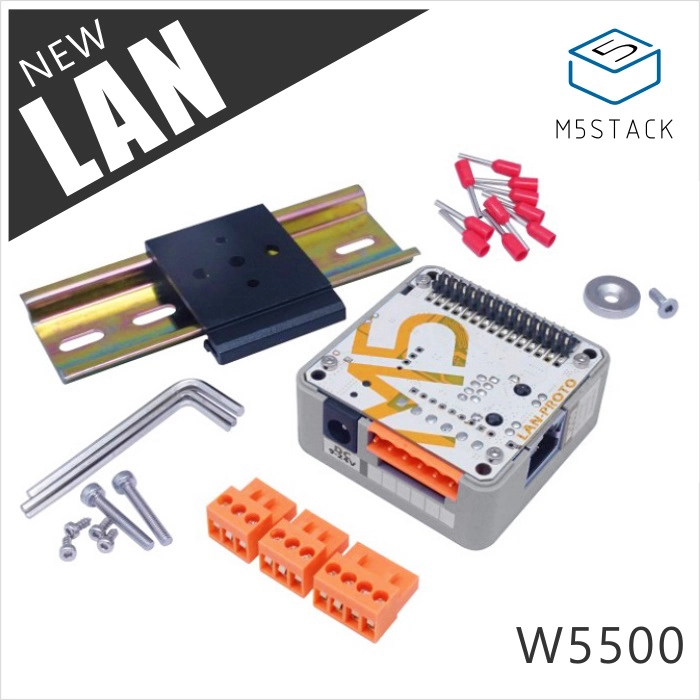
M5Stack - LAN Module with W5500

x 1


WIZnet - W5500

x 1


PROJECT DESCRIPTION

Bridging Stage Lighting with a Palm-Sized Node — An M5Atom Bridge That Converts Art-Net and DMX512 Both Ways over W5500 PoE


One-Line Summary

A tiny bridge that stacks a W5500 PoE base onto an M5Stack Atom Lite to convert bidirectionally between Art-Net, the Ethernet lighting protocol, and DMX512, the stage-lighting standard. It draws power over a single LAN cable and is configured from a web UI.


What Is This Project?

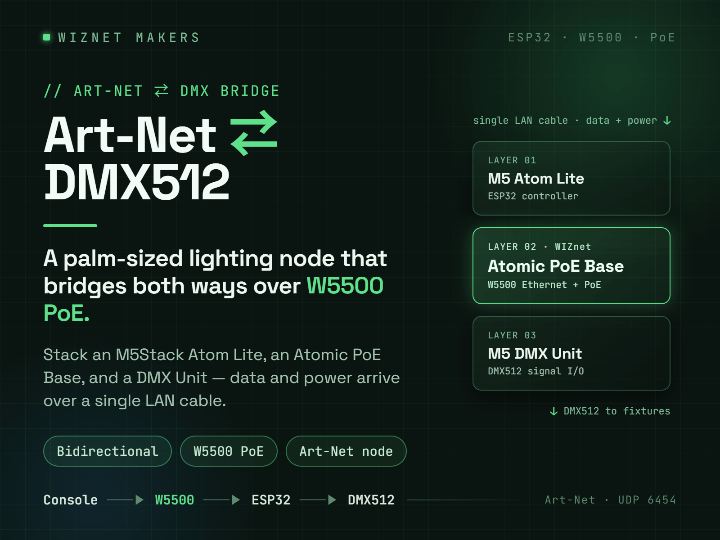
M5AtomPoeArtnet2DMX is a tiny lighting bridge that links Art-Net and DMX512 bidirectionally. It's built by stacking three parts on an M5Stack Atom Lite (ESP32) barely two knuckles in size.

  • M5Stack Atom Lite: the ESP32 controller (the body)
  • Atomic PoE Base: W5500 SPI Ethernet + PoE power
  • M5Stack DMX Unit: DMX512 signal I/O (UART)

Its role is clear. It takes the Art-Net data that a lighting console or software sends over Ethernet and converts it into the DMX512 signal that stage fixtures use (and vice versa), handling it all while drawing power over a single LAN cable. Here the WIZnet W5500 serves as the Ethernet-side gateway.

Both specs deal with lighting-control signals, but they differ in layer and transport medium.

 DMX512Art-Net
What it isA serial signal standard for lighting controlA protocol that carries DMX512 over Ethernet
TransportDedicated cable (RS-485 / XLR)Ethernet (UDP/IP)
TraitsOne cable = 512 channels; distance/scale limitsMany universes over one LAN cable; better range/integration
RelationshipThe raw data that fixtures receive directlyThe upper layer that transports that data over the network

Put simply, if DMX512 is the "lighting command (the letter's contents)," Art-Net is "the way that letter is delivered over Ethernet." Fixtures only understand DMX512, while consoles and software push commands onto Ethernet as Art-Net. This bridge goes back and forth between the two.


What WIZnet Brings: Data and Power over a Single LAN Cable

At stage and installation lighting sites, nodes are often placed where a power outlet is inconvenient — ceilings, trusses, walls. That makes PoE (power + data over a LAN cable) an especially welcome configuration for a lighting node. M5AtomPoeArtnet2DMX implements this wired Ethernet + PoE with the W5500 carried on the Atomic PoE Base.

The Path the Signal Travels

The W5500 connects to the ESP32 over SPI (SCK 22 / MISO 23 / MOSI 33 / CS 19) to provide wired Ethernet, and the Atomic PoE Base draws power from that same Ethernet line. The code reflects this too — after SPI.begin(...), it initializes the W5500 with Ethernet.init(csPin)Ethernet.begin(mac) and connects via DHCP or a static IP.

Auto-Discovered as a Standard Art-Net Node

It implements the Art-Net protocol over the W5500 on UDP 6454. Beyond carrying lighting data, it responds to a controller's discovery (ArtPoll) with its name, address (Net/Subnet/Universe), and IP info.

In other words, the W5500 doesn't merely receive data — it also handles the replies so the device acts as a standard Art-Net node that a controller can auto-discover on the network.

How the W5500 Is Used (Hardware TCP/IP?)

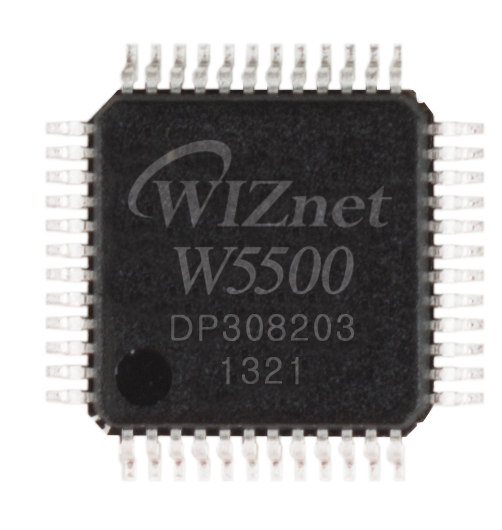
  • The chip itself: the W5500 is an Ethernet controller with TCP/IP built into hardware.
  • In this project: it uses the W5500 as an Ethernet interface through the Arduino Ethernet_Generic library and the EthernetUDP socket API — that is, it exchanges UDP the standard Arduino-Ethernet-socket way.
  • The point: either way, the W5500 serves as a stable wired-Ethernet gateway. For uses like lighting, where delay or dropouts are immediately visible, wired stability matters.

How It Works: Bidirectional Conversion

What characterizes this bridge is that it's bidirectional, not one-way. You pick a mode in the web UI.

Mode 1 — Art-Net → DMX (output) It maps ArtDmx values received over Art-Net to the configured DMX start address and outputs a continuous DMX512 stream, sending DMX frames about every 25 ms. This is the common use of relaying a lighting console's commands to actual fixtures.

Mode 2 — DMX → Art-Net (input) Conversely, it reads DMX512 frames coming in from the DMX Unit, packages them as ArtDmx packets, and sends them onto the network — via broadcast or unicast (to a set IP). This is used to lift a physical DMX console's operation up onto the Ethernet network.

In both modes, the ESP32 relays between the W5500 Ethernet and the DMX Unit (the esp_dmx driver).


What's Worth Noting

  • Free placement thanks to PoE: With the Atomic PoE Base + W5500, it takes power and data over a single LAN cable. Nodes can go on trusses or ceilings without an outlet — a good fit for lighting-install sites.
  • Bidirectional conversion: Not just Art-Net→DMX but also DMX→Art-Net. It links software lighting and physical consoles both ways.
  • Auto-discovered as a standard Art-Net node: By implementing ArtPoll/ArtPollReply, a controller finds it without an IP the moment it's plugged into the network.
  • Tiny + off-the-shelf modules: A palm-sized build that just stacks M5Stack's Atom Lite, PoE Base, and DMX Unit. It becomes a self-contained node with no custom PCB.
  • Polished management features: A web UI edits network/Art-Net/DMX settings, stores them in LittleFS, and offers JSON backup/restore and remote reboot. Access is easy via mDNS (m5atompoe-artnet2dmx.local).
  • Wired-first + Wi-Fi fallback: Ethernet is the primary path, but if stored Wi-Fi credentials exist it's used as the next path, and a button brings up a setup AP (captive portal).

Use Cases

  • Small performances/event lighting: Convert Art-Net↔DMX with a palm-sized device instead of a large dedicated node
  • Truss/ceiling-mounted nodes: Place nodes on lighting trusses without power worries, thanks to PoE
  • Networking a DMX console: Convert an existing physical DMX console's output to Art-Net and integrate it into an Ethernet lighting system
  • Architectural/exhibition lighting: A distributed node that controls fixtures scattered over Ethernet via Art-Net
  • Lighting-system prototyping: Quickly assemble and experiment with an Art-Net/DMX bridge from off-the-shelf M5Stack modules

Comparison with Related Projects on WIZnet Makers

WIZnet Makers (maker.wiznet.io) hosts several projects that handle Art-Net lighting data over the W5500. Here's a comparison with cases whose actual content we verified.

ArtNet to ESP-NOW DMX512 — ESP32 + W5500 (irina) A system where an ESP32 master receives Art-Net over W5500 wired, relays it wirelessly via ESP-NOW, and slave nodes output DMX512 over RS-485/XLR.

  • Similarities: The core of "receiving Art-Net over W5500 wired and converting to DMX512" is the same as M5AtomPoeArtnet2DMX. The input-side structure as an Art-Net node is identical.
  • Differences: irina's project is a wireless distributed structure that relays the received data over ESP-NOW and extracts DMX at the slaves. M5AtomPoeArtnet2DMX is a single node that converts straight to DMX512 within one device, and additionally supports PoE and the reverse direction (DMX→Art-Net).

2040-ArtNode: RP2040 + W5500 ArtNet LED Controller Board (Benjamin) A custom PCB that receives Art-Net with RP2040 + W5500 to drive WS2812B pixel LEDs.

  • Similarities: Both are lighting nodes that receive Art-Net (UDP 6454) over W5500 wired, and both implement ArtPoll auto-discovery.
  • Differences: 2040-ArtNode's output is digital pixel LEDs (WS2812B) and it designed a dedicated PCB. M5AtomPoeArtnet2DMX's output is standard DMX512, and instead of a custom PCB it stacks off-the-shelf M5Stack modules to make a PoE node.

In short, the approach of "receiving Art-Net over W5500 wired" is active on Makers. What sets M5AtomPoeArtnet2DMX apart is that its output is the stage standard DMX512, it supports Art-Net↔DMX in both directions, and it completes a tiny node with no custom hardware by stacking off-the-shelf M5Stack modules plus PoE.


Tech Stack Summary

ItemDetails
ControllerM5Stack Atom Lite (ESP32)
Ethernet + powerAtomic PoE Base — WIZnet W5500 (SPI, PoE)
DMX interfaceM5Stack DMX Unit (UART, esp_dmx)
Input protocolArt-Net (UDP 6454) — ArtDmx/ArtPoll/ArtPollReply
Conversion modesArt-Net→DMX / DMX→Art-Net (bidirectional)
TransmissionBroadcast / unicast
NetworkingEthernet (primary) + Wi-Fi (fallback) + setup AP, mDNS
ManagementWeb UI, JSON backup/restore, LittleFS settings storage
ToolchainPlatformIO, Arduino ESP32

FAQ

Q. What is Art-Net? Art-Net is a protocol that transmits lighting-control data (DMX512) over Ethernet as UDP. Widely used in stage, performance, and architectural lighting, this device exchanges Art-Net on UDP port 6454.

Q. What role does the W5500 play? The W5500 is the wired-Ethernet gateway through which Art-Net data flows. Carried on the Atomic PoE Base, it connects to the ESP32 over SPI, and PoE power comes in over that same Ethernet line. By responding to ArtPoll, it also acts as an Art-Net node auto-discovered on the network.

Q. Does it use the W5500's hardware TCP/IP? The W5500 chip embeds hardware TCP/IP, but this project uses the W5500 as an Ethernet interface via the Arduino Ethernet_Generic library and the EthernetUDP socket API. Either way, the W5500 serves as a stable wired gateway.

Q. What does bidirectional mean? It means two supported modes. Art-Net→DMX takes network commands and outputs DMX512 to fixtures; DMX→Art-Net reads a physical DMX console's signal and sends it onto the network as Art-Net. You pick the mode in the web UI.

Q. Why is PoE good? Lighting nodes often sit on trusses or ceilings with no outlet. PoE supplies data and power over a single LAN cable, so a node can be installed wherever you like without a separate adapter.


Project Links

Related Projects on WIZnet Makers

Documents
Comments Write