RIOT ? IoT OS
RIOT ? IoT OS
0
Components
Hardware components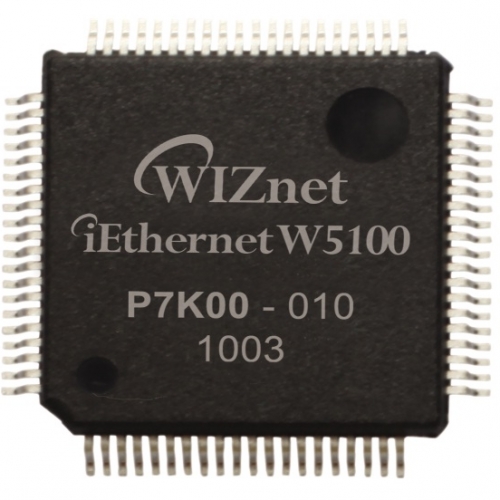
WIZnet - W5100
x 1

Various
x 1
Project description

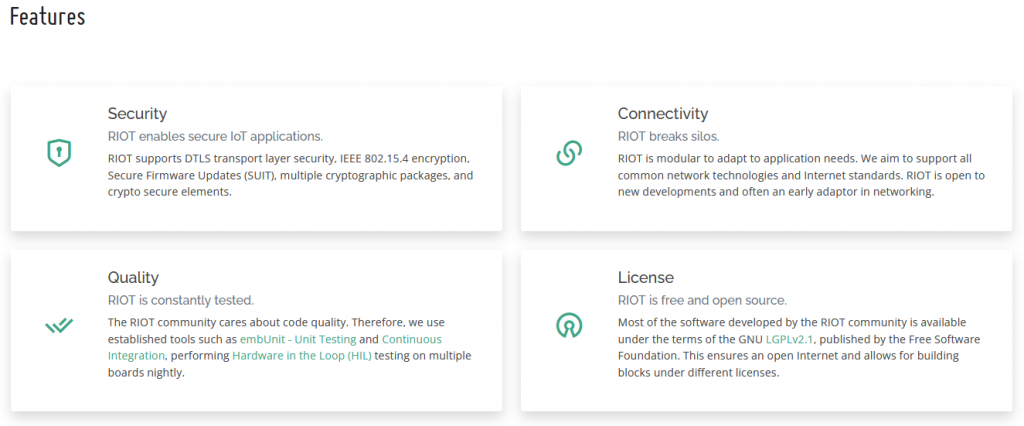
The friendly Operating System for IoT!
RIOT is a real-time multi-threading operating system that supports a range of devices that are typically found in the Internet of Things (IoT): 8-bit, 16-bit and 32-bit microcontrollers.
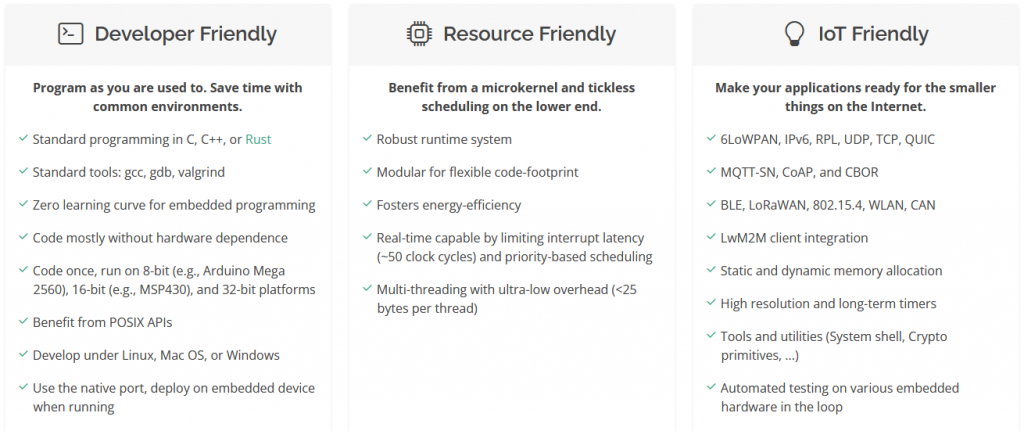
RIOT is based on the following design principles: energy-efficiency, real-time capabilities, small memory footprint, modularity, and uniform API access, independent of the underlying hardware (this API offers partial POSIX compliance).
RIOT is developed by an international open source community which is independent of specific vendors (e.g. similarly to the Linux community). RIOT is licensed with LGPLv2.1, a copyleft license which fosters indirect business models around the free open-source software platform provided by RIOT, e.g. it is possible to link closed-source code with the LGPL code.
RIOT is based on a microkernel architecture, and provides features including, but not limited to:
- a preemptive, tickless scheduler with priorities
- flexible memory management
- high resolution, long-term timers
- support 100+ boards based on AVR, MSP430, ESP8266, ESP32, MIPS, RISC-V, ARM7 and ARM Cortex-M
- the native port allows to run RIOT as-is on Linux, BSD, and MacOS. Multiple instances of RIOT running on a single machine can also be interconnected via a simple virtual Ethernet bridge
- IPv6
- 6LoWPAN (RFC4944, RFC6282, and RFC6775)
- UDP
- RPL (storing mode, P2P mode)
- CoAP
- CCN-Lite
- Sigfox
- LoRaWAN
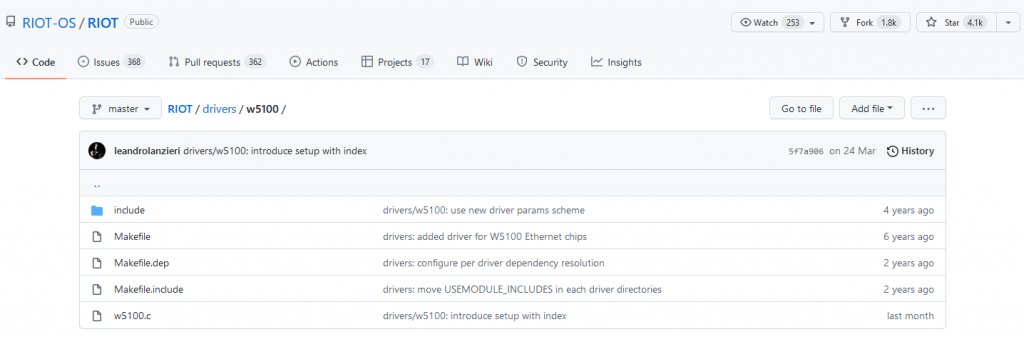
Supports W5100
Documents
-
RIOT
github
-
W5100 Driver
Source
-
W5100 ethernet driver
Documents
-
RIOT: An Open Source Operating System for Low-End Embedded Devices in the IoT
IEEE Internet of Things Journal


