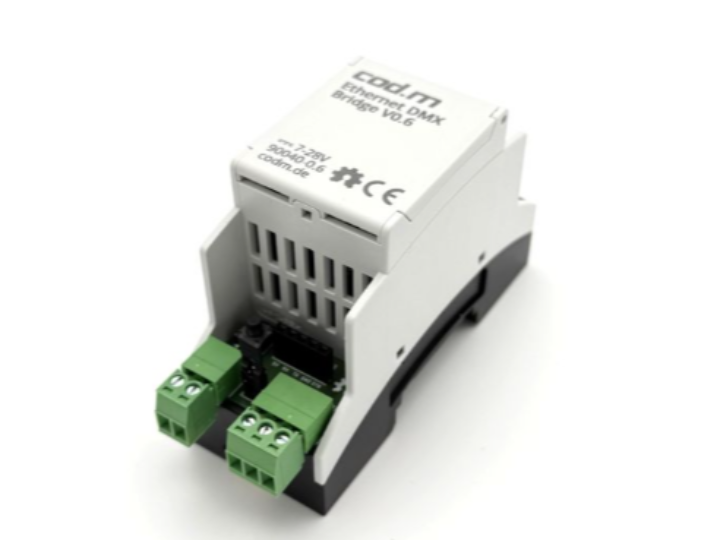
Ethernet DMX Bridge V0.6
Ethernet DMX Bridge V0.6
0
Components
Hardware components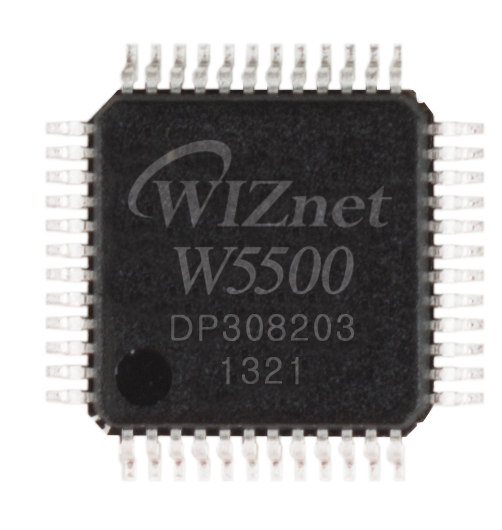
WIZnet - W5500
x 1

Project description
Overview
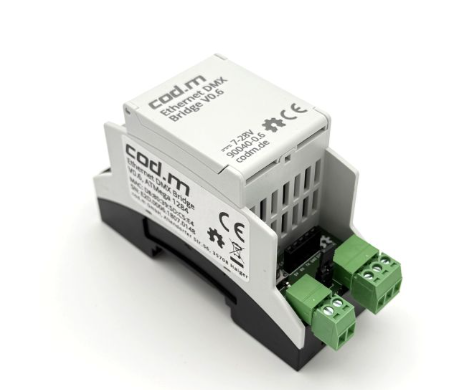
Ethernet DMX Bridge V0.6 is an Ethernet-to-DMX bridge from cod.m.
The product is designed to connect Ethernet-based control systems to a DMX bus. It receives control data over Ethernet and outputs DMX signals for lighting and automation devices.
The hardware is built around:
- ATmega 644p or ATmega 1284 running at 16 MHz
- Arduino bootloader using MightyCore
- WIZnet W5500 Ethernet chip
- Dedicated serial interface for the DMX bus
- Full 512 DMX channel support
- Phoenix-Contact DIN rail housing
- Unique EUI-48 MAC address
- Reverse polarity protection
- TVS diode protection for the DMX bus
- 7–28V input voltage range
- Pluggable screw terminals
- CE, RoHS, and WEEE compliance
- Open-source hardware and software direction
This makes Ethernet DMX Bridge V0.6 a practical example of using WIZnet W5500 to connect Ethernet networks to DMX lighting and control systems.
What Problem Does This Bridge Solve?
DMX is widely used in lighting control.
It is commonly used for:
- Stage lighting
- Architectural lighting
- LED dimmers
- Moving heads
- RGB fixtures
- Theatrical installations
- Event lighting
- Building and automation lighting
However, DMX is a bus-oriented control interface, while many modern control systems use Ethernet.
This creates a common requirement: a controller needs to send lighting data over Ethernet, but the actual fixtures or DMX devices still need a physical DMX signal.
Ethernet DMX Bridge V0.6 solves this by acting as a bridge between Ethernet and the DMX bus.
The Ethernet side receives control data.
The DMX side outputs the lighting control signal.
This allows Ethernet-based systems to control DMX fixtures through a compact DIN rail device.
How Is the System Structured?
The system sits between an Ethernet controller or automation system and the DMX bus.
The basic structure can be described as follows:
Ethernet Control System
        |
        | Ethernet
        |
WIZnet W5500
        |
        | SPI / Embedded Control
        |
ATmega 644p / ATmega 1284
        |
        | Dedicated Serial for DMX
        |
DMX Bus
        |
DMX Fixtures / LED Dimmers / Lighting Devices
The ATmega microcontroller handles the embedded bridge logic.
The W5500 provides the Ethernet interface.
The dedicated serial interface outputs the DMX signal.
Together, these parts create a compact Ethernet-to-DMX bridge suitable for professional mounting.
What Does W5500 Add to Ethernet DMX Bridge V0.6?
W5500 provides the Ethernet communication interface.
For a DMX bridge, this is important because Ethernet is the input side of the system.
The bridge must reliably receive network data and translate it into DMX output.
Reliable Ethernet Interface
W5500 provides stable wired Ethernet communication.
In lighting and automation systems, reliability is important because fixture output depends on timely and stable control data.
A wired Ethernet interface is suitable for installed systems, control cabinets, DIN rail equipment, and automation panels.
Compact Embedded Ethernet
W5500 integrates Ethernet MAC, PHY, and hardwired TCP/IP stack.
This makes it easier to add Ethernet to a compact microcontroller-based design.
The ATmega controller can focus on bridge logic and DMX output while W5500 handles Ethernet connectivity.
Low-Power Ethernet Chip
The product page describes the W5500 as a power-saving WizNet Ethernet chip.
This is useful for compact DIN rail devices where heat, power consumption, and long-term operation matter.
Good Fit for Open-Source Embedded Hardware
Ethernet DMX Bridge V0.6 is an open-source product.
W5500 is a practical choice for open embedded hardware because it is widely used, well documented, and commonly supported in Arduino-style development environments.
Why Is Full 512 DMX Channel Support Important?
DMX512 defines up to 512 channels in one DMX universe.
Earlier or smaller bridge designs may be limited by memory, timing, or firmware structure.
Ethernet DMX Bridge V0.6 is designed with enough memory to address a full 512 DMX channels.
This is important because one DMX universe may need to control many devices.
For example:
- Simple dimmer channels may use one channel each
- RGB fixtures may use three or more channels
- RGBW fixtures may use four or more channels
- Moving heads can use many channels for position, color, gobo, dimmer, strobe, and effects
- LED controllers may consume many channels depending on pixel grouping
Full 512-channel support makes the bridge more useful in real lighting installations.
What Is the Role of the ATmega 644p or ATmega 1284?
The bridge uses an ATmega 644p or ATmega 1284 running at 16 MHz.
These microcontrollers are used with an Arduino bootloader through MightyCore.
The ATmega handles:
- Ethernet data handling together with W5500
- DMX frame generation
- DMX bus timing
- Device configuration
- Bridge firmware logic
- Communication between Ethernet and DMX output
The product page notes that V0.5 and V0.6 have enough memory to address a full 512 DMX channels.
This makes the selected ATmega platform suitable for the DMX bridge function.
Why Is a Dedicated Serial Interface Used for DMX?
DMX requires accurate timing.
For a DMX bridge, the serial output used for the DMX bus must be handled carefully.
Ethernet DMX Bridge V0.6 includes a dedicated serial interface for the DMX bus.
This is important because the device must continuously output DMX frames while also handling Ethernet-side communication.
A dedicated serial interface helps keep DMX output stable and predictable.
Why Is DIN Rail Mounting Useful?
The bridge is built in a Phoenix-Contact DIN rail housing.
This is useful because many lighting, automation, and building control systems are installed inside control cabinets.
DIN rail mounting makes the product easier to integrate into professional installations.
It also makes wiring cleaner because the Ethernet, power, and DMX connections can be organized inside the same cabinet.
Why Are Protection Features Important?
Ethernet DMX Bridge V0.6 includes several protection-oriented features.
These include reverse polarity protection and a TVS diode for the DMX bus.
This matters because the device is intended for real wiring environments.
In lighting and automation installations, field wiring can be exposed to:
- Incorrect polarity
- Cable transients
- ESD events
- Long DMX cable runs
- Ground differences
- Installation mistakes
Protection features help improve product robustness and reduce field failure risk.
How Does the Network Identity Work?
The product includes a unique MAC address using EUI-48.
This is useful because each Ethernet device on a network needs a unique MAC address.
For installed products, a real unique MAC address helps avoid network conflicts and makes the device easier to manage.
This is especially important when multiple DMX bridges are installed in one lighting or automation network.
System Architecture
The complete system can be divided into four layers.
Network Control Layer
---------------------------------
Ethernet controller
Lighting control software
Automation controller
Network switch

Ethernet Interface Layer
---------------------------------
WIZnet W5500
Unique EUI-48 MAC address
Ethernet communication

Bridge Control Layer
---------------------------------
ATmega 644p or ATmega 1284
MightyCore Arduino bootloader
Bridge firmware
DMX frame processing

DMX Output Layer
---------------------------------
Dedicated serial for DMX
TVS protection
DMX bus
DMX fixtures and lighting devices
This layered structure shows how the bridge connects Ethernet control to the physical DMX output.
The Ethernet side receives control data.
The W5500 provides the network interface.
The ATmega handles bridge logic.
The DMX output drives fixtures and lighting devices.
What Applications Can Use This Design?
Ethernet DMX Bridge V0.6 can be used in many lighting and automation applications.
Possible applications include:
- Ethernet-to-DMX lighting control
- Stage lighting systems
- Architectural lighting control
- LED dimmer control
- Event lighting installations
- Theater lighting systems
- Building automation lighting
- DIN rail lighting control panels
- DMX fixture control from Ethernet systems
- Open-source lighting controller projects
- Cabinet-mounted DMX gateways
- Automation systems requiring DMX output
The design is especially useful when an Ethernet-based controller needs to output a standard DMX signal.
Why Is This a Good W5500 Use Case?
Ethernet DMX Bridge V0.6 is a good W5500 use case because Ethernet is central to the product.
The bridge is not just adding Ethernet for configuration.
Ethernet is the input side of the DMX bridge.
W5500 helps the product:
- Receive control data from Ethernet
- Provide a compact wired network interface
- Work with an ATmega-based embedded controller
- Support a DIN rail bridge design
- Enable Ethernet-to-DMX conversion
- Fit open-source embedded hardware development
- Support installed lighting and automation systems
This makes W5500 an important part of the product architecture.
Conclusion
Ethernet DMX Bridge V0.6 is a compact DIN rail Ethernet-to-DMX bridge from cod.m.
It uses WIZnet W5500 for Ethernet communication and an ATmega 644p or ATmega 1284 for embedded bridge control and DMX output.
The product supports full 512 DMX channels, a dedicated serial interface for the DMX bus, a unique EUI-48 MAC address, reverse polarity protection, DMX bus TVS protection, and a 7–28V input voltage range.
By using W5500, the bridge can provide reliable wired Ethernet connectivity in a compact open-source lighting control device.
This design shows how W5500 can be used to connect Ethernet-based control systems to DMX lighting infrastructure in stage, architectural, automation, and DIN rail applications.
Q&A
What is Ethernet DMX Bridge V0.6?
Ethernet DMX Bridge V0.6 is an Ethernet-to-DMX bridge from cod.m for lighting and automation control.
Which WIZnet product is used?
The product uses WIZnet W5500 as the Ethernet chip.
What MCU is used?
The product uses ATmega 644p or ATmega 1284 running at 16 MHz with an Arduino bootloader using MightyCore.
What does the bridge do?
It receives control data over Ethernet and outputs DMX signals to the DMX bus.
How many DMX channels are supported?
The product supports a full 512 DMX channels.
Why is W5500 useful in this product?
W5500 provides compact and reliable wired Ethernet communication for the Ethernet-to-DMX bridge.
Why is a dedicated serial interface important?
DMX requires accurate timing, so a dedicated serial interface helps maintain stable DMX output.
What protection features are included?
The product includes reverse polarity protection and a TVS diode for the DMX bus.
What input voltage does it support?
The product supports a 7–28V input voltage range.
What applications can use this design?
This design can be used for stage lighting, architectural lighting, event lighting, LED dimmer control, building automation lighting, and DIN rail Ethernet-to-DMX gateway systems.


