Wiznet makers

scott

Published June 08, 2021 ©

112 UCC

20 WCC

45 VAR

0 Contests

0 Followers

0 Following

Original Link

Ethernet для МК. W5500 и ENC28J60. MQTT

Ethernet для МК. W5500 и ENC28J60. MQTT

COMPONENTS Hardware components

x 1


x 1


x 1

Software Apps and online services

x 1


PROJECT DESCRIPTION

Introduction: The Best Ethernet Solution for Your Microcontroller

When it comes to integrating Ethernet connectivity into microcontroller projects, choosing the right module is crucial. The WIZNet W5500 and Microchip ENC28J60 are two of the most popular choices, but they serve different needs. Understanding their strengths and limitations will help you make the best decision for your project.

This article provides an in-depth comparison of the W5500 and ENC28J60, breaking down their features, real-world applications, and key performance metrics. Whether you are developing an IoT system, an industrial application, or a smart home network, this guide will give you everything you need to know about these two Ethernet modules.

The Core Debate: W5500 vs ENC28J60

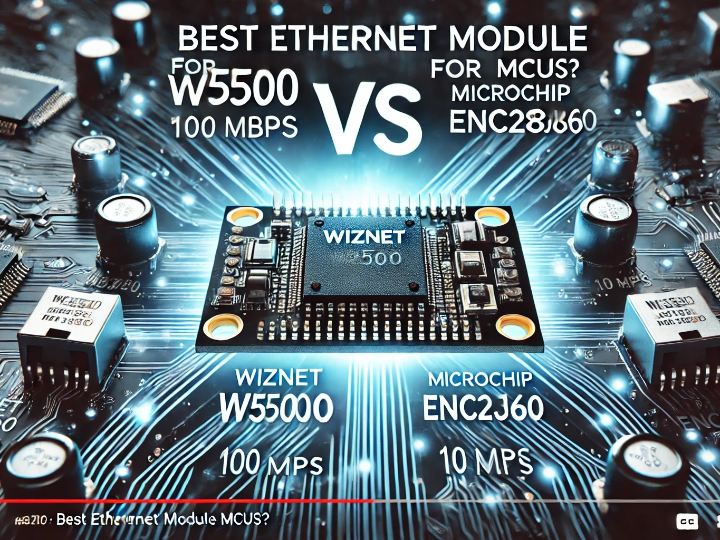
The ENC28J60 and W5500 enable microcontrollers to communicate over an Ethernet network, but their architectures and capabilities are quite different.

🔍 A Head-to-Head Comparison

FeatureWIZNet W5500Microchip ENC28J60
CommunicationSPI (Up to 80 MHz)SPI (Up to 20 MHz)
Network StackBuilt-in TCP/IP StackRequires MCU-based Stack
RAM Size32KB Buffer (Optimized)8KB Buffer (Shared)
Max Speed100 Mbps10 Mbps
Socket SupportUp to 8 SocketsNo Built-in Sockets
Packet FilteringHardware-Assisted FilteringMAC-Based Filtering
Ease of UsePlug-and-PlayComplex Software Management
Power Supply3.3V (5V tolerant)3.3V (5V tolerant)

🏆 Why W5500 Stands Out

  1. Efficient Processing: With its built-in TCP/IP stack, W5500 reduces the MCU’s processing burden, freeing up resources for other tasks.
  2. Higher Data Throughput: With a maximum speed of 100 Mbps, it is 10x faster than ENC28J60.
  3. Better Socket Management: Supports up to 8 concurrent sockets, making it ideal for IoT and real-time applications.
  4. Larger Buffer Size: 32KB RAM allows better traffic handling, while ENC28J60 struggles with its limited 8KB buffer.
  5. Plug-and-Play Simplicity: No need for a separate TCP/IP software stack, reducing development complexity.

How This Video Explains It All

This video provides a structured analysis of both modules, detailing their performance, capabilities, and real-world applications. Some of the key takeaways include:

  • Understanding network layer functions in microcontrollers
  • Detailed breakdown of Ethernet packet structures
  • Direct performance benchmarking between W5500 and ENC28J60
  • Practical demonstrations using STM32 & Atmega

If you're looking for a well-explained, visually structured tutorial on choosing the right Ethernet module, this video is a must-watch.

Real-World Applications of W5500

The W5500 module is widely used in IoT, industrial automation, smart home systems, and robotics. It provides stable, high-speed connectivity while reducing MCU workload, making it a perfect fit for projects requiring real-time communication.

Example Use Cases

  • IoT Gateways: Reliable MQTT communication with multiple sensors.
  • Smart Home Systems: Instant response to commands with low-latency.
  • Industrial Automation: High-speed, deterministic data transfer.
  • Game Servers & Embedded Applications: Seamless multiplayer connectivity.

FAQs (Frequently Asked Questions)

1. Can I use W5500 with Arduino?

Yes! The W5500 is fully compatible with Arduino using the Ethernet library. Just connect it via SPI, and you’re ready to go.

2. Why is W5500 better than ENC28J60?

W5500 offloads network processing from the MCU, has a built-in TCP/IP stack, and supports 100 Mbps speed, making it significantly more efficient for high-performance applications.

3. Is W5500 suitable for IoT applications?

Absolutely! It supports multiple sockets, stable connections, and low power consumption, making it ideal for IoT environments.

4. Does ENC28J60 still have any advantages?

Yes, ENC28J60 is cheaper and can be useful in simple projects where networking requirements are minimal.

5. How difficult is it to migrate from ENC28J60 to W5500?

It’s relatively straightforward. The W5500’s built-in stack simplifies code implementation, and many libraries are available to assist in migration.

Conclusion

The W5500 stands as a game-changer in MCU-based networking. Whether you’re working on an IoT project, industrial automation, or real-time applications, this module simplifies Ethernet integration while delivering outstanding performance.

If you want reliable, high-speed Ethernet without overburdening your microcontroller, the W5500 is your best bet.

🚀 Explore the video and experience the power of W5500 for yourself!

Documents
Comments Write