MONITOR FOR RESUSCITATION AND ANAESTHESIA TO CONTROL THE RANGE OF PHYSIOLOGICAL PARAMETERS
MITAR-01-R-D combines bedside patient monitoring with optional Ethernet connectivity for central observation and data review.
0
Project description
MITAR-01-“R-D”: Connecting Bedside Patient Data to a Central Monitoring Station
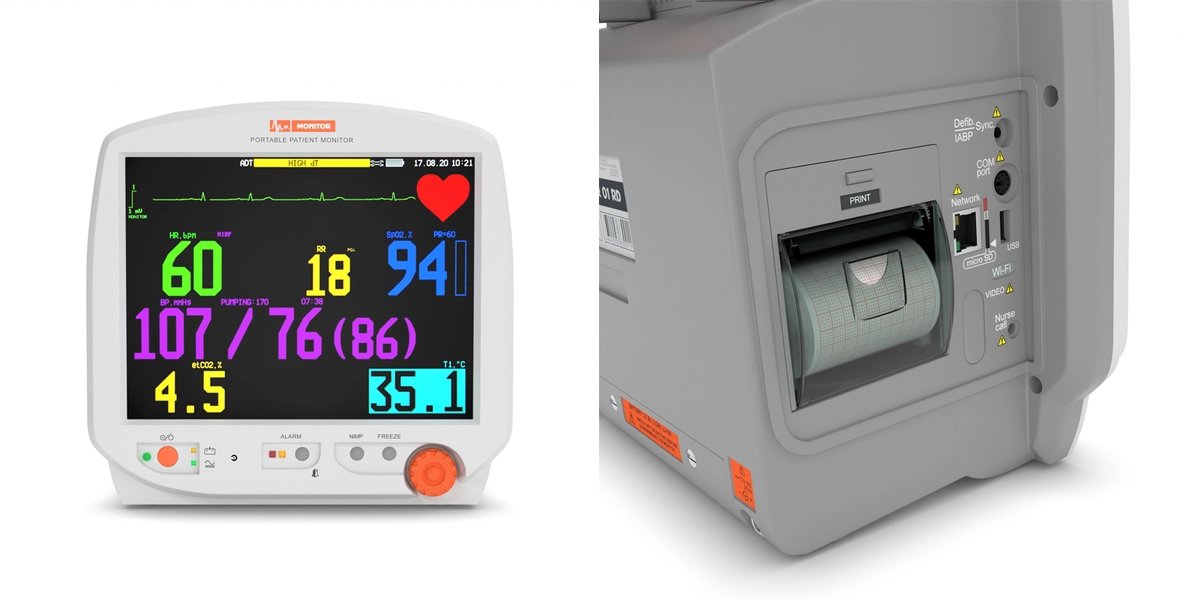
Source: https://www.monitor-ltd.ru/en/resuscitation-monitors
Overview
A bedside monitor displays physiological information as numerical readings and waveforms. A central monitoring system extends that function by bringing measurements and alarms from multiple beds together at a shared observation point.
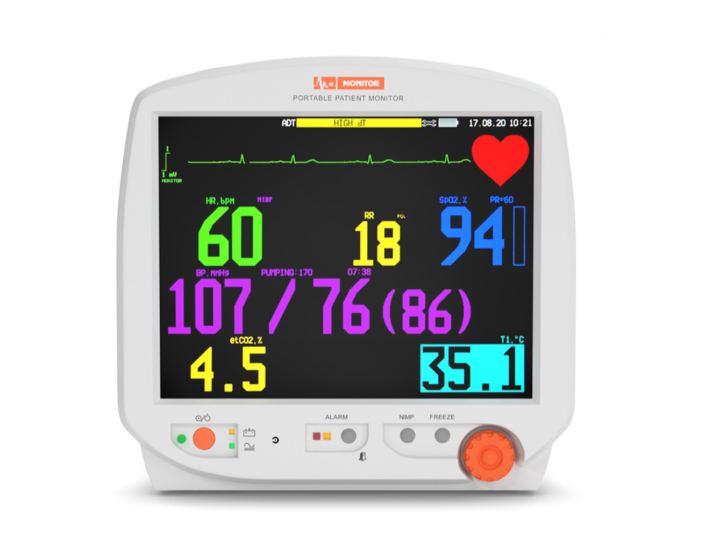
MITAR-01-“R-D”, manufactured by Russia’s NPP Monitor, supports this type of installation. Its original product name is МИТАР-01-«Р-Д». The manufacturer identifies intensive care units, operating rooms, and ambulances among its intended environments. It is a finished medical instrument with a display, operating controls, and sensor connections assembled into an enclosure. (Manufacturer product page)
An optional central-monitoring interface described in the 2013 service manual provides a specific example of its network architecture. The document identifies WIZnet WIZ100SR as an internal communication component. The product family’s published features and this historical internal design need to be considered separately. (Public copy of the service manual)
About NPP Monitor
NPP Monitor is a medical-device developer and manufacturer based in Rostov-on-Don, Russia. Established in February 1992 by specialists in medical instrumentation and electronics, the company develops patient monitors, central monitoring systems, electrocardiographs, and pulmonary-function testing equipment. (Company background)
The manufacturer’s history records the start of MITAR-01-“R-D” production in 2002. This is the product family’s production history, not evidence that WIZ100SR was used from that date. The network component is identified separately in the service documentation. (Company history)
What Is MITAR-01-“R-D”?
MITAR-01-“R-D” is a bedside patient monitor that acquires and displays information such as ECG, oxygen saturation, blood pressure, respiration, and temperature. Measurement modules and sensors are selected for the required configuration, with additional options for central monitoring and recording. (Manufacturer configuration information)
Main Specifications and Options
| Item | Manufacturer-Published Information |
|---|---|
| Product | MITAR-01-“R-D” / МИТАР-01-«Р-Д» |
| Patient modes | Adult, paediatric, and neonatal |
| Display | 10.4-inch or 12.1-inch colour touch TFT |
| Display resolution | 800 × 600 |
| Main measurements | ECG and heart rate, non-invasive blood pressure, SpO₂, respiration, temperature, and other configuration-dependent parameters |
| Additional measurement options | Invasive blood pressure, CO₂, and multigas analysis |
| Alarms | Three-level visual and audible alarms |
| Recording | Graphical and tabular trends, up to eight days |
| Power | 85–265 V AC, a 12 V vehicle supply, and an internal battery |
| Battery operation | Up to five hours, according to the manufacturer |
| Central-monitoring connection | Wired or Wi-Fi options |
| Historical Ethernet implementation | WIZ100SR-based central-monitoring module described in the 2013 service manual |
This table combines product-family specifications with available options. Not every measurement module or network option is included in a standard unit. Supported parameters and battery operating conditions depend on the supplied configuration. (Manufacturer specifications)
How Does It Work?
1. Sensor Signals Become Measurement Data
ECG electrodes, oxygen-saturation sensors, blood-pressure cuffs, and temperature sensors connect to their respective measurement channels.
The service manual describes the basic signal path as acquisition, amplification, and digitization → signal processing and filtering → output handling by the central processor. The processed information is then made available to the bedside display and, when equipped, the central monitoring system. (Service manual)
2. The Bedside Monitor Displays Readings, Waveforms, and Alarms
The monitor presents processed information as numerical readings and physiological waveforms. It also provides trends for reviewing changes over time and visual and audible alarms for conditions such as measurements exceeding configured limits.
Measurement, display, and bedside alarm functions belong to the patient monitor itself. (Manufacturer product information)
3. The Central System Collects Information from Multiple Beds
In a central-monitoring installation, patient monitors connect through a network switch to a central PC. The central software displays received readings and waveforms and provides alarm-database and event-review functions. The manufacturer specifies connections for one to 32 compatible MITAR monitors. (Central Monitoring Station)
Central monitoring therefore means more than reproducing a bedside screen. It provides a shared environment for viewing measurements and reviewing information from multiple patients. The figure of 32 is the manufacturer’s stated connection capacity—not the number installed in a particular hospital or a sales figure. (Central Monitoring Station)
Network Architecture and Evidence of WIZnet Use
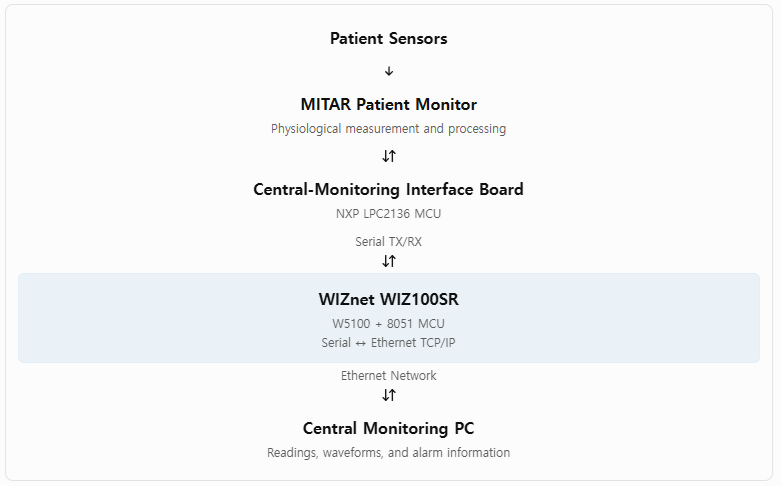
WIZ100SR Is Identified on the Central-Monitoring Interface Board
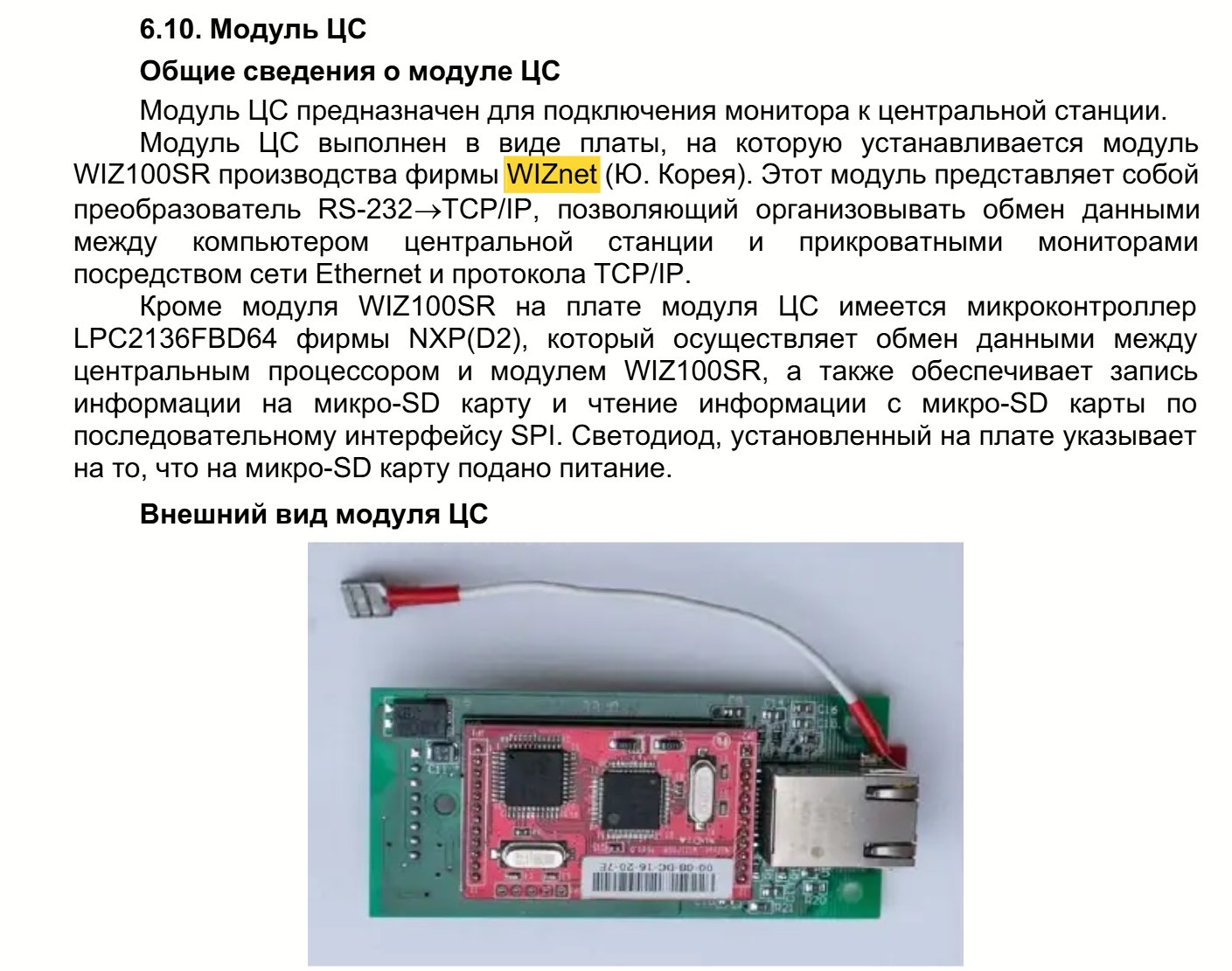
Section 6.10, “Модуль ЦС,” on printed page 69 of the 2013 service and repair manual, revision 1.1, states that the central-monitoring interface board carries a WIZ100SR module from South Korean manufacturer WIZnet.
The same section explains that the module converts between RS-232 and TCP/IP, allowing the bedside monitor and central PC to exchange data over Ethernet. The component name and its role appear together in the product’s service documentation. (Service manual, Section 6.10)
The reviewed material is a publicly hosted copy of the manufacturer-authored manual on Scribd and Studylib. It identifies the historical component and its function, but it is not a current bill of materials published on the manufacturer’s server.
Service manual copy on Scribd · Searchable copy on Studylib
An Interface-Board MCU Connects the Monitor Processor to the Module
The same section identifies an NXP LPC2136FBD64 microcontroller on the interface board. It exchanges data between the monitor’s central processor and WIZ100SR and also handles microSD-card reading and writing.
The complete central-monitoring interface board and the WIZ100SR mounted on it are therefore distinct components. (Service manual)
The documented communication relationship can be summarized as:
Monitor central processor ↔ Interface-board MCU ↔ WIZ100SR ↔ Ethernet network ↔ Central monitoring PC
This is a functional summary, not a connector map or installation wiring diagram. (Service manual)
WIZ100SR Performs Bidirectional Data Conversion
WIZnet’s documentation describes WIZ100SR as a Serial-to-Ethernet module built around W5100 and an 8051 MCU. It sends serial-device data over a TCP/IP network and converts incoming network data back into serial data.
The module’s internal 8051 MCU is separate from the NXP MCU on the monitor’s interface board. (WIZ100SR documentation)
The responsibilities are different: the monitor measures and processes patient signals, WIZ100SR transports data, and the central software displays and records information from multiple beds. WIZ100SR does not itself measure physiological signals or make clinical judgments. (Service manual, Central Monitoring Station)
Products and Purchasing Channels
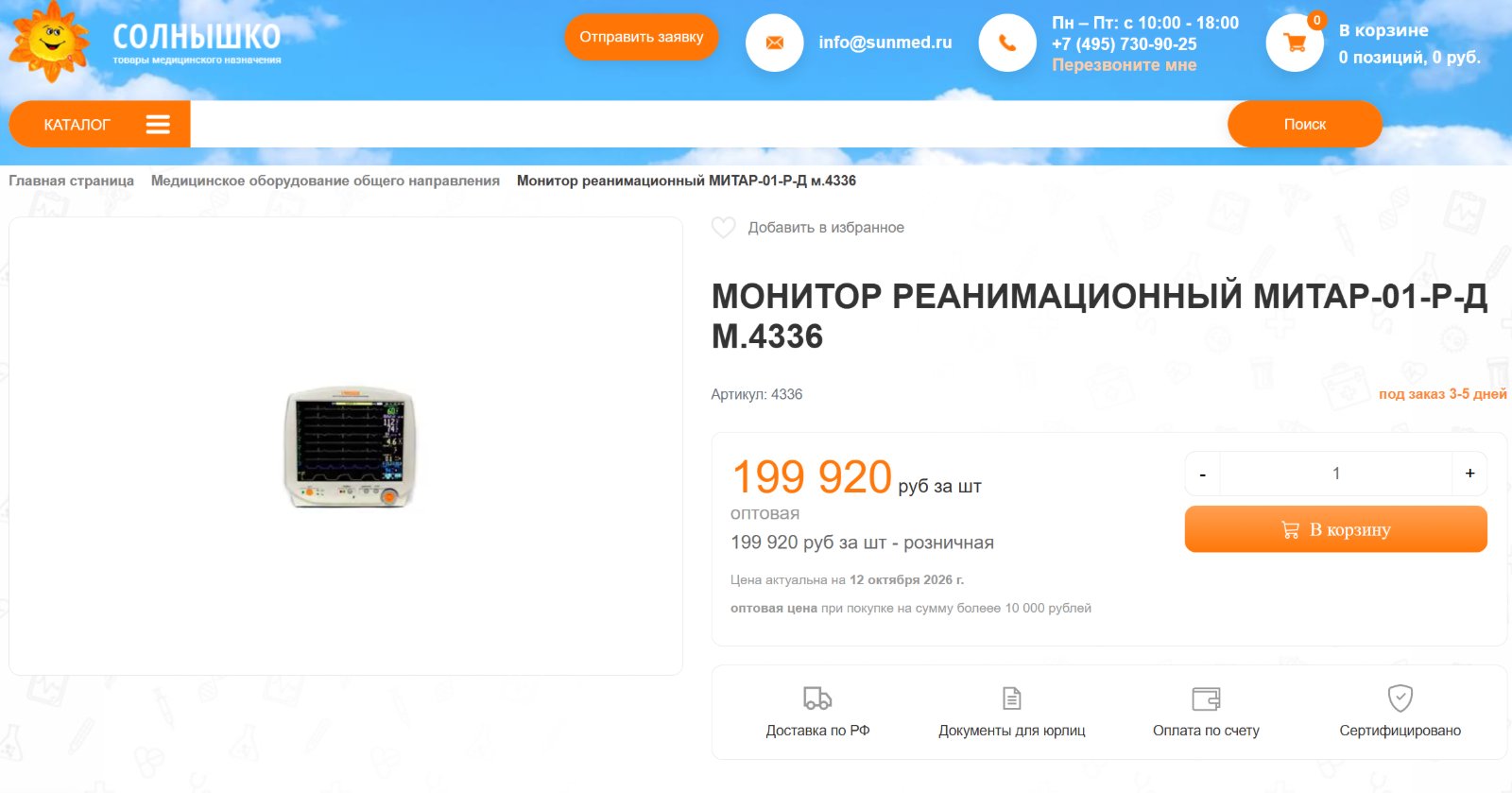
Source: https://www.sunmed.ru/product/monitor-reanimatsionnyy-mitar-01-r-d-4336/
The purchased product is a patient monitor configured with the required measurement and communication capabilities, not a standalone network module. The manufacturer’s product page lists display sizes, measurement functions, and accessories and provides a quotation enquiry route.
The central monitoring station is described separately as a system incorporating a PC, software, and network equipment. (Patient monitor, Central Monitoring Station)
Specialist suppliers also list the monitor. Sunmed’s sales information for a 10.4-inch MITAR configuration shows a price of 199,920 Russian rubles, dated August 1, 2026. This is a supplier’s price for a particular configuration, not a universal manufacturer price or a complete system price including every central-monitoring option. (Sunmed product listing)
Comparing purchase conditions therefore involves more than the monitor’s base price. Measurement modules, patient accessories, central-monitoring connectivity, installation, and service coverage need to be considered together. A displayed price does not establish current stock or delivery time.
Application Market and Published Supply Figures
MITAR belongs to the market for professional patient-monitoring equipment supplied to hospitals and ambulances. The manufacturer publishes examples of product-family deliveries, including the following projects in its 2016 history. (Manufacturer supply history)
| Manufacturer-Reported Project | MITAR Monitors Supplied |
|---|---|
| Ambulance equipment for the Moscow Region | 200 |
| Ambulance equipment for Perm | 100 |
These figures document multi-unit supply in healthcare and emergency-transport equipment procurement. They are historical project quantities reported by the manufacturer, not current annual sales or independently audited figures. The source does not identify whether those monitors included the central-monitoring option or WIZ100SR. (Manufacturer supply history)
The quantities therefore cannot be converted into WIZnet module sales or used to estimate the global patient-monitoring market. What they establish is commercial supply of the MITAR product family in named projects, with disclosed quantities.
Product Communication: Exhibitions and Operating Guides
Specialist Exhibitions Introduce Products and Build Partner Relationships
NPP Monitor published an announcement for Russian Health Care Week, December 2–6, 2024. It described presenting the product range and new developments, discussing future directions, and meeting existing and prospective partners.
This provides a documented example of how the company introduces its equipment to a specialist medical-device audience. (Manufacturer exhibition announcement)
Videos Organize Information Around Operating Tasks
A RUTUBE channel carrying the name “ООО НПП МОНИТОР” publishes product operating videos.
An approximately 19-minute video for the SMP-21/01-“R-D” pulmonary-function instrument, published on March 19, 2022, includes description timestamps for power connection, sensor connection, settings, and record review. It is not a MITAR-specific video, but it illustrates product education published under the company’s name. (RUTUBE operating video)
For MITAR itself, the manufacturer provides a maintenance notice covering battery care and periodic inspection. Exhibition announcements help prospective buyers explore equipment, while operating videos and maintenance documents address the needs of people continuing to use it after purchase. (MITAR maintenance notice)
What Makes This Application Interesting?
Adding a new measurement and expanding access to an existing measurement are different kinds of functionality.
Additional sensor modules extend the monitor’s measurement capabilities. Central-monitoring connectivity instead carries information already produced at the bedside into a shared display and recording environment. (Patient-monitor options, Central Monitoring Station)
Ethernet does not replace the patient monitor. Measurements remain a bedside function, while the connection expands where the resulting information can be viewed and reviewed. The useful question is therefore not simply whether the instrument has a network port, but what that connection enables its users to do.
Current Status and Limitations
The product family’s published specifications and its 2013 internal design must be distinguished. The manufacturer’s product page describes wired and Wi-Fi central-monitoring options. This does not mean that WIZ100SR itself provides Wi-Fi or that every current unit uses the same internal board. (Manufacturer product page)
WIZnet’s documentation does not mark WIZ100SR as discontinued, but states that it is not recommended for new designs and that technical support has ended. This is not a discontinuation notice for the MITAR monitor, nor does it establish that a different module can be substituted without manufacturer approval. (WIZ100SR product status)
The manufacturer’s English product page also labels a linked historical CE document “CANCELLED.” That label alone does not establish the product’s registration status in every jurisdiction. Valid documentation for the intended supply region needs to be checked separately. Installation and maintenance must also follow the documentation and manufacturer support arrangements applicable to the supplied version. (Manufacturer product documentation)
Related WIZnet Maker Projects
| Related Curation | Useful Comparison |
|---|---|
| humimeter LF-TD-E | Also connects instrument-generated measurements to a PC. However, it is an environmental humidity and temperature transmitter, not a patient monitor subject to the same medical requirements. |
| BR Remote MFC2 | Adds optional IP connectivity to specialist equipment. Its camera-control commands provide a comparison with MITAR’s transmission of patient-monitoring information. |
The basic functions of these products are documented by their manufacturers. These comparisons illustrate different uses of networking in specialist equipment; they do not establish identical modules, shared protocols, or medical-device compatibility. (humimeter LF-TD-E, BR Remote MFC)
Conclusion
MITAR-01-“R-D” measures and displays physiological information at the bedside and can connect to a central monitoring environment through an optional interface. The WIZ100SR identified in its service manual provides the communication link between monitor-side serial data and an Ethernet network. (Service manual)
The bedside monitor measures, the communication module transfers, and the central software brings information from multiple beds together. That division of responsibilities explains the practical role of networking in this product. (Central Monitoring Station)
FAQ
Q. What kind of product is MITAR-01-“R-D”?
A. It is a patient monitor that acquires information from connected sensors and presents readings, waveforms, and alarms. Available measurement parameters depend on the supplied configuration. (Manufacturer product information)
Q. Is WIZ100SR included in every unit?
A. No. Central-monitoring connectivity is optional, and the WIZ100SR identification applies to the configuration documented in the 2013 service manual. Components in currently supplied units require separate confirmation. (Service manual)
Q. Does WIZ100SR measure patient signals directly?
A. No. It performs bidirectional conversion between serial data and Ethernet TCP/IP. Measurement and signal processing are handled by the monitor’s acquisition and processing sections. (WIZ100SR documentation, Service manual)
Q. What does the central system’s “32 monitors” specification mean?
A. It is the manufacturer’s stated maximum number of compatible MITAR monitors connected to the central system. It is not a hospital installation count, a module-sales figure, or an independently measured result for every configuration. (Central Monitoring Station)
Source Snapshot
Review date: October 12, 2026
Product: MITAR-01-“R-D” / МИТАР-01-«Р-Д»
Internal-design reference: 2013 service manual, revision 1.1, Section 6.1 and Section 6.10, “Модуль ЦС,” on printed page 69.
Scope: The optional central-monitoring interface board documented in that manual. This does not establish identical component use in all current shipments.
| Source | What It Supports | URL |
|---|---|---|
| Manufacturer English product page | Intended environments, display, power and alarm specifications, central-monitoring options, and quotation enquiries | MITAR Patient Monitor |
| Manufacturer Russian product page | Original product name, measurement modules, and configuration options | МИТАР-01-«Р-Д» |
| Public copies of the service manual | Signal acquisition, processing, and output; WIZ100SR; the interface board’s LPC2136FBD64 and microSD functions | Scribd · Studylib |
| WIZnet official documentation | WIZ100SR’s W5100 and 8051 architecture, bidirectional conversion, and support status | WIZ100SR |
| Manufacturer central-monitoring system | PC, software and switch configuration; support for one to 32 monitors; display and recording functions | Central Monitoring Station |
| Manufacturer company history | Company origins, production history, and project-specific delivery quantities reported for 2016 | About NPP Monitor |
| Sunmed sales listing | A particular 10.4-inch configuration and a displayed price dated August 1, 2026 | Product Listing |
| Manufacturer exhibition announcement | Product presentations and partner meetings at the 2024 healthcare exhibition | Russian Health Care Week 2024 |
| RUTUBE product-education video | An operating video published under the NPP Monitor name, with description timestamps; not a MITAR-specific video | Operating Video |
| Manufacturer maintenance notice | MITAR battery care and periodic-inspection information | Maintenance Notice |
