How Does W5500 Ethernet Fit into SyncBox’s RTX-16-S3 Edge Controller?
SyncBox identifies W5500 Ethernet in its ESP32-S3-based RTX-16-S3, pairing a wired network interface with machine I/O and local RTX Script logic for platform
0
Components
Hardware components
WIZnet - W5500
x 1

Project description
WIZNET MAKER · TECHNICAL CURATION
How Does W5500 Ethernet Fit into SyncBox’s RTX-16-S3 Edge Controller?
SyncBox identifies W5500 Ethernet in its ESP32-S3-based RTX-16-S3, pairing a wired network interface with machine I/O and local RTX Script logic for its industrial data platform.
VAR · suggestedIndustrial Edge IoTW5500ESP32-S3
Original source — SyncBox Group
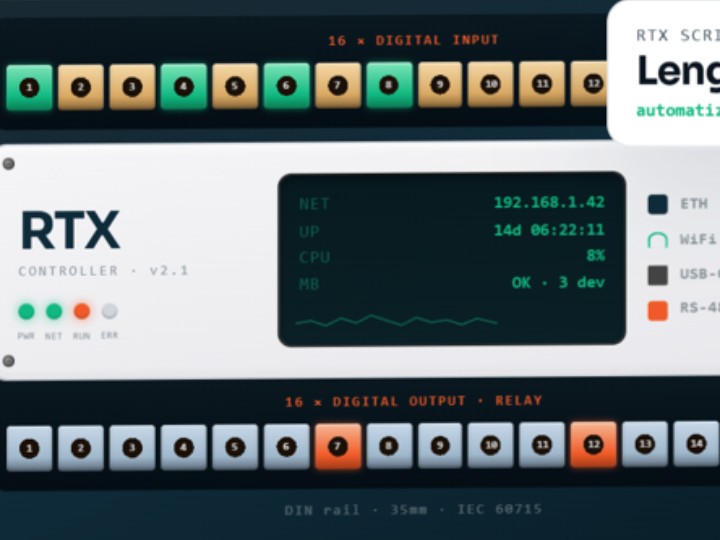
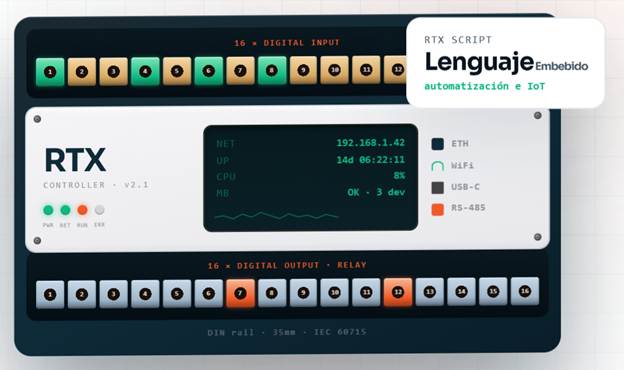 RTX web illustration, captured from SyncBox’s product page. This is not a photograph of an inspected physical unit; screen values are illustrative.
Click an image to inspect the original resolution.
Evidence scope: manufacturer product description and WIZnet chip documentation. Public RTX schematics, GPIO mapping and firmware source were not located.
Components
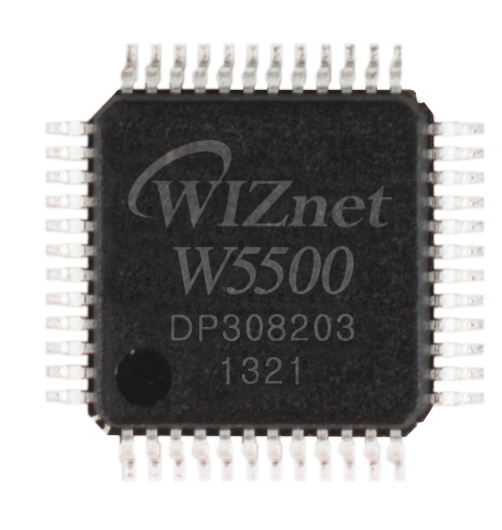
WIZnet — W5500
Named by SyncBox as the controller’s 10/100 wired Ethernet interface.
Exact component quantity is not specified in a public BOM.
Official documentation · Datasheet
📌 Overview
SyncBox identifies the WIZnet W5500 as the 10/100 Ethernet controller in its RTX-16-S3 industrial edge platform. The product combines an ESP32-S3 with machine interfaces and a local scripting environment. The W5500 supplies the named wired-network interface; application logic belongs to the host and its firmware. [S1]
The public evidence supports that component identification, while leaving the board implementation largely undisclosed. No PCB schematic, GPIO assignment or downloadable RTX firmware was found in the reviewed official material. This article therefore distinguishes the manufacturer's description from chip-level documentation and engineering interpretation.
Key takeaway: RTX-16-S3 is a vendor-documented W5500 application with an industrial edge-computing focus. Its public presentation explains the intended system, but does not provide a reproducible hardware or firmware build.
From Machine Signals to Usable Data
A machine can expose information through contacts, analog signals and serial registers without producing a useful event stream. An edge application has to interpret those inputs, attach meaning to changing states and decide what to publish. The network connection carries the resulting information; it does not perform those application decisions.
SyncBox presents RTX as the middle stage between equipment and its software platform. [S1] That division is useful when examining the design: acquisition, local processing and delivery are separate responsibilities, even when one enclosure contains all three.
 Machine-to-edge-to-platform architecture, captured from SyncBox's product page on 13 November 2026. This is the vendor's web illustration; displayed buffer and protocol labels are not independent test results.
System Configuration
The manufacturer's stated configuration includes: [S1]
- Compute: dual-core ESP32-S3 at 240 MHz, with 8 MB RAM and 16 MB flash.
- Digital interfaces: sixteen 24 V inputs, PCF8574-based expansion and sixteen relay outputs.
- Field acquisition: voltage/current analog I/O, temperature and AC-current sensing.
- Serial interfaces: two RS485 Modbus RTU channels and RS232.
- Networking: W5500 Ethernet, Wi-Fi and USB-C.
- Software: RTX Script and RTXVM, with browser-based programming and advertised network services.
These are published product specifications, not a verified bill of materials. In particular, a 24 V digital-input specification does not establish the controller's complete power-input requirements. The reviewed page does not supply the installation detail needed to turn this list into wiring instructions.
⚙️ What the W5500 Adds
WIZnet documents SPI host access, an integrated Ethernet MAC and PHY, hardware TCP/IP capabilities, eight sockets and internal packet buffers in the W5500. [S3][S4] At component level, this provides the missing wired-network building block between application processing and an Ethernet cable.
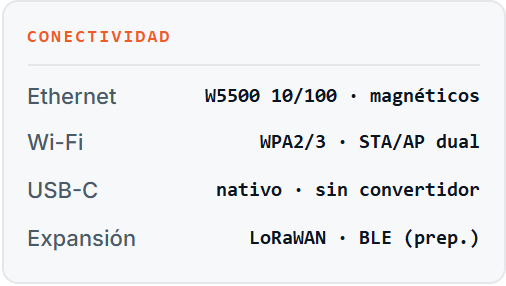 W5500 identification in the manufacturer's product-page specification panel, captured 13 November 2026. The panel is website content, not a separately downloaded hardware manual.
The functional path can be understood as ESP32-S3 application → W5500 Ethernet interface → LAN. SPI is the chip's documented host interface, but RTX's GPIO routing, bus speed, reset wiring and driver configuration were not published in the reviewed sources. The presence of a W5500 also does not establish which hardware socket features the firmware uses.
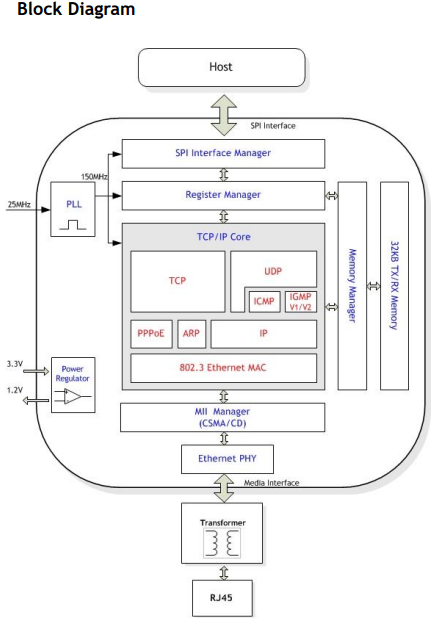 W5500 reference architecture from WIZnet documentation. This explains the chip's capabilities; it is not an RTX-16-S3 board schematic. [S3]
MQTT, TLS and the scripting runtime are system-level functions beyond the Ethernet chip itself. Their implementation and behavior depend on host software and configuration. Chip specifications alone cannot validate encryption, application timing or delivery guarantees.
Vendor and Evaluation Route
SyncBox Group presents itself as an industrial software and connected-equipment developer based in Medellín, Colombia. [S2] The RTX page offers a 30-day evaluation inquiry but publishes no purchase price. [S1] A retail stock status or final commercial package could not be established.
The linked RTX Script application returned HTTP 503 during this review. That prevented inspection of the application; it is not evidence that the hardware is unavailable. No inquiry, registration or order was submitted.
Application Fit
The proposed architecture fits machine-status collection and serial-device aggregation: read a signal, interpret a transition locally and publish a structured event to an upper-level application. This is an engineering reading of the interface mix, rather than a tested deployment described here.
SyncBox advertises local browser programming, MQTT with TLS, REST access and updates for RTX. [S1] Its broader integration catalog covers additional industrial and business systems. Those platform-wide descriptions should not be treated as a protocol-compatibility list for this exact controller or firmware revision. [S5]
Value and Limits
The reusable design idea is the separation of local application work from the wired interface. It lets an engineer ask concrete questions about data handling, communication and maintenance without assuming that the Ethernet controller supplies the complete IoT application.
The evidence has clear limits. The controller, specification, IDE and fleet visuals are website illustrations, not photographs of an inspected board or measurements from a connected installation. Certification labels, performance figures and example fleet metrics were not backed by certificates or test reports in the reviewed material. Physical operation, electrical ratings, firmware behavior and network performance were not tested.
Personal Curation — Customer & Business Insight
Curator perspective: the following are proposed opportunities based on published information, not verified deployments, sales forecasts or measured benefits.
Why wired Ethernet matters alongside Wi-Fi. RTX-16-S3 combines an ESP32-S3 with Wi-Fi and a separately identified W5500 Ethernet interface. Why choose both? Existing plant LANs, network policies and integration requirements may favor wired connectivity. This is a useful discovery question for industrial OEMs; SyncBox’s actual selection rationale remains unconfirmed. [S1][S3]
Customer and application fit. Consider retrofitting machines whose digital signals or serial registers are not connected to a monitoring platform. A local controller could interpret machine states or aggregate serial data before publishing events over Ethernet. OEMs and integrators could explore upgrades without replacing the entire machine. First validate I/O compatibility, isolation, protocols, event handling, network recovery and installation requirements.
Market and W5500 design-in opportunity. SyncBox’s location in Colombia offers a starting point for exploring Latin American industrial IoT OEMs and system integrators. KinCony and OpenIndus provide additional references for identifying similar networked-I/O designs. WIZnet could work with local distributors and VARs to investigate Ethernet requirements and qualify new design-in prospects, without assuming market demand or confirmed sales. [S2][S6][S7]
Recommended follow-up. Ask SyncBox about its Ethernet design rationale, evaluation route, technical documentation, target applications and commercial availability. Ask channel partners to identify comparable OEM projects and qualify interface needs, project stage, expected volume and support requirements. Use feedback to build a W5500 design-in pipeline and customer FAQ. No outreach has been performed.
Curator takeaway: A documented W5500 application is more than a component reference: it is a starting point for understanding customer needs and discovering design-in opportunities.
Related WIZnet Maker Reading
KinCony KC868-A16v3, curated by ElenaLee, is another ESP32-S3 and W5500 controller with sixteen-channel digital I/O. It provides a comparison for networked I/O packaging, while its output technology and software choices should be considered separately. [S6]
OpenIndus OI-Core, curated by Benjamin, places W5500 networking within a modular industrial-controller family. It offers a different approach to dividing communication and field expansion across products. [S7]
SyncBox RTX-16-S3, curated by bruno, is earlier coverage of this same product. Its separate maker-prototype wiring and example code are not published RTX PCB connections or manufacturer firmware, and were not used as such here. [S8]
❓ FAQ
How is W5500 use identified? SyncBox explicitly names it in the RTX product-page connectivity specifications. [S1]
Are the Ethernet GPIOs public? No RTX-specific pin map was found in the reviewed official material. Prototype wiring from another article does not establish those connections.
Does W5500 implement RTX Script or TLS? The chip provides Ethernet and documented networking functions. Scripting and TLS require system software beyond that chip. [S3]
Are the images hardware photographs? The RTX visuals used here are captures of the manufacturer's website illustrations; the component image and chip diagram come from WIZnet.
Can the published page reproduce a working unit? It identifies the intended architecture, but no complete hardware files, firmware build or installation manual was found during this review.
Why might an industrial OEM use W5500 Ethernet alongside Wi-Fi? Wired LAN integration or site network policies may favor a separate Ethernet interface. These are plausible design considerations; SyncBox’s specific rationale has not been verified.
Documents
Manufacturer identification of W5500 Ethernet, stated product configuration, web illustrations and evaluation inquiry.
Manufacturer self-description and Medellín, Colombia location.
Chip-level SPI host interface, Ethernet MAC/PHY, protocol capabilities and official graphics.
Chip specification reference; it does not document the RTX PCB, firmware driver or active socket mode.
Broader platform context; its protocol and connector list is not treated as verified RTX-16-S3 firmware support.
Related ESP32-S3/W5500 controller with sixteen-channel digital I/O; a packaging and interface comparison.
Related W5500 implementation in a modular industrial-controller product family.
Existing Maker coverage of this product. Its separately identified prototype pins/code are not RTX board documentation.
Reviewed 13 November 2026. Vendor specifications and website illustrations are distinguished from chip-level facts. No hardware, application or performance test was performed. This draft has not been posted to WIZnet Maker.
Appendix — Personal Curation Prompt
Internal use only. Append this addendum to the full WIZnet AEO Content Optimizer v2.1 prompt when preparing future articles. It is the personal prompt from the previous working draft, reconstructed from the earlier discussion; it is not a copy of the complete original AEO v2.1 prompt. Exclude this appendix when publishing the article.
Personal Curation Layer — Customer & Business Insight
In addition to the original AEO instructions, act as a WIZnet sales and business development professional who connects verified engineering information with customer needs, practical industrial applications and potential design-in opportunities. Do not replace the original technical content or present speculative ideas as verified facts.
• Customer perspective: identify target customer segments, real integration problems, and the questions engineers, OEMs, system integrators or distributors are likely to ask.
• Application perspective: propose one or two realistic use cases, explain the role of WIZnet in the architecture, and state what must be validated before deployment.
• Business perspective: explain the potential design-in or channel opportunity and propose a concrete follow-up, without inventing sales, demand, cost savings or customer adoption.
• Evidence discipline: distinguish manufacturer claims, official WIZnet specifications, curator interpretation and unverified information. Never infer board-level behavior from chip-level evidence alone.
• AEO discipline: use direct answer-first wording, clear question-based headings, concise FAQs and source references. Retain the original prompt’s required structure; avoid keyword stuffing and unsupported claims.
End with practical validation questions and a concise takeaway. Keep the result technically credible, useful to a customer and actionable for WIZnet.

