Foenix Retro Systems — F256K2
F256K2 pairs a W65C816 processor with FPGA graphics, audio hardware, and networking for hands-on retro programming and music experiments.
0
Project description
F256K2: A Retro Computer for Hands-On BASIC, Graphics, and Music
Overview
Enjoying retro computers is not limited to restoring old machines or replaying classic games. Another attraction is the opportunity to create new programs, games, and music using a classic style of computing.
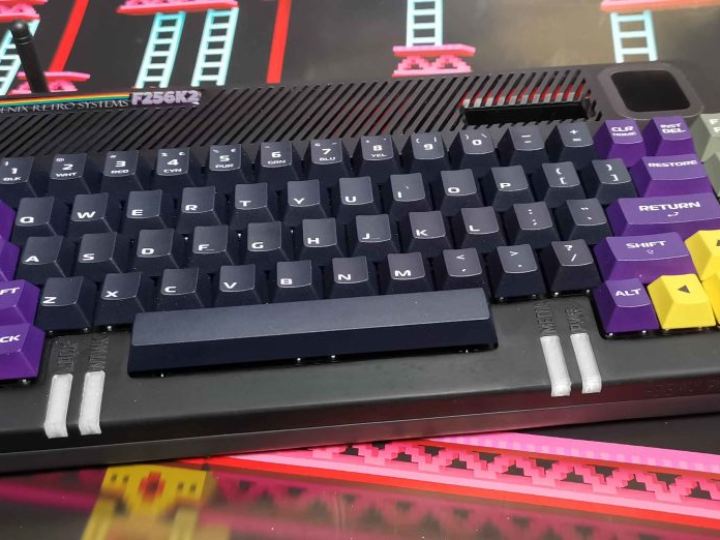
The F256K2 is a keyboard-integrated computer designed around this new-retro approach. It combines a classic processor with FPGA-based graphics, dedicated audio hardware, and networking capabilities, giving users an environment in which they can write programs and explore how the hardware works.
An IEEE Spectrum interview about the origins of Foenix describes this philosophy: creating new retro-style computers rather than simply reproducing historical machines.
About the Creator and Current Supplier
F256K2 originated from the Foenix computer family designed by Stefany Allaire. The project combines classic CPUs with modern supporting hardware to bring hands-on programming experiences to a new generation of machines. (IEEE Spectrum)
The commercial arrangements have changed since the original Foenix sales period. According to an April 19, 2026 announcement from Foenix, the intellectual property for the F256x family was transferred to Wildbits Computing Company in October 2025, and the former Foenix Retro Systems store stopped accepting new orders.
The original F256K2 product page now directs prospective buyers to Wildbits. The Foenix website therefore remains a useful source for the original product specifications, while Wildbits provides the current ordering information. (Foenix)
What Is the F256K2?
The F256K2 is a complete computer with a physical W65C816 processor and FPGA hardware. It is not an emulator running on a modern PC.
The keyboard and enclosure form a single unit. The manufacturer's listed package includes the assembled computer with its keyboard and rear bezel, a Wi-Fi antenna, and an installed internal microSD card. (F256K2 Product Page)
Main Specifications
| Item | Manufacturer-Published Information |
|---|---|
| Product form | Keyboard-integrated retro computer |
| Main processor | W65C816 |
| Memory | 2 MB SRAM and 512 KB Flash |
| Graphics | FPGA-based VICKY “The FOURTH,” supporting bitmap, tile, and sprite graphics |
| Video output | DVI output through an HDMI-style connector |
| Audio | FPGA PSG, SID, and OPL3 capabilities; SAM2695 and VS1053b audio hardware |
| Ethernet | W6100L, as identified by the manufacturer |
| Wi-Fi | Listed as Wifi360 by the manufacturer; identified as WizFi360 in community documentation |
| Basic software environment | Microkernel and SuperBASIC |
| Keyboard | 66-key optical keyboard |
| Development connections | USB-C connections for FPGA configuration, debugging, and serial communication |
| Storage and expansion | External SD slot, internal microSD, and optional RAM/Flash cartridges |
These specifications follow the original Foenix F256K2 product page. Available graphics functions and memory access depend on the selected FPGA core and software environment.
How Do You Use It?
Write Programs Directly on the Computer
The F256K2 includes SuperBASIC, allowing users to enter commands and run programs from the keyboard.
The community's Getting Started guide explains basic programming, loading BASIC programs from an SD card, and running executable files.
Users do not need to begin by developing a complete game. Simple experiments can involve changing text colors, moving a sprite, or producing sounds in response to keyboard input. Public example repositories contain programs demonstrating screen output, sprite animation, and audio functions. (Mu0n's examples)
Develop on a Modern PC and Run on Real Hardware
Programs do not have to be written entirely on the F256K2.
The Getting Started guide also explains how to connect a PC or Mac through the USB debug interface and transfer programs to the machine.
Users can therefore combine quick experiments written directly on the retro computer with larger programs developed on a modern computer. (Getting Started)
An appealing part of this workflow is seeing how changes in code affect the actual computer's graphics and sound.
Exploring the F256K2 Through Community Software
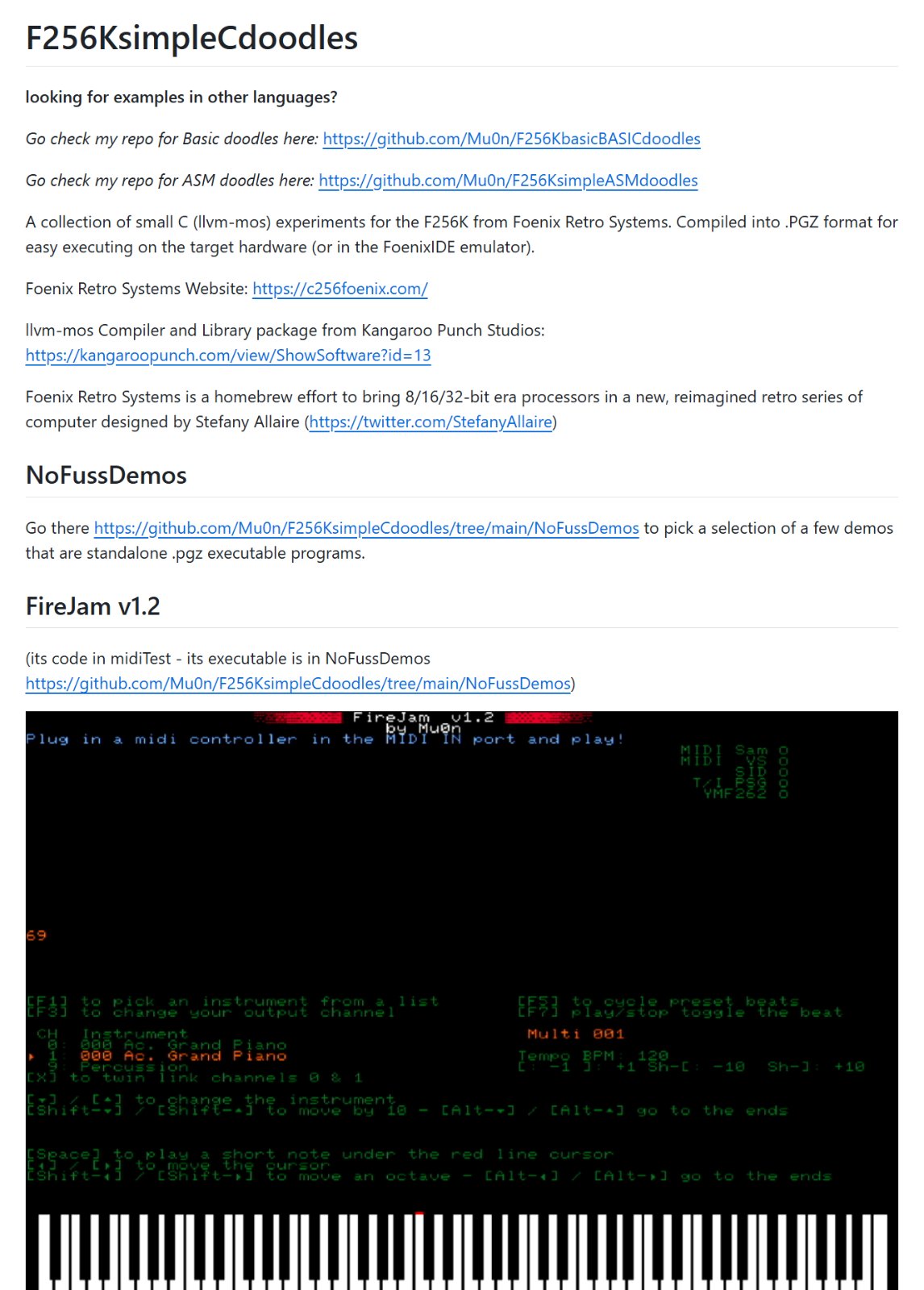
Community developer Mu0n publishes F256 programs together with source code and executable files.
The following examples demonstrate some of the creative possibilities of the F256K2. (F256KsimpleCdoodles)
Source: https://github.com/Mu0n/F256KsimpleCdoodles
| Program | What It Demonstrates |
|---|---|
| F256amp | Playback of MP3 and other supported audio formats using the VS1053b hardware in the F256K2 and Jr2 |
| FireJam | Music and sound experiments using MIDI input and multiple audio devices |
| LCD example | Displaying a user-prepared image on the small LCD built into the F256K2 enclosure |
These applications are distributed separately from the manufacturer's standard software.
Users can try the finished programs, examine their source code, and modify parts of the implementation. Compatibility and peripheral requirements vary between programs and F256 models.
Explore Mu0n's Programs and Source Code
Sales and Pricing
Source: https://wildbitscomputing.com/
Current Ordering Through Wildbits
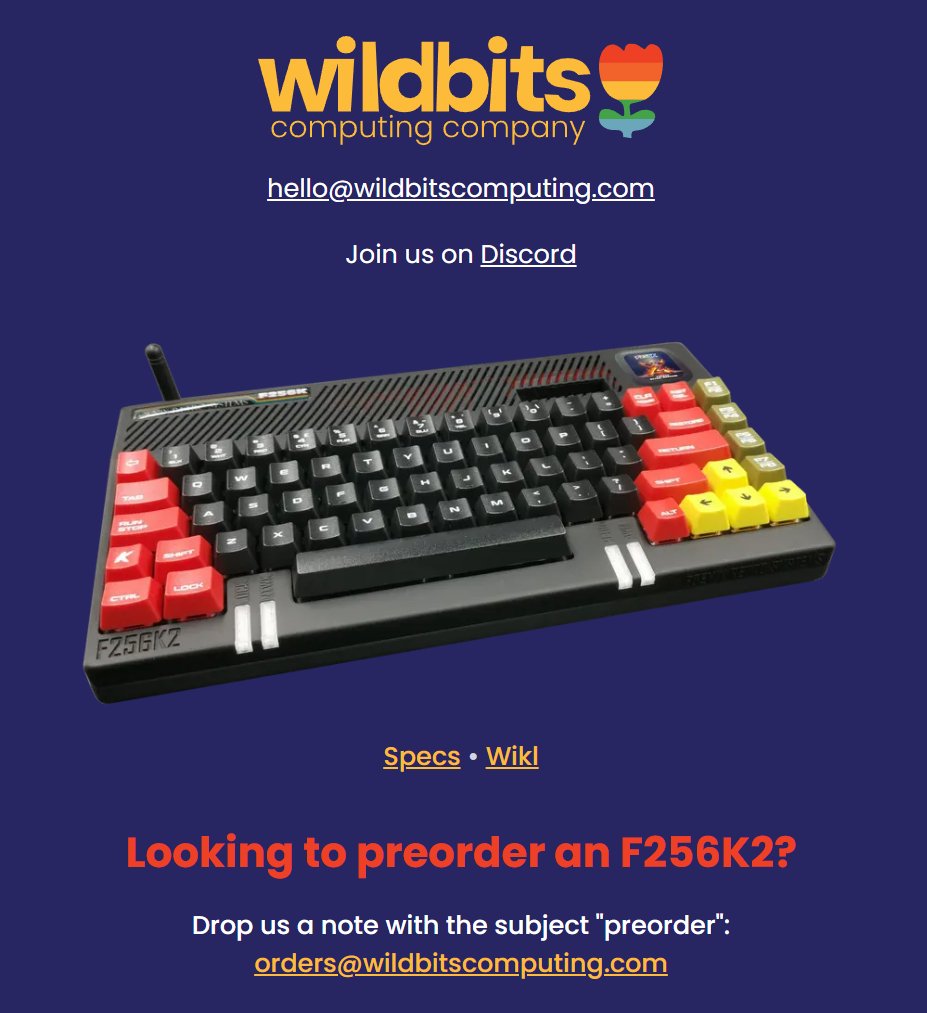
The Wildbits Computing Company website currently directs customers interested in F256K2 preorders to email orders@wildbitscomputing.com, using preorder as the subject.
The public ordering page does not display a fixed retail price, inventory quantity, or confirmed shipping schedule. Rather than offering immediate online checkout, it directs prospective buyers to confirm the purchase arrangements with the supplier.
Buyers should check the supplied configuration, shipping availability, delivery costs, taxes, lead time, and support conditions. Prices and promotions from the former Foenix store should not automatically be applied to current Wildbits orders. (Foenix)
Historical Pricing: Starting at $595
A June 17, 2025 article by The Oasis BBS introduced the F256K2 with a starting price of US$595.
The article was based on product coverage from AnyBit Fever Dreams. It is useful as a historical price reference, but it is a secondary source from the earlier Foenix sales period—not a current Wildbits quotation. (The Oasis BBS)
The same publication also reported a $50 discount promotion from June 13–20, 2025. That was a time-limited historical offer and should not be interpreted as a current discount. (Historical Promotion)
In short, a historical starting price is available, but current pricing must be confirmed with Wildbits.
Historical Product and Price Coverage · Current Ordering Information
Shipment Evidence and Market Context
Documented F256K2 Delivery
A user report provides evidence that F256K2 units reached customers.
In TinkerDifferent post #12, published February 22, 2025, community member Mu0n stated that they had received an F256K2 in late 2024. This is a firsthand account of receiving the product, but it does not establish the first shipping date or total units sold. (TinkerDifferent)
The reviewed public sources do not establish the F256K2's cumulative sales, annual shipments, or current preorder volume. Historical deliveries and a present-day ordering channel confirm commercial activity at different points in time, but they are not sufficient to calculate market share or sales growth.
How Large Is the New-Retro Computer Market?
The closest comparison is not the entire used-computer or retro-gaming market. F256K2 belongs to a smaller category of newly developed computers designed around classic computing experiences.
Published figures from other projects provide some context.
| Comparable Computer | Published Quantity | Scope of the Figure |
|---|---|---|
| MEGA65 | Initial 400 units sold | An early production batch described by Sundance; not current cumulative sales |
| Commander X16 | Approximately 1,100 units sold at the time | A figure reported in a September 23, 2024 article by The Oasis BBS, summarizing an update from the project creator |
Sundance distinguished its initial 400-unit batch from reservations for a later production run. The Commander X16 figure comes from a secondary article, rather than a verified manufacturer sales ledger. (Sundance)
These examples show that some new-retro computers have achieved sales in the hundreds or around a thousand units at particular stages of their development.
They do not establish the size of the global market, and they cannot be used to estimate F256K2 sales. The products differ in software ecosystems, compatibility, prices, and production histories.
A reliable market-wide shipment or revenue figure limited to computers directly comparable with F256K2 was not established in the reviewed sources.
MEGA65 Production Information · Commander X16 Sales Coverage
Learning Through Video and Community Activity
YouTube — Seeing Programs Written and Run
The F256 community's Getting Started guide links to educational videos, including 8-Bit Wall of Doom's SuperBASIC series and content from AnyBit Fever Dreams.
These videos allow newcomers to watch programs being entered and executed. They complement hardware specifications with demonstrations from the user's perspective. (Getting Started)
SuperBASIC Video Playlist · AnyBit Fever Dreams
Wiki, Discord, and Game Jams
Wildbits links to its Wiki and Discord community alongside its ordering information. These resources provide routes for finding documentation, asking questions, and exchanging development experiences. (Wildbits)
One example of community software creation is the Foenix BFG game jam. Its public entry list includes six submitted projects, covering genres such as racing, cards, puzzles, and action.
That number represents submissions to this particular event, not total F256 software availability or computer sales. (Foenix BFG)
The relationship between these channels is useful: product videos introduce the computer, documentation helps users get started, and community-created programs give other users new things to explore.
A Community Discussion About Creating Software
A discussion in the Wildbits Computing Discord general-f256k2 channel on June 15–16, 2026 also highlighted the value some community members place on creating software by hand.
One participant discussed a preference for featuring human-authored creations in an official storefront, emphasizing the process of understanding and building software. Other participants pointed to the productivity benefits of AI-assisted development.
The discussion provides an interesting view of the community's interest in learning, experimentation, and the creative process.
These individual comments should not be interpreted as a community-wide position or a verified policy prohibiting all AI-assisted software.
Source: Wildbits Computing Discord, general-f256k2 discussion, June 15–16, 2026, reviewed from shared screenshots. The official server is linked through Wildbits.
Network Hardware and WIZnet Integration

Source: https://c256foenix.com/f256k2/?v=dcf0d7d2cd12
The original F256K2 product page identifies two network components under SYSTEM MISC → Network:
“Wiznet W6100L Controller with integrated IP Stack”
“Wiznet Wifi360 module with integrated IP Stack”
The wired interface is identified as W6100L in the manufacturer's specifications. The wireless module, listed as Wifi360 on the product page, is identified as WizFi360 in community documentation. Although both are networking components, they use different software interfaces. (F256K2 Product Specifications, Community Hardware Documentation)
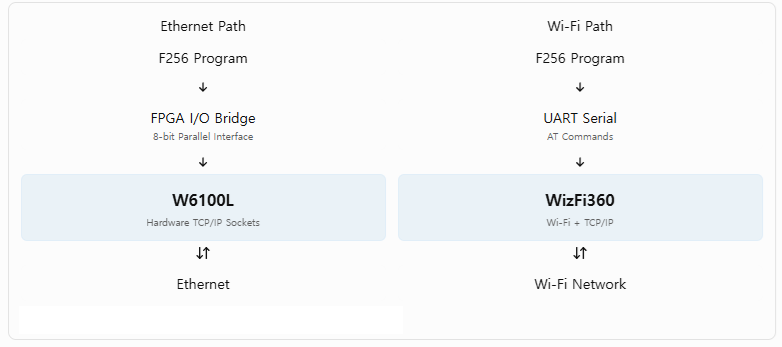
Ethernet — Accessing W6100 Through an FPGA Bridge
A publicly available Ethernet implementation can be found in the NitrOS-9 project's Wildbits K2 software, which targets an optional 6809-based computing environment, rather than the standard W65C816/SuperBASIC environment.
The w6100eth source describes how software communicates with the W6100 through an FPGA I/O bridge and an eight-bit parallel interface. The program accesses the Ethernet controller's registers through this bridge instead of communicating with the chip directly over SPI. (W6100 Ethernet Source)
The project also includes network utilities demonstrating how the interface can be used. For example, w6100recv opens a W6100 hardware TCP socket, connects to a server, and receives data into a disk file. The application manages the file, while the W6100 provides the network transport. (W6100 File-Receive Implementation)
These are environment-specific development examples, not proof that equivalent applications are installed on every F256K2. The source documents FPGA-bridge compatibility issues, and parts of the network software still require confirmation on actual K2 hardware. (Development Notes, Telnet Implementation Notes)
Wi-Fi — WizFi360 Through UART and AT Commands
The community-developed F256-Wizfi360 project demonstrates a different networking approach.
Its assembly code communicates with WizFi360 through a UART serial interface, sending AT commands to configure wireless operation and establish TCP connections. Commands such as AT+CWMODE=1 and AT+CIPSTART appear directly in the project's source code. (UART Interface, AT Command Implementation)
Incoming data is processed by the program and passed to a VT100-style terminal parser, allowing network responses to be displayed as text and terminal-control operations.
In this arrangement, the F256 application handles keyboard input and screen presentation, while the WizFi360 module provides the wireless connection and TCP/IP functionality. (Receive and Terminal Processing, WizFi360 Documentation)
This terminal is independently developed community software rather than a guaranteed factory-installed application. Its compatibility depends on the software environment and hardware configuration.
Two Networking Interfaces, Different Software Approaches
The F256K2 provides hardware for both wired and wireless networking, but the two examples illustrate different approaches:
W6100 Ethernet: Software accesses controller registers and hardware network sockets through an FPGA interface in the documented Wildbits K2/NitrOS-9 environment.
WizFi360 Wi-Fi: An F256 application uses UART and AT commands to request connections and exchange data through the wireless module.
These implementations show how networking can be explored on a retro-computing platform. They do not establish simultaneous Ethernet and Wi-Fi operation, automatic failover, or identical driver support across all F256K2 software environments.
Technical references: Manufacturer Network Specifications · W6100 Ethernet Implementation · W6100 TCP File Transfer · F256-Wizfi360 GitHub · W6100 Documentation · WizFi360 Documentation
What to Consider Before Buying
Not every program written for the F256 family works identically across all models.
For example, the author of F256amp states that it uses the VS1053b available in the F256K2 and Jr2 and does not run on the earlier K and Jr models. Checking the required hardware is therefore more useful than relying only on similarities in model names. (F256KsimpleCdoodles)
FPGA-core and software maturity also matter. The original product page describes some graphics capabilities and a 68000 core as future features. The community documentation distinguishes uses of the internal microSD for FPGA images and data storage.
Buyers should consider the advertised hardware, the FPGA cores currently available, and the requirements of the programs they intend to run. (F256K2)
For this kind of computer, sales figures are not the only useful consideration. The availability of programs, examples, documentation, and community support can be just as relevant to the experience of using the machine.
Related WIZnet Maker Projects
F256-Wizfi360 explores a terminal application using WizFi360 in the F256 environment. Its source repository provides a reference for readers interested in how a network application communicates with the module. It is separate from the manufacturer's standard installed software.
Foenix Labs A2560Me introduces another Foenix retro-computing platform. It provides a comparison of hardware designs and product formats, without implying software compatibility between the two machines.
Conclusion
The appeal of F256K2 goes beyond recreating an older computing experience. It provides an environment in which users can continue creating and sharing new programs today.
Starting with BASIC, users can experiment with graphics and music, run programs written by other developers, and learn from publicly available examples. (Getting Started)
Current purchasing is directed through Wildbits' email-based preorder process, while historical price reports and delivery accounts provide context about earlier supply periods. (Wildbits)
Understanding this computer is not only a question of which chips it contains. An equally useful starting point is:
“What would you like to create with it?”
FAQ
Q. Is F256K2 an emulator?
A. No. It is a physical keyboard-integrated computer with a W65C816 processor, FPGA hardware, and other dedicated components. PC-based development tools and emulators are available separately. (F256K2)
Q. What is the current price?
A. Wildbits does not publish a current fixed price on its public ordering page. A 2025 article described a starting price of US$595, but today's price, delivery costs, and taxes must be confirmed with the seller. (Wildbits, Historical Price Coverage)
Q. Are all the games and music programs mentioned here preinstalled?
A. No. The standard SuperBASIC environment is separate from applications distributed by community developers. Download instructions and compatible models should be checked for each project. (Getting Started)
Q. How many F256K2 units have been sold?
A. Cumulative F256K2 sales were not established in the reviewed public sources. A user reported receiving one in late 2024, but that account cannot be used to estimate total sales. (TinkerDifferent)
Source Snapshot
Review date: October 12, 2026
Product: F256K2, originally developed under Foenix, with current ordering information provided by Wildbits Computing Company.
Sales and pricing: Historical prices and reported sales quantities are identified by date and source. F256K2 cumulative sales remain unconfirmed.
| Source | What It Supports | URL |
|---|---|---|
| Foenix product page | Product configuration, hardware specifications, standard software, and networking components | F256K2 |
| Foenix official announcement, April 2026 | F256x intellectual-property transfer and closure of the former store for new orders | Foenix Announcement |
| Wildbits official website | Current preorder email and links to community resources | Wildbits |
| IEEE Spectrum interview | Stefany Allaire and the design philosophy behind Foenix | Creator Interview |
| F256/Wildbits Getting Started guide | SuperBASIC, program execution and transfer, storage, and learning resources | Getting Started |
| Mu0n software repository | F256amp, FireJam, LCD examples, source code, and hardware requirements | Programs and Source |
| The Oasis BBS, June 2025 | Historical starting price of US$595 and a separately reported temporary promotion; secondary sources | Product and Price Article · Promotion Article |
| TinkerDifferent owner account | Firsthand report, posted in February 2025, of receiving an F256K2 in late 2024 | Post #12 |
| Sundance | Early MEGA65 batch of 400 units sold; comparison only, not F256K2 sales | MEGA65 |
| The Oasis BBS, September 2024 | Secondary report summarizing approximately 1,100 Commander X16 sales at the time | Commander X16 Article |
| Foenix BFG | Community game jam and six submitted entries | Game Jam |
| Wildbits Discord discussion | June 15–16, 2026 conversation about human-authored software and AI tools; individual remarks, not a confirmed platform-wide policy | Official Server Access |
| Network hardware resources | WizFi360 identification and W6100/WizFi360 capabilities | Community Documentation · W6100 · WizFi360 |
| F256-Wizfi360 source | F256 wireless-terminal implementation | GitHub |
| NitrOS-9 Wildbits K2 Ethernet implementation | FPGA I/O bridge access to W6100, hardware TCP socket file transfer, and documented development limitations in the optional 6809 environment | W6100 Ethernet Interface · TCP File Receiver · Telnet Development Notes |
