CLICK Basic PLC, 24 VDC required, serial ports, Discrete Input
The PLC CPU is the brain of the control system and contains a microprocessor, memory storage, and other integrated circuits.
7
Project description
The PLC CPU is the brain of the control system and contains a microprocessor, memory storage, and other integrated circuits that are used to execute the control program, store logic data, and communicate to external devices. PLC CPUs follow a repeated sequence of operations that perform those functions and other internal processes. Below is an example of a typical PLC scan.
CLICK PLC units contain the CPU and a fixed set of up to 14 I/O points in a compact form factor. Thirty-one stand-alone PLC combinations are available with varying I/O configurations including 8 DC inputs with 6 DC outputs, 8 AC inputs with 6 relay outputs, and units offering 2 analog inputs and outputs with 4 discrete inputs and outputs.
- Basic and Standard PLCs feature discrete-only inputs and outputs; Analog PLCs feature both discrete and analog I/O
- Basic PLC units have two built-in RS-232 communications ports - one programming port and one that can be configured for either Modbus RTU or ASCII protocols
- Standard and Analog PLCs include the same ports as the Basic PLCs with an additional RS-485 communications port
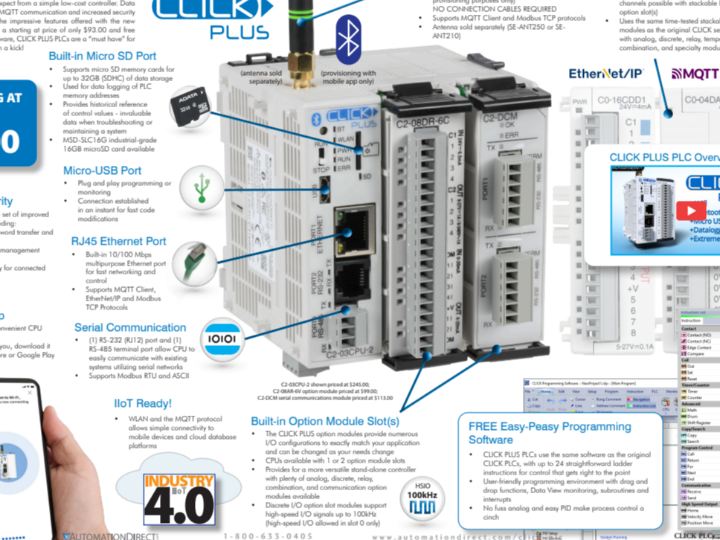
- All CLICK Ethernet-capable PLCs have one built-in Ethernet communications port that supports Modbus TCP and EtherNet/IP protocols and one RS-232 serial comm port
- Ethernet Standard and Ethernet Analog PLC units also have an RS-485 port for Modbus and ASCII communication
- Up to 8 stackable I/O modules can be connected to a CLICK PLC unit to expand the system I/O count and meet the needs of a specific application
