


How Does Hawk Use W5500 Ethernet for Low-Power Appliance Recognition?
Hawk uses W5500 Ethernet to stream 16 kHz current data from ESP32 acquisition boards for NALM dataset construction and recognition.
WIZnet - W5500
x 1

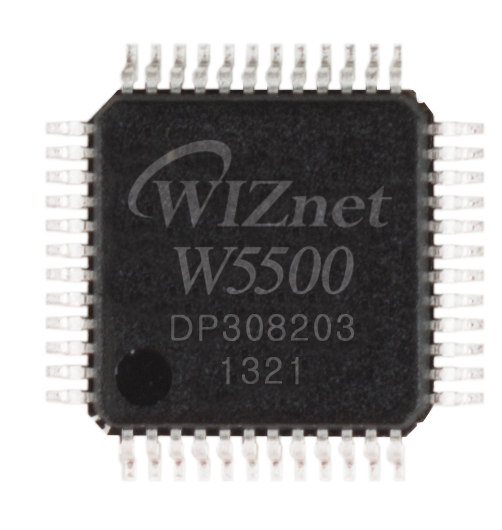
Ethernet controller in the Hawk acquisition-board prototype for reliable dataset-construction data transport over MQTT/Ethernet
📌 Overview
Hawk is a SenSys 2024 research system for non-intrusive appliance load monitoring, or NALM. It recognizes individual low-power appliance states from mains-side electrical measurements instead of placing sensors inside every appliance.
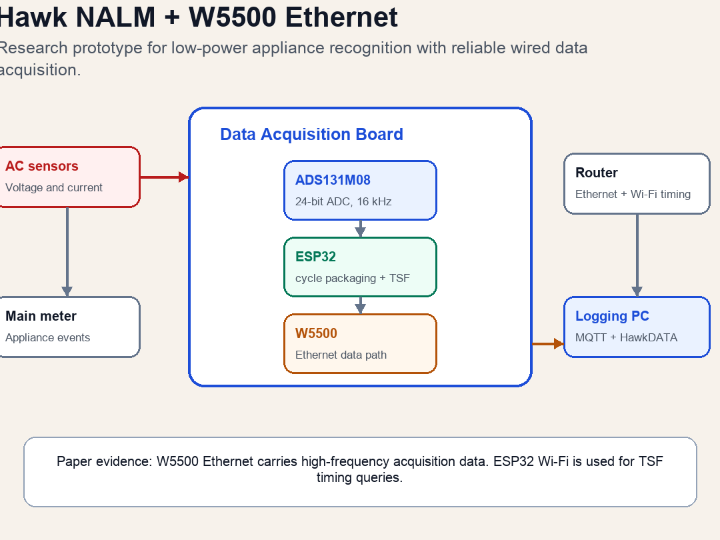
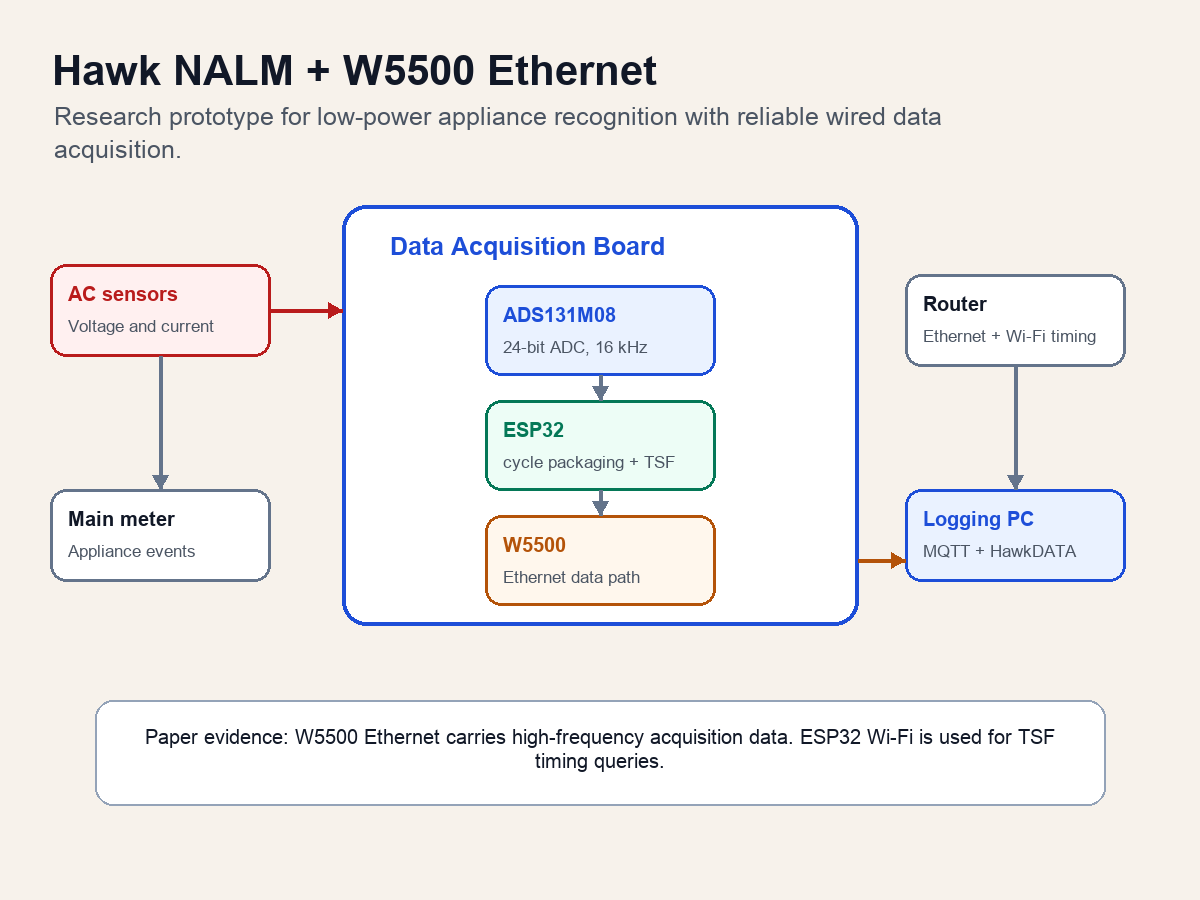
The WIZnet angle is in the data acquisition prototype. The paper describes an acquisition board built around an ADS131M08 ADC, an ESP32 MCU, and a W5500 Ethernet controller. In that design, W5500 provides the reliable wired transport path for high-frequency data during dataset construction, while the ESP32 Wi-Fi interface is used for timing synchronization queries.
System Configuration
The prototype starts at the mains measurement point. AC-to-AC voltage and current sensing feed an ADS131M08, a 24-bit ADC capable of simultaneous multi-channel sampling. The paper reports 16 kHz sampling and describes the ESP32 as the controller that responds to ADC interrupts, packages cycle-level data, checks packet status, and moves data from shared memory toward the logging PC.
The same board also includes a W5500 Ethernet controller. Hawk uses Wi-Fi for TSF timing queries, but uses W5500 Ethernet for the data stream that matters most during dataset construction. The logging side receives the stream through MQTT and stores the data used to build HawkDATA and evaluate the recognition pipeline.
The public GitHub repository is narrower than the full hardware prototype. It contains artifact-evaluation scripts, sampling synchronization checks, dataset-balance analysis, XGBoost model artifacts, BLUED event data, and an in-the-wild video. It does not publish the ESP32 firmware, W5500 driver code, PCB files, or board BOM.
System Architecture & Data Flow
Hawk's acquisition path can be read as a sensing and logging pipeline. Current and voltage inputs are sampled by the ADC. The ESP32 packages data around voltage cycles and handles timing-related work. W5500 then provides the wired Ethernet path to the logging infrastructure, where MQTT carries the data into the dataset and recognition workflow.
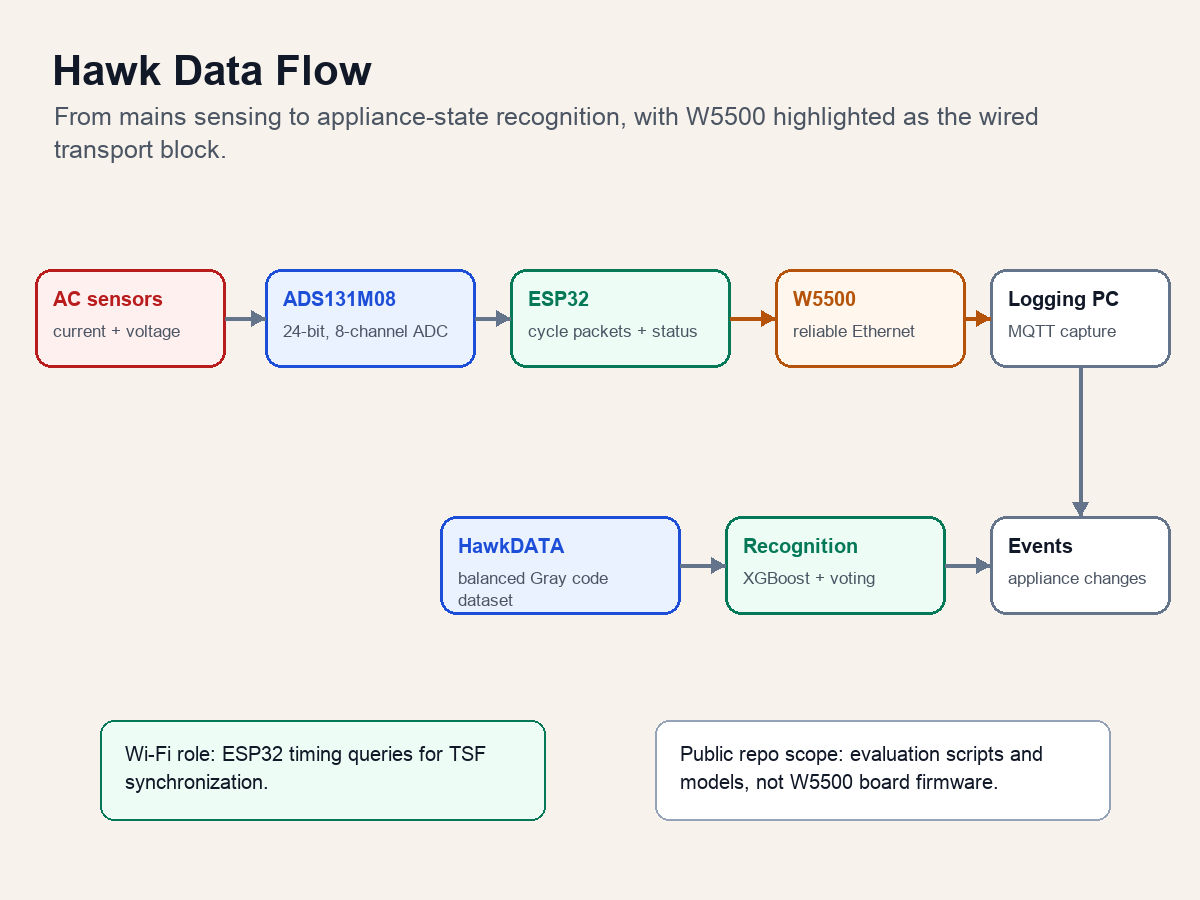
After collection, HawkDATA is used by the recognition side of the system. The paper reports state-recognition and event-recognition experiments, including embedded-computer validation. The repository makes the evaluation path easier to inspect, but the networked acquisition-board firmware remains outside the public release.
⚙️ Role of the WIZnet Chip
W5500 is not presented as a side accessory in Hawk. It is part of the acquisition-board architecture that lets the researchers move high-rate measurement data from the board to the logging PC. That matters because NALM dataset construction depends on clean, synchronized, continuous electrical traces.
The paper's network split is also useful: ESP32 Wi-Fi is used for timing queries, while W5500 Ethernet is used for the data path. That is a pragmatic hybrid design. Wi-Fi helps synchronization, but the heavy acquisition stream goes over wired Ethernet.
This post does not mark the project as a public WIZnet TOE implementation because the repository does not include W5500 socket code, register access, or firmware. The evidence is hardware-architecture evidence from the paper, not source-level driver evidence.
Public Artifact Scope
The most important boundary is what is public. The paper documents the hardware prototype and W5500 role. The GitHub repository documents how to reproduce and inspect the evaluation results. Those are related, but they are not the same deliverable.
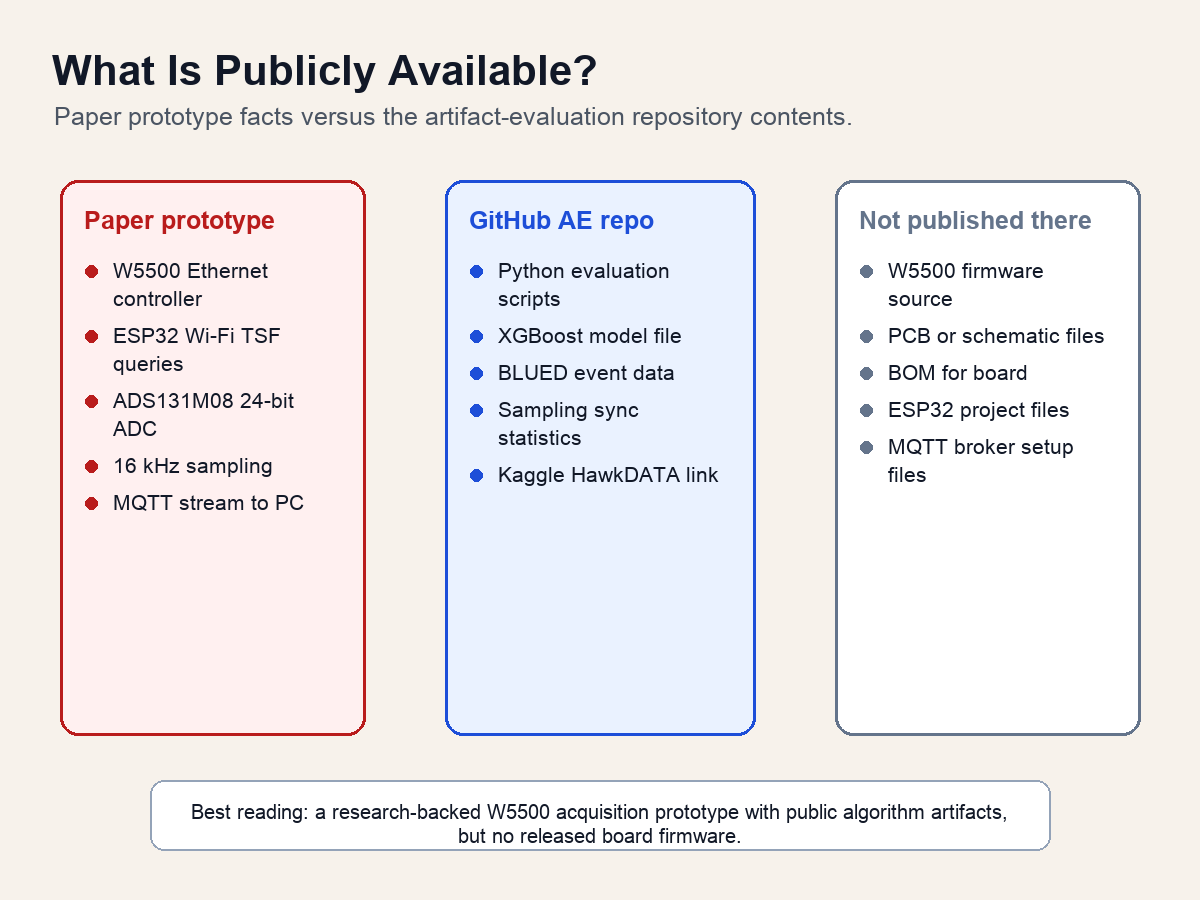
For a Maker reader, that means Hawk is best treated as a research-backed example of W5500 in high-frequency energy sensing. It is not a ready-to-flash ESP32 + W5500 firmware project. The value is in the system pattern: deterministic wired data movement for AI-oriented energy monitoring.
Where It Fits - Value & Limits
Hawk fits energy monitoring, AIoT sensing, smart building analytics, and appliance-level event detection. It is especially relevant to projects where a microcontroller acquisition node has to move time-sensitive sensor data into a logging or inference pipeline.
The limitation is that the public artifacts stop short of a hardware reference design. There is no public schematic, BOM, PCB, MQTT broker setup, or W5500 firmware source. Anyone rebuilding a similar acquisition board would need to design and validate that embedded networking layer independently.
Still, the paper is a strong external signal for WIZnet's role in AI and energy systems. It shows W5500 being chosen for the data transport side of a research prototype where reliable high-frequency acquisition is central to the result.
Related WIZnet Maker Projects
The closest energy-metering comparison is ESP32 JSY Energy Meter Gateway with W5500 Support. Both combine energy measurement with an ESP32 and W5500 context, but Hawk targets high-frequency NALM research data instead of a practical JSY meter gateway.
LoRa Datalogger with W5500 Host is related because it treats W5500 as a reliable host-side data path. Hawk uses the same kind of wired reliability for acquisition logging, but its application layer is appliance recognition rather than LoRa data collection.
How Does W5500 Fit into an STM32 Predictive Maintenance Datalogger? connects on the AI monitoring side. That post is a datalogger-oriented scaffold, while Hawk is a published research system with public evaluation artifacts and a W5500-based acquisition prototype.
❓ FAQ
Q. What does Hawk recognize? Hawk recognizes appliance states and appliance events from mains-side electrical measurements, focusing on low-power appliance recognition without per-appliance indoor sensors.
Q. Where is W5500 used? W5500 is part of the data acquisition board and is used for reliable Ethernet data transport during dataset construction.
Q. Is the W5500 firmware public? No. The public GitHub repository contains evaluation scripts and model artifacts, but not the ESP32 or W5500 board firmware.
Q. Why does the design use both Wi-Fi and Ethernet? The paper uses ESP32 Wi-Fi for TSF timing queries and W5500 Ethernet for the acquisition data stream, separating timing support from the heavier wired data path.
Q. Can this be reused as a complete hardware reference? Not directly. It is valuable as a research architecture and evaluation reference, but a rebuild would still need independent firmware, board design, and network validation.
한국어 (Korean)
개요
Hawk는 SenSys 2024에 발표된 비침입식 부하 모니터링, 즉 NALM 연구 시스템입니다. 개별 가전 안에 센서를 넣는 대신, 메인 전력 계측 지점의 전기 신호만으로 저전력 가전의 상태를 인식합니다.
WIZnet 관점의 핵심은 데이터 수집 프로토타입입니다. 논문은 ADS131M08 ADC, ESP32 MCU, W5500 Ethernet 컨트롤러로 구성된 데이터 수집 보드를 설명합니다. 이 구조에서 W5500은 데이터셋 구축 단계의 고주파 데이터를 안정적으로 보내는 유선 전송 경로를 맡고, ESP32 Wi-Fi는 타이밍 동기화 질의에 사용됩니다.
시스템 구성
프로토타입은 메인 전력 계측 지점에서 시작합니다. AC-to-AC 전압 및 전류 센싱 신호가 24비트 ADS131M08 ADC로 들어가고, 논문은 16 kHz 동시 샘플링을 설명합니다. ESP32는 ADC 인터럽트에 반응하고, 전압 주기 단위로 데이터를 패키징하며, 패킷 상태 확인과 로깅 PC로 보내기 위한 데이터 이동을 담당합니다.
같은 보드에는 W5500 Ethernet 컨트롤러도 포함됩니다. Hawk는 TSF 타이밍 질의에는 Wi-Fi를 사용하지만, 데이터셋 구축에서 중요한 수집 데이터 스트림에는 W5500 Ethernet을 사용합니다. 로깅 측은 MQTT를 통해 스트림을 받고, 이 데이터가 HawkDATA와 인식 파이프라인 평가에 사용됩니다.
공개 GitHub 저장소는 전체 하드웨어 프로토타입보다 범위가 좁습니다. 여기에는 artifact evaluation 스크립트, 샘플링 동기화 확인, 데이터셋 균형 분석, XGBoost 모델 아티팩트, BLUED 이벤트 데이터, 실사용 비디오가 들어 있습니다. ESP32 펌웨어, W5500 드라이버 코드, PCB 파일, 보드 BOM은 공개되어 있지 않습니다.
시스템 아키텍처와 데이터 흐름
Hawk의 수집 경로는 센싱과 로깅 파이프라인으로 볼 수 있습니다. 전류와 전압 입력은 ADC에서 샘플링됩니다. ESP32는 전압 주기 기준으로 데이터를 패키징하고 타이밍 관련 작업을 처리합니다. 이후 W5500이 로깅 인프라까지 유선 Ethernet 경로를 제공하고, MQTT를 통해 데이터가 데이터셋과 인식 워크플로로 들어갑니다.
수집 이후 HawkDATA는 인식 시스템에서 사용됩니다. 논문은 상태 인식과 이벤트 인식 실험, 그리고 임베디드 컴퓨터 검증을 보고합니다. 저장소는 평가 경로를 확인하기 쉽게 해주지만, 네트워크 수집 보드 펌웨어는 공개 릴리스에 포함되어 있지 않습니다.
WIZnet 칩의 역할
W5500은 Hawk에서 부가적인 액세서리처럼 등장하지 않습니다. 연구자가 고속 계측 데이터를 수집 보드에서 로깅 PC로 이동시키기 위해 사용한 데이터 수집 보드 아키텍처의 일부입니다. NALM 데이터셋 구축에는 깨끗하고 동기화된 연속 전기 신호가 필요하므로 이 역할이 중요합니다.
논문의 네트워크 분리도 의미가 있습니다. ESP32 Wi-Fi는 타이밍 질의에 사용되고, W5500 Ethernet은 데이터 경로에 사용됩니다. Wi-Fi는 동기화에 도움을 주고, 무거운 수집 데이터 스트림은 유선 Ethernet으로 보내는 실용적인 하이브리드 구조입니다.
다만 이 글은 이 프로젝트를 공개 WIZnet TOE 구현으로 표시하지 않습니다. 저장소에 W5500 소켓 코드, 레지스터 접근, 펌웨어가 없기 때문입니다. 여기서의 근거는 논문의 하드웨어 아키텍처 근거이지, 소스 코드 수준의 드라이버 근거는 아닙니다.
공개 아티팩트 범위
가장 중요한 경계는 무엇이 공개되어 있는지입니다. 논문은 하드웨어 프로토타입과 W5500의 역할을 설명합니다. GitHub 저장소는 평가 결과를 재현하고 확인하기 위한 자료를 제공합니다. 둘은 연결되어 있지만 같은 산출물은 아닙니다.
Maker 독자 입장에서는 Hawk를 고주파 에너지 센싱에서 W5500을 사용한 연구 기반 사례로 보는 것이 가장 적절합니다. 바로 플래시할 수 있는 ESP32 + W5500 펌웨어 프로젝트는 아닙니다. 가치는 AI 지향 에너지 모니터링을 위해 결정적인 유선 데이터 이동을 구성한 시스템 패턴에 있습니다.
활용 가치와 한계
Hawk는 에너지 모니터링, AIoT 센싱, 스마트 빌딩 분석, 가전 단위 이벤트 감지에 맞습니다. 특히 마이크로컨트롤러 기반 수집 노드가 시간 민감한 센서 데이터를 로깅 또는 추론 파이프라인으로 보내야 하는 프로젝트와 잘 연결됩니다.
한계는 공개 아티팩트가 하드웨어 레퍼런스 설계까지 제공하지 않는다는 점입니다. 공개 회로도, BOM, PCB, MQTT 브로커 설정, W5500 펌웨어 소스가 없습니다. 비슷한 수집 보드를 다시 만들려면 임베디드 네트워킹 계층을 별도로 설계하고 검증해야 합니다.
그래도 이 논문은 AI와 에너지 시스템에서 WIZnet의 역할을 보여주는 좋은 외부 신호입니다. 안정적인 고주파 데이터 수집이 핵심인 연구 프로토타입에서 W5500이 데이터 전송 경로로 선택된 사례이기 때문입니다.
관련 WIZnet Maker 프로젝트
에너지 계측 관점에서 가장 가까운 비교 대상은 ESP32 JSY Energy Meter Gateway with W5500 Support입니다. 둘 다 에너지 계측, ESP32, W5500 맥락이 있지만 Hawk는 실용적인 JSY 미터 게이트웨이가 아니라 고주파 NALM 연구 데이터에 초점을 둡니다.
LoRa Datalogger with W5500 Host는 W5500을 안정적인 호스트 측 데이터 경로로 다룬다는 점에서 관련이 있습니다. Hawk도 수집 로깅에 유선 신뢰성을 활용하지만, 응용 계층은 LoRa 데이터 수집이 아니라 가전 인식입니다.
How Does W5500 Fit into an STM32 Predictive Maintenance Datalogger?는 AI 모니터링 관점에서 연결됩니다. 해당 글은 데이터로거 지향 스캐폴드이고, Hawk는 공개 평가 아티팩트와 W5500 기반 수집 프로토타입을 가진 출판 연구 시스템입니다.
FAQ
Hawk는 무엇을 인식하나요? Hawk는 메인 전력 계측 신호에서 가전 상태와 이벤트를 인식합니다. 개별 가전에 실내 센서를 붙이지 않는 저전력 가전 인식에 초점을 둡니다.
W5500은 어디에 사용되나요? W5500은 데이터 수집 보드의 일부이며, 데이터셋 구축 단계에서 안정적인 Ethernet 데이터 전송에 사용됩니다.
W5500 펌웨어가 공개되어 있나요? 아닙니다. 공개 GitHub 저장소에는 평가 스크립트와 모델 아티팩트가 있지만 ESP32 또는 W5500 보드 펌웨어는 포함되어 있지 않습니다.
왜 Wi-Fi와 Ethernet을 같이 사용하나요? 논문은 ESP32 Wi-Fi를 TSF 타이밍 질의에 사용하고, W5500 Ethernet을 수집 데이터 스트림에 사용합니다. 타이밍 지원과 무거운 유선 데이터 경로를 분리한 구조입니다.
완전한 하드웨어 레퍼런스로 바로 재사용할 수 있나요? 직접적으로는 어렵습니다. 연구 아키텍처와 평가 레퍼런스로는 가치가 있지만, 재구현에는 펌웨어, 보드 설계, 네트워크 검증이 별도로 필요합니다.
-
arXiv HTML paper
Hawk paper with hardware prototype, NALM method, and W5500 acquisition-board evidence

-
arXiv PDF paper
Downloadable PDF version of the Hawk paper
-
Artifact evaluation repository
Public evaluation scripts, model files, BLUED event data, and in-the-wild video
-
HawkDATA dataset
Dataset link referenced by the artifact repository
-
WIZnet W5500
Hardwired TCP/IP Ethernet controller used in the Hawk acquisition-board prototype


