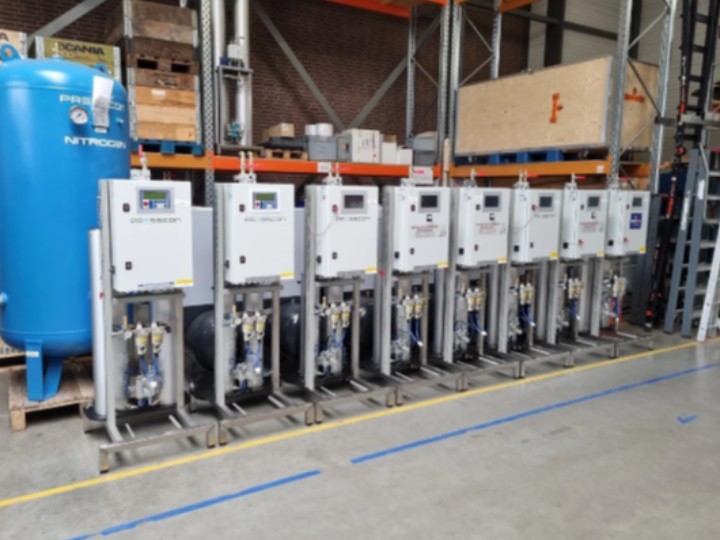
Customized nitrogen generators are ready for installation in greenhouses
Customized nitrogen generators are ready for installation in greenhouses
0
Project description
How Does PRESSCON Use W5500 Networking in Its Greenhouse Nitrogen Expansion Systems?
Overview
PRESSCON is a Netherlands-based company specializing in nitrogen generation, pressure management, and expansion systems for industrial and horticultural applications.
Its VERNIT and HORNIT nitrogen expansion systems are designed to manage the pressure conditions inside thermal storage tanks used in greenhouse heating installations.
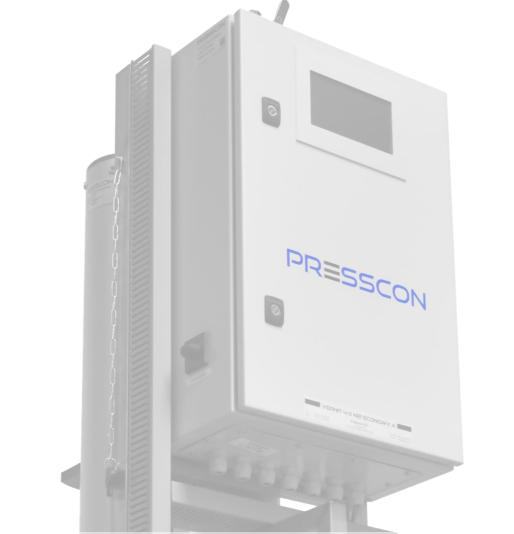
These systems combine nitrogen generation, pressure sensors, safety devices, and electronic control equipment to protect heating infrastructure against unwanted pressure changes and oxygen-related corrosion.
An important detail appears in the official VERNIT/HORNIT N2(i) user manual, Version 4.2, dated September 18, 2019.
The manual identifies WIZnet W5500 in the system's diagnostic information, including the specific fault entry F52 - W5500 cmd.
The same diagnostic table includes IP address conflicts, MAC address errors, NTP connection faults, and TCP transmit and receive buffer errors.
These details provide documentary evidence of W5500-related network functionality within the PRESSCON control platform.
What Problem Do PRESSCON Nitrogen Expansion Systems Solve?
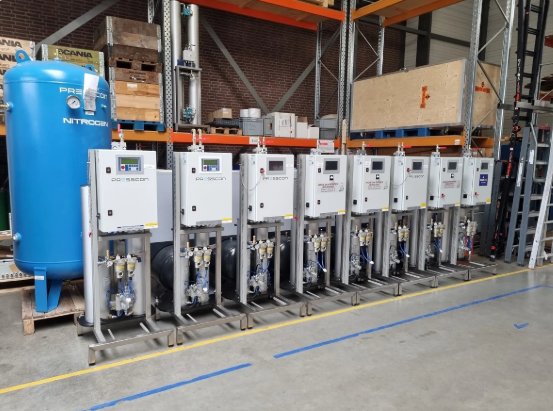
Commercial greenhouses often use central heating systems with large water-filled thermal storage tanks.
Water expands when heated and contracts when cooled. These volume changes must be accommodated without allowing excessive pressure or unwanted air entry.
The tanks therefore contain an expansion space above the water.
However, the presence of oxygen in the expansion space can contribute to corrosion and oxidation in the heating installation.
PRESSCON addresses this challenge by maintaining a nitrogen atmosphere in the expansion chamber.
The system monitors pressure conditions and generates additional nitrogen when required.
According to PRESSCON, its nitrogen generation system produces a gas mixture containing 99.0 vol.% nitrogen.
The system also monitors water levels and reports abnormal operating conditions.
This combines pressure management, corrosion prevention, and equipment monitoring in one industrial installation.
How Is the System Structured?
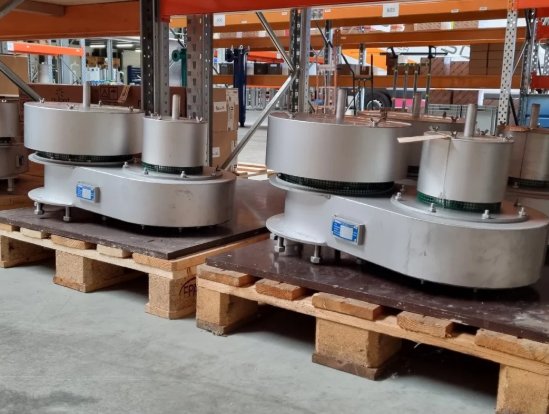
The PRESSCON nitrogen expansion system combines several mechanical and electronic components.
The main components include:
- Nitrogen generator
- Compressed-air compressor
- Pressure sensors for tank pressure and water-level measurement
- Vacuum and overpressure protection equipment
- Electronic control module
- Operator interface and diagnostic functions
The basic operating structure is:
Greenhouse Heating System
          |
          v
Thermal Storage Tank
          |
          +--- Pressure Sensors
          |
          +--- Nitrogen Expansion Space
          |
          +--- Safety Valve
          |
          v
PRESSCON Control System
          |
          +--- Nitrogen Generator Control
          |
          +--- Pressure Monitoring
          |
          +--- Water-Level Monitoring
          |
          +--- Fault and Alarm Handling
          |
          +--- Network Diagnostics
The control system continuously monitors the equipment and responds to changing operating conditions.
The official manual also documents network-related functionality and fault handling.
This is where W5500 becomes relevant to the system architecture.
Where Does W5500 Appear in the PRESSCON Documentation?
One of the strongest technical references is found in the official user manual.
Document: VERNIT - HORNIT N2(i) Expansion Systems
Version: 4.2, Revision 00
Document date: September 18, 2019
Section: 7.3.2 - Fault and alarm messages for the Touchscreen
Page: 50
The manual lists several network-related diagnostic entries:
| Error code | Diagnostic description |
|---|---|
| F50 | IP-conflict |
| F51 | MAC-address |
| F52 | W5500 cmd |
| F53 | NTP connection |
| F57 | MAC-address |
| F60 | TCP Tx buffer |
| F63 | TCP Rx buffer |
The F52 - W5500 cmd entry is particularly significant because it identifies the W5500 by its exact chip name rather than referring only to Ethernet functionality.
The additional network diagnostics show that the control platform monitors several aspects of network operation.
These include device addressing, time-server connectivity, and TCP communication buffers.
Although the manual does not publish the complete circuit schematic or MCU-to-W5500 interface, these diagnostic entries establish a concrete connection between WIZnet W5500 and the PRESSCON control platform.
What Does W5500 Contribute to the Control Platform?
The W5500 is a hardwired TCP/IP Ethernet controller from WIZnet.
It integrates an Ethernet MAC, 10/100 Mbps PHY, and hardware TCP/IP stack.
The chip communicates with a host microcontroller through SPI and supports hardware-managed TCP and UDP sockets.
For an embedded industrial controller, this architecture allows network communication to be implemented without requiring the host MCU to execute a full software TCP/IP stack.
Network Communication
The PRESSCON documentation includes IP addressing and TCP communication diagnostics.
These functions are consistent with the type of network connectivity provided by W5500.
Hardware TCP/IP Processing
W5500 supports TCP/IP processing in dedicated hardware.
This can reduce the network protocol processing burden on the main embedded controller.
It is particularly useful in equipment where the application processor must also manage sensors, alarms, actuators, and other control functions.
Network Fault Diagnosis
An interesting aspect of the PRESSCON implementation is that network faults are represented in the equipment's diagnostic system.
The manual identifies specific fault conditions involving:
- IP address conflicts
- MAC address errors
- W5500 command handling
- NTP server connectivity
- TCP transmit buffers
- TCP receive buffers
This demonstrates that network communication is treated as a diagnosable function of the industrial control platform.
How Do VERNIT and HORNIT Differ?
PRESSCON offers two main nitrogen expansion system configurations.
VERNIT Expansion System
VERNIT is designed for vertical thermal storage tanks.
The system regulates the pressure of the nitrogen blanket in the expansion chamber.
PRESSCON describes a nitrogen-blanket pressure control range of approximately 10 to 18 mbar for its VERNIT expansion system.
This supports pressure management while accommodating changes in the stored water volume.
HORNIT Expansion System
HORNIT is designed for horizontal thermal storage tanks.
Instead of regulating only the nitrogen blanket pressure, it regulates the overall system pressure.
The expansion space may be located within the storage tank or in an external expansion vessel.
Both designs apply nitrogen-based pressure management to greenhouse heating infrastructure, but their mechanical arrangements and control requirements differ.
How Does the System Monitor Water Level?
Water-level monitoring is another major function of the PRESSCON expansion system.
Pressure sensors are used to determine the water level inside the thermal storage tank.
If the water level rises beyond the permitted range, the system can generate an alarm.
A water level that is too high may damage the tank structure.
If the water level becomes too low, air may enter the heating network or associated piping.
The control system therefore monitors both pressure and water-level conditions.
The manual also documents fault and alarm conditions for sensor problems, pressure limits, and communication failures.
This makes the expansion system an industrial monitoring and control application rather than merely a nitrogen generator.
What Does CAN-bus Add to the Architecture?
The official manual also documents CAN-bus communication between control components.
Certain PRESSCON configurations use CAN-bus to exchange information between expansion systems or controllers.
For example, the Equal Level Control and Switching Level Control options use communication between control devices to coordinate water-level-related functions.
This indicates that the equipment can involve more than one communication interface.
At the system level, the documented architecture includes:
- Sensor measurement and equipment control
- CAN-bus communication between control devices
- Ethernet-related network functions identified by W5500 diagnostics
- Operator monitoring and fault reporting
The manual does not establish that every model and configuration uses all of these interfaces simultaneously.
However, it shows how network-related and field-control communication functions appear within the broader PRESSCON control platform.
Why Is This an Interesting W5500 Application?
Many W5500 projects focus on development boards, sensor gateways, or small Ethernet-enabled controllers.
The PRESSCON case is different.
Its main purpose is to operate specialized industrial equipment associated with greenhouse heating and nitrogen pressure management.
Network connectivity is only one part of a larger system involving:
- Pressure regulation
- Nitrogen generation
- Water-level measurement
- Compressor operation
- Safety devices
- Alarm handling
- Controller communication
- Industrial maintenance
The W5500 reference is also found in a manufacturer's operational manual rather than only in a prototype description.
This makes the case especially useful as evidence of W5500-related functionality in a documented industrial control platform.
It demonstrates how embedded Ethernet technology can be integrated into equipment whose primary value comes from mechanical control, process stability, and operational safety.
Conclusion
PRESSCON's VERNIT and HORNIT nitrogen expansion systems protect greenhouse heating installations by managing nitrogen pressure and monitoring thermal storage tank conditions.
The systems combine nitrogen generation, compressed-air equipment, pressure sensors, protective valves, and electronic control functions.
The official VERNIT/HORNIT N2(i) user manual, Version 4.2, explicitly references WIZnet W5500 through diagnostic code F52 - W5500 cmd.
The manual also documents network-related diagnostics covering IP conflicts, MAC addressing, NTP connectivity, and TCP communication buffers.
These details provide a valuable technical reference for W5500-related networking in an industrial nitrogen expansion control platform.
Rather than presenting a generic Ethernet demonstration, this case connects W5500 to a specialized application in greenhouse heating infrastructure, pressure management, and industrial equipment monitoring.
References
PRESSCON - Customized Nitrogen Generators Are Ready for Installation in Greenhouses
Published July 14, 2022
https://presscon.com/customized-nitrogen-generators-are-ready-for-installation-in-greenhouses/
PRESSCON - VERNIT/HORNIT N2(i) Expansion Systems User Manual
Version 4.2, Revision 00, September 18, 2019
Section 7.3.2, Page 50
https://presscon.com/wp-content/uploads/2024/10/VERNIT-HORNIT-N2i-expansiesystemen-gebruikershandleiding-v4.2_R00-ENG.pdf
