


How Two W5500 Nodes Bridge Siemens LOGO Telemetry Across 500 m of LoRa
A 2026 UTFSM thesis uses two STM32-W5500 Ethernet nodes and SX1278 LoRa to read a Siemens LOGO register across an offline 500 m rural link.
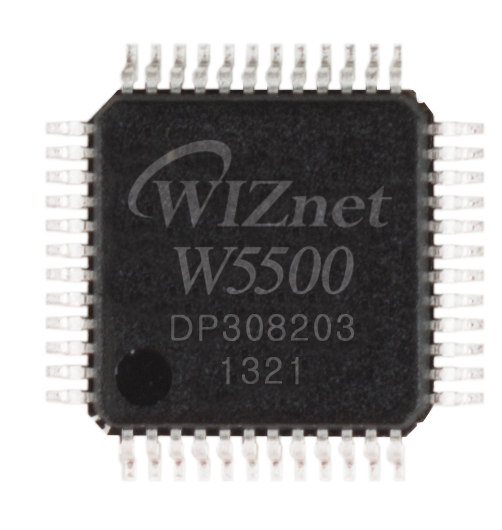
WIZnet - W5500
x 2

Two SPI Ethernet modules: remote-node Modbus TCP client to the Siemens LOGO and base-node TCP server to the control-room PC.
📌 Two Ethernet Islands Across a Rural Site
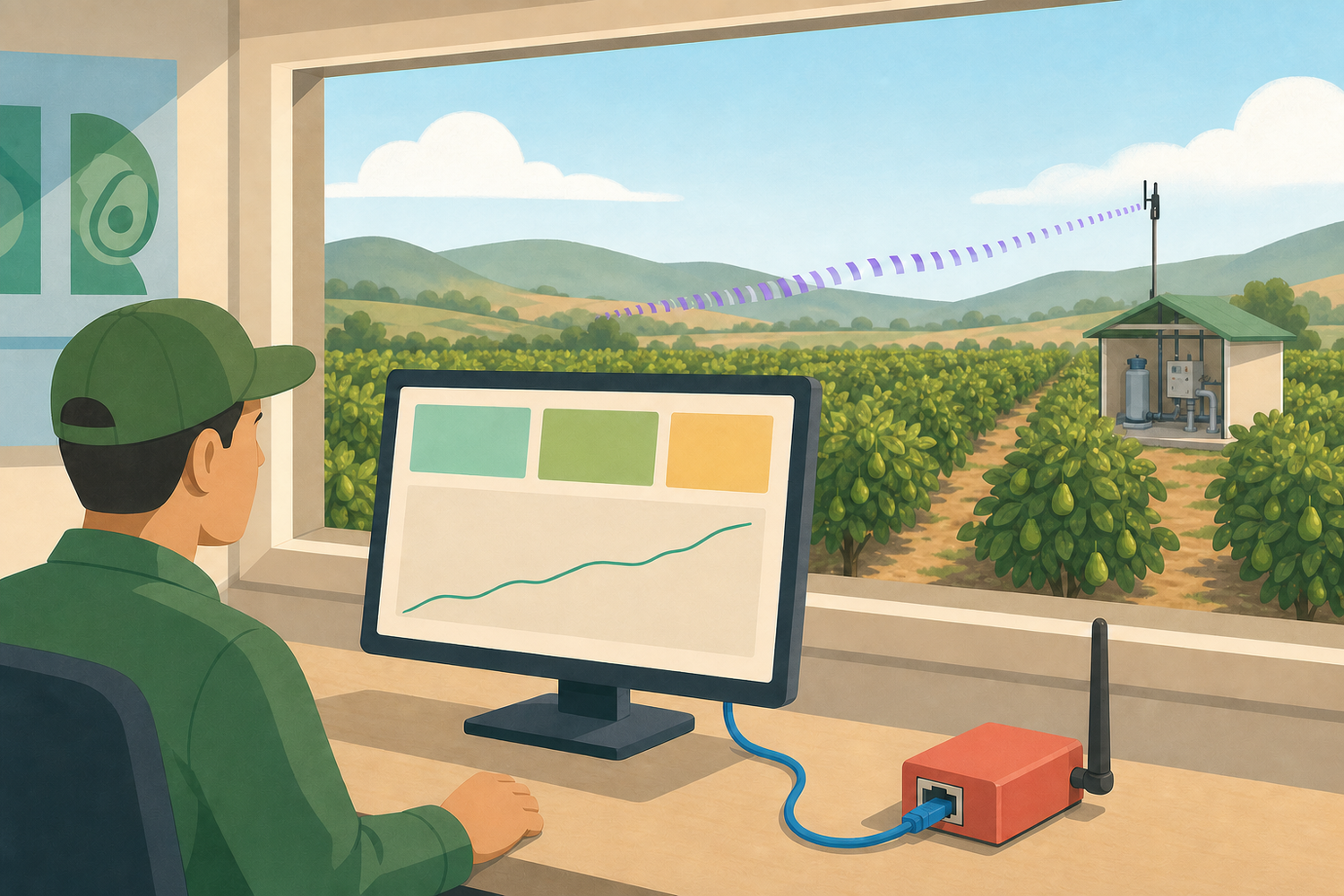
Alan Gamalier Vergara Muñoz's 2026 thesis at Universidad Técnica Federico Santa María presents two local Ethernet islands joined by a direct LoRa field link. An irrigation shelter and an operator shelter sit about 500 m apart on a rural property without a practical Internet or cable route. The prototype keeps Ethernet beside the Siemens LOGO PLC and the operator PC, then uses SX1278 radios only for the long crossing.
Each end uses the same core stack: an STM32F103C8T6, a WIZnet W5500 Ethernet module, and an SX1278 radio. Point-to-point LoRa here means a direct link between two radios, without a LoRaWAN gateway or network server. The UTFSM repository record and 52-page thesis PDF document the prototype and its tests.
Key takeaway: Ethernet stays local at both shelters; only the difficult field crossing moves to direct LoRa.
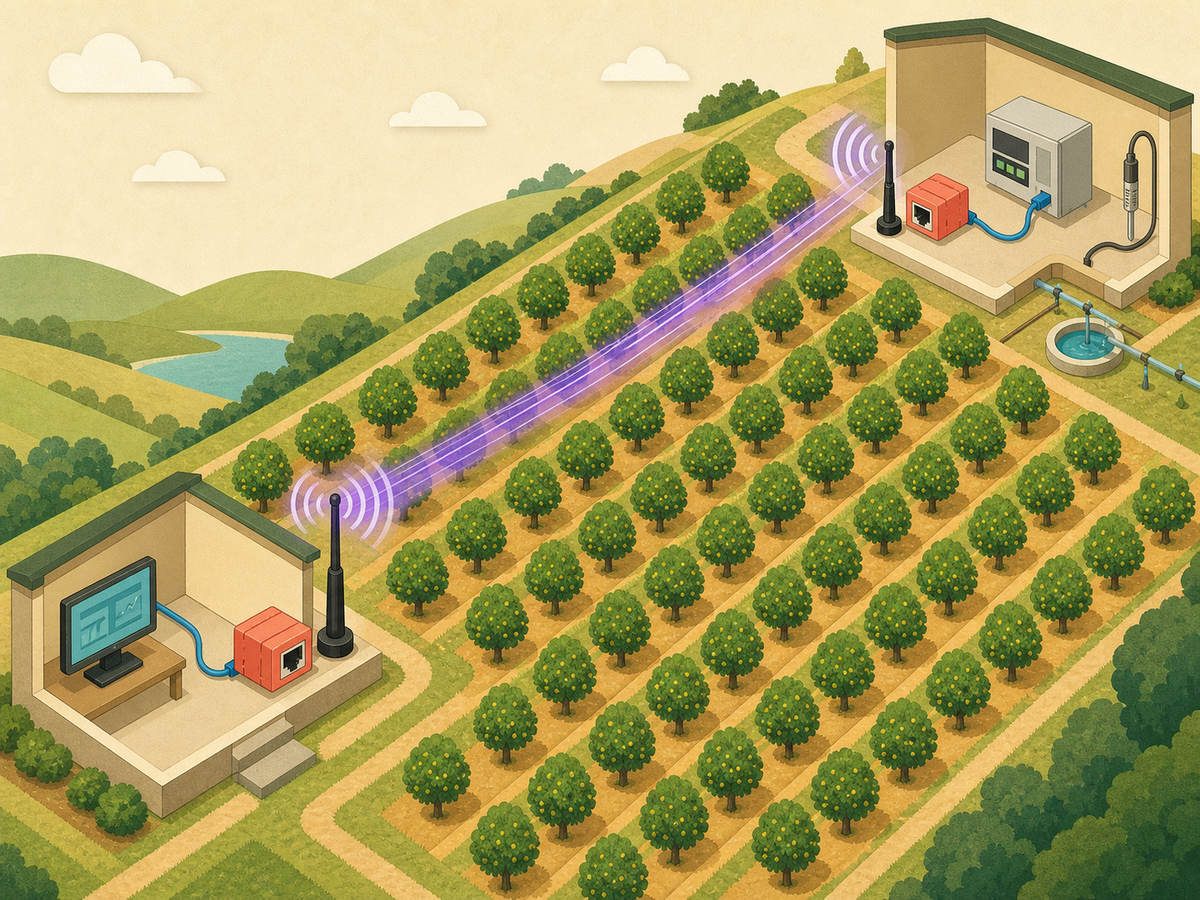
This split is attractive for brownfield automation because the PLC and PC keep familiar local TCP interfaces. The transport across the site can change without replacing the controller or extending copper through the field.
How the Dual-W5500 Architecture Works
The two Ethernet sides are separate networks. On the irrigation side, the remote node uses 192.168.0.100 and connects to the Siemens LOGO at 192.168.0.5:502. On the control side, the base node uses 192.168.1.60 and accepts a Hercules TCP client from the PC at 192.168.1.2 on port 23.
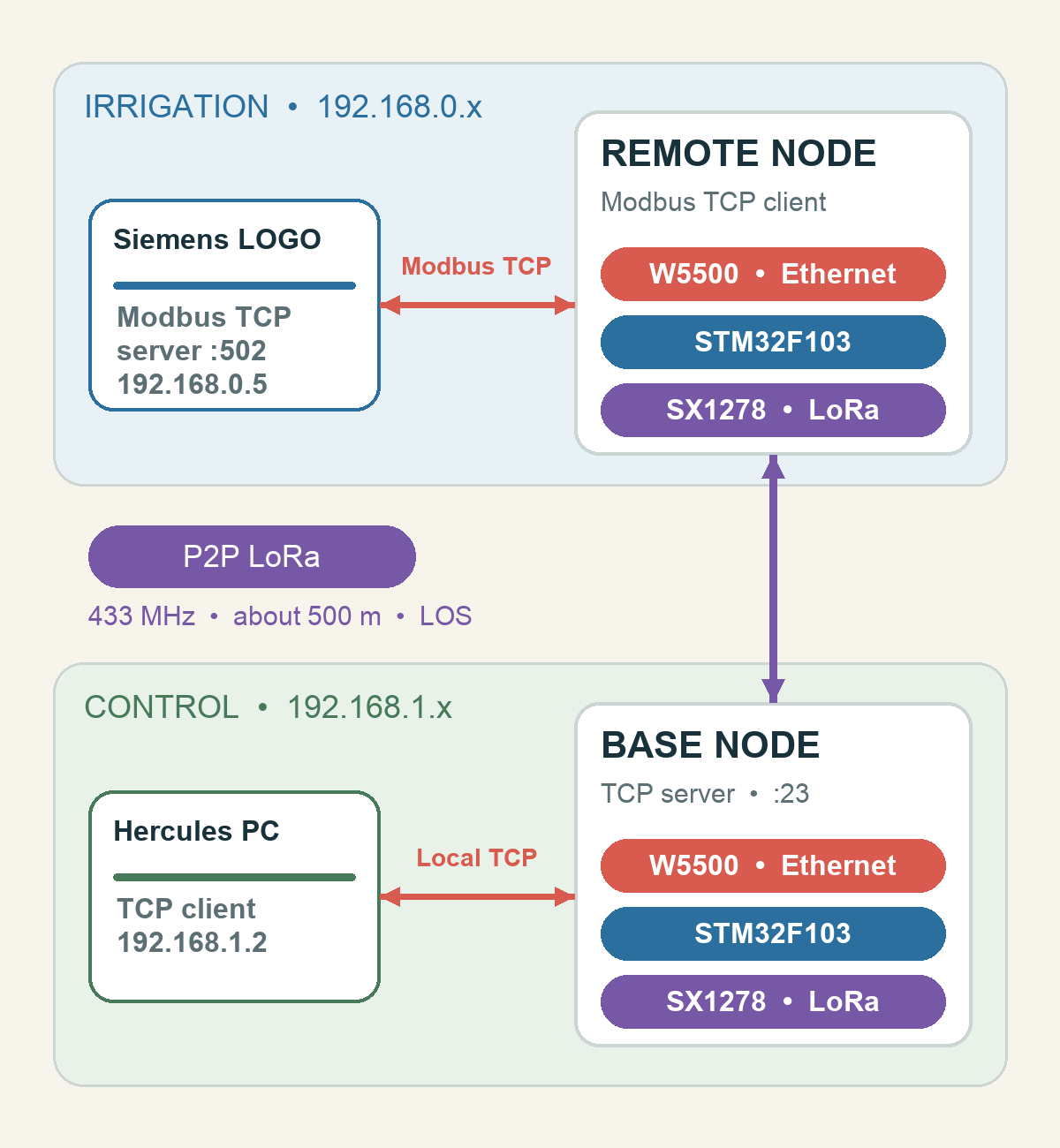
The STM32 firmware terminates each local connection and exchanges a narrow application request over LoRa. In other words, this is an application gateway, not a transparent Modbus TCP bridge. The radio does not carry arbitrary Ethernet frames or preserve one end-to-end TCP session.
The W5500 roles are complementary:
- The remote W5500 carries a Modbus TCP client connection to the LOGO server on port 502.
- The base W5500 provides a local TCP server for the operator PC on port 23.
The official W5500 documentation describes its hardwired TCP/IP stack, integrated 10/100 Ethernet MAC and PHY, eight hardware sockets, 32 KB packet memory, and SPI host interface. In this design, W5500 supplies the local Ethernet and TCP endpoints, while STM32 firmware handles the request logic, Modbus data, and LoRa coordination.
WIZnet role: The remote W5500 reaches the PLC's Modbus TCP server, while the base W5500 gives the operator PC a local TCP endpoint.
From GET DATA to LOGO AI1
The end-to-end demonstration begins when the operator enters GET DATA in Hercules. The base STM32 sends a LoRa request, the remote STM32 opens a Modbus TCP transaction through its W5500, and the LOGO returns one input-register value. The raw value and radio RSSI then travel back to Hercules.
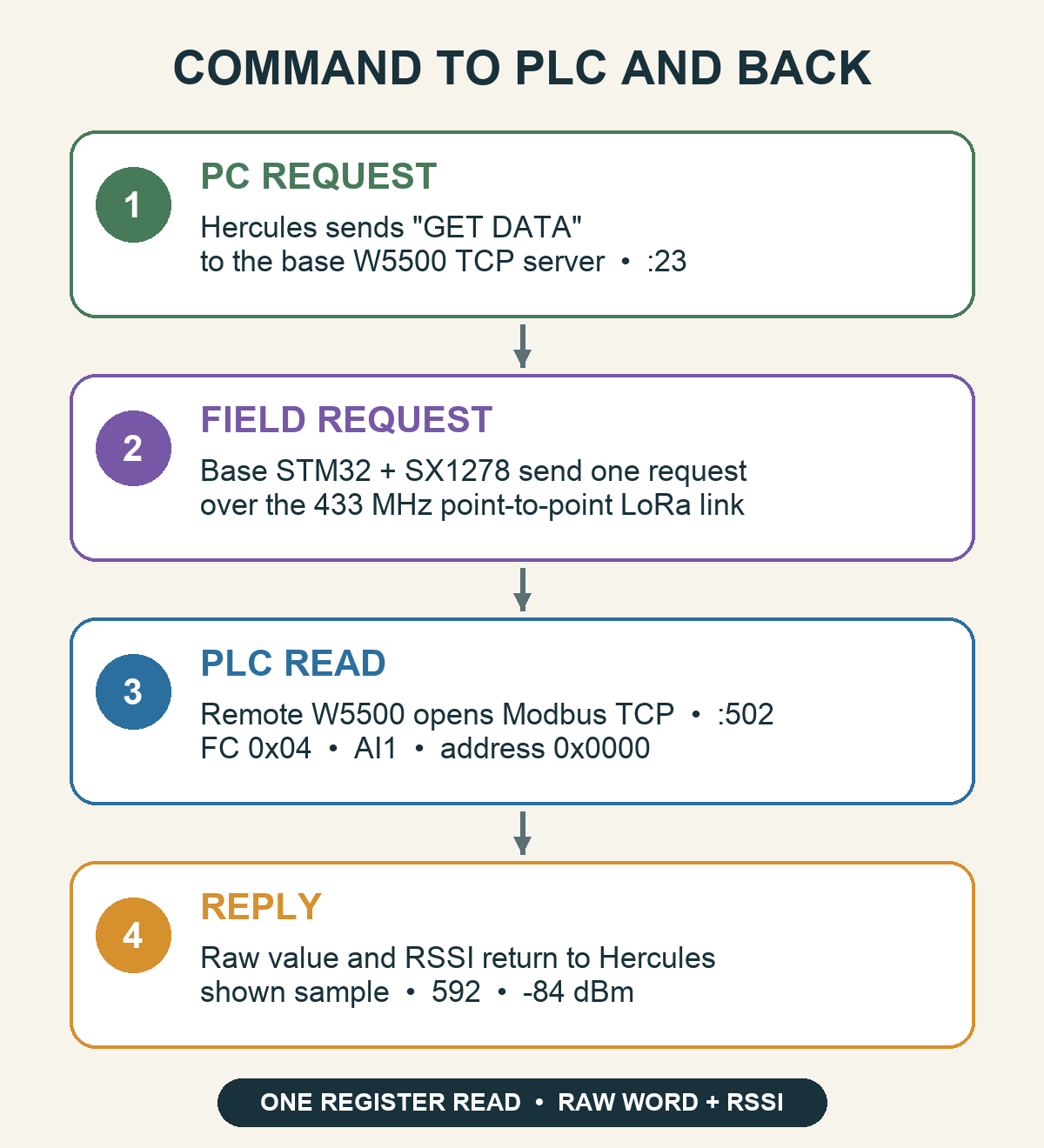
The demonstrated PLC operation is Modbus function code 0x04, Read Input Registers, at zero-based PDU address 0x0000. LOGO input I7 is configured as analog input AI1, corresponding to Input Register 1. Siemens' LOGO Modbus TCP guide explains the server/client model, and the Modbus specification site defines FC04.
In the local PLC test, polling every two seconds returned raw value 570, which increased when heat was applied to the thermocouple input. The integrated screen shows 592, 591, and 593 with RSSI values of -84, -85, and -83 dBm. These are raw register words rather than calibrated temperatures, and the demonstrated path is read-only.
What the Field Test Demonstrated
The author validated the system in stages: local PLC reading, a short-range LoRa exchange, an approximately 500 m line-of-sight radio test, and the complete manual GET DATA path. The thesis reports an average RSSI of -85 dBm for the field test.
The result shows that the complete request-and-reply path worked at the reported test location. A full radio characterization, including packet count, loss rate, latency, SNR, retries, and long-duration operation, was not published.
The radio profile also deserves a deployment check. The design table lists SF9, 125 kHz, coding rate 4/7, and +17 dBm, while a firmware capture shows spreadingFactor = 7, bandwidth = 7, and codingRate = 1. The public source does not identify which profile was active during the 500 m test.
Deployment note: Confirm the active radio profile, sensor calibration, and regional EIRP limit before reuse. Chile's July 2026 rule lists 433.05 to 434.79 MHz IoT operation at a maximum of 10 mW EIRP, or +10 dBm.
Why This Pattern Matters
The reusable idea is the architecture: two local W5500 Ethernet edges connected by a purpose-built LoRa request-and-reply link. It lets an existing PLC and operator PC keep their local network interfaces while a small gateway pair handles the difficult field segment. The same pattern can inform telemetry links for farms, tanks, pump shelters, and remote utility cabinets.
Moving from this academic prototype to a field product would require published firmware and schematics, calibrated sensing, authenticated messages, timeout and retry behavior, regional radio compliance, and longer testing. The thesis is still a useful WIZnet reference because it shows each W5500 performing a concrete TCP role at a different edge of one hybrid wired and wireless system.
Related WIZnet Maker Reading Path
For a direct wired PLC comparison, Siemens PLC+STM32-Modbus also places STM32 and W5500 beside a Siemens PLC, but uses one local Ethernet link instead of two Ethernet islands joined by LoRa.
For another LoRa-to-Ethernet pattern, LoRa Datalogger with W5500 Host focuses on a datalogger and host gateway. This thesis instead uses a paired request-and-reply path to reach one PLC register.
For the irrigation application, Remote monitoring of automatic irrigation systems and utilization of UECS uses W55RP20, LTE, MQTT, and UECS, providing an Internet-connected counterpart to this offline STM32 and SX1278 design.
❓ FAQ
Q. Is this a transparent Modbus TCP over LoRa bridge? No. The two Ethernet sides use separate subnets, and the STM32 firmware converts a local TCP command into a LoRa request and a new Modbus TCP transaction.
Q. What does each W5500 do? The remote W5500 connects to the LOGO Modbus TCP server on port 502. The base W5500 provides a TCP server for Hercules on port 23.
Q. What did the prototype read from the PLC? It used FC04 to read AI1 at PDU address 0x0000, returning raw register values such as 570 and 592.
Q. What happened at approximately 500 m? The thesis reports a working line-of-sight field demonstration with an average RSSI of -85 dBm, followed by a complete manual GET DATA test.
Q. Can the listed LoRa settings be copied directly? No. The design table and firmware capture differ, and a new installation must confirm its active profile and comply with local frequency and EIRP rules.
한국어 (Korean)
농촌 현장을 가로지르는 두 Ethernet 구간
Universidad Técnica Federico Santa María의 Alan Gamalier Vergara Muñoz가 2026년에 발표한 논문은 두 개의 로컬 Ethernet 구간을 direct LoRa 현장 링크로 연결합니다. 농촌 부지의 관개실과 운영자실은 약 500 m 떨어져 있고 Internet이나 cable을 설치할 현실적인 경로가 없습니다. 이 프로토타입은 Siemens LOGO PLC와 운영자 PC 옆에는 Ethernet을 유지하고, 긴 현장 구간에만 SX1278 radio를 사용합니다.
양쪽 노드는 STM32F103C8T6, WIZnet W5500 Ethernet module, SX1278 radio로 구성됩니다. 여기서 point-to-point LoRa는 LoRaWAN gateway나 network server 없이 두 radio가 직접 통신하는 방식입니다. UTFSM 저장소 레코드와 52페이지 논문 PDF가 prototype과 시험 내용을 보여 줍니다.
핵심: Ethernet은 양쪽 shelter의 로컬 구간에 남고, 설치가 어려운 현장 구간만 direct LoRa로 연결됩니다.
이 역할 분리는 기존 자동화 설비를 개조할 때 유용합니다. PLC와 PC는 익숙한 local TCP interface를 유지하고, controller를 교체하거나 field에 copper cable을 연장하지 않고도 현장 전송 구간을 바꿀 수 있습니다.
Dual-W5500 architecture의 동작
양쪽 Ethernet은 서로 다른 network입니다. 관개 측 remote node는 192.168.0.100을 사용하고 Siemens LOGO 192.168.0.5:502에 연결됩니다. 제어실 측 base node는 192.168.1.60을 사용하고 PC 192.168.1.2의 Hercules TCP client를 port 23에서 받습니다.
STM32 firmware는 각 local connection을 종단하고 LoRa로 필요한 application request만 주고받습니다. 따라서 이 장치는 transparent Modbus TCP bridge가 아니라 application gateway입니다. Radio가 임의의 Ethernet frame을 전달하거나 하나의 end-to-end TCP session을 유지하는 구조는 아닙니다.
두 W5500은 서로 보완적인 역할을 맡습니다.
- Remote W5500은 port 502의 LOGO server에 Modbus TCP client로 연결됩니다.
- Base W5500은 port 23에서 운영자 PC를 위한 local TCP server를 제공합니다.
W5500 공식 문서는 hardwired TCP/IP stack, 10/100 Ethernet MAC과 PHY, hardware socket 8개, packet memory 32 KB, SPI host interface를 설명합니다. 이 설계에서 W5500은 local Ethernet과 TCP endpoint를 제공하고, STM32 firmware가 request logic, Modbus data, LoRa coordination을 담당합니다.
WIZnet 역할: Remote W5500은 PLC의 Modbus TCP server에 연결하고, base W5500은 운영자 PC에 local TCP endpoint를 제공합니다.
GET DATA에서 LOGO AI1까지
End-to-end 시험은 운영자가 Hercules에 GET DATA를 입력하면서 시작합니다. Base STM32가 LoRa request를 보내고, remote STM32가 W5500을 통해 새로운 Modbus TCP transaction을 연 뒤, LOGO가 input-register 값 하나를 반환합니다. Raw value와 radio RSSI는 다시 Hercules로 돌아옵니다.
검증된 PLC operation은 Modbus function code 0x04, Read Input Registers이며 zero-based PDU address는 0x0000입니다. LOGO input I7은 analog input AI1으로 설정되어 Input Register 1에 해당합니다. Siemens의 LOGO Modbus TCP guide는 server/client model을 설명하고, Modbus specification site는 FC04를 정의합니다.
Local PLC 시험은 2초마다 polling하여 raw value 570을 반환했고 thermocouple input에 열을 가하면 값이 증가했습니다. 통합 화면에는 592, 591, 593과 RSSI -84, -85, -83 dBm이 보입니다. 이 숫자는 교정된 온도가 아니라 raw register word이며, 검증된 경로는 read-only입니다.
현장 시험에서 확인한 결과
저자는 local PLC reading, short-range LoRa exchange, 약 500 m line-of-sight radio test, 전체 수동 GET DATA path 순서로 검증했습니다. 논문은 현장 시험의 평균 RSSI를 -85 dBm으로 보고합니다.
이 결과는 논문에 기록된 시험 위치에서 전체 request-and-reply path가 동작했음을 보여 줍니다. Packet count, loss rate, latency, SNR, retry, 장기 운용을 포함한 전체 radio characterization은 공개되지 않았습니다.
Radio profile도 실제 배포 전에 확인해야 합니다. Design table은 SF9, 125 kHz, coding rate 4/7, +17 dBm을 적고 있지만, firmware capture에는 spreadingFactor = 7, bandwidth = 7, codingRate = 1이 보입니다. 공개 자료에는 500 m 시험에서 활성화된 profile이 명시되지 않습니다.
배포 시 확인: Active radio profile, sensor calibration, 지역 EIRP 제한을 확인해야 합니다. 칠레의 2026년 7월 규정은 433.05-434.79 MHz IoT 운용의 maximum EIRP를 10 mW, 즉 +10 dBm으로 정합니다.
이 구조가 의미 있는 이유
재사용 가치가 높은 부분은 두 개의 local W5500 Ethernet edge를 목적형 LoRa request-and-reply link로 연결한 architecture입니다. 기존 PLC와 운영자 PC의 local network interface를 유지하면서 작은 gateway pair가 설치하기 어려운 현장 구간을 담당합니다. 농장, tank, pump shelter, 원격 utility cabinet의 telemetry link에 참고할 수 있는 pattern입니다.
Academic prototype을 현장 제품으로 발전시키려면 공개 firmware와 schematic, calibrated sensing, authenticated message, timeout과 retry 동작, 지역 radio 규정 준수, 장기 시험이 추가로 필요합니다. 이 논문은 한 hybrid wired/wireless system의 서로 다른 edge에서 각 W5500이 구체적인 TCP 역할을 수행하는 사례라는 점에서 WIZnet reference 가치가 있습니다.
관련 WIZnet Maker 읽을거리
직접 연결된 PLC 사례를 비교하려면 Siemens PLC+STM32-Modbus가 적합합니다. STM32와 W5500을 Siemens PLC 옆에 두지만, LoRa로 연결된 두 Ethernet island 대신 하나의 local Ethernet link를 사용합니다.
다른 LoRa-to-Ethernet pattern은 LoRa Datalogger with W5500 Host에서 볼 수 있습니다. 이 글은 datalogger와 host gateway가 중심이고, 현재 논문은 PLC register 하나에 접근하는 paired request-and-reply path가 중심입니다.
관개 application은 Remote monitoring of automatic irrigation systems and utilization of UECS와 이어집니다. 이 프로젝트는 W55RP20, LTE, MQTT, UECS를 사용하므로 offline STM32와 SX1278 설계의 Internet-connected counterpart입니다.
FAQ
Q. Transparent Modbus TCP over LoRa bridge인가요? 아닙니다. 두 Ethernet side는 서로 다른 subnet을 사용하고 STM32 firmware가 local TCP command를 LoRa request와 새로운 Modbus TCP transaction으로 변환합니다.
Q. 두 W5500은 각각 무엇을 하나요? Remote W5500은 port 502의 LOGO Modbus TCP server에 연결하고, base W5500은 port 23에서 Hercules용 TCP server를 제공합니다.
Q. PLC에서 무엇을 읽었나요? FC04로 PDU address 0x0000의 AI1을 읽어 570과 592 같은 raw register value를 반환했습니다.
Q. 약 500 m 시험에서는 어떤 결과가 나왔나요? 논문은 평균 RSSI -85 dBm의 line-of-sight field demonstration을 보고하고, 이후 전체 수동 GET DATA test를 수행했습니다.
Q. LoRa 설정을 그대로 복사해도 되나요? 아닙니다. Design table과 firmware capture가 다르며, 새 설치에서는 active profile과 지역 frequency 및 EIRP 규정을 확인해야 합니다.
-
UTFSM Thesis Record
Official repository metadata for Alan Gamalier Vergara Muñoz's 2026 thesis.

-
Thesis PDF
Primary 52-page source for the dual W5500, STM32F103, SX1278, Siemens LOGO prototype and reported tests.
-
WIZnet W5500 Documentation
Official W5500 features, datasheet, driver, TCP application notes, and hardware resources.
-
Siemens LOGO Modbus TCP Guide
Official Siemens example covering LOGO Modbus TCP roles, configuration, and port 502.
-
Modbus Specifications
Official Modbus protocol specifications, including Read Input Registers function 0x04.
-
Chile Low-Power Radio Regulation, CVE 2835626
Current official spectrum and EIRP limits relevant to reuse of a 433 MHz IoT design in Chile.


