


How Does W5500 Stream 8-Channel RF Data for Drone Detection?
A Zhejiang University patent uses STM32, AD7606, and W5500 Ethernet to stream 8-channel RF data into CNN-based drone detection.
WIZnet - W5500
x 1

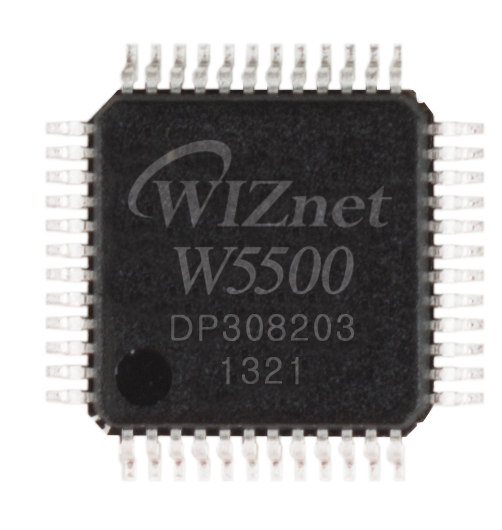
WIZnet W5500 network protocol chip used as the STM32 SPI-to-Ethernet path in the patent's microprocessor preprocessing module.
Overview
Zhejiang University ZJU is the assignee listed for CN110213010B, a Chinese granted patent for an unmanned aerial vehicle detection system based on multi-channel radio-frequency signals. The useful WIZnet Maker angle is concrete: the disclosed preprocessing module combines an STM32 MCU, an AD7606 8-channel ADC, and a WIZnet W5500 network protocol chip to move collected RF data toward a cloud training module or a decision host.
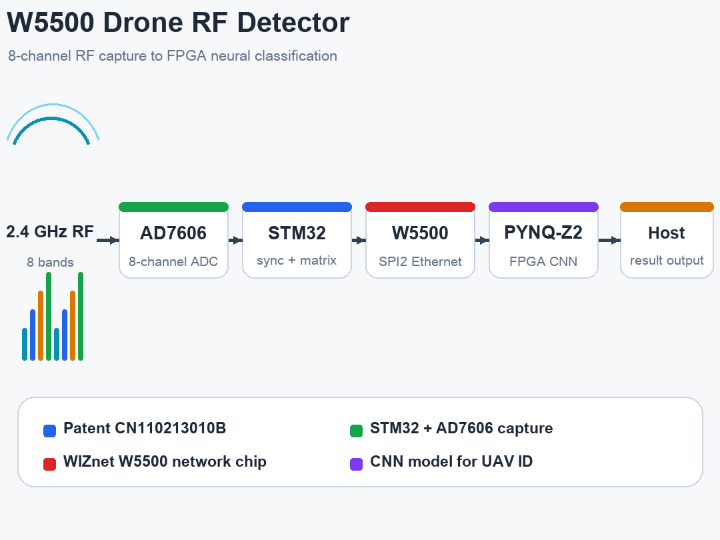
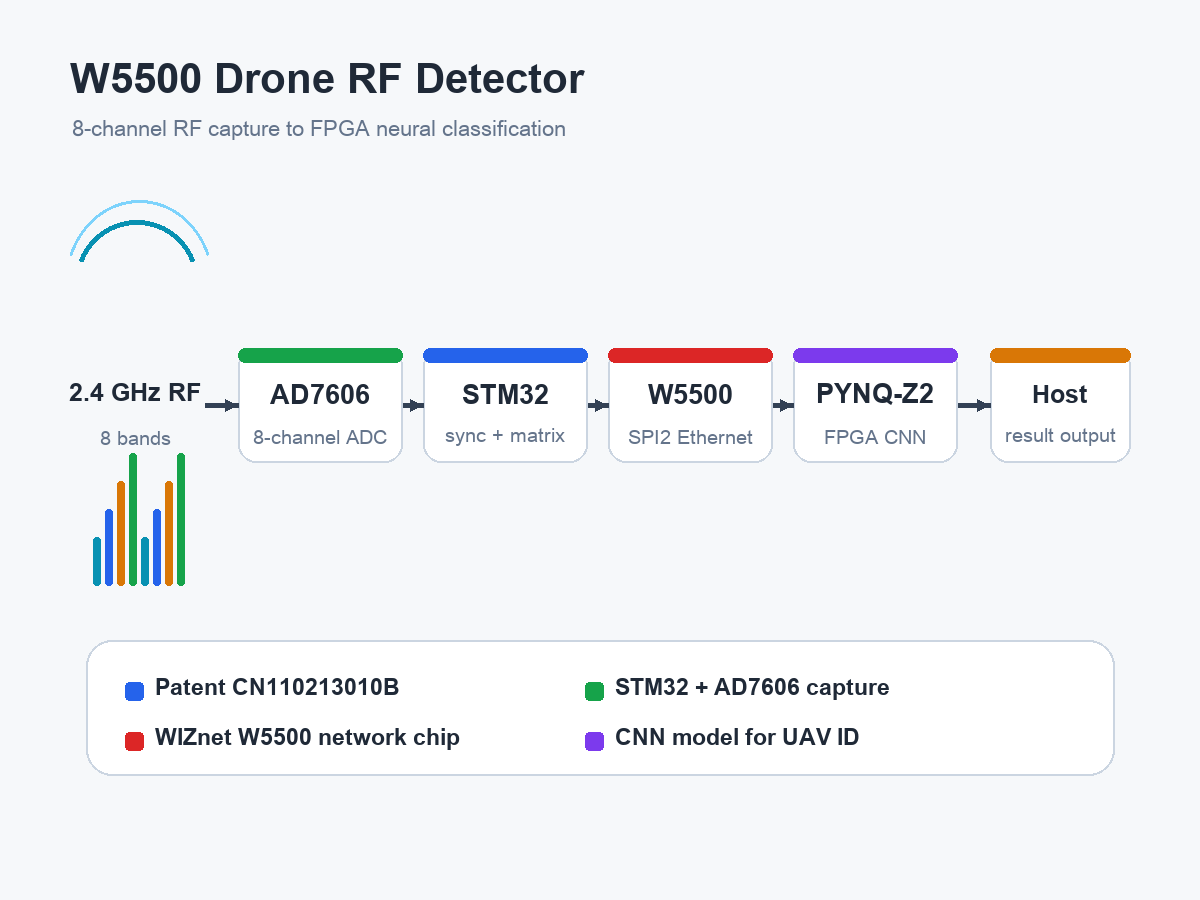
The patent shows how an embedded RF acquisition front end can turn eight channels of drone-controller signal power into structured data, then use wired Ethernet as the bridge into a CNN-based detection and drone-model identification pipeline. For WIZnet readers, the key lesson is the data path: keep RF sampling and synchronization close to the analog front end, and move the prepared matrix data to a stronger AI decision layer over W5500 Ethernet.
System Configuration
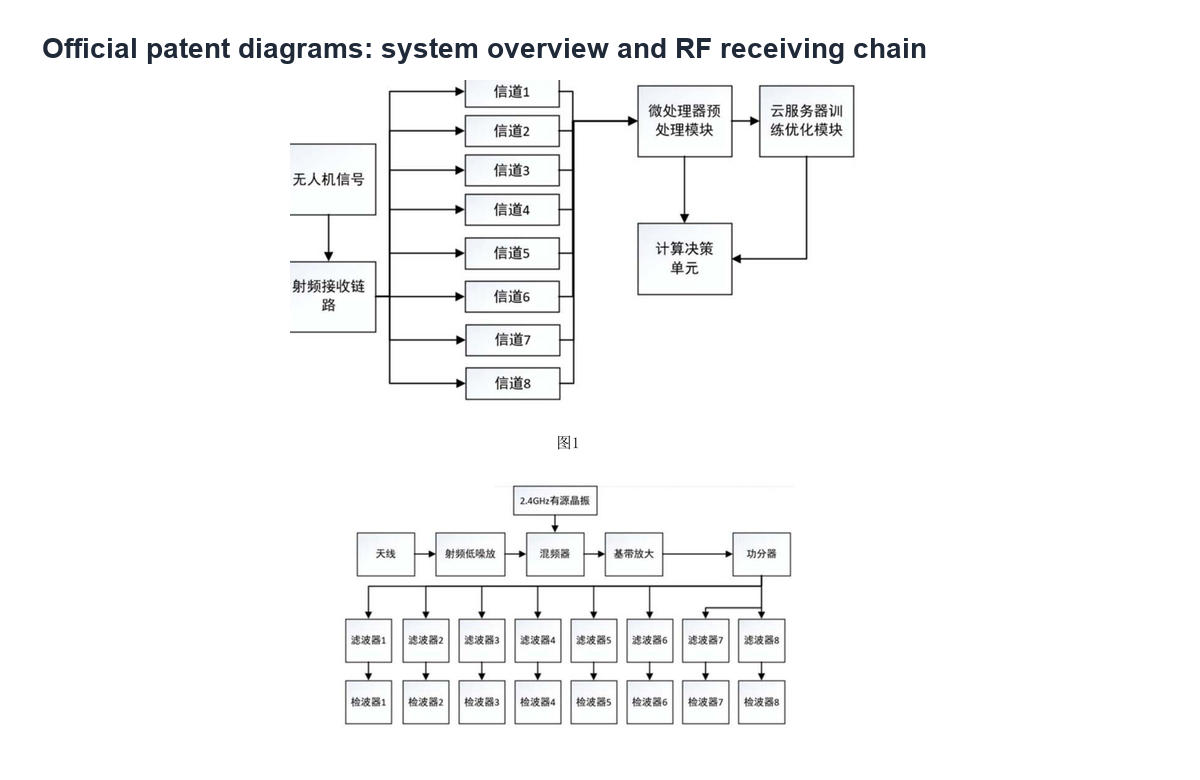
The RF receiving link targets the 2.40 GHz to 2.48 GHz band used by many drone remote-control links. The patent describes a superheterodyne receive chain with an external antenna, low-noise amplifier, mixer, 2.4 GHz active oscillator, intermediate-frequency amplification, a Mini-Circuits ZFSC-8-43 power divider, eight Chebyshev band-pass filters, and AD8362 logarithmic RF detector modules.
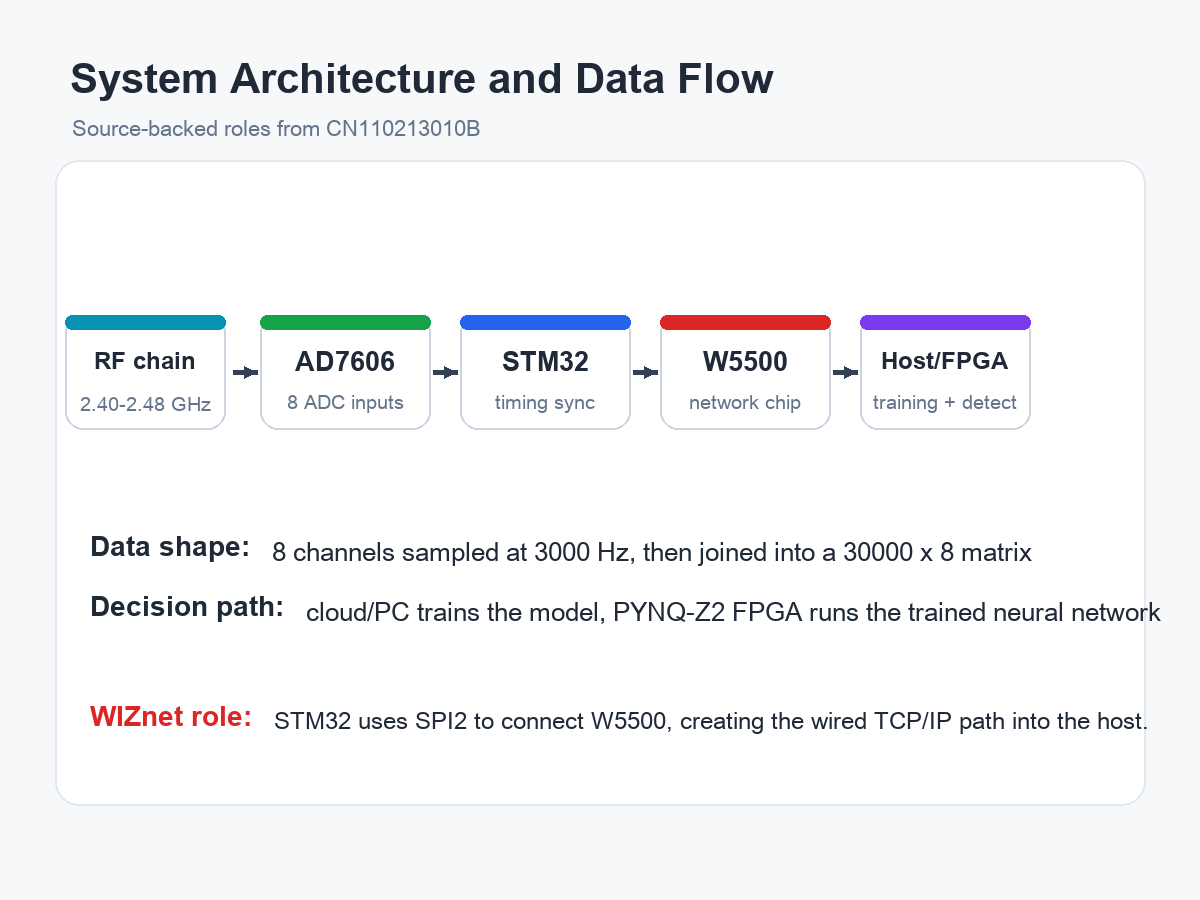
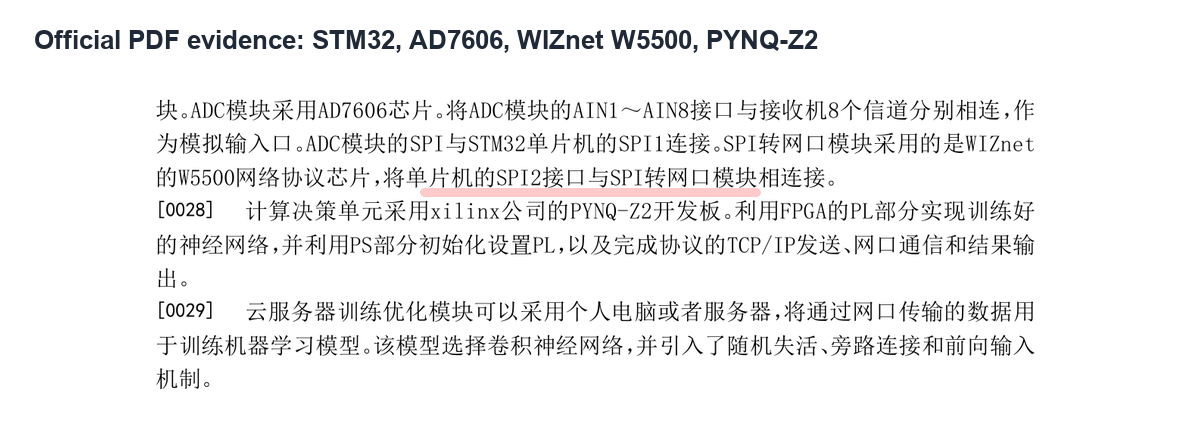
After that analog front end, the microprocessor preprocessing module is described with an STM32F104 MCU as written in the patent PDF, an AD7606 8-channel ADC, and an SPI-to-network-port module using WIZnet's W5500 network protocol chip. The AD7606 AIN1 to AIN8 inputs connect to the eight receiver channels. The ADC uses STM32 SPI1, while the W5500 module connects through STM32 SPI2.
The decision side uses a Xilinx PYNQ-Z2 development board. The patent places the trained neural network in the FPGA PL side, while the PS side receives network data, initializes the PL side, handles TCP/IP transmission and network-port communication, and outputs the result.
System Architecture and Data Flow
The data flow starts at the RF receive chain. Drone remote-control signals are divided into eight 10 MHz channels, filtered, detected as signal power, and passed to the microprocessor preprocessing module. The patent then samples the eight-channel output at 3000 Hz. Each channel contributes 30000 level values per group, and the eight channels are joined into a 30000 x 8 matrix. That matrix is labeled with drone presence and model information to become a training sample.
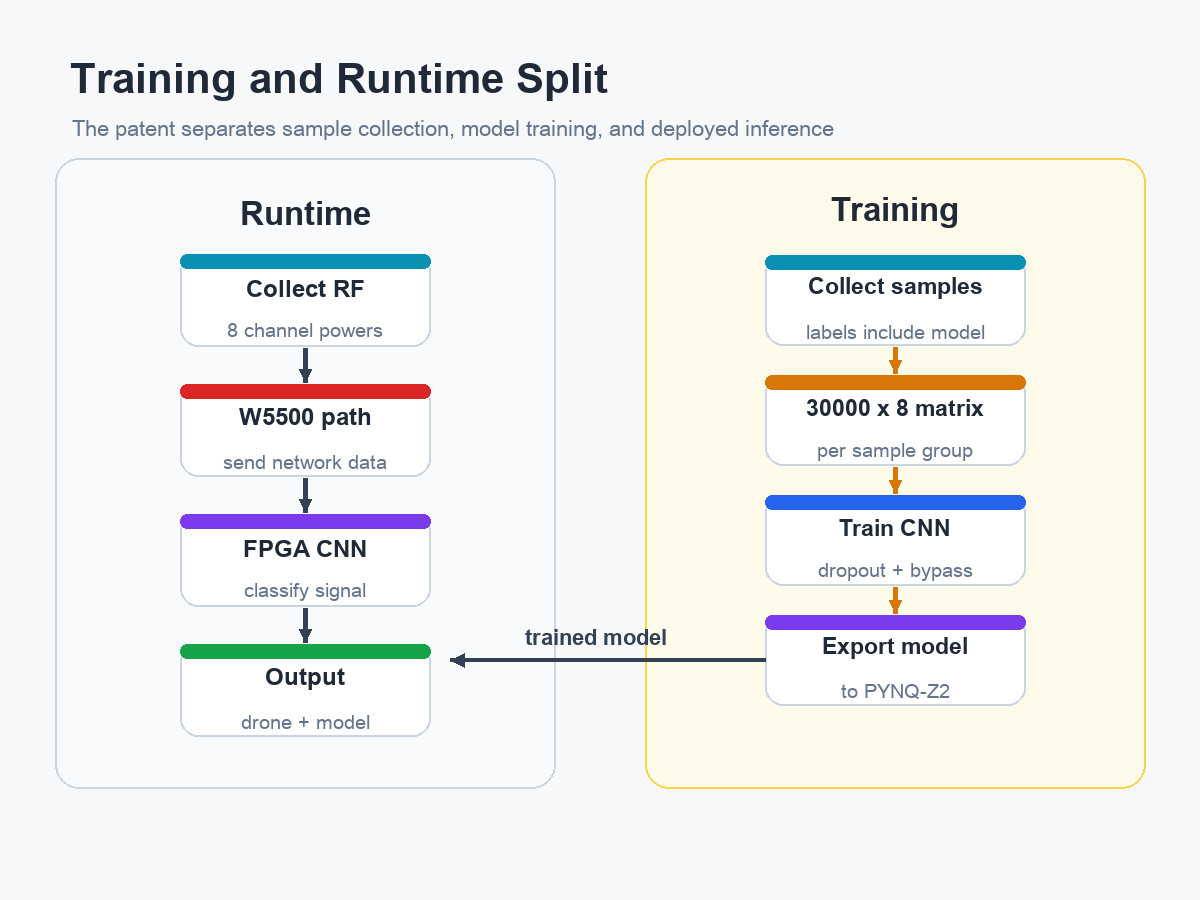
During training, the cloud server training optimization module receives the preprocessed samples and trains a machine-learning model. The model is described as a convolutional neural network with dropout, bypass connections, and a forward input mechanism. During detection, the trained model is moved to the decision unit so collected RF data can be classified for drone presence and drone model.
Role of the WIZnet W5500
The W5500 is not the AI engine in this system. It is the wired network handoff between the STM32 acquisition side and the recognition side. The patent states that the SPI-to-network-port module uses WIZnet's W5500 network protocol chip, and that the STM32 SPI2 interface connects to that module. This makes W5500 the Ethernet path for moving RF acquisition data out of the preprocessing module.
That role matters because the MCU is already coordinating ADC input, channel synchronization, and matrix construction. Offloading wired network transport to a hardwired TCP/IP Ethernet controller is a practical way to keep the acquisition side focused on timing and data preparation while a host, cloud server, or FPGA decision board handles heavier model work.
The public patent source does not include firmware, buffer configuration, driver code, or a board schematic. So this article does not speculate about the network implementation. The system-level W5500 role is clear: it is the Ethernet handoff for RF acquisition data.
Machine Learning and RF Classification
The classification idea is based on frequency-hopping behavior. Instead of trying to identify the drone from one narrow signal snapshot, the system observes signal power across multiple parallel RF channels and learns patterns associated with drone presence, drone model, and distance conditions collected during sample generation.
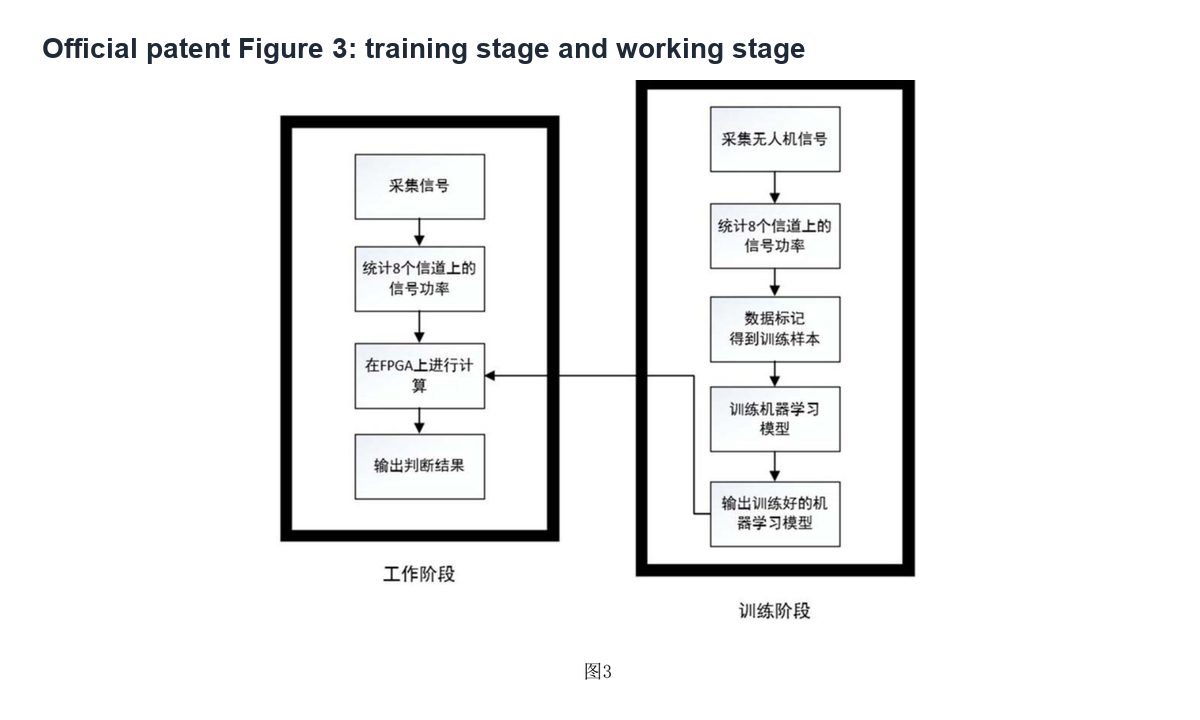
The source describes two stages. In the training stage, RF data is collected, eight-channel signal power is counted, samples are labeled, and the CNN model is trained. In the working stage, the deployed system collects RF data, performs the same channel-power processing, runs computation on the FPGA, and outputs the judgment result.
External Signals and Context
Google Patents listed ten citing patent families for this family when checked on 2026-07-06. That is useful context because it suggests the RF drone detection theme continued to attract patent activity. It should not be overread as market adoption, product shipment, or independent performance validation.
The patent itself also frames the application as low-cost, easy-to-deploy drone monitoring. For Maker readers, the strongest supported takeaway is narrower and more technical: W5500 can be used as the wired data path from an embedded RF acquisition node to a larger AI decision system.
Market and Application Value
The direct application is counter-drone monitoring. The patent targets remote-control RF activity in the 2.40 GHz to 2.48 GHz band, then uses multi-channel signal-power patterns to support drone presence and model identification. That makes the architecture relevant to RF sensing research, perimeter monitoring studies, and data-acquisition experiments where the signal source is not a simple single-channel telemetry stream.
For education and research labs, the useful teaching value is the split between sensing, preprocessing, networking, and AI inference. Students can read the system as a layered design: RF front end, AD7606 sampling, STM32 preprocessing, W5500 Ethernet transfer, and PYNQ-Z2 or host-side classification. That is easier to reason about than a single monolithic AI board that hides the data path.
For operational or B2B-style settings, the source supports only a cautious architecture-level claim. Counter-drone installations would need field validation, RF compliance review, enclosure design, calibration, datasets, and deployment evidence that are not included in the patent page. The productization path is possible as an engineering direction, but the public source does not prove a finished commercial device.
WIZnet Strategic Value
This patent is useful for WIZnet because W5500 is not presented as a generic add-on. It sits at a clear boundary between time-sensitive acquisition and heavier AI classification. The STM32 side has to coordinate eight ADC channels and construct a 30000 x 8 sample matrix; the recognition side can be a cloud server, host, or FPGA decision board. W5500 provides the wired handoff between those two responsibilities.
That pattern is reusable beyond drone detection. Any system that collects multi-channel analog data, preprocesses it on a small MCU, and then sends structured samples to a host can use the same division of labor. WIZnet's strategic value is the repeatable architecture: edge acquisition stays close to the sensor, while Ethernet moves prepared data into a larger decision system.
Where It Fits: Value and Limits
This architecture fits counter-drone monitoring, RF sensing research, and data-acquisition systems where an MCU must collect multiple analog channels but should not also carry the full recognition workload. The reusable pattern is to keep sensing and synchronization close to the RF front end, stream structured data over W5500 Ethernet, and put model training or inference on a host or FPGA board.
The limits are important. The source does not provide a firmware repository, a PCB design, a BOM, raw datasets, model files, accuracy results, or field-deployment evidence. It also should not be treated as legal advice about patent status. This Maker post curates the engineering disclosure, especially the W5500 network role, and keeps the claims within that public evidence.
Related Existing Contents and Expansion Value
Similarity Point: Batear is another drone-detection project, so it belongs to the same counter-drone learning path on Maker. Both posts ask how a sensing node can detect drone activity and send data or results through a networked embedded system.
Difference: Batear listens for drones with acoustic sensing around ESP32-S3, MEMS microphones, and LoRa or wired Ethernet/PoE options. CN110213010B works on RF remote-control signal patterns, using an analog RF receiving chain, AD7606 sampling, STM32 preprocessing, and W5500 Ethernet.
Connection Value: Together, these two posts show that counter-drone detection is not one sensor problem. Acoustic sensing and RF sensing can become two branches of a Maker learning path around drone monitoring, edge acquisition, and WIZnet-connected infrastructure.
WIZnet Success Stories: Fixed Counter-Drone Detection Infrastructure Powered by W5500 and PoE
Similarity Point: This success-story post shares the counter-drone infrastructure theme and the W5500 networking angle. Both articles make WIZnet relevant to fixed monitoring rather than a handheld or purely wireless prototype.
Difference: The success-story post is a deployed infrastructure case with W5500 and PoE. This Zhejiang University patent is a research disclosure around multi-channel RF feature acquisition and neural classification, without public firmware or deployment data.
Connection Value: Linking them gives Maker readers a range: this patent explains an RF acquisition and AI classification architecture, while the success-story post shows how W5500 can appear in fixed counter-drone infrastructure. One is an engineering disclosure, the other is closer to deployment context.
STM32+W5500+AD7606 8-channel network data acquisition board design
Similarity Point: This is the closest hardware neighbor because it shares the STM32, W5500, and AD7606 acquisition pattern. Both designs use W5500 as the network path for multi-channel acquisition data.
Difference: The acquisition-board post covers a generic 8-channel network data-acquisition board. CN110213010B applies a similar acquisition stack to drone RF detection, sample-matrix construction, and CNN-based identification.
Connection Value: The pair creates a practical bridge between product-style data acquisition and application-specific AI sensing. A reader can study the board-style acquisition case first, then use this patent article to see how the same STM32+AD7606+W5500 pattern can feed an RF classification pipeline.
Source-Backed Summary
CN110213010B is a patent disclosure for drone detection using multi-channel RF signal acquisition and CNN-based classification. Its WIZnet relevance is specific: W5500 is named in the STM32 preprocessing module as the network protocol chip that moves collected RF data out of the acquisition front end.
The strongest Maker takeaway is architectural rather than build-level. The patent separates RF sensing, ADC sampling, MCU preprocessing, Ethernet transfer, and AI decision work into distinct responsibilities. The missing pieces are also clear: there is no public firmware, PCB design, BOM, dataset, model file, benchmark, or field validation package. Within that boundary, the article is a useful WIZnet example of Ethernet-backed sensor data streaming for AI-assisted RF monitoring.
FAQ
Q. Is this a build guide? No. It is a patent disclosure. The public source does not include firmware, PCB files, schematics, training code, or a reproducible dataset package.
Q. What does W5500 do in this system? The patent names W5500 as the WIZnet network protocol chip in the STM32 SPI-to-network-port module. Its role is to move preprocessed RF acquisition data over the wired network path.
Q. Does W5500 run the neural network? No. The neural network is trained by the cloud training module and deployed on the PYNQ-Z2 decision unit. W5500 is the Ethernet transport component.
Q. What are the source limits? The chip role is verified at the system level, but implementation details are missing. The patent does not expose firmware internals, W5500 driver behavior, board files, datasets, or accuracy results.
Q. What should a maker learn from this patent? The useful pattern is to separate time-sensitive acquisition from heavy AI work: collect and structure sensor data on the MCU side, stream it through W5500 Ethernet, and classify it on a stronger host or FPGA.
한국어 (Korean)
개요
Zhejiang University ZJU는 CN110213010B의 양수인으로 표시되어 있습니다. 이 특허는 다채널 무선 주파수 신호 기반 무인기 탐지 시스템에 관한 중국 등록 특허입니다. WIZnet Maker 관점에서 중요한 지점은 명확합니다. 공개된 전처리 모듈은 STM32 MCU, AD7606 8채널 ADC, WIZnet W5500 네트워크 프로토콜 칩을 조합해 수집된 RF 데이터를 클라우드 학습 모듈 또는 판단 호스트로 보냅니다.
이 특허는 임베디드 RF 수집 프런트엔드가 8채널 드론 조종기 신호 전력을 구조화된 데이터로 만들고, 유선 이더넷을 통해 CNN 기반 탐지 및 드론 모델 식별 파이프라인으로 넘기는 방식을 보여줍니다. WIZnet 독자가 볼 핵심은 데이터 경로입니다. RF 샘플링과 동기화는 아날로그 프런트엔드 가까이에서 처리하고, 준비된 행렬 데이터는 W5500 Ethernet을 통해 더 강한 AI 판단 계층으로 보냅니다.
시스템 구성
RF 수신 링크는 많은 드론 조종 링크가 사용하는 2.40 GHz부터 2.48 GHz 대역을 대상으로 합니다. 특허는 외부 안테나, 저잡음 증폭기, 믹서, 2.4 GHz 능동 발진기, 중간주파 증폭, Mini-Circuits ZFSC-8-43 전력 분배기, 8개의 체비셰프 대역통과 필터, AD8362 로그 RF 검파 모듈로 구성된 슈퍼헤테로다인 수신 체인을 설명합니다.
그 아날로그 프런트엔드 뒤에는 마이크로프로세서 전처리 모듈이 있습니다. 특허 PDF 표현 그대로 STM32F104 MCU, AD7606 8채널 ADC, WIZnet W5500 네트워크 프로토콜 칩을 쓰는 SPI-네트워크 포트 모듈이 포함됩니다. AD7606의 AIN1부터 AIN8 입력은 수신기의 8개 채널에 연결됩니다. ADC는 STM32 SPI1을 사용하고, W5500 모듈은 STM32 SPI2로 연결됩니다.
판단 장치는 Xilinx PYNQ-Z2 개발 보드를 사용합니다. 특허는 훈련된 신경망을 FPGA PL 영역에 배치하고, PS 영역이 네트워크 데이터를 수신하며 PL 초기화, TCP/IP 전송, 네트워크 포트 통신, 결과 출력을 담당한다고 설명합니다.
시스템 아키텍처와 데이터 흐름
데이터 흐름은 RF 수신 체인에서 시작합니다. 드론 조종기 신호는 8개의 10 MHz 채널로 나뉘고, 필터링 및 검파 과정을 거쳐 신호 전력으로 전처리 모듈에 전달됩니다. 특허는 이 8채널 출력을 3000 Hz로 샘플링한다고 설명합니다. 각 채널은 한 그룹당 30000개의 레벨 값을 제공하고, 8개 채널 데이터는 30000 x 8 행렬로 결합됩니다. 이 행렬에 드론 유무와 모델 정보를 라벨링해 학습 샘플로 사용합니다.
학습 단계에서는 클라우드 서버 훈련 최적화 모듈이 전처리된 샘플을 받아 머신러닝 모델을 훈련합니다. 모델은 랜덤 드롭아웃, 바이패스 연결, 전방 입력 메커니즘을 도입한 합성곱 신경망으로 설명됩니다. 탐지 단계에서는 훈련된 모델을 판단 장치로 이식해 수집된 RF 데이터를 드론 존재 여부와 드론 모델로 분류합니다.
WIZnet W5500의 역할
W5500은 이 시스템에서 AI 엔진이 아닙니다. STM32 수집부와 인식부 사이의 유선 네트워크 연결을 담당합니다. 특허는 SPI-네트워크 포트 모듈이 WIZnet의 W5500 네트워크 프로토콜 칩을 사용하며, STM32의 SPI2 인터페이스가 그 모듈에 연결된다고 설명합니다. 따라서 W5500은 전처리 모듈 밖으로 RF 수집 데이터를 내보내는 이더넷 경로입니다.
이 역할은 중요합니다. MCU는 이미 ADC 입력, 채널 동기화, 행렬 구성을 처리해야 하기 때문입니다. 유선 네트워크 전송을 전용 Ethernet 컨트롤러에 맡기면, 수집부는 타이밍과 데이터 준비에 집중하고 호스트, 클라우드 서버, FPGA 판단 보드가 더 무거운 모델 작업을 처리할 수 있습니다.
공개 특허 자료에는 펌웨어, 버퍼 설정, 드라이버 코드, 보드 회로도가 없습니다. 따라서 이 글은 네트워크 구현을 추정하지 않습니다. 공개된 시스템 수준의 역할은 명확합니다. W5500은 RF 수집 데이터를 내보내는 Ethernet 전달부입니다.
머신러닝과 RF 분류
분류 아이디어는 주파수 도약 특성에 기반합니다. 하나의 좁은 신호 스냅샷만 보는 대신, 여러 RF 채널의 신호 전력을 병렬로 관찰하고, 샘플 생성 과정에서 수집된 드론 유무, 드론 모델, 거리 조건과 관련된 패턴을 학습합니다.
소스는 두 단계를 설명합니다. 학습 단계에서는 RF 데이터를 수집하고, 8채널 신호 전력을 통계화하며, 샘플을 라벨링하고, CNN 모델을 훈련합니다. 동작 단계에서는 배치된 시스템이 RF 데이터를 수집하고 같은 채널 전력 처리를 수행한 뒤 FPGA에서 계산하고 판단 결과를 출력합니다.
외부 신호와 맥락
2026년 7월 6일 확인 시점에 Google Patents는 이 패밀리를 인용하는 10개의 특허 패밀리를 표시했습니다. 이는 RF 드론 탐지 주제가 이후에도 특허 활동을 끌어냈다는 맥락으로는 유용합니다. 다만 이를 시장 채택, 제품 출하, 독립 성능 검증으로 해석하면 안 됩니다.
특허 자체는 이 응용을 저비용, 배치가 쉬운 드론 모니터링 구조로 설명합니다. Maker 독자에게 가장 강하게 뒷받침되는 결론은 더 좁고 기술적입니다. W5500은 임베디드 RF 수집 노드에서 더 큰 AI 판단 시스템으로 들어가는 유선 데이터 경로로 쓰일 수 있습니다.
시장 및 응용 가치
직접적인 응용 분야는 카운터 드론 모니터링입니다. 특허는 2.40 GHz부터 2.48 GHz 대역의 드론 조종 RF 활동을 대상으로 하고, 다채널 신호 전력 패턴을 이용해 드론 존재 여부와 모델 식별을 지원합니다. 따라서 단일 채널 텔레메트리보다 복잡한 신호를 다루는 RF 센싱 연구, 주변 감시 연구, 데이터 수집 실험과 연결됩니다.
교육 및 연구실 관점에서는 센싱, 전처리, 네트워킹, AI 추론이 분리되어 있다는 점이 유용합니다. 학생은 RF 프런트엔드, AD7606 샘플링, STM32 전처리, W5500 Ethernet 전송, PYNQ-Z2 또는 호스트 측 분류라는 계층 구조로 시스템을 읽을 수 있습니다. 데이터 경로가 숨겨진 단일 AI 보드보다 학습용 구조로 설명하기 쉽습니다.
운영 환경이나 B2B형 적용은 신중하게 다뤄야 합니다. 카운터 드론 설치 시스템이 되려면 현장 검증, RF 규제 검토, 인클로저 설계, 보정, 데이터셋, 배치 증거가 필요하지만 특허 페이지에는 포함되어 있지 않습니다. 제품화는 가능한 엔지니어링 방향으로 볼 수 있지만, 공개 자료가 완성형 상용 장치를 증명하지는 않습니다.
WIZnet 전략 가치
이 특허가 WIZnet에 의미 있는 이유는 W5500이 단순 부가 부품처럼 등장하지 않기 때문입니다. W5500은 시간 민감한 수집부와 더 무거운 AI 분류부 사이의 경계에 놓입니다. STM32 쪽은 8개 ADC 채널을 조정하고 30000 x 8 샘플 행렬을 구성해야 하며, 인식 쪽은 클라우드 서버, 호스트, FPGA 판단 보드가 맡을 수 있습니다. W5500은 이 두 역할 사이의 유선 전달부입니다.
이 패턴은 드론 탐지를 넘어 재사용할 수 있습니다. 여러 아날로그 채널을 수집하고, 작은 MCU에서 전처리한 뒤, 구조화된 샘플을 호스트로 보내는 시스템이라면 같은 역할 분리를 적용할 수 있습니다. WIZnet 관점의 전략 가치는 반복 가능한 구조입니다. 센서 가까이에서는 에지 수집을 처리하고, Ethernet은 준비된 데이터를 더 큰 판단 시스템으로 보냅니다.
적용 가치와 한계
이 구조는 MCU가 여러 아날로그 채널을 수집해야 하지만 전체 인식 워크로드까지 담당하기 어려운 카운터 드론 모니터링, RF 센싱 연구, 데이터 수집 시스템에 맞습니다. 재사용 가능한 패턴은 RF 프런트엔드 가까이에서 센싱과 동기화를 처리하고, W5500 이더넷으로 구조화된 데이터를 스트리밍하며, 모델 학습이나 추론은 호스트 또는 FPGA 보드에 맡기는 것입니다.
한계도 중요합니다. 공개 소스에는 펌웨어 저장소, PCB 설계, BOM, 원시 데이터셋, 모델 파일, 정확도 결과, 현장 배치 증거가 없습니다. 또한 특허 상태에 대한 법률 조언으로 다루면 안 됩니다. 이 Maker 글은 공개된 엔지니어링 구조, 특히 W5500 네트워크 역할을 큐레이션하며 주장 범위를 그 증거 안에 제한합니다.
관련 기존 콘텐츠와 확장 가치
유사점: Batear는 또 다른 드론 탐지 프로젝트이므로 Maker 사이트의 카운터 드론 학습 흐름에 함께 놓을 수 있습니다. 두 글 모두 센싱 노드가 드론 활동을 감지하고, 네트워크형 임베디드 시스템을 통해 데이터나 결과를 전달하는 문제를 다룹니다.
차이점: Batear는 ESP32-S3, MEMS 마이크, LoRa 또는 유선 Ethernet/PoE 옵션을 쓰는 음향 기반 방식입니다. CN110213010B는 RF 조종 신호 패턴을 대상으로 하며, 아날로그 RF 수신 체인, AD7606 샘플링, STM32 전처리, W5500 Ethernet을 사용합니다.
연결 가치: 두 글을 함께 보면 카운터 드론 탐지가 하나의 센서 문제만은 아니라는 점을 보여줄 수 있습니다. 음향 센싱과 RF 센싱은 드론 모니터링, 에지 수집, WIZnet 연결 인프라라는 학습 흐름의 두 가지 가지가 됩니다.
WIZnet Success Stories: Fixed Counter-Drone Detection Infrastructure Powered by W5500 and PoE
유사점: 이 성공 사례 글은 카운터 드론 인프라와 W5500 네트워킹이라는 주제를 공유합니다. 두 글 모두 WIZnet을 핸드헬드 장치나 순수 무선 프로토타입이 아니라 고정형 모니터링 구조와 연결합니다.
차이점: 성공 사례 글은 W5500과 PoE가 쓰인 배치형 인프라 사례입니다. 이 Zhejiang University 특허는 다채널 RF 특징 수집과 신경망 분류를 다루는 연구 공개 자료이며, 공개 펌웨어나 배치 데이터는 포함하지 않습니다.
연결 가치: 두 글을 연결하면 Maker 독자에게 넓은 범위를 보여줄 수 있습니다. 이 특허는 RF 수집과 AI 분류 구조를 설명하고, 성공 사례 글은 W5500이 고정형 카운터 드론 인프라에 어떻게 등장할 수 있는지를 보여줍니다.
STM32+W5500+AD7606 8-channel network data acquisition board design
유사점: 가장 가까운 하드웨어 이웃입니다. STM32, W5500, AD7606 수집 패턴을 공유하며, 두 설계 모두 W5500을 다채널 수집 데이터의 네트워크 경로로 사용합니다.
차이점: 해당 글은 일반 8채널 네트워크 데이터 수집 보드를 다룹니다. CN110213010B는 비슷한 수집 스택을 드론 RF 탐지, 샘플 행렬 구성, CNN 기반 식별에 적용합니다.
연결 가치: 두 글은 제품형 데이터 수집과 응용 특화 AI 센싱 사이를 연결합니다. 독자는 먼저 보드형 수집 사례를 보고, 그 다음 이 특허 글을 통해 같은 STM32+AD7606+W5500 패턴이 RF 분류 파이프라인으로 어떻게 이어지는지 볼 수 있습니다.
소스 기반 요약
CN110213010B는 다채널 RF 신호 수집과 CNN 기반 분류를 이용한 드론 탐지 특허 공개 자료입니다. WIZnet 관련성은 구체적입니다. W5500은 STM32 전처리 모듈에서 수집된 RF 데이터를 수집 프런트엔드 밖으로 보내는 네트워크 프로토콜 칩으로 명시되어 있습니다.
Maker 관점의 핵심은 빌드 절차보다 아키텍처입니다. 이 특허는 RF 센싱, ADC 샘플링, MCU 전처리, Ethernet 전송, AI 판단을 서로 다른 역할로 분리합니다. 동시에 한계도 분명합니다. 공개 펌웨어, PCB 설계, BOM, 데이터셋, 모델 파일, 벤치마크, 현장 검증 패키지는 없습니다. 그 범위 안에서 이 글은 AI 기반 RF 모니터링을 위한 Ethernet 센서 데이터 스트리밍 사례로 볼 수 있습니다.
FAQ
Q. 빌드 가이드인가요? 아닙니다. 특허 공개 자료입니다. 공개 소스에는 펌웨어, PCB 파일, 회로도, 학습 코드, 재현 가능한 데이터셋 패키지가 없습니다.
Q. W5500은 이 시스템에서 무엇을 하나요? 특허는 W5500을 STM32 SPI-네트워크 포트 모듈에 쓰인 WIZnet 네트워크 프로토콜 칩으로 명시합니다. 역할은 전처리된 RF 수집 데이터를 유선 네트워크 경로로 내보내는 것입니다.
Q. W5500이 신경망을 실행하나요? 아닙니다. 신경망은 클라우드 훈련 모듈에서 학습되고 PYNQ-Z2 판단 장치에 배치됩니다. W5500은 이더넷 전송 부품입니다.
Q. 이 자료의 한계는 무엇인가요? 칩 역할은 시스템 수준에서 확인되지만 구현 세부는 빠져 있습니다. 특허에는 펌웨어 내부 구현, W5500 드라이버 동작, 보드 파일, 데이터셋, 정확도 결과가 공개되어 있지 않습니다.
Q. 메이커가 이 특허에서 배울 점은 무엇인가요? 시간 민감한 수집과 무거운 AI 작업을 분리하는 구조입니다. MCU 쪽에서 센서 데이터를 수집하고 구조화한 뒤 W5500 이더넷으로 스트리밍하고, 더 강한 호스트나 FPGA에서 분류를 수행합니다.
-
CN110213010B patent page
Original Google Patents page for the multi-channel RF signal UAV detection system.

-
CN110213010B patent PDF
Downloadable official patent PDF with figures and the W5500 hardware evidence paragraph.
-
Zhejiang University
Official English website for the patent assignee shown by Google Patents.
-
WIZnet W5500 documentation
Official W5500 documentation for the hardwired TCP/IP Ethernet controller.


