


How Does W5500 Fit an AI-Enabled IoT Box Substation?
CN120262698A places W5500 Ethernet beside STM32H743 edge diagnosis, adaptive sensing, wireless failover, and cloud-trained fault models.

WIZnet - W5500
x 1

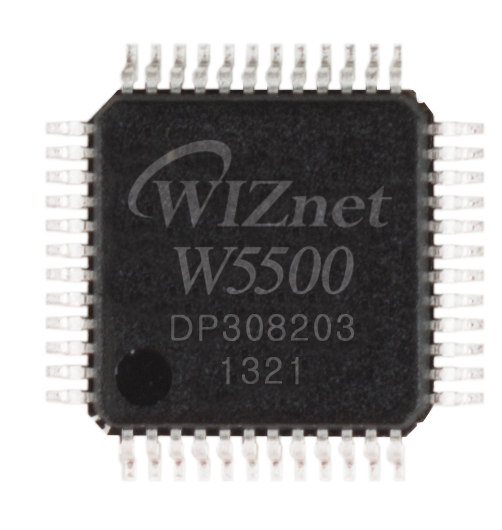
WIZnet W5500 Ethernet controller with RJ45 and stated 100 Mbps support on the patent's STM32H743 edge node.
Overview
CN120262698A is a Chinese invention-patent application from Inode Power Group for online monitoring of a box-type substation. Published in July 2025, it divides the system into a sensor network, an intelligent edge node, a self-healing communication layer, and a cloud management platform.
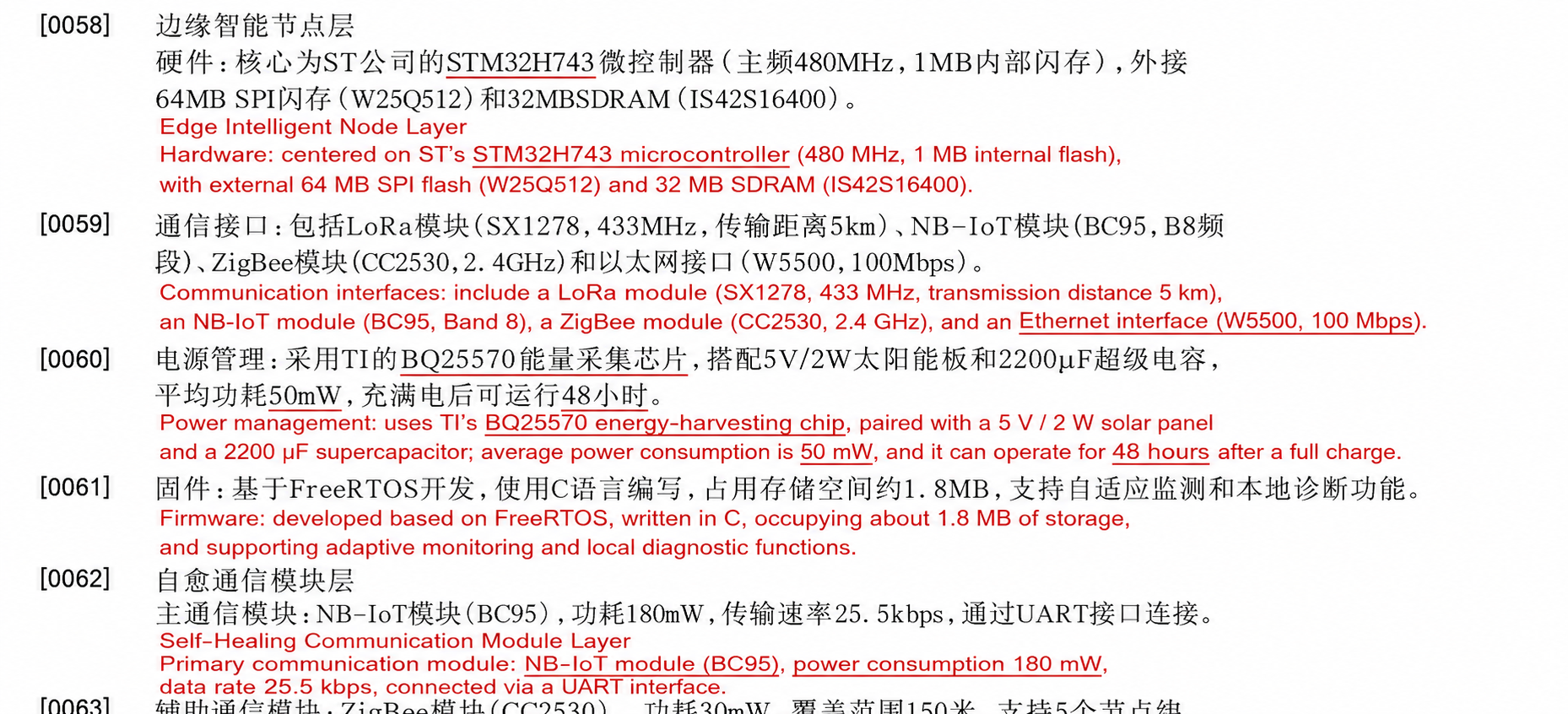
The direct WIZnet answer appears in the detailed embodiment: an STM32H743 edge board includes a WIZnet W5500 Ethernet interface with an RJ45 socket and stated 100 Mbps support. That board also carries LoRa, NB-IoT, and ZigBee interfaces. The distinction matters because the patent's worked sequence uses NB-IoT for remote upload, ZigBee for failover and relay, and LoRa for model updates or operator commands. W5500 is therefore best understood as the system's wired edge and local-network interface, not as the only communications backbone.
Key takeaway: This patent places W5500 at the edge of a multi-network monitoring system, where wired Ethernet complements sensor buses and wireless remote links.
Four Layers Around One Compact Substation
A box-type substation packages a transformer, high-voltage switchgear, and low-voltage distribution equipment inside a compact enclosure. That makes installation efficient, but it also concentrates several failure signals in one place. The patent addresses this by monitoring five signal families: temperature, partial discharge, vibration, SF6 gas, and ambient temperature and humidity.
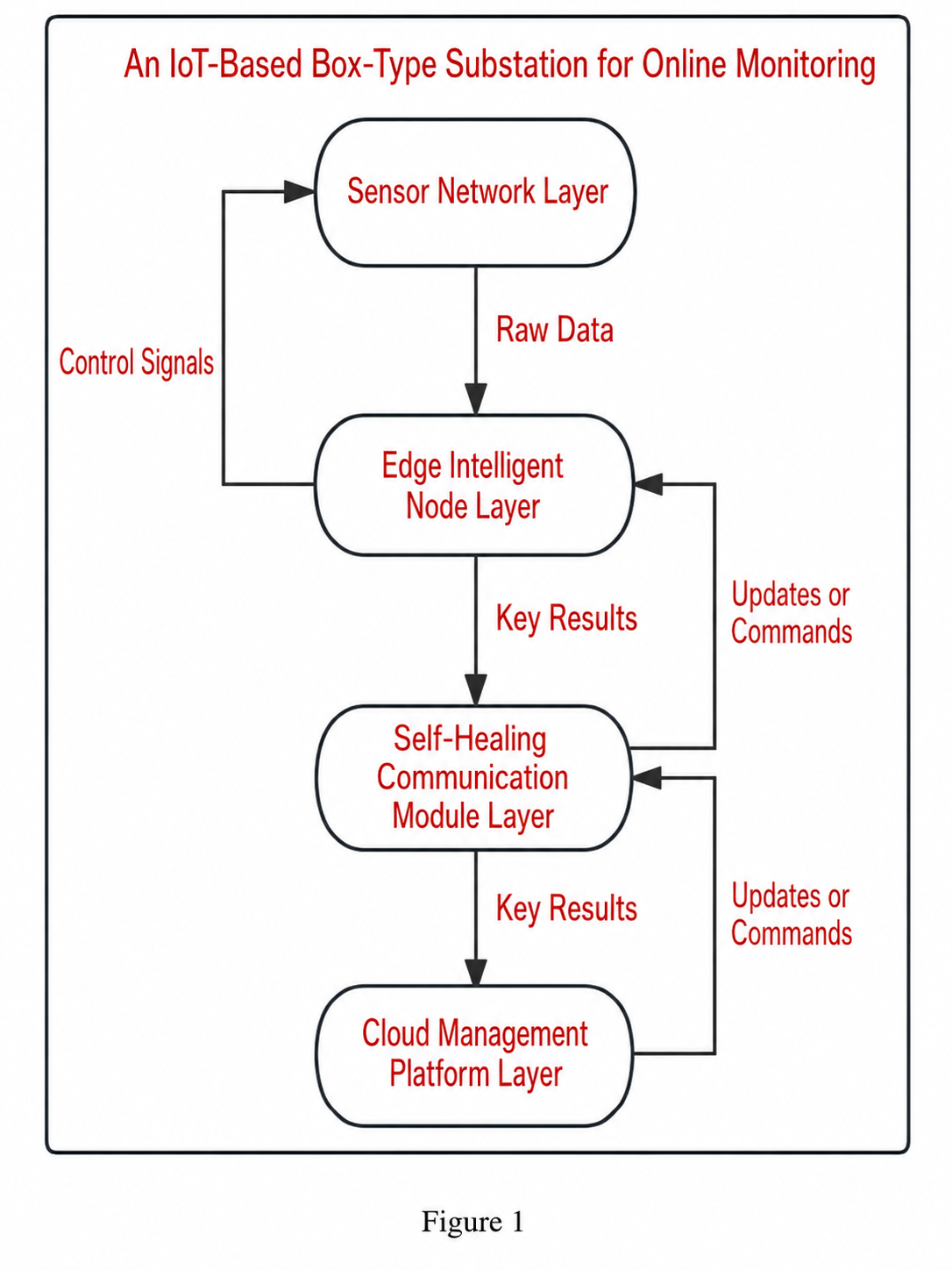
Its first layer acquires those signals. The second layer processes them close to the equipment. The third watches link quality and can change communication paths. The fourth stores long-term data, optimizes models, presents alarms, and returns updates or instructions. Figure 1 expresses that feedback loop: raw data flows upward, while control signals and updates return toward the edge and sensors.
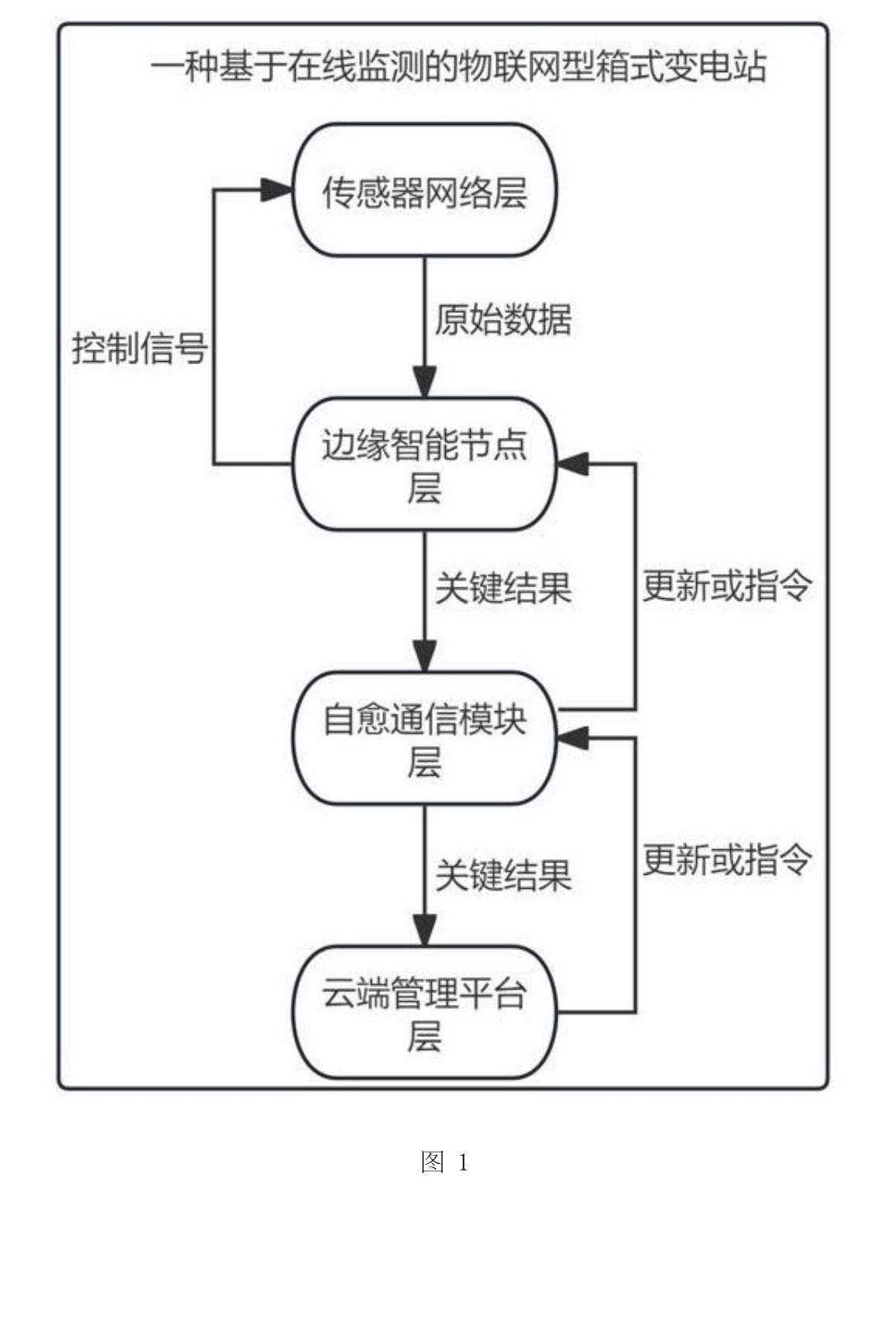
Source-derived image: official Figure 1 from CN120262698A. The Chinese labels show the four-layer architecture and its return paths.
This division gives the architecture a useful operating principle: urgent decisions stay near the substation, while slower trend analysis and model improvement stay in the cloud. A link outage should not prevent the edge node from recording an event or triggering a local response.
Sensors, Adaptive Sampling, and Local Diagnosis
The fullest sensor example names four DS18B20 temperature sensors, two custom UHF partial-discharge antennas, two ADXL345 accelerometers, one Alphasense SF6-AH gas sensor, and one SHT31 temperature/humidity module. The filing describes a mix of RS485/Modbus, I2C or SPI, and ZigBee connections rather than forcing every sensor onto one bus.
At the edge, the STM32H743 runs a sliding-window monitoring routine. One example uses a 10-second window with a 1-second step. When temperature change or vibration crosses a threshold, the node increases partial-discharge sampling and sends the new feature set to a local classifier. The example classifier separates normal, overheating, and insulation-degradation states, then can drive a relay, sound/light alarm, and local event record.
The important design idea is not a particular threshold value. It is adaptive attention: keep routine sampling economical, then spend more sensing and compute effort when multiple signals indicate a developing event.
Where W5500 Fits
Paragraph [0031] of the patent PDF names a custom edge PCB built around STM32H743, external flash and SDRAM, and four communication interfaces. The Ethernet entry is explicit: W5500 with an RJ45 socket and 100 Mbps support. Paragraph [0059] repeats that placement.
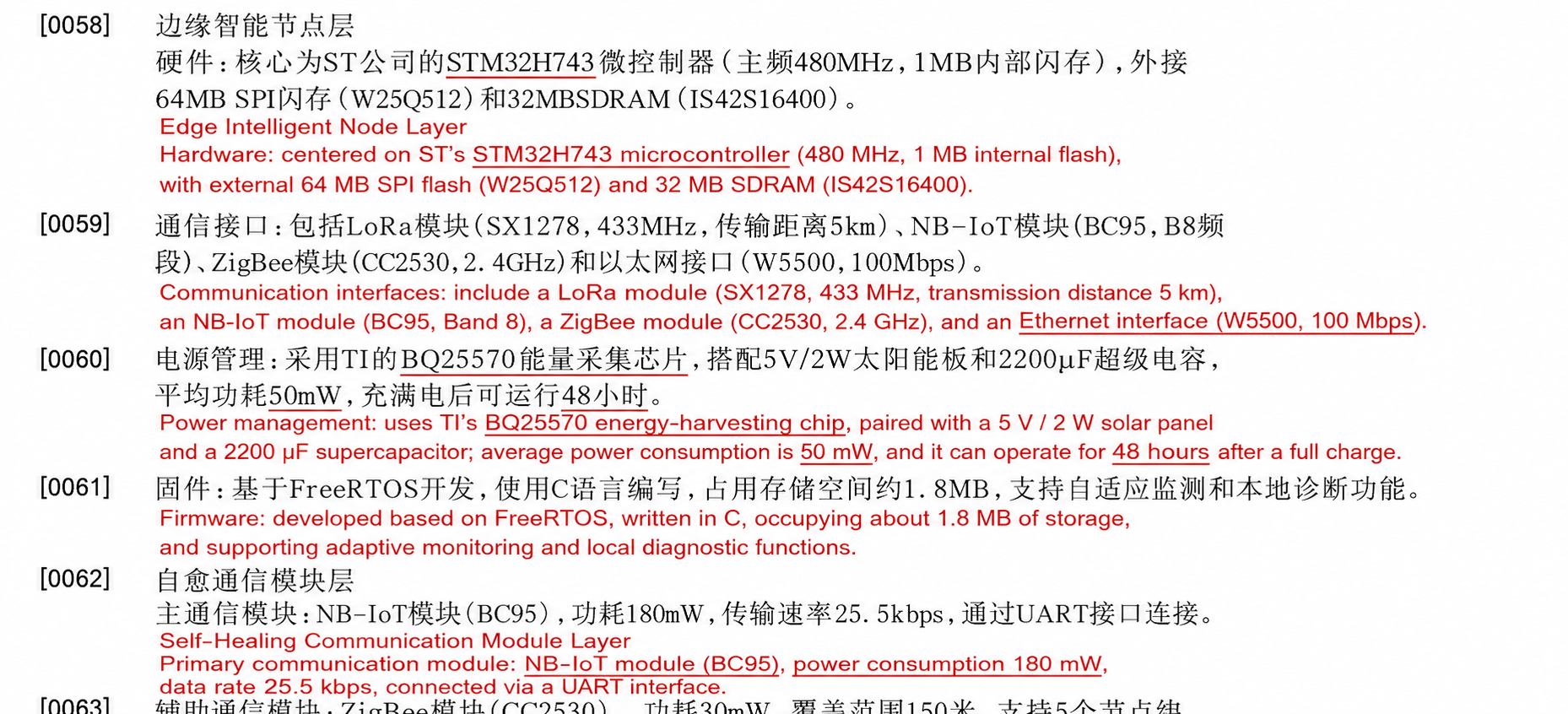
WIZnet's official W5500 documentation describes the chip as a hardwired TCP/IP Ethernet controller with an integrated 10/100 MAC/PHY, SPI host interface, eight sockets, and 32 KB of packet memory. Those capabilities explain why it suits an MCU edge node that is already busy with sensing, classification, alarms, storage, and power management.
The patent does not publish its MCU-to-W5500 wiring, socket allocation, packet format, IP configuration, or chosen application protocol. Its source-backed contribution is more architectural: it reserves a deterministic wired Ethernet surface on the edge board alongside several radio interfaces.
Source evidence: The claims refer to Ethernet generally. The detailed embodiment is where STM32H743, W5500, RJ45, and 100 Mbps are named together.
Wired Ethernet Beside the Worked Wireless Paths
The communication roles become clearer when separated by job. In the detailed runtime sequence, NB-IoT carries key anomaly data toward the cloud. ZigBee acts as an auxiliary path and can relay through neighboring nodes when the primary link degrades. LoRa carries a model update or an operator instruction back toward the edge. RS485/Modbus and ZigBee also appear on the sensor side.
W5500 is different. It gives the edge controller a local wired LAN or maintenance-facing Ethernet option. The public filing does not show that interface replacing the NB-IoT, ZigBee, or LoRa paths in the worked sequence. Reading the interfaces as parallel tools produces a more useful engineering picture than treating every network as one interchangeable cloud uplink.
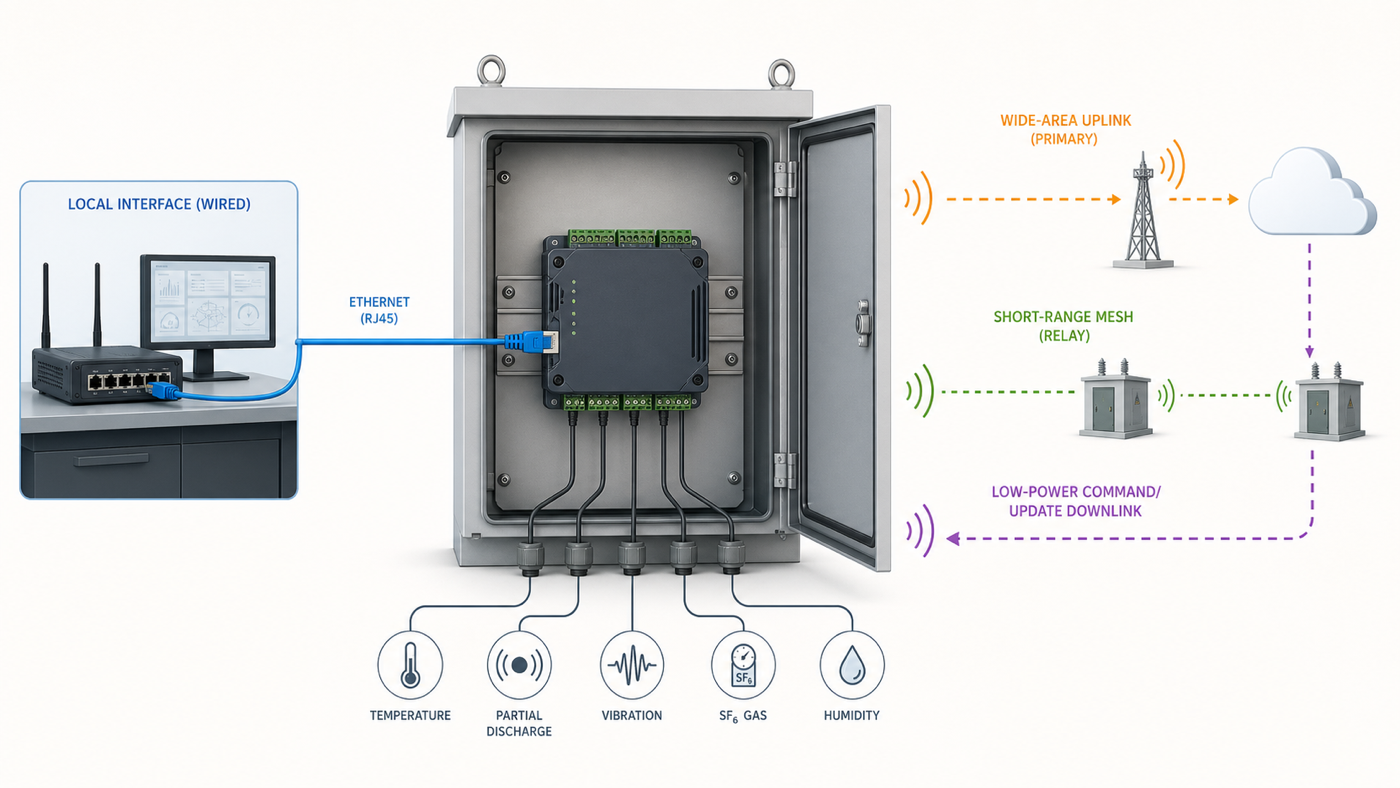
This division is especially relevant in a metal enclosure and electrically noisy environment. A designer may want wired access for commissioning, local integration, or a site LAN, while retaining low-power radios for remote or inter-node communication. The patent establishes the available interfaces, but the final operational policy would still require firmware, network design, and field validation.
Cloud Training and Edge Inference
The filing separates model development from runtime action. Historical records accumulate in the cloud, where the patent offers example SVM and random-forest training paths. A trained model is then delivered back to the edge. During operation, the STM32H743 evaluates current sensor features locally, so a relay or alarm does not have to wait for a cloud round trip.
That lifecycle can be summarized as cloud training, edge inference, local action, and later model refresh. The document describes LoRa-based OTA delivery in one embodiment and a CRC32 integrity check after transfer. It does not release the training data, feature pipeline, model files, inference library, or update-security implementation.
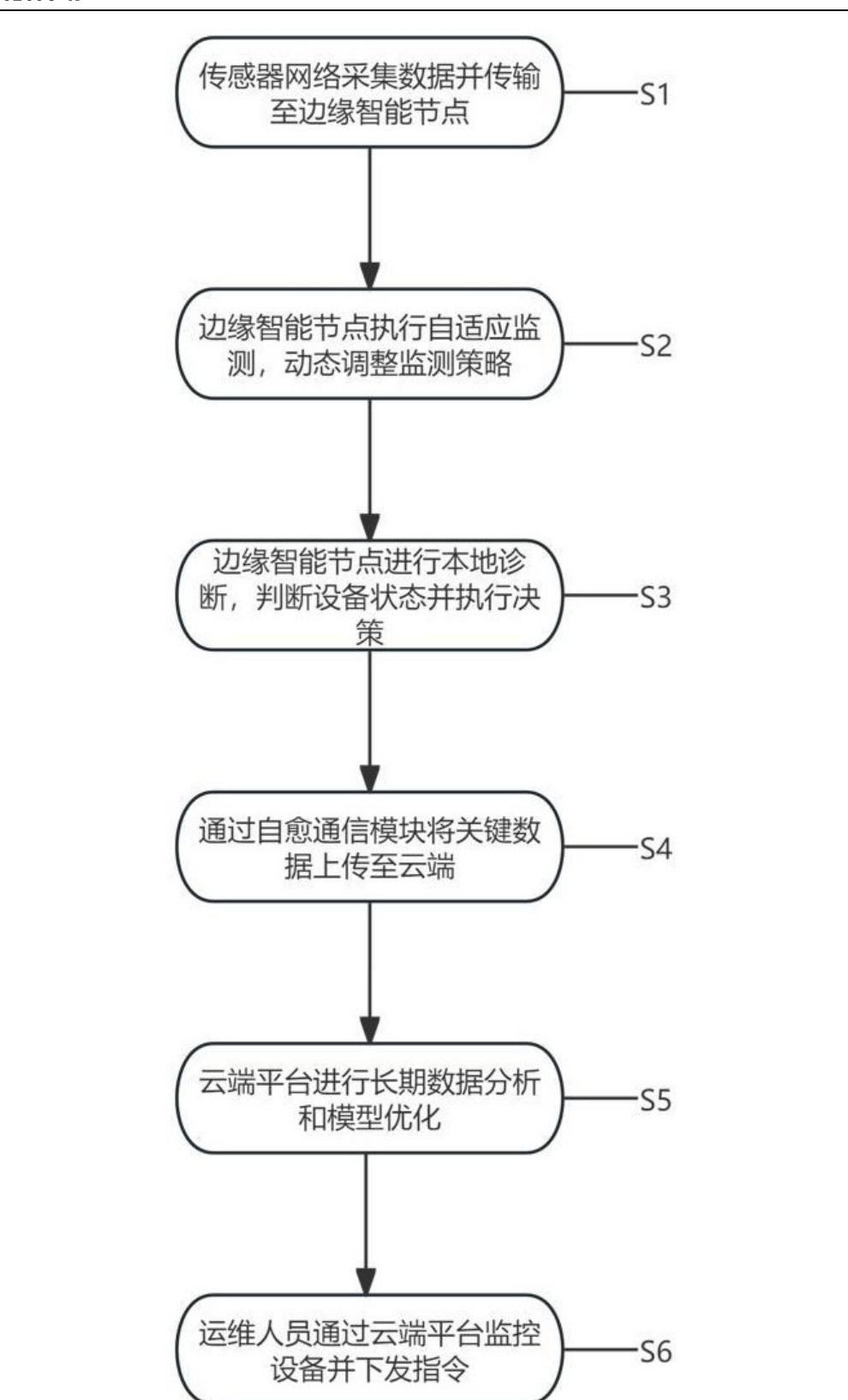
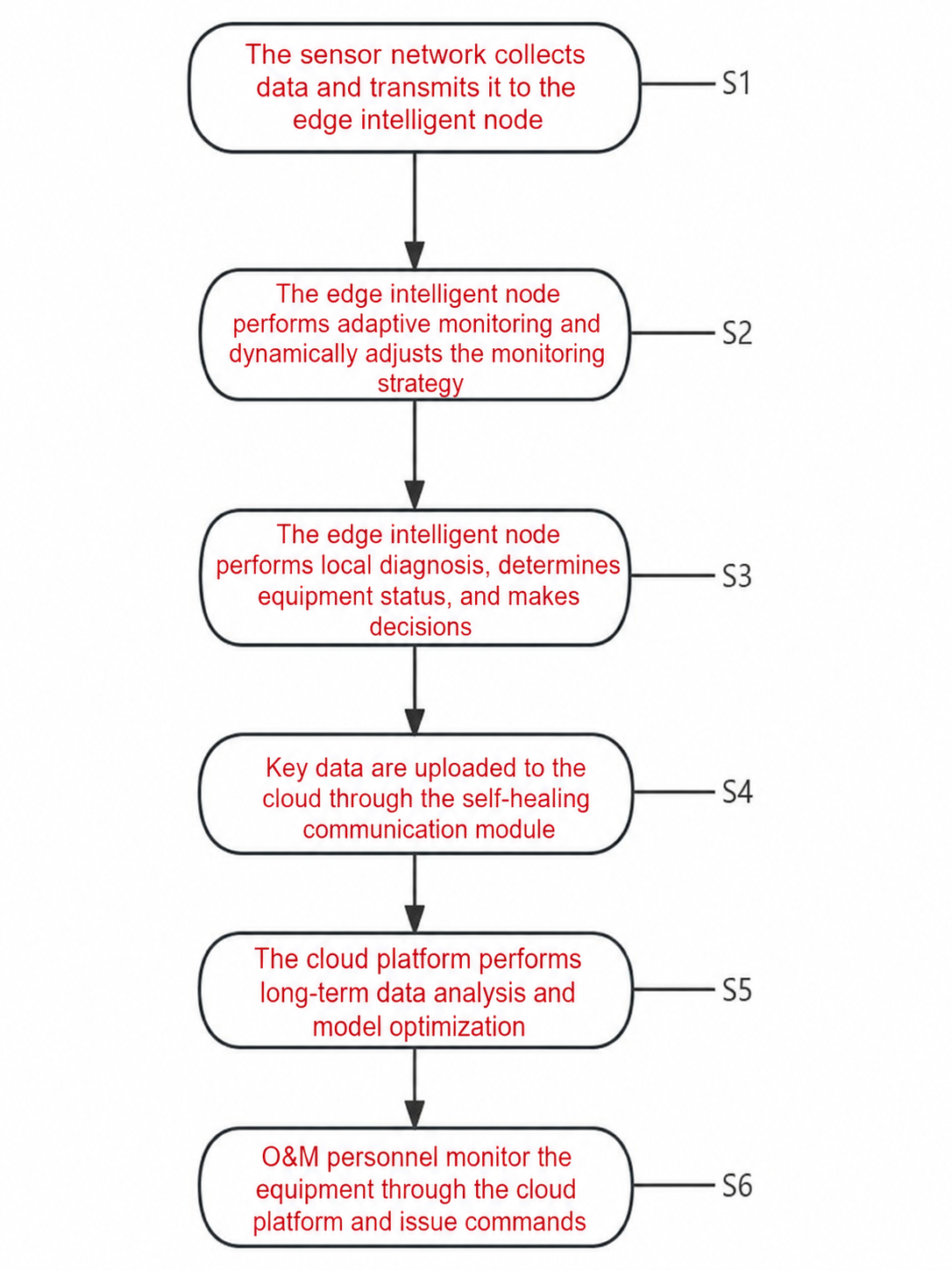
The patent presents several performance and accuracy figures, but its model names, sample counts, and software stacks vary between passages. For a Maker reader, the reproducible insight is the lifecycle boundary, not the applicant-authored benchmark numbers.
Product-Family Context Beyond the Filing
Inode Power published a company report on May 10, 2025, 25 days before the patent filing, describing installation of a 2,000 kVA IoT smart box substation for a charging-station project. The report says its management platform can monitor environmental and electrical parameters from a PC or phone and issue graded fault alarms.
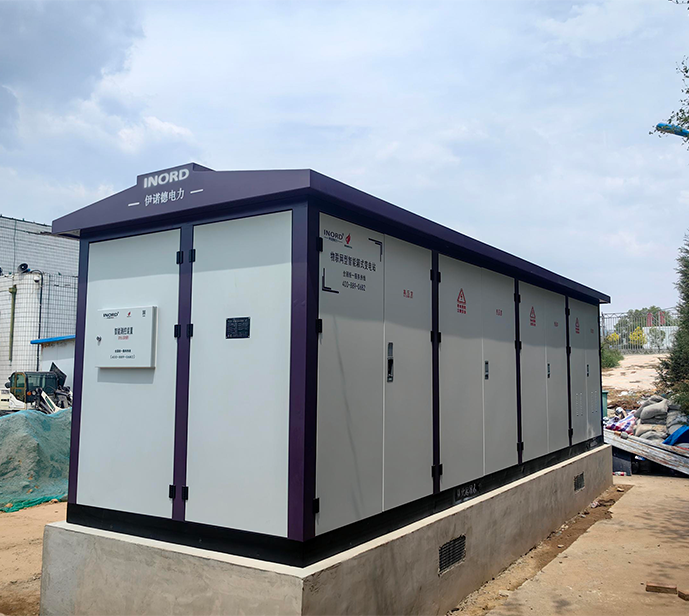
This is useful context because it shows that online-monitored box substations were part of the company's public product activity around the filing date. It is not evidence that this installation used W5500, the disclosed classifiers, or every communication layer in CN120262698A.
The filing also sits inside a wider technical trail. The same assignee has 2024 patents for an IoT low-voltage switchgear cabinet and an online-monitoring intelligent switchgear cabinet, followed by a 2025 AI high-voltage switchgear patent and a 2026 online-monitoring IoT transformer patent. Chen Feng appears as an inventor across this progression. The pattern suggests a continuing move from connected switchgear toward monitoring and local intelligence across several power-distribution assets.
Context boundary: The official installation and related patents show product and research continuity. Only CN120262698A was verified here to name W5500.
Engineering Value and Available Evidence
The strongest reusable lesson is the system partition. Multiple sensor types feed a local controller. The edge adapts its sampling and keeps immediate protection close to the equipment. Wired and wireless interfaces serve different access and resilience needs. The cloud handles history, operator visibility, and model improvement.
For a real build, the next artifacts would need to be a schematic, PCB, firmware task map, sensor calibration method, W5500 socket design, packet schema, network-security plan, OTA authentication and rollback, dataset, and field-test logs. None of those implementation files is attached to the public patent page.
Source limit: This is an architecture reference from a published patent application, supported by official company context. It is not a reproducible firmware, hardware, dataset, or validation package.
Related WIZnet Maker Reading Path
For the closest power-infrastructure comparison, read From Ethernet Chip to Power Infrastructure Safety: W5500 in PD Monitoring Systems. That article focuses on partial-discharge monitoring in switchgear, while CN120262698A expands the problem to five sensor classes, edge diagnosis, and multiple communication paths around an entire box substation.
To move from a patent architecture toward MCU implementation thinking, How Does W5500 Fit into an STM32 Predictive Maintenance Datalogger? is the useful bridge. It uses vibration, temperature, current, local storage, and an STM32/W5500 plan for machine condition monitoring. The repository is still an early scaffold, but it makes the firmware responsibilities easier to picture.
For a tangible electrical-monitoring board, continue with IPEM-S3 AI Ethernet Energy Monitor. It combines an ESP32-S3, energy-metering IC, and W5500 on an open hardware project, providing a practical counterpoint to this system-level patent disclosure.
Source-Backed Summary
CN120262698A describes an online-monitoring box substation built around sensor, edge, resilient-communication, and cloud layers. Its detailed embodiment names STM32H743 and W5500 with RJ45 and 100 Mbps Ethernet, while the worked remote sequence assigns upload, failover, and update duties to NB-IoT, ZigBee, and LoRa.
The Maker value is the division of responsibility. W5500 supplies a wired edge-network option, the MCU handles local sensing and diagnosis, wireless links support remote and inter-node communication, and the cloud maintains history and model updates. Official company material adds product-family and lifecycle context, while the missing firmware, PCB, dataset, and independent validation keep this article at architecture-reference level.
FAQ
Q. Is W5500 named in the patent claims? The claims name Ethernet generally. W5500, RJ45, and 100 Mbps appear in the detailed embodiment, including paragraphs [0031] and [0059].
Q. Is W5500 the primary cloud uplink? Not in the worked runtime sequence. That sequence uses NB-IoT for upload, ZigBee for fallback or relay, and LoRa for model updates or commands. W5500 is the named wired Ethernet interface on the edge node.
Q. Does W5500 run the machine-learning model? No. Model inference is assigned to the STM32H743 edge node, while model training and optimization are cloud tasks. W5500 provides Ethernet connectivity.
Q. Was a real box substation deployed? The company reported a 2,000 kVA IoT box-substation installation in May 2025. That report does not identify W5500 or establish that the installation implements this patent.
Q. Can this patent be reproduced as a build? Not from the public package alone. The filing does not provide firmware, a PCB or schematic, W5500 network configuration, training data, model files, or independent field-test records.
한국어 (Korean)
개요
CN120262698A는 Inode Power Group이 출원한 박스형 변전소 온라인 모니터링 기술에 관한 중국 발명특허 출원입니다. 2025년 7월 공개된 이 문서는 시스템을 센서 네트워크, 지능형 엣지 노드, 자가복구 통신 계층, 클라우드 관리 플랫폼으로 나눕니다.
WIZnet과 직접 연결되는 근거는 상세 실시예에 있습니다. STM32H743 엣지 보드에 RJ45 소켓과 100 Mbps 지원이 명시된 WIZnet W5500 Ethernet 인터페이스가 포함됩니다. 같은 보드에는 LoRa, NB-IoT, ZigBee 인터페이스도 있습니다. 여기서 역할 구분이 중요합니다. 특허의 구체 동작 예시는 원격 업로드에 NB-IoT, 장애 우회와 릴레이에 ZigBee, 모델 업데이트와 운영자 명령에 LoRa를 사용합니다. 따라서 W5500은 유일한 통신 백본이라기보다 엣지의 유선 접점과 로컬 네트워크 인터페이스로 읽는 것이 정확합니다.
핵심 요약: 이 특허에서 W5500은 다중 네트워크 모니터링 시스템의 엣지에 놓이며, 유선 Ethernet으로 센서 버스와 무선 원격 경로를 보완합니다.
하나의 소형 변전소를 둘러싼 네 계층
박스형 변전소는 변압기, 고압 개폐 장치, 저압 배전 장치를 하나의 소형 외함에 넣습니다. 설치 효율은 높지만 여러 종류의 고장 신호도 한곳에 모입니다. 이 특허는 이를 위해 온도, 부분방전, 진동, SF6 가스, 주변 온습도라는 다섯 종류의 신호를 모니터링합니다.
첫 번째 계층은 신호를 수집합니다. 두 번째 계층은 설비 가까이에서 데이터를 처리합니다. 세 번째 계층은 링크 품질을 감시하고 통신 경로를 바꿀 수 있습니다. 네 번째 계층은 장기 데이터를 저장하고 모델을 최적화하며 경보를 표시한 뒤 업데이트나 명령을 다시 보냅니다. Figure 1은 이 피드백 루프를 보여줍니다. 원시 데이터는 위로 올라가고, 제어 신호와 업데이트는 엣지와 센서 쪽으로 돌아옵니다.
이 역할 분리는 유용한 운용 원칙을 만듭니다. 긴급한 판단은 변전소 가까이에 두고, 느린 추세 분석과 모델 개선은 클라우드에 둡니다. 링크가 끊겨도 엣지 노드는 이벤트를 기록하거나 로컬 대응을 실행할 수 있어야 합니다.
센서, 적응형 샘플링, 로컬 진단
가장 구체적인 센서 예시는 DS18B20 온도 센서 4개, 주문형 UHF 부분방전 안테나 2개, ADXL345 가속도계 2개, Alphasense SF6-AH 가스 센서 1개, SHT31 온습도 모듈 1개를 열거합니다. 모든 센서를 한 버스에 넣지 않고 RS485/Modbus, I2C 또는 SPI, ZigBee를 조합합니다.
엣지의 STM32H743은 슬라이딩 윈도 모니터링을 실행합니다. 한 실시예는 10초 윈도와 1초 스텝을 사용합니다. 온도 변화나 진동이 임계값을 넘으면 부분방전 샘플링을 높이고 새 특징값을 로컬 분류기에 넣습니다. 예시 분류기는 정상, 과열, 절연 열화를 구분하며 릴레이, 소리/빛 경보, 로컬 이벤트 기록을 동작시킬 수 있습니다.
여기서 중요한 설계 아이디어는 특정 임계값 자체가 아니라 적응형 주의 배분입니다. 평상시에는 샘플링 비용을 낮게 유지하고, 여러 신호가 이상 징후를 보일 때 센싱과 연산 자원을 더 투입합니다.
W5500이 놓이는 자리
특허 PDF 문단 [0031]은 STM32H743, 외부 Flash와 SDRAM, 네 종류의 통신 인터페이스로 구성한 주문형 엣지 PCB를 설명합니다. Ethernet 항목은 명확합니다. RJ45 소켓과 100 Mbps 지원이 명시된 W5500입니다. 문단 [0059]도 같은 배치를 다시 적습니다.
WIZnet 공식 W5500 문서는 W5500을 10/100 MAC/PHY, SPI 호스트 인터페이스, 8개 소켓, 32 KB 패킷 메모리를 통합한 하드와이어드 TCP/IP Ethernet 컨트롤러로 설명합니다. 이런 특성은 센싱, 분류, 경보, 저장, 전력 관리를 동시에 처리해야 하는 MCU 엣지 노드에 잘 맞습니다.
특허는 MCU와 W5500의 배선, 소켓 할당, 패킷 형식, IP 설정, 응용 프로토콜을 공개하지 않습니다. 공개 근거로 확인되는 가치는 구조적입니다. 여러 무선 인터페이스와 함께 엣지 보드에 안정적인 유선 Ethernet 접점을 확보합니다.
원문 근거: 청구항은 Ethernet을 일반적으로 적습니다. STM32H743, W5500, RJ45, 100 Mbps가 함께 등장하는 곳은 상세 실시예입니다.
실제 동작 예시의 무선 경로 옆에 놓인 유선 Ethernet
통신을 역할별로 나누면 구조가 더 잘 보입니다. 상세 동작 예시에서 NB-IoT는 핵심 이상 데이터를 클라우드로 보냅니다. ZigBee는 보조 경로로 동작하며 주 링크 품질이 나빠지면 이웃 노드를 통해 릴레이할 수 있습니다. LoRa는 모델 업데이트나 운영자 명령을 엣지 쪽으로 전달합니다. 센서 쪽에는 RS485/Modbus와 ZigBee도 등장합니다.
W5500의 역할은 다릅니다. 엣지 컨트롤러에 로컬 유선 LAN 또는 유지보수용 Ethernet 선택지를 제공합니다. 공개 특허의 동작 예시는 이 인터페이스가 NB-IoT, ZigBee, LoRa를 대체한다고 설명하지 않습니다. 각 인터페이스를 병렬 도구로 읽는 편이 모든 네트워크를 하나의 클라우드 업링크로 보는 것보다 실제 설계에 유용합니다.
이 역할 분리는 금속 외함과 전기적 노이즈가 있는 환경에서 특히 의미가 있습니다. 설계자는 시운전, 로컬 통합, 현장 LAN에는 유선을 쓰고 원격 또는 노드 간 통신에는 저전력 무선을 유지할 수 있습니다. 특허는 사용 가능한 인터페이스를 제시하지만, 최종 운용 정책에는 펌웨어, 네트워크 설계, 현장 검증이 추가로 필요합니다.
클라우드 학습과 엣지 추론
특허는 모델 개발과 런타임 동작을 분리합니다. 과거 데이터는 클라우드에 누적되고, 문서는 SVM과 랜덤 포레스트를 예시 학습 경로로 제시합니다. 학습된 모델은 다시 엣지에 전달됩니다. 운용 중에는 STM32H743이 현재 센서 특징을 로컬에서 평가하므로 릴레이나 경보가 클라우드 왕복을 기다릴 필요가 없습니다.
이 수명주기는 클라우드 학습, 엣지 추론, 로컬 동작, 이후 모델 갱신으로 정리할 수 있습니다. 한 실시예는 LoRa 기반 OTA와 전송 후 CRC32 무결성 확인을 설명합니다. 그러나 학습 데이터, 특징 처리 파이프라인, 모델 파일, 추론 라이브러리, 업데이트 보안 구현은 공개하지 않습니다.
원본 기반 이미지: CN120262698A의 공식 Figure 5로, 센서 수집부터 클라우드 최적화와 운영자 명령까지 표시합니다.
특허에는 여러 성능 및 정확도 수치가 나오지만 구간마다 모델명, 샘플 수, 소프트웨어 구성이 달라집니다. Maker 독자가 재사용할 수 있는 핵심은 출원인이 적은 벤치마크 숫자가 아니라 학습과 추론의 역할 경계입니다.
특허 밖에서 확인되는 제품군 맥락
Inode Power는 특허 출원일보다 25일 앞선 2025년 5월 10일, 충전소 프로젝트에 2,000 kVA IoT 스마트 박스 변전소를 설치했다고 회사 공식 자료로 알렸습니다. 해당 자료는 PC나 휴대폰에서 환경·전기 파라미터를 모니터링하고 장애 등급별 경보를 제공한다고 설명합니다.
이 자료는 온라인 모니터링형 박스 변전소가 출원 시점 전후 회사의 공개 제품 활동에 포함되어 있었다는 맥락을 보여줍니다. 하지만 그 현장에 W5500, 공개된 분류기, CN120262698A의 모든 통신 계층이 적용되었다는 근거는 아닙니다.
이번 출원은 더 넓은 기술 흐름 안에도 놓입니다. 동일 출원인은 2024년 IoT 저압 개폐반과 온라인 모니터링형 지능 개폐반 특허를 보유하고, 이후 2025년 AI 고압 개폐반, 2026년 온라인 모니터링 IoT 변압기 특허로 이어집니다. Chen Feng은 이 흐름 전반에 발명자로 등장합니다. 이는 연결형 개폐반에서 여러 배전 설비의 모니터링과 로컬 지능으로 확장되는 방향을 보여줍니다.
맥락의 경계: 회사 설치 자료와 관련 특허들은 제품 및 연구의 연속성을 보여줍니다. 이번 조사에서 W5500을 명시적으로 확인한 자료는 CN120262698A입니다.
엔지니어링 가치와 공개된 근거
가장 재사용하기 좋은 교훈은 시스템 분할입니다. 여러 센서가 로컬 컨트롤러로 들어오고, 엣지는 샘플링을 조절하며 즉각적인 보호 동작을 설비 가까이에 둡니다. 유선과 무선 인터페이스는 서로 다른 접근성과 복원력 요구를 담당합니다. 클라우드는 이력, 운영자 가시성, 모델 개선을 맡습니다.
실제 빌드로 옮기려면 회로도, PCB, 펌웨어 태스크 구성, 센서 보정 방법, W5500 소켓 설계, 패킷 스키마, 네트워크 보안 계획, OTA 인증과 롤백, 데이터셋, 현장 테스트 로그가 필요합니다. 공개 특허 페이지에는 이런 구현 파일이 첨부되어 있지 않습니다.
자료 한계: 이 글은 공개 특허 출원과 회사 공식 맥락을 바탕으로 한 아키텍처 참고 사례입니다. 재현 가능한 펌웨어, 하드웨어, 데이터셋, 검증 패키지는 아닙니다.
함께 읽으면 좋은 WIZnet Maker 글
가장 가까운 전력 인프라 비교는 From Ethernet Chip to Power Infrastructure Safety: W5500 in PD Monitoring Systems입니다. 이 글은 개폐반 부분방전 모니터링에 집중하고, CN120262698A는 다섯 센서 종류, 엣지 진단, 박스 변전소 전체를 둘러싼 다중 통신 경로로 문제를 확장합니다.
특허 구조를 MCU 구현 관점으로 이어 보고 싶다면 How Does W5500 Fit into an STM32 Predictive Maintenance Datalogger?가 유용합니다. 진동, 온도, 전류, 로컬 저장, STM32/W5500 계획을 기계 상태 모니터링에 적용합니다. 저장소는 아직 초기 스캐폴드이지만 펌웨어 책임을 구체적으로 상상하는 데 도움이 됩니다.
실물 전력 모니터링 보드를 보고 싶다면 IPEM-S3 AI Ethernet Energy Monitor로 이어갈 수 있습니다. ESP32-S3, 전력 계측 IC, W5500을 공개 하드웨어 프로젝트에 결합해 이번 시스템 수준 특허와 실용적인 대조를 이룹니다.
소스 기반 요약
CN120262698A는 센서, 엣지, 복원력 있는 통신, 클라우드 계층으로 구성된 온라인 모니터링 박스 변전소를 설명합니다. 상세 실시예는 STM32H743과 RJ45·100 Mbps Ethernet을 지원하는 W5500을 명시하고, 구체적인 원격 동작 예시는 NB-IoT, ZigBee, LoRa에 업로드, 장애 우회, 업데이트 역할을 나눕니다.
Maker 관점의 가치는 역할 분리입니다. W5500은 유선 엣지 네트워크 선택지를 제공하고, MCU는 로컬 센싱과 진단을 처리하며, 무선 링크는 원격 및 노드 간 통신을 지원하고, 클라우드는 이력과 모델 업데이트를 관리합니다. 회사 공식 자료는 제품군과 수명주기 맥락을 더하지만, 펌웨어, PCB, 데이터셋, 독립 검증이 없기 때문에 이 글은 아키텍처 참고 수준을 유지합니다.
FAQ
Q. 특허 청구항에 W5500이 직접 나오나요? 청구항은 Ethernet을 일반적으로 명시합니다. W5500, RJ45, 100 Mbps는 문단 [0031], [0059] 등 상세 실시예에 등장합니다.
Q. W5500이 주 클라우드 업링크인가요? 구체적인 동작 예시에서는 아닙니다. 업로드는 NB-IoT, 장애 우회와 릴레이는 ZigBee, 모델 업데이트와 명령은 LoRa를 사용합니다. W5500은 엣지 노드에 명시된 유선 Ethernet 인터페이스입니다.
Q. W5500이 머신러닝 모델을 실행하나요? 아닙니다. 모델 추론은 STM32H743 엣지 노드, 학습과 최적화는 클라우드 역할입니다. W5500은 Ethernet 연결을 제공합니다.
Q. 실제 박스 변전소 설치 사례가 있나요? 회사는 2025년 5월 2,000 kVA IoT 박스 변전소 설치를 공식 자료로 공개했습니다. 그 자료는 W5500 사용이나 해당 현장이 이 특허를 구현했다는 점을 밝히지 않습니다.
Q. 이 특허만으로 동일한 장치를 재현할 수 있나요? 공개 패키지만으로는 어렵습니다. 펌웨어, PCB와 회로도, W5500 네트워크 설정, 학습 데이터, 모델 파일, 독립 현장 테스트 기록이 제공되지 않습니다.
-
CN120262698A patent page
Original Google Patents record for the online-monitoring IoT box-substation application.

-
CN120262698A patent PDF
Official 20-page PDF containing the claims, detailed embodiment, W5500 evidence, and five figures.
-
WIZnet W5500 documentation
Official overview of the W5500 hardwired TCP/IP Ethernet controller.
-
Inode Power IoT box-substation installation
Official company report for a 2,000 kVA IoT smart box-substation installation dated May 10, 2025.
-
Inode Power Group
Official website of the patent applicant and assignee.


