RP PoE Hub: A PoE-Powered Control Panel Built on WIZnet Ethernet
The RP PoE Hub from Fine Grain Solutions is a wall-mountable smart home control panel that takes network and power from one Ethernet cable
0
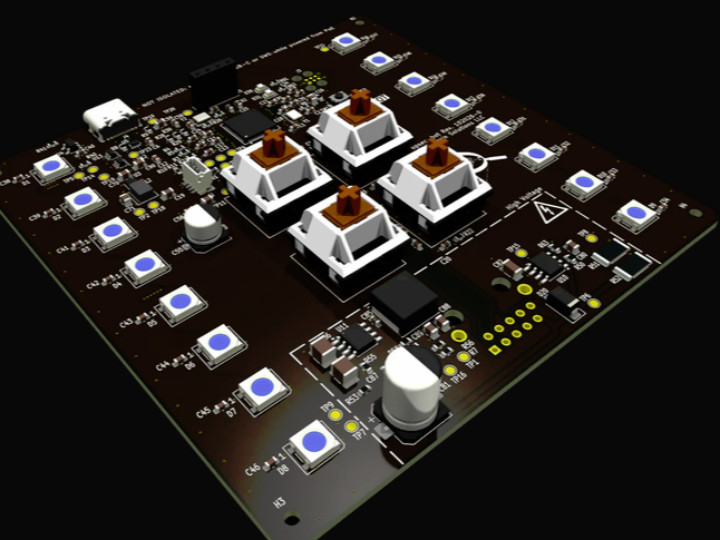
Components
Hardware components
WIZnet - W55RP20
x 1

Project description
Product introduction
The RP PoE Hub from Fine Grain Solutions is a wall-mountable smart home control panel that takes network and power from one Ethernet cable and talks to Home Assistant over MQTT. It is built on WIZnet's W55RP20 and sells for $149, listed as in stock with same-business-day shipping.
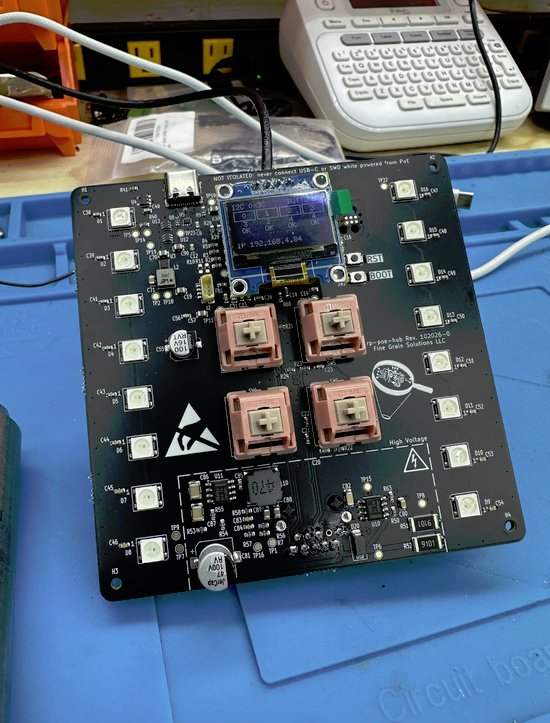
The board is a 101.6 mm square with four mechanical key positions, a small OLED screen and a strip of RGB LEDs down each side. The idea is a fixed panel by a door or on a desk: keys trigger scenes or devices, LEDs show status, and the screen shows data, all over a wired link on the local network.
| Item | Specification |
|---|---|
| Core chip | WIZnet W55RP20 (RP2040 dual-core Cortex-M0+, W5500 Ethernet and 2 MB flash in one package) |
| Ethernet | 10/100 Mbps, RJ45 |
| PoE | IEEE 802.3af from a PoE switch or injector, surge protection on the PoE input, not isolated from USB |
| Inputs | Four Cherry MX switch footprints, keyswitches currently included; reset and boot buttons |
| Display | Included 3.3 V I2C OLED module on a 4-pin socket |
| Indicators | 16 addressable WS2812B RGB LEDs, eight along each side edge |
| Connectors | USB-C (power and programming), SWD, Qwiic for add-ons |
| Size and mounting | 101.6 × 101.6 mm, 4-layer PCB, four M2 mounting holes |
| Software | Home Assistant integration over MQTT on the local network |
| Price | $149 |
Two points to know before installing one:
- PoE and USB power are not isolated. Fine Grain says to connect USB-C or SWD only while the board is disconnected from PoE. Running Ethernet data while powered from USB is supported.
- It ships as a bare board. The page mentions mounting holes but no enclosure, and it does not state the PoE class, power budget, OLED size or firmware details.
Use cases
The RP PoE Hub fits anywhere a household or workspace wants physical buttons and at-a-glance status for Home Assistant without relying on Wi-Fi or a wall adapter. Fine Grain describes it as a wall-mounted panel with four buttons for scenes or devices, LEDs for status and a screen for data.
- Scene keys by a door or bedside. Four mechanical keys map naturally to actions such as all lights off, away mode, a movie scene or a garage door. Tactile switches can be found and pressed without looking, which a touchscreen cannot offer.
- Status board. The 16 RGB LEDs can show states that matter at a glance: alarm armed, doors locked, washing finished, air quality or energy price bands.
- Small data display. The OLED can show a temperature, a power reading, a timer or the label of the currently selected scene.
- Workshop, lab or studio control. One PoE drop gives a bench a hard-wired panel for extraction fans, lighting, equipment power or an on-air indicator.
- Room sensor node. The Qwiic connector accepts I2C sensors, so the same panel can report temperature, humidity or presence back to Home Assistant.
- Places where Wi-Fi is weak or unwelcome. Garages, basements, plant rooms and rental or commercial spaces with locked-down wireless still tend to have Ethernet.
Because it speaks MQTT on the local network, it keeps working when the internet connection is down, and a managed PoE switch can power-cycle it remotely.
WIZnet's role
WIZnet's W55RP20 is the only processor and the only network device on the board. The chip packages a Raspberry Pi RP2040, a W5500 hardwired Ethernet controller and 2 MB of flash together, so one part runs the keys, LEDs and display and also carries the MQTT traffic to Home Assistant.
What that gives the product:
- A complete networked controller in one package. With MCU, Ethernet MAC and PHY, and flash in a single device, the remaining board area goes to the user interface and the PoE power stage.
- Hardwired TCP/IP for a reliable local link. The W5500 core handles TCP, UDP, IPv4, ICMP, ARP, IGMP and PPPoE in hardware with up to 8 sockets. An MQTT client sits on top of that TCP socket, and the RP2040's cores stay free for key scanning, LED timing and the display.
- Wired by design. The W55RP20 has no radio, which suits a fixed wall panel: no Wi-Fi credentials to provision and no wireless link to drop.
- A known software base. WIZnet documents C/C++, MicroPython, CircuitPython and Arduino support and MQTT examples for the W55RP20, which gives buyers a route to custom firmware. Fine Grain's page does not detail the shipped firmware.
The Hub is also notable for WIZnet as an end product rather than a development board. Most W55RP20 hardware on sale is evaluation boards such as WIZnet's own W55RP20-EVB-Pico; here the chip sits inside an assembled, in-stock consumer device, alongside the same maker's RP PoE Pico module.
About the author
The RP PoE Hub comes from Fine Grain Solutions, a hardware engineering company that works across electronics design and validation, firmware development and design-for-manufacturability consulting. Alongside its own products it takes on custom design work for clients, with a published case study on a candle-flicker RGB LED controller.
| Product | What it is | Price |
|---|---|---|
| RP PoE Hub | PoE wall control panel for Home Assistant | $149 |
| RP PoE Pico | Pico-format W55RP20 module with integrated PoE | $40 early-bird, $50 regular |
| SD Mux Edge | microSD mux for test benches | $29 |
| BMW ADS Interface | Adapter board for pre-OBD2 BMWs | $50 |
The company posts project write-ups on its projects blog and bring-up progress on X as @fine_grain_sol.
Open item: the website names no founder, team or location. Confirm with Fine Grain Solutions how they would like to be credited before publishing.
Price comparison
At $149 the RP PoE Hub is priced like a finished touchscreen wall panel, although it ships as a bare board with keys and a small OLED. No product found matches it directly, so the table compares it with the nearest alternatives on each side. Prices are single-unit list prices shown by each seller on 13 November 2026, in the seller's currency.
| Product | Interface | Network and power | Price |
|---|---|---|---|
| Fine Grain RP PoE Hub | 4 mechanical keys, OLED, 16 RGB LEDs, bare board | Ethernet with built-in 802.3af PoE (W55RP20) | $149 |
| Shelly Wall Display X1i | 4-inch colour touchscreen, fits a wall box | Wi-Fi, mains powered with 5 A relay | €189 inc. VAT |
| Shelly Wall Display + H&T bundle | 4-inch colour touchscreen plus sensor | Wi-Fi and Bluetooth, mains powered | £129.50 inc. VAT |
| Elecrow 10.1-inch Home Assistant panel | 10.1-inch touchscreen, no case | Wi-Fi, 5 V USB power | $129 |
| Adafruit MacroPad RP2040 starter kit | 12 mechanical keys, OLED, rotary encoder | USB only, no network | £37.36 ex. VAT |
| Waveshare ESP32-S3-POE-ETH-8DI-8DO | None (8 digital inputs and 8 outputs, rail-mount case) | Ethernet via W5500 with built-in 802.3af PoE, plus Wi-Fi | $42.99 |
What the numbers show:
- Finished panels cost about the same but are wireless. The Shelly and Elecrow panels land between roughly $129 and €189 with large touchscreens, yet each relies on Wi-Fi and mains or USB power. None offers a single-cable wired install.
- Tactile keys are cheap without a network. Adafruit's MacroPad gives three times the keys for about a third of the price, but it is a USB peripheral and needs a host computer.
- PoE Ethernet hardware alone is inexpensive. A PoE controller with a WIZnet W5500 costs $42.99 from Waveshare, and a W55RP20-EVB-Pico at $11.95 with a WIZPoE-P1 module at £6.50 covers the same core electronics as the Hub. The buyer then has to add keys, LEDs, a display, a board and firmware.
- The Hub's premium pays for integration and low volume. Its case rests on being an assembled, in-stock board that combines PoE, mechanical keys, LEDs and a display with Home Assistant support. An enclosure and published power and firmware details would strengthen that case against the finished panels.
The comparison mixes currencies and tax treatment, so treat it as a positioning guide rather than a like-for-like ranking.

