


WIS-PLC
Why Industrial Shields Has Stuck With the W5500 for a Decade — One Ethernet Layer Across AVR, ESP32, and Linux
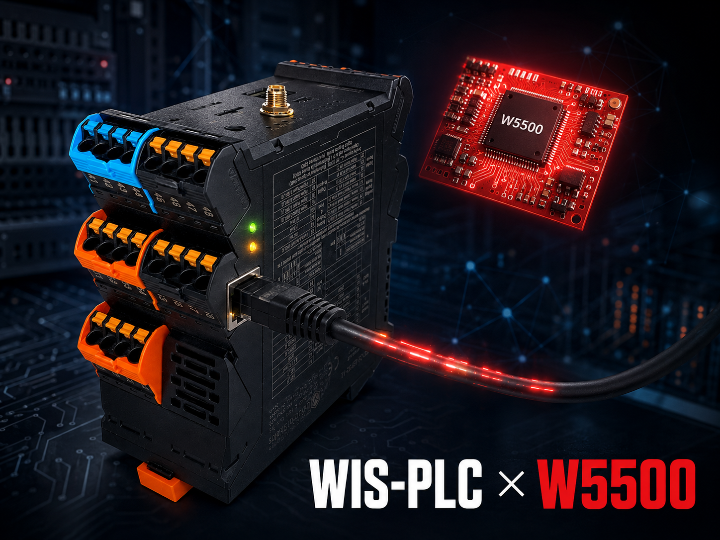
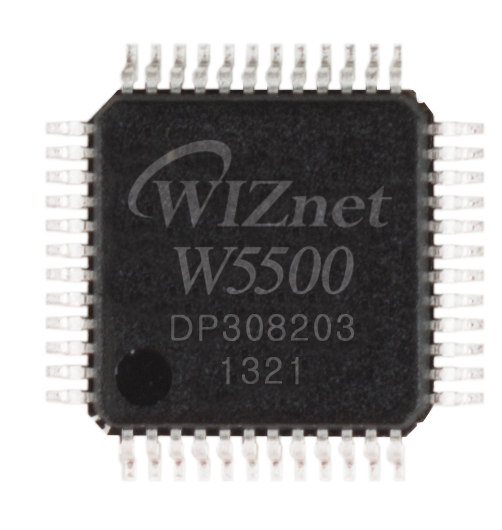
WIZnet - W5500
x 1

요약
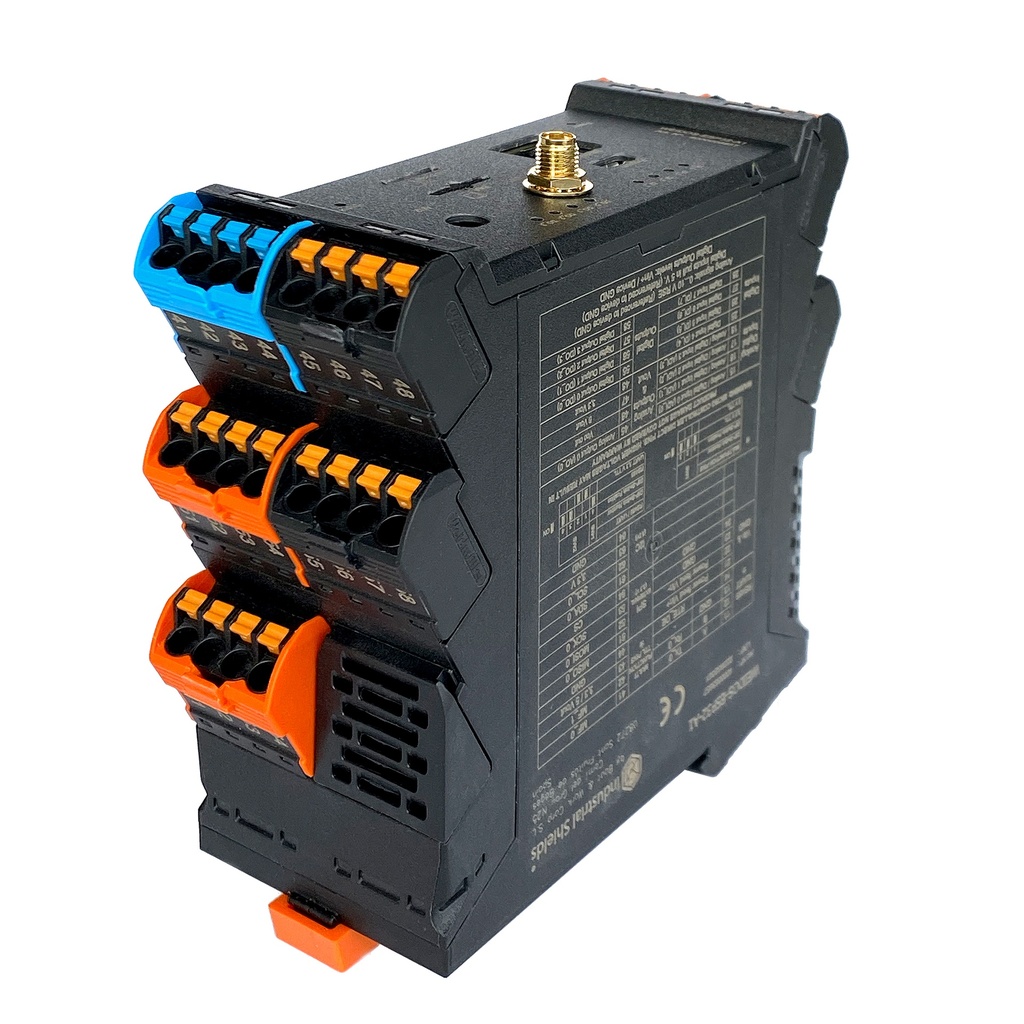
WIS-PLC는 Arduino MKR1010 또는 ESP32-WROOM-32UE를 산업 등급 하우징과 절연 I/O로 감싼 스페인 Industrial Shields의 IoT 컨트롤러입니다. 이 회사는 이더넷을 탑재한 모든 제품 라인 — AVR 기반 M-Duino, ESP32 PLC, 심지어 리눅스가 도는 Raspberry PLC까지 — 에서 예외 없이 WIZnet W5500을 채택하고 있습니다. CPU 아키텍처가 세 갈래로 갈라지는데도 네트워크 계층만 한 점으로 수렴하는 이유를, 제품 구조와 규제 환경 양쪽에서 살펴봅니다.
개요
산업 현장에 오픈소스 MCU 보드를 그대로 투입하기는 어렵습니다. 12~24Vdc 전원, 24V 필드 신호, 갈바닉 절연, EMC 내성, DIN 레일 장착, CE 인증 — 개발 보드가 갖추지 않은 요구가 겹겹이 쌓여 있기 때문입니다.
WIS-PLC는 이 간극을 메우는 제품입니다. 검증된 오픈소스 CPU 모듈을 그대로 쓰되, 그 주변을 산업 등급 인터페이스로 감쌉니다. 개발자는 익숙한 Arduino IDE와 C/C++를 유지한 채 현장 설비를 제어할 수 있고, 벤더 락인 없이 자동화 시스템을 구성할 수 있습니다.
대상 사용자는 명확합니다. 기존 PLC 벤더에 종속되기를 원치 않는 자동화 엔지니어, 소규모 설비 자동화와 원격 모니터링을 다루는 시스템 통합업체, 그리고 산업용 IoT 게이트웨이를 직접 설계하려는 팀입니다.
제품 페이지: https://www.industrialshields.com/shop/wis-plc-industrial-controller-esp32-raspberry-pi-9586
제조사 소개 — Industrial Shields
Industrial Shields는 2012년 10월 스페인 바르셀로나 인근 Sant Fruitós de Bages에서 설립된 **Boot & Work Corp. S.L.**의 산업용 컨트롤러 브랜드입니다. 설계부터 제조·창고·출하까지 바르셀로나 자체 시설에서 직접 수행합니다.
제품 계보를 따라가면 이 회사의 노선이 한눈에 보입니다.
- Ardbox (Arduino Leonardo 기반) — 컴팩트 PLC, 이더넷 없음
- M-Duino (Arduino Mega 2560) — 이더넷 도입. 회사 설명에 따르면 "산업에서 흔한 요구사항인 이더넷을 쓰기 위해 Mega를 선택"
- Raspberry PLC (Raspberry Pi 4) — 리눅스 기반, 이더넷 2포트
- ESP32 PLC (ESP32-WROOM-32UE) — 엔트리 모델 ESP32 PLC 14는 2024년 1월 출시
- WIS / WIS-PLC — MKR1010 또는 ESP32 기반 소형 IoT 컨트롤러
- 이 외 Touchberry(산업용 HMI), GateBerry(게이트웨이)
주목할 점은 AVR·ESP32·Linux라는 세 개의 서로 다른 CPU 아키텍처를 동일한 하우징과 동일한 I/O 명명 규칙(I0.x / Q0.x / A0.x / R0.x)으로 통일했다는 것입니다. 이 카테고리에서는 드문 전략이며, 뒤에서 다룰 부품 선택의 일관성과도 직결됩니다.
유통 측면에서는 Mouser, DigiKey(Preferred Supplier), RS Components, Farnell 4대 카탈로그에 모두 등재되어 있고 약 45개국에 대리점을 두고 있습니다. 한국에도 3곳의 대리점이 있습니다. 스페인 과학혁신부의 PYME Innovadora(혁신중소기업) 인증을 2029년까지 보유하고 있으며, EU Horizon 2020 공동지원을 받았습니다.
오픈소스 태도는 정확히 정의할 필요가 있습니다. GitHub 조직에 45개 저장소를 공개하고 있으나 내용은 모두 소프트웨어입니다 — 보드 패키지(GPL-3.0), Arduino/Raspberry Pi 라이브러리(LGPL-3.0), Node-RED 노드 등입니다. 회로도·거버 파일은 공개하지 않습니다. 즉 "오픈소스 하드웨어 플랫폼 위에 만든 자체 하드웨어 + 오픈 펌웨어"에 가깝고, 대신 사용자 매뉴얼에서 핀맵과 내부 부품명(W5500, MAX485, MAX232 등)을 상세히 공개하는 방식으로 투명성을 확보합니다. 인원수와 매출은 비상장이라 확인 불가입니다.
GitHub 조직: https://github.com/Industrial-Shields
도입 배경 / 왜 필요한가
저장소 도입 사례 — 확인 불가
WIS-PLC는 커뮤니티 프로젝트가 아닌 상용 제품이므로 Star·Fork 지표가 존재하지 않습니다. 제3자 도입 사례를 다룬 기사나 보도 역시 검색되지 않아 확인 불가로 남깁니다. 확인되는 유일한 정량 레퍼런스는 2019년 말 ETL 인증 취득 후 미국 고객에 M-Duino 58을 수백 대 납품했다는 자사 기록입니다.
산업적·규제적 필요성 — 확인됨
반면 이 카테고리 자체의 필요성은 규제로 뒷받침됩니다. EU 사이버 복원력법(Cyber Resilience Act, Regulation (EU) 2024/2847) 은 2024년 12월 10일 발효되었고, 취약점·사고 보고 의무는 2026년 9월 11일, CE 마킹을 포함한 전면 적용은 2027년 12월 11일부터입니다. 네트워크에 연결되는 모든 "디지털 요소 제품"이 대상이므로, 이더넷을 갖춘 산업용 컨트롤러는 정면으로 해당합니다.
WIS-PLC가 CPU 종류에 따라 ATECC508 또는 ATECC608 암호 칩셋을 기본 탑재한 점은 이 흐름과 정합합니다. 안전·EMC 측면에서도 EN 61010-1, EN 61010-2-201(제어 장비), IEC 61000-6-1~6-4, RED(EN 301 489 계열)를 충족합니다.
CRA 요약(European Commission): https://digital-strategy.ec.europa.eu/en/policies/cra-summary
산업 트렌드 통찰 — 커뮤니티가 먼저 움직였습니다
오픈소스 하드웨어 진영의 산업 진출은 최근 몇 년 사이 플랫폼 벤더 차원으로 확산되었습니다.
- Arduino는 2022년 11월 SPS Nuremberg에서 첫 마이크로 PLC Opta를 발표하고 같은 해 12월 출시했습니다. Finder와의 협업으로 IEC 61131-3 언어를 지원합니다.
- Raspberry Pi는 Compute Module 5를 산업용으로 명시 포지셔닝했으며, 매출의 약 70~75%가 산업 고객에서 발생하는 것으로 보고됩니다.
그런데 Industrial Shields는 2012년부터 같은 시장을 개척해 왔습니다. 플랫폼 벤더가 산업 시장에 진입하기 10년 전에, 서드파티가 먼저 수요를 확인하고 제품화한 셈입니다. 커뮤니티와 주변 생태계가 본가보다 먼저 움직인 전형적 사례이며, 이는 카테고리 수요가 일시적 유행이 아니라 구조적임을 시사합니다.
Arduino Opta 발표: https://blog.arduino.cc/2022/11/08/welcome-opta-our-first-ever-micro-plc-with-industrial-iot-capabilities/
아키텍처
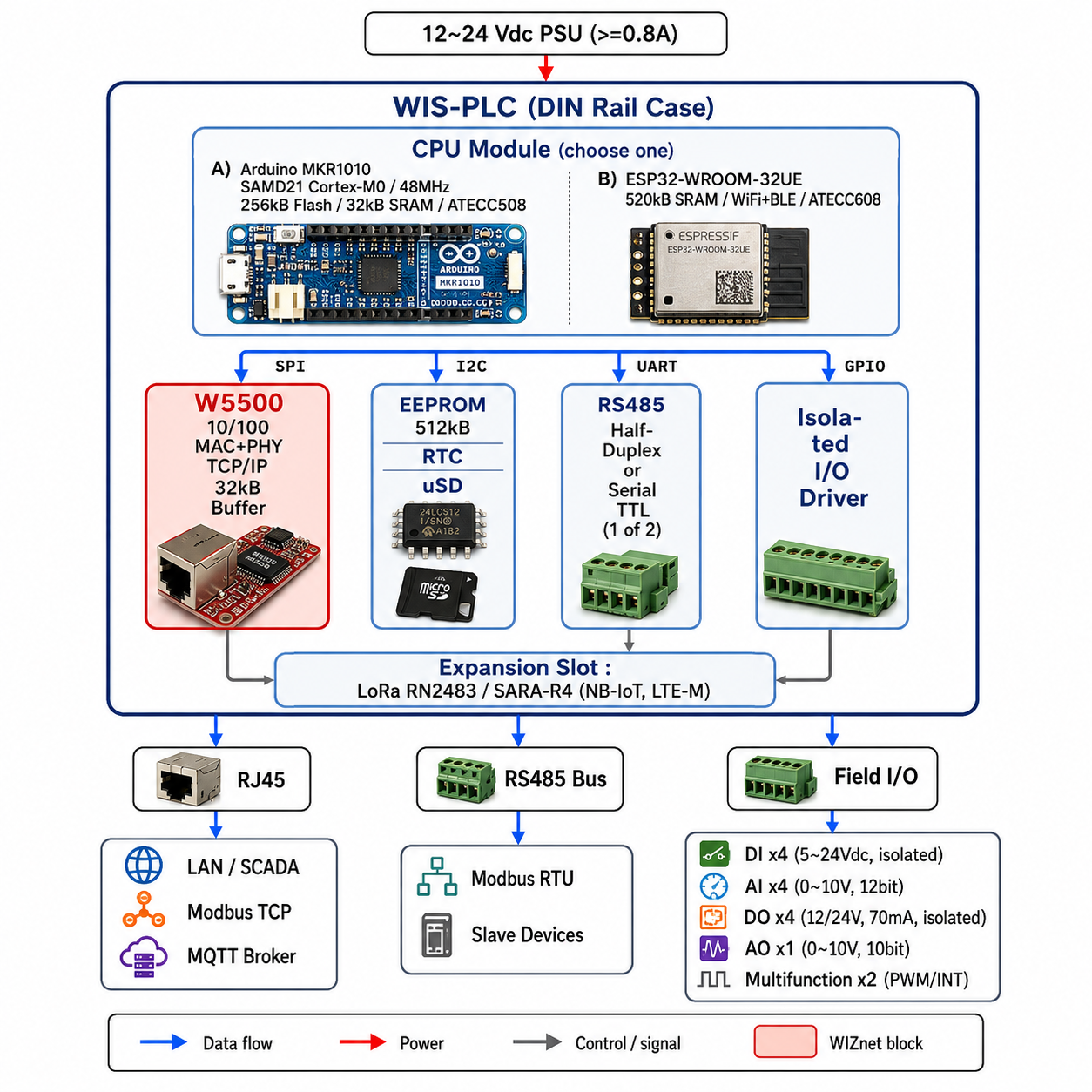
WIS-PLC의 내부 구조는 다음과 같습니다.
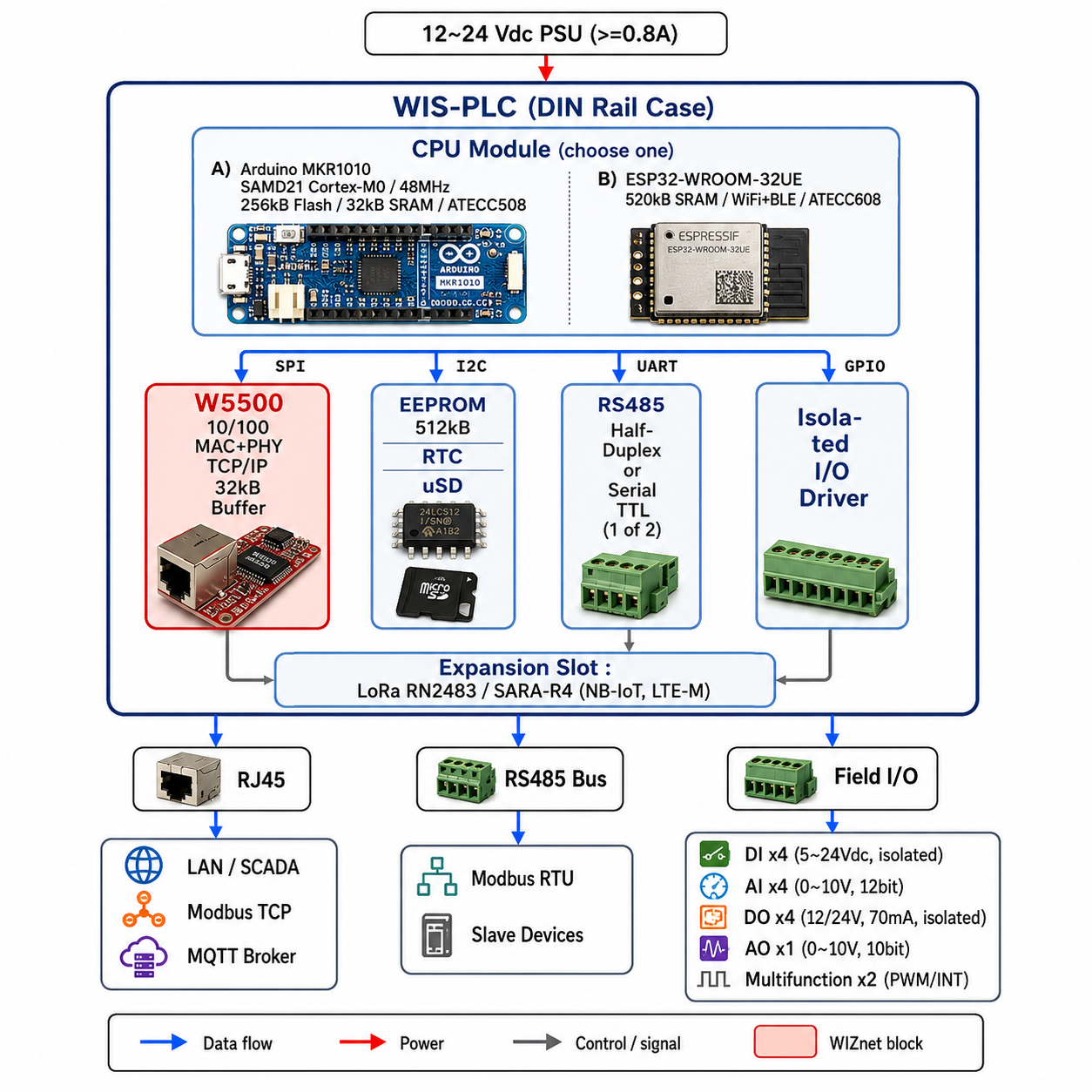
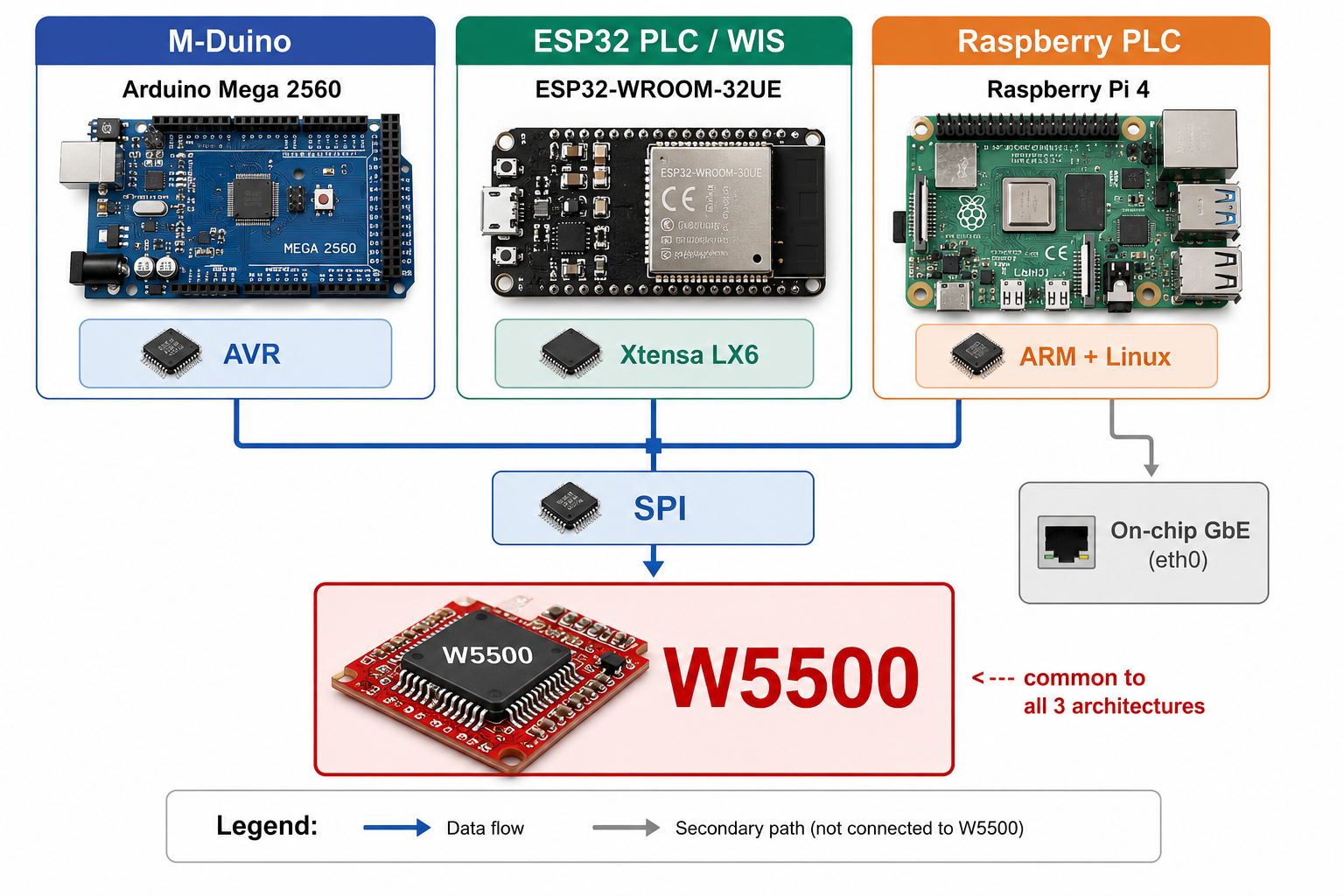
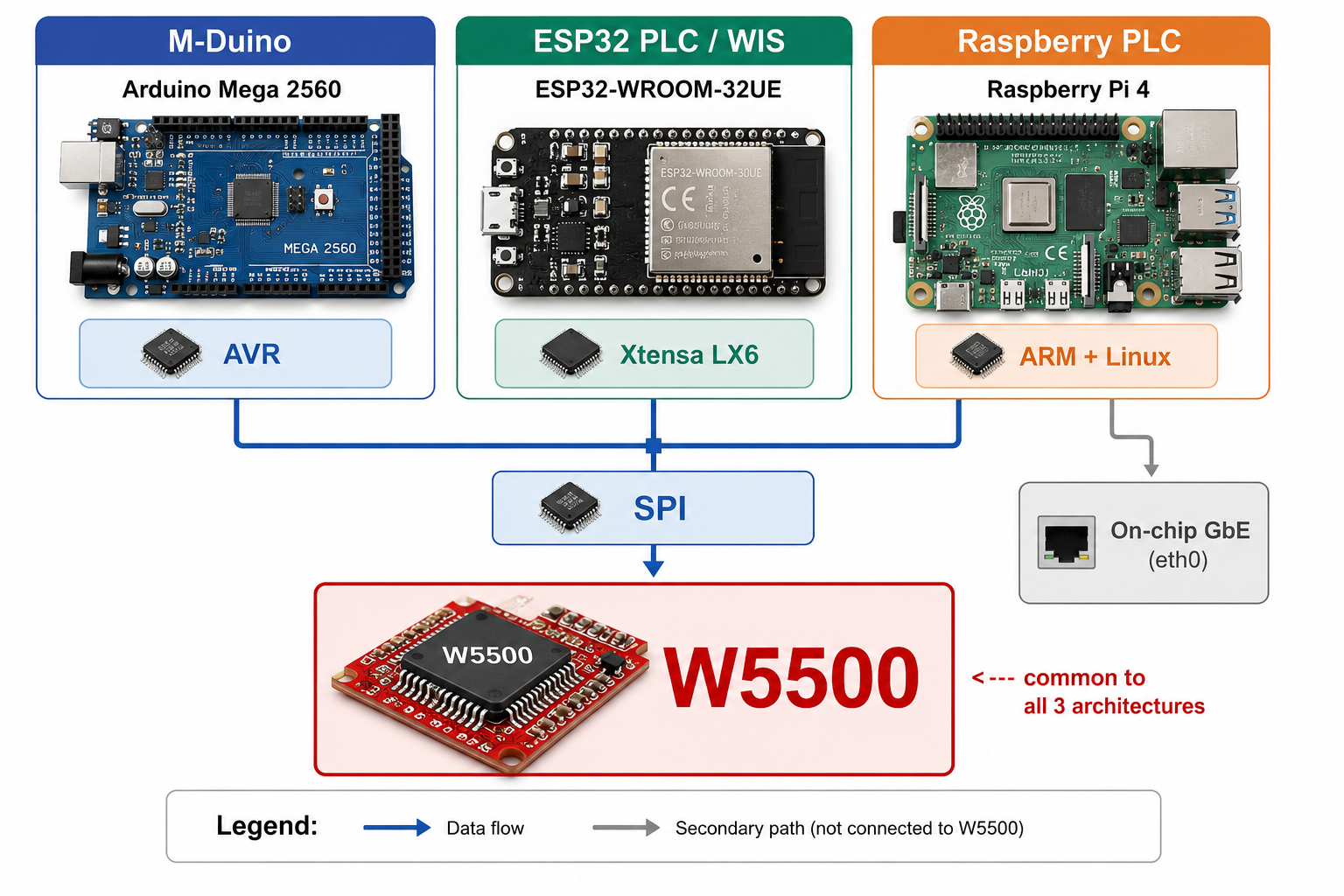
제품군 전체로 시야를 넓히면 더 흥미로운 그림이 나옵니다.
기술 배경
RS-485 반이중과 Modbus RTU
RS-485는 차동 신호 방식의 시리얼 통신 규격으로, 한 쌍의 꼬임선에 최대 32개(리피터 사용 시 그 이상) 노드를 멀티드롭으로 연결합니다. 반이중(Half-Duplex) 은 송신과 수신이 같은 선로를 시분할로 공유하는 방식이라, 마스터가 요청을 보낸 뒤 드라이버를 수신 모드로 전환해야 응답을 받을 수 있습니다.
그 위에 얹히는 Modbus RTU는 마스터-슬레이브 폴링 구조의 필드버스 프로토콜입니다. 1979년 등장한 규격이 아직도 현장 표준인 이유는, 프레임이 단순하고 노이즈가 심한 환경에서도 예측 가능하게 동작하기 때문입니다.
WIS-PLC에서 RS-485는 Serial TTL과 배타적으로만 사용할 수 있으며, 스위치로 선택합니다. 필드버스와 디버그 시리얼을 동시에 써야 하는 설계에서는 미리 고려가 필요한 제약입니다.
갈바닉 절연과 산업 I/O 설계
갈바닉 절연(Galvanic Isolation) 은 두 회로 사이의 전기적 도통을 끊고 신호만 전달하는 기법입니다. 포토커플러나 절연 트랜스로 구현하며, 서로 다른 접지 기준을 가진 장비를 연결할 때 발생하는 접지 루프(Ground Loop) 와 전위차 손상을 막습니다.
이것이 "Arduino를 케이스에 넣은 것"과 산업 컨트롤러를 가르는 실질적 경계선입니다. WIS-PLC는 디지털 입력 4채널과 디지털 출력 4채널에 갈바닉 절연을 적용하고, 출력단에는 릴레이 부하 대비 다이오드 보호를 추가했습니다. 이 설계가 EN 61010-2-201 준수의 물리적 기반이 됩니다.
다만 아날로그 입출력은 단일 기준(Referenced Single Ended) 방식이라 모든 채널이 공통 기준점을 공유합니다. 서로 다른 접지 기준의 외부 센서를 붙일 때는 별도 아이솔레이터가 필요합니다.
LoRaWAN Class A와 LTE-M / NB-IoT
유선 인프라가 없는 현장을 위해 WIS-PLC는 확장 슬롯에 두 가지 광역 통신 옵션을 제공합니다.
LoRaWAN은 Sub-GHz 대역(유럽 868MHz, 미국 902MHz)의 저전력 장거리 통신 규격입니다. Class A는 단말이 상향 전송을 한 직후에만 짧게 수신창을 여는 방식으로, 전력 소비가 가장 낮은 대신 하향 지연이 큽니다. WIS-PLC는 RN2483 모듈로 이를 지원합니다.
LTE-M(Cat M1)과 NB-IoT(NB1) 은 이동통신망을 사용하는 셀룰러 IoT 규격입니다. 게이트웨이를 직접 구축할 필요가 없다는 것이 LoRaWAN 대비 가장 큰 차이이며, WIS-PLC는 u-blox SARA-R4 모듈로 최대 1200kbit/s 급 전송을 지원합니다.
이 두 옵션은 광역 업링크를 담당하고, 로컬 설비 제어와 SCADA 연동은 이더넷과 RS-485가 맡습니다. 계층이 명확히 분리된 구조입니다.
기술 특징
- 동일 폼팩터, 다중 아키텍처: 하나의 하우징과 I/O 명명 규칙 아래 MKR1010(SAMD)과 ESP32를 선택할 수 있어, 프로젝트 성격이 바뀌어도 배선과 캐비닛 설계를 재사용할 수 있습니다.
- 114 × 46 × 127 mm, 350g 미만: DIN 레일 캐비닛에서 슬롯 부담이 적습니다.
- 11.4~25.4 Vdc 광범위 입력, 최대 30W: 실측 소비는 40~74mA로 낮지만, USB 전원만으로는 정상 동작하지 않습니다. 이더넷 구동에 필요한 전력이 부족하기 때문이며, 공식 문서도 이를 명시합니다.
- 암호 칩셋 기본 탑재: ATECC508/608이 키 저장과 인증을 하드웨어로 처리해 CRA 대응의 출발점을 제공합니다.
- 소프트웨어 다중 경로: Arduino IDE, PlatformIO, Node-RED, CODESYS, OpenPLC, Home Assistant까지 선택지가 열려 있습니다.
WIZnet 적용 — 3개 아키텍처, 하나의 W5500
Industrial Shields의 이더넷 탑재 제품은 전 라인이 WIZnet W5500을 사용합니다. 마케팅 문구 수준이 아니라, 사용자 매뉴얼의 핀맵과 리눅스 디바이스 트리 오버레이 수준까지 칩 이름이 노출되어 있습니다.
| 제품군 | 이더넷 | W5500 실장 위치 |
|---|---|---|
| Ardbox (Leonardo) | 없음 | — |
| M-Duino (Mega 2560) | 1포트 | SPI, SS = D10 |
| ESP32 PLC (14~58) | 1포트 | SPI |
| WIS-PLC | 1포트 | SPI |
| Raspberry PLC (Pi 4) | 2포트 | SPI1, CS = GPIO7 → eth1 |
요청 하나가 처리되는 순서
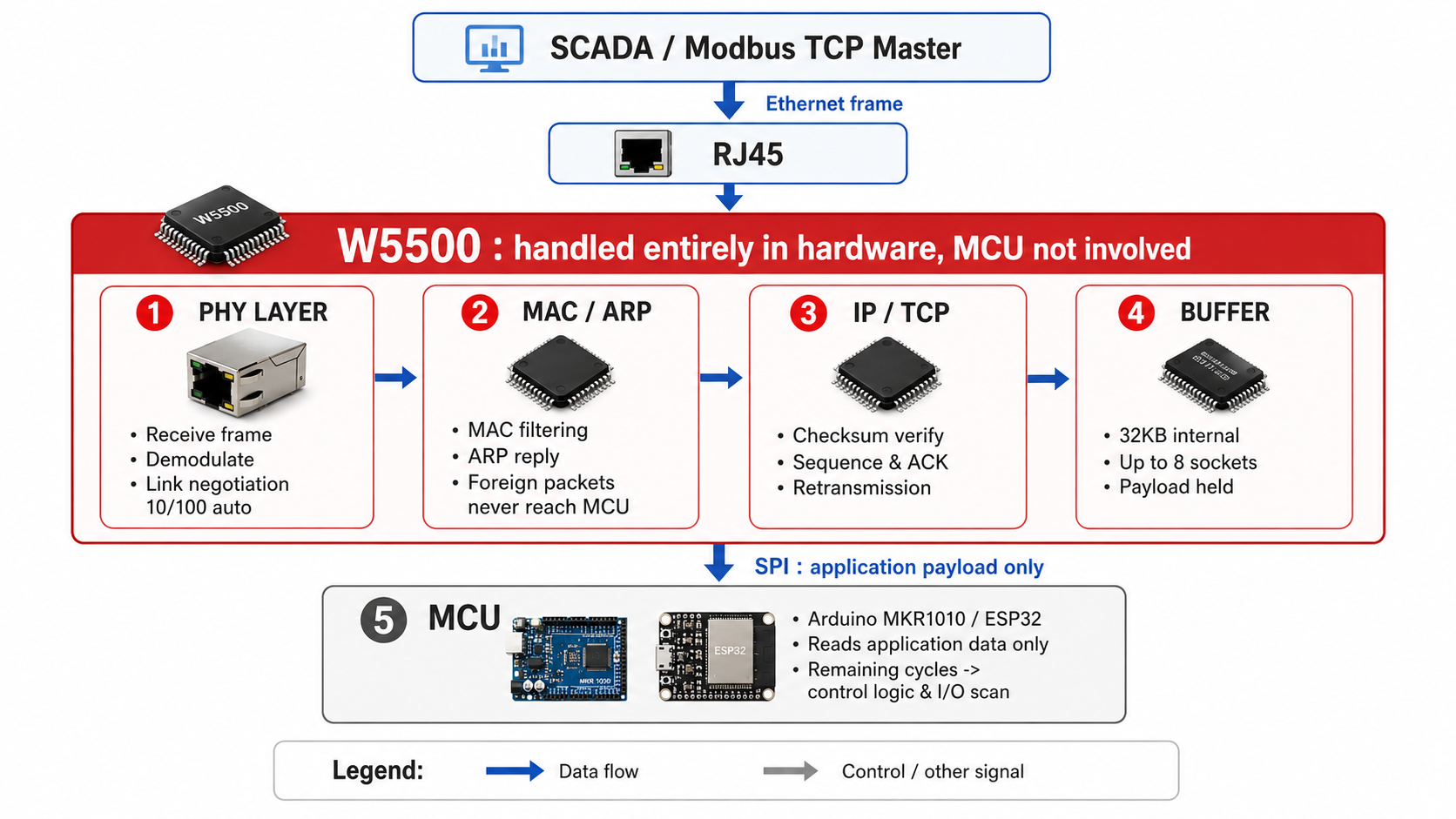
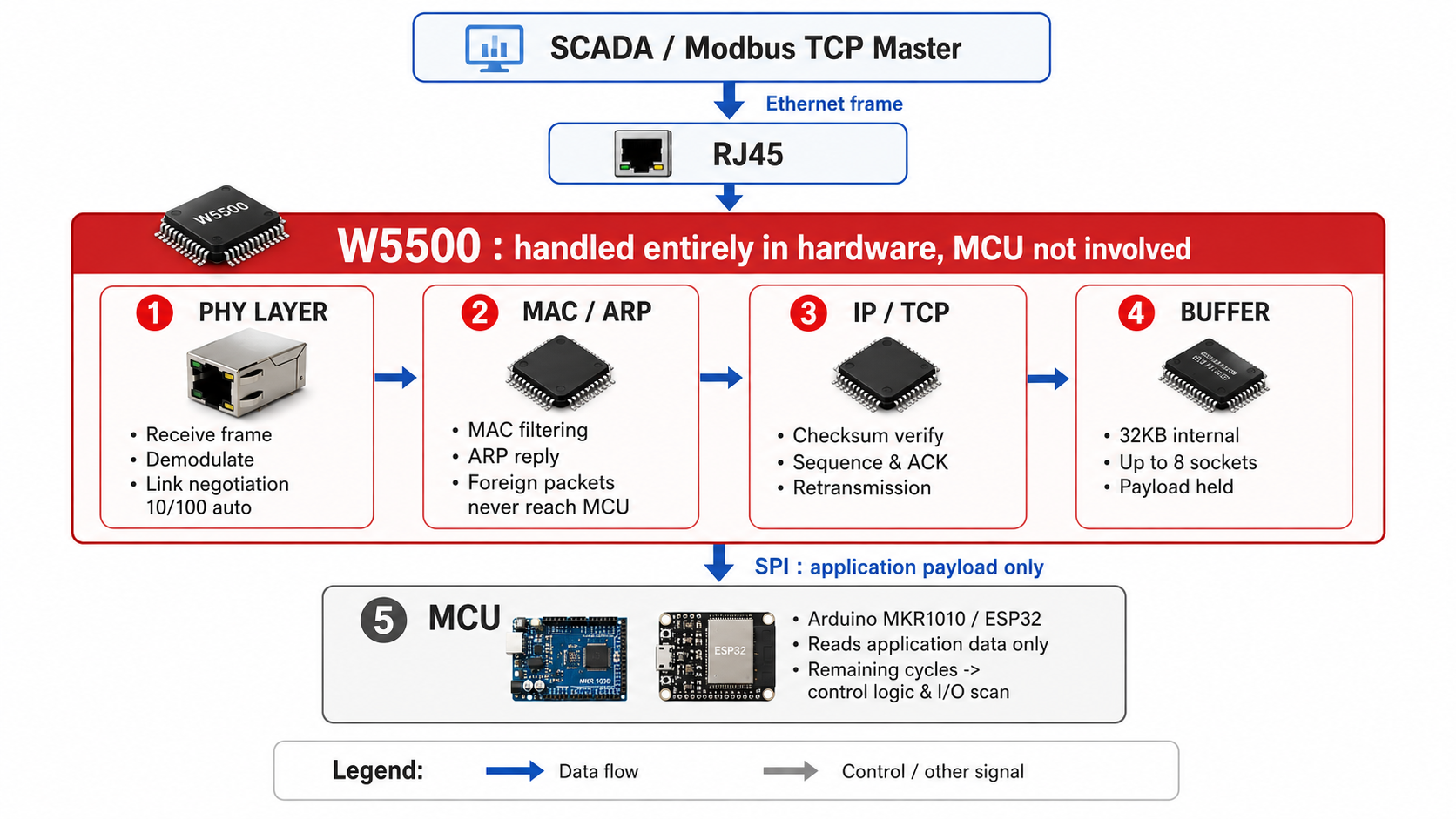
상위 SCADA가 Modbus TCP 요청을 보냈을 때 WIS-PLC 내부에서 벌어지는 일을 단계로 나누면 이렇습니다.
- W5500이 이더넷 프레임을 수신하고 PHY 계층에서 신호를 복조합니다. 링크 협상, 10/100 속도 결정도 칩 내부에서 끝납니다.
- MAC 주소 필터링과 ARP 응답을 W5500이 자체 처리합니다. 자신에게 오지 않은 패킷은 MCU에 도달조차 하지 않습니다.
- IP·TCP 계층 처리 — 체크섬 검증, 시퀀스 번호 관리, ACK 생성, 재전송까지 하드와이어드 로직이 담당합니다.
- 32kB 내부 버퍼에 페이로드를 적재합니다. 최대 8개 소켓을 동시에 유지할 수 있어, Modbus TCP 서버와 MQTT 클라이언트를 함께 돌릴 수 있습니다.
- MCU는 SPI로 애플리케이션 데이터만 읽어갑니다. 남은 사이클은 전부 제어 로직과 I/O 스캔에 쓰입니다.
비유하자면 W5500은 국제 물류센터의 통관 대행사입니다. 서류 검증, 검역, 분류, 반송 처리를 대행사가 모두 끝내고, 공장(MCU)에는 개봉 가능한 부품 상자만 도착합니다. 공장은 통관 규정을 알 필요가 없습니다.
만약 이 칩이 없었다면
MKR1010의 SAMD21은 이더넷 MAC 자체가 없고, SRAM은 32kB입니다. lwIP 같은 소프트웨어 TCP/IP 스택은 소켓 버퍼만으로도 이 용량을 잠식하며, 재전송 타이머와 상태 머신이 제어 루프의 주기를 흔듭니다. W5500이 없었다면 WIS-PLC의 이더넷 지원은 성립하지 않았을 것이라고 보는 편이 정확합니다.
가장 흥미로운 사례 — Raspberry PLC
Raspberry Pi 4는 기가비트 MAC과 PHY를 이미 내장하고 있습니다. 그럼에도 Industrial Shields는 두 번째 산업용 포트를 W5500으로 추가했습니다.
공식 기술 문서는 이렇게 서술합니다. "Our Raspberry Pi family incorporates both an integrated W5500 IC and the own Ethernet port of the Raspberry." 설정 방법도 공개되어 있습니다 — dtparam=spi=on, dtoverlay=w5500,cs=1,int_pin=6로 eth1 인터페이스가 생성되며, 기본 IP는 eth0:1이 10.10.10.20, eth1:1이 10.10.11.20입니다.
리눅스가 도는 SBC에서도 네트워크 분리(제어망과 관리망), 결정적 동작, 커널 네트워크 스택 부하 회피라는 요구가 있으면 하드와이어드 TCP/IP 칩을 별도로 두는 편이 낫다는 판단입니다.
Raspberry PLC 이더넷 설정: https://www.industrialshields.com/blog/raspberry-pi-for-industry-26/how-to-check-ethernet-configuration-295
WIZnet Makers 유사 사례
Industrial Shields Arduino PLC for: Automation, Monitoring and Control — 동일 회사의 Arduino 기반 산업 PLC를 다룬 리셀러 게시물입니다. 제품 소개 중심이라 칩 레벨 구조 분석은 없으며, 본 글은 그 지점을 기술 분석으로 보완합니다.
→ 프로젝트 링크: https://maker.wiznet.io/matthew/resellers/industrial-shields-arduino-plc-for-automation-monitoring-and-control/
[RE] Industrial Shields 10 I/Os PLCs with ESP32 — ESP32 + W5500 조합의 소형 PLC 단일 모델을 소개합니다. 본 글은 이를 AVR·ESP32·Linux 3개 아키텍처를 관통하는 관점으로 확장합니다.
→ 프로젝트 링크: https://maker.wiznet.io/rena/resellers/%5Bre%5D-industrial-shields-10-i-os-plcs-with-esp32/
NORVI ENET: ESP32 + Ethernet W5500 Circuit analysis — 스리랑카 NORVI의 산업용 ESP32 컨트롤러를 회로 수준에서 분석한 사례입니다. 직접 경쟁 제품이면서 동일하게 W5500을 채택했다는 점에서 대조군으로 유용합니다.
→ 프로젝트 링크: https://maker.wiznet.io/gavinchang/projects/norvi-enet-esp32-ethernet-w5500-circuit-analysis/
서로 다른 국가, 다른 CPU, 다른 가격대의 상용 산업 컨트롤러들이 네트워크 계층에서만은 동일한 선택에 도달했다는 점이 이 사례들의 공통 결론입니다.
| 항목 | WIS-PLC | NORVI ENET | Raspberry PLC |
|---|---|---|---|
| CPU | MKR1010 / ESP32 | ESP32-WROOM32 | Raspberry Pi 4 |
| 이더넷 컨트롤러 | W5500 | W5500 | W5500 + Pi 내장 GbE |
| 포트 수 | 1 | 1 | 2 |
| 절연 I/O | DI 4 / DO 4 | 있음 | 있음 |
| 산업 규격 | EN 61010-1/-2-201 | EN 61131-2, EN 61010 | EN 61010 계열 |
| 확장 통신 | LoRa / NB-IoT / 4G | GSM / LoRa | LoRa / 4G / CAN |
| 폼팩터 | DIN 레일 | DIN 레일 | DIN 레일 |
공통 설계 철학은 "제어 계층은 플랫폼별로 자유롭게, 네트워크 계층은 검증된 단일 부품으로" 입니다. 차별점은 WIS-PLC가 소형·저 I/O에 광역 통신 옵션을 얹은 IoT 노드 성격인 반면, Raspberry PLC는 리눅스 기반 게이트웨이 겸 컨트롤러라는 데 있습니다.
비즈니스 가치
외부 관점 — 적용 시나리오
- 소규모 설비 원격 모니터링: 현장 센서를 절연 입력으로 수집하고, Modbus TCP로 상위 SCADA에 노출합니다. 별도 게이트웨이 없이 컨트롤러 하나로 완결됩니다.
- 수처리·농업 등 유선 인프라 부재 현장: 로컬 제어는 RS-485, 광역 업링크는 LoRaWAN 또는 NB-IoT로 분리합니다.
- 기존 PLC 리트로핏: 벤더 락인 없이 기존 설비의 Modbus 자산을 그대로 유지하면서 IP 네트워크로 끌어올립니다.
- CRA 대응 신규 설계: 2027년 12월부터 CE 마킹 요건에 사이버보안이 포함되므로, 암호 칩셋과 인증 이력을 갖춘 컨트롤러 수요는 일시적 유행이 아니라 규제가 만드는 구조적 수요로 이어질 가능성이 큽니다.
내부 관점 — WIZnet 기술 인사이트
Arduino는 Opta로, Raspberry Pi는 CM5로 산업 시장에 들어왔고, Industrial Shields와 NORVI 같은 서드파티는 그보다 먼저 자리를 잡았습니다. 플랫폼 경쟁은 격화되고 있지만, 이들 모두가 이더넷 계층에서는 SPI 하드와이어드 TCP/IP 컨트롤러라는 같은 답에 도달했습니다.
어느 오픈소스 플랫폼이 산업 시장을 가져가든, 네트워크 계층은 결국 W5500 계열로 수렴합니다. 골드러시에서 곡괭이를 파는 위치이며, 특히 Raspberry PLC 사례는 "MCU에 MAC이 있어도 W5500을 쓰는 이유" 라는 강력한 레퍼런스입니다.
실무적으로도 접점이 있습니다. Industrial Shields는 4대 글로벌 카탈로그에 모두 등재되어 있고 한국 대리점 3곳과 아시아 전담 세일즈를 두고 있어, 공급망과 커뮤니케이션 경로가 이미 열려 있습니다.
한계 및 개선 방향
10년 넘게 부품 선택의 일관성을 유지한 것은 분명한 강점이지만, 구조적 제약도 함께 굳어졌습니다.
SPI 버스 독점 — 가장 큰 마찰점입니다. W5500이 SPI를 점유하면 사용자 애플리케이션은 같은 버스를 쓸 수 없습니다. 이는 추측이 아니라 제조사 공식 문서에 세 개 라인 모두 명시된 내용입니다. ESP32 PLC 문서는 "both behaviours cannot occur at the same time" 이라고 적고 있고, Raspberry PLC도 SPI0이 W5500과 공유된다고 밝힙니다.
→ 개선 방향: W6300은 QSPI 인터페이스로 대역폭을 확보하면서 핀 점유 대비 처리량을 높입니다. 더 근본적으로는 W55RP20처럼 MCU와 이더넷을 하나로 통합한 SiP를 쓰면 외부 SPI 버스 경합 자체가 사라집니다. 확장 슬롯을 가진 이 제품군의 구조상, 통신 서브보드 단위로 적용해 볼 여지가 있습니다.
생태계 지원 지연 리스크 — Home Assistant 커뮤니티에는 2021년 ESPHome이 W5500을 지원하지 않아 Industrial Shields 제품을 검토하다 경쟁사로 옮긴 사례가 남아 있습니다. 현재는 ESPHome이 W5500을 지원하고 제조사도 자체 가이드를 제공하지만, 주요 오픈소스 프레임워크 지원 여부가 칩 채택에 직결된다는 교훈은 유효합니다.
커뮤니티 스레드: https://community.home-assistant.io/t/very-interesting-esp32-based-plc-what-do-you-think/299233
문서 정합성 — 신설 문서 사이트는 이더넷을 "1x Gigabit Ethernet"으로 표기하고 있으나 W5500은 10/100입니다. WIS 랜딩 페이지에는 Raspberry PLC용 문구(듀얼 이더넷, Linux, UPS)가 혼입되어 있습니다. 제품 선정 단계의 혼선을 줄이려면 데이터시트 기준으로 정리가 필요합니다.
하드웨어 범위 — I/O가 DI 4(+AI 4 겸용) / DO 4 / AO 1로 소형이고 확장 I/O 옵션이 문서화되어 있지 않습니다. 동작 온도도 0~60°C라 옥외·한랭지에는 부적합합니다.
FAQ
Q1. Arduino나 ESP32 보드에 W5500 모듈을 직접 붙이는 것과 무엇이 다릅니까?
전기적 보호와 인증입니다. 24V 필드 신호 대응, 갈바닉 절연, EMC 내성, DIN 레일 장착, CE 인증이 완성품 형태로 제공됩니다. 프로토타입 단계라면 모듈 조합이 저렴하지만, 현장 납품 단계에서는 인증 비용과 신뢰성이 역전됩니다.
Q2. W5500이 SPI를 점유하면 제 센서용 SPI는 어떻게 합니까?
같은 버스를 시분할로 쓰되 CS 라인을 분리하는 것이 원칙이지만, 제조사는 이더넷 사용 중 SPI 동시 사용을 권장하지 않습니다. 실무적으로는 I2C 센서로 대체하거나, 별도 SPI 채널을 가진 상위 모델을 검토하는 편이 안전합니다.
Q3. Raspberry Pi 내장 이더넷만으로 부족한 이유는 무엇입니까?
포트가 하나뿐이기 때문입니다. 제어망과 관리망을 물리적으로 분리하려면 두 번째 인터페이스가 필요하고, W5500은 여기에 커널 네트워크 스택 부하를 덜어주는 이점까지 더합니다.
Q4. Modbus TCP와 Modbus RTU 중 무엇을 써야 합니까?
기존 RS-485 자산이 있고 노드가 물리적으로 가까우면 RTU, 여러 마스터가 동시에 접근하거나 상위 SCADA·MQTT와 연동해야 하면 TCP가 적합합니다. WIS-PLC는 둘 다 지원하므로 게이트웨이 역할도 가능합니다.
Q5. CRA 대응에 하드웨어 차원에서 무엇이 필요합니까?
보안 부팅과 키 보관을 위한 하드웨어 루트 오브 트러스트, 펌웨어 업데이트 경로, 그리고 취약점 대응을 위한 공급망 문서화입니다. WIS-PLC의 ATECC508/608은 첫 번째 항목에 해당하며, 나머지는 개발 조직의 프로세스 영역입니다.
Summary
The WIS-PLC is an IoT controller from Spain's Industrial Shields. It wraps an Arduino MKR1010 or an ESP32-WROOM-32UE in an industrial-grade enclosure with isolated I/O. Every Ethernet-equipped product line this company ships — the AVR-based M-Duino, the ESP32 PLC, and even the Linux-driven Raspberry PLC — uses the WIZnet W5500 without exception. This article examines why three CPU architectures diverge while the network layer converges on a single point.
Overview
You cannot drop an open-source MCU board straight onto a factory floor. The requirements stack up quickly: 12–24 Vdc power, 24 V field signals, galvanic isolation, EMC immunity, DIN rail mounting, and CE certification. Development boards meet none of these.
The WIS-PLC closes that gap. It keeps a proven open-source CPU module intact and surrounds it with industrial-grade interfaces. Developers stay with the Arduino IDE and C/C++ they already know, while controlling real equipment — and they do it without vendor lock-in.
The target audience is clear. Automation engineers who refuse to be tied to a single PLC vendor. System integrators handling small-scale automation and remote monitoring. Teams designing their own industrial IoT gateways.
Product page: https://www.industrialshields.com/shop/wis-plc-industrial-controller-esp32-raspberry-pi-9586
About the Manufacturer: Industrial Shields
Industrial Shields is the industrial controller brand of Boot & Work Corp. S.L., founded in October 2012 in Sant Fruitós de Bages, near Barcelona, Spain. The company handles design, manufacturing, warehousing, and shipping at its own Barcelona facilities.
Trace the product lineage and the company's direction becomes obvious.
- Ardbox (Arduino Leonardo) — compact PLC, no Ethernet
- M-Duino (Arduino Mega 2560) — Ethernet arrives. The company explains it chose the Mega "with which they can use Ethernet, a common requirement in industry"
- Raspberry PLC (Raspberry Pi 4) — Linux-based, two Ethernet ports
- ESP32 PLC (ESP32-WROOM-32UE) — the entry-level ESP32 PLC 14 launched in January 2024
- WIS / WIS-PLC — compact IoT controller on MKR1010 or ESP32
- Plus Touchberry (industrial HMI) and GateBerry (gateway)
What stands out is that three distinct CPU architectures — AVR, ESP32, and Linux — share one enclosure and one I/O naming convention (I0.x / Q0.x / A0.x / R0.x). That strategy is rare in this category, and it connects directly to the component consistency discussed below.
On distribution, the company is listed with all four major catalogs — Mouser, DigiKey (Preferred Supplier), RS Components, and Farnell — and maintains distributors in roughly 45 countries, including three in South Korea. It holds Spain's PYME Innovadora (innovative SME) certification through 2029 and received EU Horizon 2020 co-funding.
Its open-source posture deserves a precise definition. The GitHub organization publishes 45 repositories, but all of them contain software: board packages (GPL-3.0), Arduino and Raspberry Pi libraries (LGPL-3.0), and Node-RED nodes. Schematics and Gerber files are not published. The reality is closer to "proprietary hardware built on open-source platforms, paired with open firmware." Transparency instead comes through user manuals that document pinouts and internal part numbers — W5500, MAX485, MAX232, and others. Headcount and revenue are not confirmed, since the company is privately held.
GitHub organization: https://github.com/Industrial-Shields
Background: Why This Matters
Deployment Evidence — Not Confirmed
The WIS-PLC is a commercial product, not a community project, so star and fork counts do not apply. No third-party articles or press coverage of actual deployments turned up in research, so this remains not confirmed. The only quantified reference available is the company's own record: after obtaining ETL certification in late 2019, it shipped several hundred M-Duino 58 units to a US customer.
Industry and Regulatory Drivers — Confirmed
The category's necessity, however, is backed by regulation. The EU Cyber Resilience Act (Regulation (EU) 2024/2847) entered into force on December 10, 2024. Vulnerability and incident reporting obligations begin September 11, 2026, and full application including CE marking starts December 11, 2027. The regulation covers every "product with digital elements" that connects to a network, which puts Ethernet-equipped industrial controllers squarely in scope.
The WIS-PLC ships with an ATECC508 or ATECC608 cryptographic chipset depending on CPU, which aligns with this trajectory. On safety and EMC, it meets EN 61010-1, EN 61010-2-201 (control equipment), IEC 61000-6-1 through 6-4, and the RED directive (EN 301 489 series).
CRA summary (European Commission): https://digital-strategy.ec.europa.eu/en/policies/cra-summary
Industry Trend: The Community Moved First
Open-source hardware has pushed into industry at the platform-vendor level only recently.
- Arduino unveiled Opta, its first micro PLC, at SPS Nuremberg in November 2022 and shipped it that December. Built with Finder, it supports IEC 61131-3 languages.
- Raspberry Pi positioned the Compute Module 5 explicitly for industrial use, and roughly 70–75% of its revenue is reported to come from industrial customers.
Yet Industrial Shields has worked this market since 2012 — a full decade before the platform vendors arrived. A third party identified the demand and productized it first. This is a textbook case of the ecosystem moving ahead of the parent platform, and it suggests the category is structural rather than faddish.
Arduino Opta announcement: https://blog.arduino.cc/2022/11/08/welcome-opta-our-first-ever-micro-plc-with-industrial-iot-capabilities/
Architecture
Here is the internal structure of the WIS-PLC.
Widen the view to the whole product family and a more interesting picture emerges.
Technology Background
RS-485 Half-Duplex and Modbus RTU
RS-485 is a differential serial standard. It supports up to 32 nodes on a single twisted pair in a multidrop topology, and more with repeaters. In half-duplex operation, transmit and receive share the same line in time slices. The master must flip its driver to receive mode after sending a request before any reply arrives.
Modbus RTU rides on top of this as a master-slave polling protocol. A 1979 specification remains a field standard because its frames are simple and its behavior stays predictable in electrically noisy environments.
On the WIS-PLC, RS-485 and Serial TTL are mutually exclusive and selected by a switch. Any design that needs a fieldbus and a debug serial port at the same time must account for this up front.
Galvanic Isolation and Industrial I/O Design
Galvanic isolation breaks the electrical path between two circuits while still passing the signal. Optocouplers or isolation transformers implement it. The purpose is to prevent ground loops and potential-difference damage when connecting equipment that references different grounds.
This is the practical line separating an industrial controller from "an Arduino in a box." The WIS-PLC applies galvanic isolation to four digital inputs and four digital outputs, and adds diode protection on the output stage for relay loads. That design forms the physical basis for EN 61010-2-201 compliance.
The analog I/O, however, is referenced single-ended, so all channels share a common reference point. Connecting external sensors on a different ground reference requires a separate isolator.
LoRaWAN Class A, LTE-M, and NB-IoT
For sites without wired infrastructure, the WIS-PLC offers two wide-area options in its expansion slot.
LoRaWAN is a low-power, long-range standard in the Sub-GHz bands — 868 MHz in Europe, 902 MHz in the US. Class A opens a short receive window only immediately after an uplink. That gives the lowest power consumption at the cost of downlink latency. The WIS-PLC implements it with the RN2483 module.
LTE-M (Cat M1) and NB-IoT (NB1) are cellular IoT standards that ride the mobile network. The key difference from LoRaWAN is that you never build a gateway. The WIS-PLC uses the u-blox SARA-R4 module, supporting data rates up to roughly 1200 kbit/s.
These two options handle the wide-area uplink while Ethernet and RS-485 handle local equipment control and SCADA integration. The layers stay cleanly separated.
Technical Highlights
- One form factor, multiple architectures: The same enclosure and I/O naming convention support both the MKR1010 (SAMD) and the ESP32. Wiring and cabinet design carry over when project requirements shift.
- 114 × 46 × 127 mm, under 350 g: Slot consumption in a DIN rail cabinet stays modest.
- 11.4–25.4 Vdc wide input, 30 W maximum: Measured draw runs 40–74 mA, but USB power alone will not run the unit. Ethernet needs more than USB can supply, and the official documentation states this explicitly.
- Cryptographic chipset as standard: The ATECC508/608 handles key storage and authentication in hardware, giving CRA compliance a starting point.
- Multiple software paths: Arduino IDE, PlatformIO, Node-RED, CODESYS, OpenPLC, and Home Assistant are all viable.
Where WIZnet Fits: Three Architectures, One W5500
Every Ethernet-equipped Industrial Shields product uses the WIZnet W5500. This is not marketing copy. The chip name appears in user manual pinouts and even in Linux device tree overlays.
| Product family | Ethernet | W5500 placement |
|---|---|---|
| Ardbox (Leonardo) | None | — |
| M-Duino (Mega 2560) | 1 port | SPI, SS = D10 |
| ESP32 PLC (14–58) | 1 port | SPI |
| WIS-PLC | 1 port | SPI |
| Raspberry PLC (Pi 4) | 2 ports | SPI1, CS = GPIO7 → eth1 |
How a Single Request Is Handled
Break down what happens inside the WIS-PLC when a SCADA system sends a Modbus TCP request.
- The W5500 receives the Ethernet frame and demodulates the signal at the PHY layer. Link negotiation and 10/100 speed selection also complete inside the chip.
- MAC address filtering and ARP replies are handled by the W5500 itself. Packets not addressed to the device never reach the MCU.
- IP and TCP processing — checksum verification, sequence number tracking, ACK generation, and retransmission — all run on hardwired logic.
- The payload lands in the 32 KB internal buffer. Up to eight sockets stay open simultaneously, so a Modbus TCP server and an MQTT client can run side by side.
- The MCU reads only the application data over SPI. Every remaining cycle goes to control logic and I/O scanning.
Think of the W5500 as a customs broker at an international logistics hub. The broker completes document verification, inspection, sorting, and returns. The factory — the MCU — receives only boxes it can open. It never needs to learn customs regulations.
What If the Chip Weren't There
The MKR1010's SAMD21 has no Ethernet MAC at all, and offers 32 KB of SRAM. A software TCP/IP stack such as lwIP would consume that budget on socket buffers alone, while retransmission timers and state machines would disturb the control loop period. It is more accurate to say that without the W5500, Ethernet support on the WIS-PLC would not exist.
The Most Interesting Case: Raspberry PLC
The Raspberry Pi 4 already integrates a gigabit MAC and PHY. Industrial Shields added a second industrial port with a W5500 anyway.
The official documentation states it plainly: "Our Raspberry Pi family incorporates both an integrated W5500 IC and the own Ethernet port of the Raspberry." The setup is public as well — dtparam=spi=on and dtoverlay=w5500,cs=1,int_pin=6 create the eth1 interface, with default addresses of 10.10.10.20 on eth0:1 and 10.10.11.20 on eth1:1.
The reasoning holds even on a Linux SBC. When you need network segregation between control and management planes, deterministic behavior, and relief from kernel network stack load, a dedicated hardwired TCP/IP chip is the better answer.
Raspberry PLC Ethernet configuration: https://www.industrialshields.com/blog/raspberry-pi-for-industry-26/how-to-check-ethernet-configuration-295
Similar Projects on WIZnet Makers
Industrial Shields Arduino PLC for: Automation, Monitoring and Control covers the same company's Arduino-based industrial PLCs in a reseller post. It focuses on product introduction rather than chip-level structure, which is exactly the gap this article fills with technical analysis.
→ Project link: https://maker.wiznet.io/matthew/resellers/industrial-shields-arduino-plc-for-automation-monitoring-and-control/
[RE] Industrial Shields 10 I/Os PLCs with ESP32 introduces a single compact PLC model built on ESP32 plus W5500. This article widens that lens to span three architectures — AVR, ESP32, and Linux.
→ Project link: https://maker.wiznet.io/rena/resellers/%5Bre%5D-industrial-shields-10-i-os-plcs-with-esp32/
NORVI ENET: ESP32 + Ethernet W5500 Circuit analysis examines Sri Lanka-based NORVI's industrial ESP32 controller at circuit level. It is a direct competitor that made the same W5500 choice, which makes it a useful control case.
→ Project link: https://maker.wiznet.io/gavinchang/projects/norvi-enet-esp32-ethernet-w5500-circuit-analysis/
The shared conclusion across these cases is striking. Commercial industrial controllers from different countries, on different CPUs, at different price points arrived at the same answer for the network layer.
| Item | WIS-PLC | NORVI ENET | Raspberry PLC |
|---|---|---|---|
| CPU | MKR1010 / ESP32 | ESP32-WROOM32 | Raspberry Pi 4 |
| Ethernet controller | W5500 | W5500 | W5500 + on-chip GbE |
| Ports | 1 | 1 | 2 |
| Isolated I/O | DI 4 / DO 4 | Yes | Yes |
| Industrial standards | EN 61010-1 / -2-201 | EN 61131-2, EN 61010 | EN 61010 series |
| Expansion comms | LoRa / NB-IoT / 4G | GSM / LoRa | LoRa / 4G / CAN |
| Form factor | DIN rail | DIN rail | DIN rail |
The common design philosophy reads as "stay flexible at the control layer, standardize on one proven part at the network layer." The difference is positioning: the WIS-PLC is a compact IoT node with low I/O count and wide-area options, while the Raspberry PLC serves as a Linux-based gateway and controller in one.
Business Value
External View: Use Cases
- Remote monitoring of small installations: Collect field sensors through isolated inputs and expose them to an upstream SCADA system over Modbus TCP. One controller completes the job without a separate gateway.
- Sites without wired infrastructure, such as water treatment or agriculture: Handle local control over RS-485 and the wide-area uplink over LoRaWAN or NB-IoT.
- Retrofitting existing PLCs: Preserve existing Modbus assets and lift them onto an IP network, with no vendor lock-in.
- New designs targeting CRA compliance: From December 2027, CE marking includes cybersecurity requirements. Demand for controllers with cryptographic chipsets and certification history looks like structural demand created by regulation, not a passing trend.
Internal View: What This Means for WIZnet
Arduino entered industry with Opta. Raspberry Pi did it with the CM5. Third parties like Industrial Shields and NORVI got there first. Platform competition keeps intensifying — yet all of them landed on the same answer at the Ethernet layer: an SPI hardwired TCP/IP controller.
Whichever open-source platform wins the industrial market, the network layer converges on the W5500 family. This is the picks-and-shovels position. The Raspberry PLC case is especially valuable as a reference for "why you still add a W5500 when the MCU already has a MAC."
There is a practical channel as well. Industrial Shields is listed with all four major catalogs and maintains three Korean distributors plus a dedicated Asia sales contact, so supply chain and communication paths already exist.
Limitations and Future Improvements
Holding component choices steady for over a decade is a real strength. It also hardened certain structural constraints.
SPI bus monopolization is the sharpest friction point. Once the W5500 occupies SPI, user applications cannot share the bus. This is not speculation — the manufacturer documents it across all three product lines. The ESP32 PLC documentation states that "both behaviours cannot occur at the same time," and the Raspberry PLC notes that SPI0 is shared with the W5500.
→ Improvement direction: The W6300 uses a QSPI interface, raising throughput relative to pin count. More fundamentally, a SiP like the W55RP20 that integrates MCU and Ethernet removes external SPI contention entirely. Given that this product family already has an expansion slot, applying such a part at the communication sub-board level is worth exploring.
Ecosystem support lag carries real risk. The Home Assistant community holds a 2021 thread where a user evaluated Industrial Shields hardware, found that ESPHome did not support the W5500, and moved to a competitor. ESPHome now supports the W5500 and the manufacturer publishes its own guide. Still, the lesson stands: support in major open-source frameworks directly drives chip adoption.
Community thread: https://community.home-assistant.io/t/very-interesting-esp32-based-plc-what-do-you-think/299233
Documentation consistency needs attention. The newer documentation site lists Ethernet as "1x Gigabit Ethernet," but the W5500 is 10/100. The WIS landing page carries Raspberry PLC copy — dual Ethernet, Linux, UPS — that does not apply. Aligning both to the datasheet would reduce confusion during product selection.
Hardware scope is limited. I/O runs to DI 4 (plus 4 AI usable as DI), DO 4, and AO 1, with no documented expansion I/O option. The 0–60 °C operating range also rules out outdoor and cold-climate installations.
FAQ
Q1. How is this different from attaching a W5500 module to an Arduino or ESP32 board myself?
Electrical protection and certification. You get 24 V field signal handling, galvanic isolation, EMC immunity, DIN rail mounting, and CE certification as a finished product. Module assemblies are cheaper for prototyping, but certification cost and reliability flip the equation once you ship to a site.
Q2. If the W5500 owns SPI, what happens to my sensor SPI?
In principle you time-share the bus with separate CS lines, but the manufacturer advises against concurrent SPI use while Ethernet is active. In practice, substituting I2C sensors or moving to a model with a separate SPI channel is the safer route.
Q3. Why isn't the Raspberry Pi's built-in Ethernet enough?
Because there is only one port. Physically separating control and management networks requires a second interface, and the W5500 adds the benefit of offloading the kernel network stack.
Q4. Should I use Modbus TCP or Modbus RTU?
Choose RTU if you have existing RS-485 assets and the nodes sit physically close. Choose TCP if multiple masters need concurrent access or you must integrate with upstream SCADA and MQTT. The WIS-PLC supports both, so it can also act as a gateway.
Q5. What does CRA compliance require at the hardware level?
A hardware root of trust for secure boot and key storage, a firmware update path, and supply chain documentation for vulnerability response. The WIS-PLC's ATECC508/608 covers the first item; the rest belongs to your development process.