



Open Deck
OpenDeck is an open-source MIDI and OSC controller platform for DIY control surfaces, sensor interfaces, and Ethernet-connected OSC nodes with W5500 support.
OpenDeck — MIDI and Ethernet OSC Controller Platform with W5500 Support
URL Link
GitHub Repository:
https://github.com/shanteacontrols/OpenDeck
Online Configurator:
https://config.shanteacontrols.com
Offline Configurator Releases:
https://github.com/shanteacontrols/OpenDeckUI/releases
Documentation / Wiki:
https://github.com/shanteacontrols/OpenDeck/wiki
Recommended Components
- WIZnet W5500
- WIZnet W6100
- W5500-EVB-Pico
- W5500-EVB-Pico2
- W6100-EVB-Pico
- W6100-EVB-Pico2
- Adafruit Metro ESP32-S3 + W5500 Ethernet Shield
- Adafruit Metro RP2040 + W5500 Ethernet Shield
- LILYGO T-ETH Elite
- Waveshare ESP32-S3-ETH
- Zephyr RTOS
- USB MIDI
- DIN MIDI
- Bluetooth MIDI
- OSC
- UDP / Ethernet
- Buttons
- Encoders
- Potentiometers
- FSR Sensors
- Relays / Transistor Outputs
- APDS-9960 Gesture Sensor
- CAP1188 Capacitive Touch Sensor
- VL53L4CX / VL53L5CX Time-of-Flight Sensors
- BNO085 9-DOF IMU
- SSD1306 OLED
- Nextion HMI Display
PROJECT DESCRIPTION
📌 Overview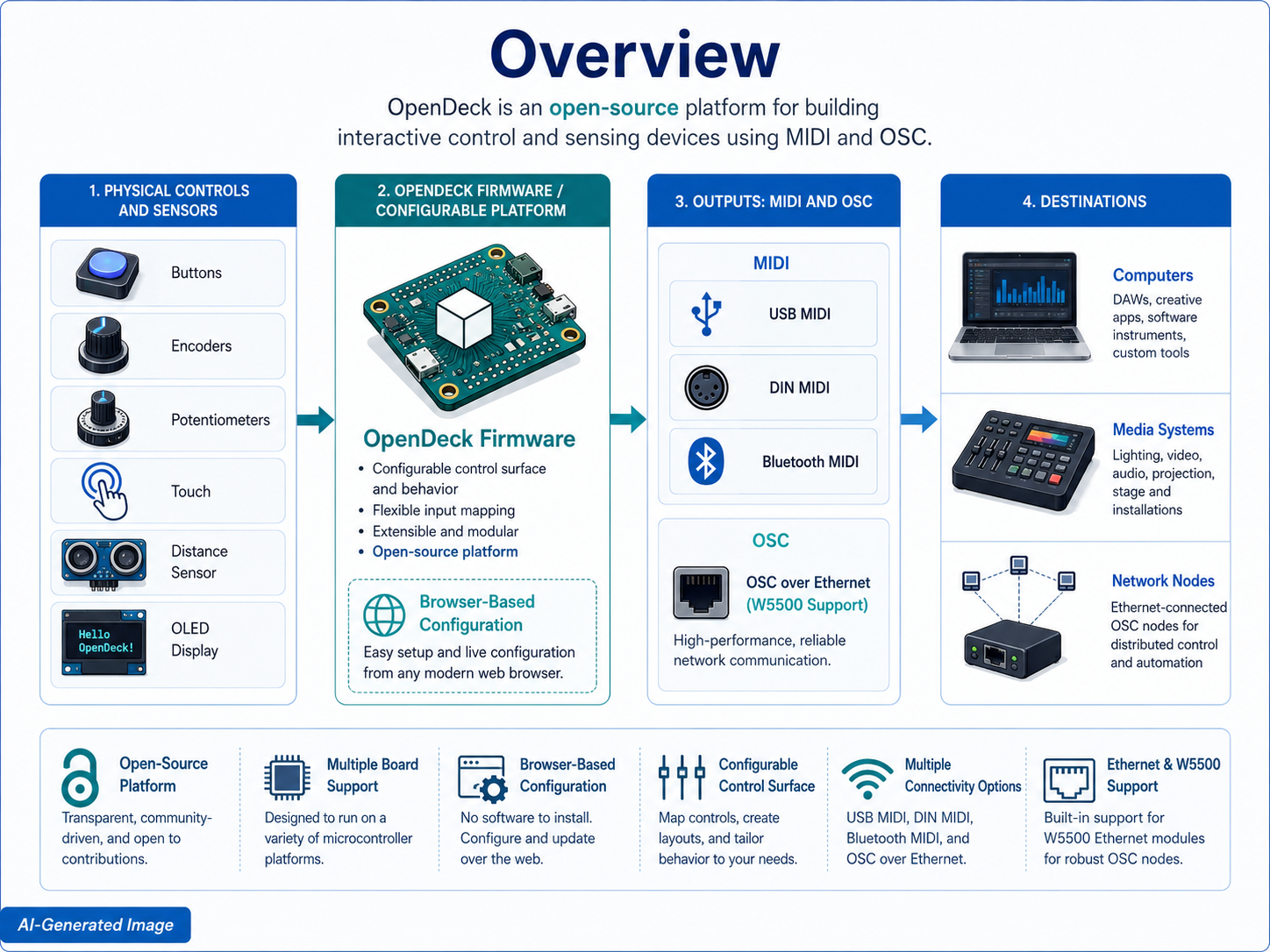
OpenDeck is an open-source platform for building interactive control and sensing devices using MIDI and OSC.
It can be used to create USB MIDI DJ controllers, DAW control surfaces, Ethernet-connected OSC nodes, sensor interfaces, and interactive media installations. The main goal of the project is to let users focus on hardware and interaction design instead of writing and debugging firmware from scratch.
OpenDeck supports browser-based configuration, multiple MCU families, MIDI, OSC, extensible sensor support, and a wide range of boards. It is especially interesting for WIZnet Maker Site because several supported boards use W5500 Ethernet or WIZnet Ethernet modules to provide network-based OSC communication.
In simple terms, OpenDeck turns buttons, encoders, potentiometers, sensors, LEDs, displays, and outputs into a configurable MIDI / OSC control surface. With W5500-based boards, those controls can also become Ethernet-connected OSC nodes.
📌 Project / Organization Context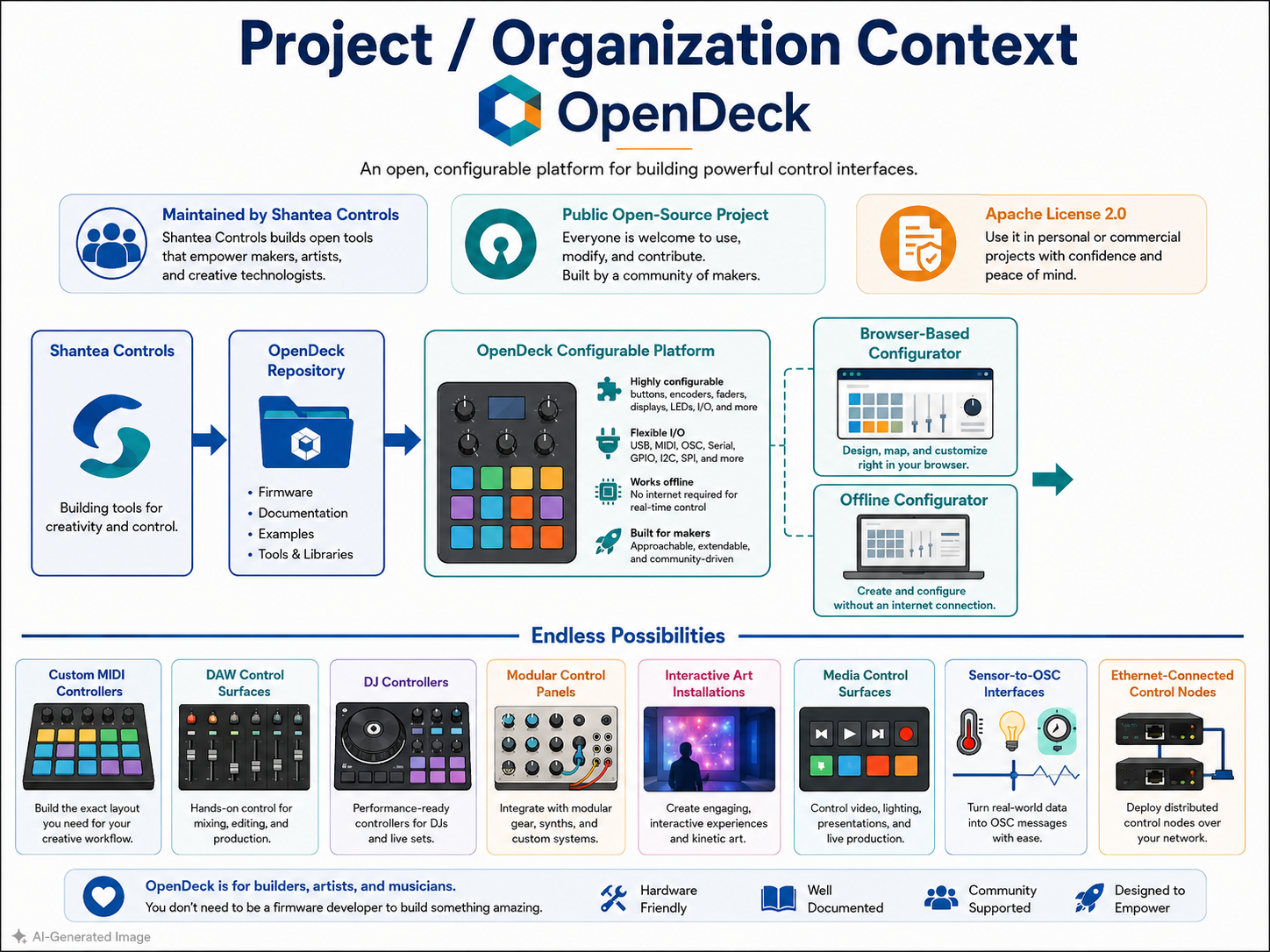
OpenDeck is maintained by Shantea Controls, and the repository is public under the Apache License 2.0.
The project is not just a one-board firmware example. It is a configurable platform that supports many different boards and I/O combinations. Users can configure their device through a browser-based configurator rather than modifying firmware code manually.
OpenDeck is particularly suitable for people building:
- Custom MIDI controllers
- DAW control surfaces
- DJ controllers
- Modular control panels
- Interactive art installations
- Media control surfaces
- Sensor-to-OSC interfaces
- Ethernet-connected control nodes
- Hardware prototypes for sound, light, video, and stage systems
The project also provides an online configurator and an offline configurator, which makes it more accessible to users who are not firmware developers.
📌 What This Project Does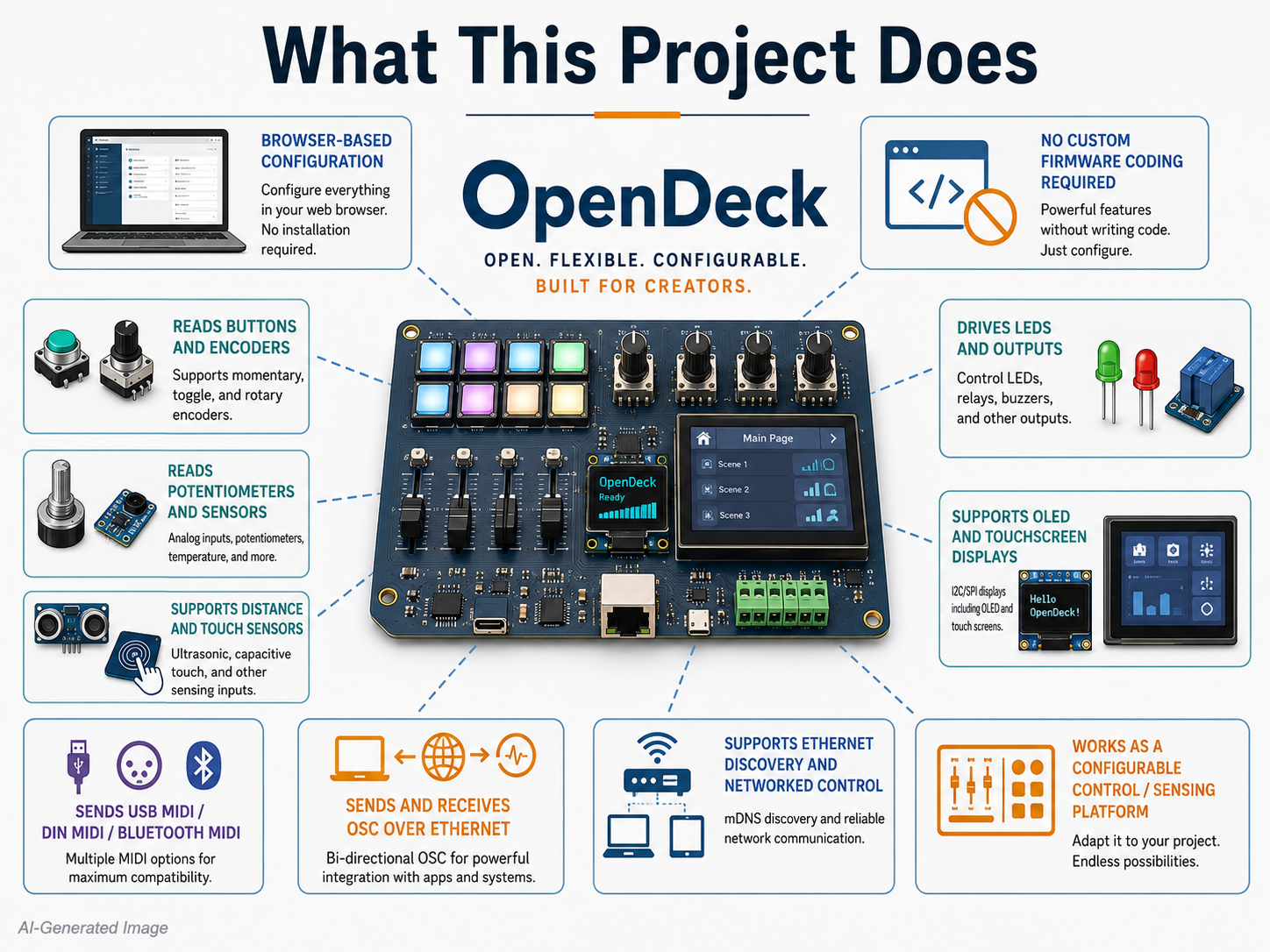
OpenDeck allows users to build custom control and sensing devices without writing custom firmware.
It supports many types of inputs and outputs, including:
- Buttons
- Encoders
- Single-color LEDs
- Relay or transistor outputs
- Potentiometers
- Force-sensitive resistors
- Touchscreen displays
- OLED displays
- Gesture sensors
- Capacitive touch sensors
- Time-of-flight distance sensors
- IMU / orientation sensors
For MIDI use cases, OpenDeck can send MIDI messages from buttons, encoders, potentiometers, and other controls. It supports USB MIDI, DIN MIDI, and Bluetooth MIDI depending on the selected board.
For OSC use cases, OpenDeck can send and receive OSC messages over Ethernet. This is where WIZnet becomes important. W5500-based boards can act as Ethernet OSC nodes, sending control and sensor data to software such as TouchDesigner, Max/MSP, Pure Data, VJ tools, DAWs, lighting systems, custom media servers, or interactive installation software.
📌 What is OSC and Why Ethernet Matters?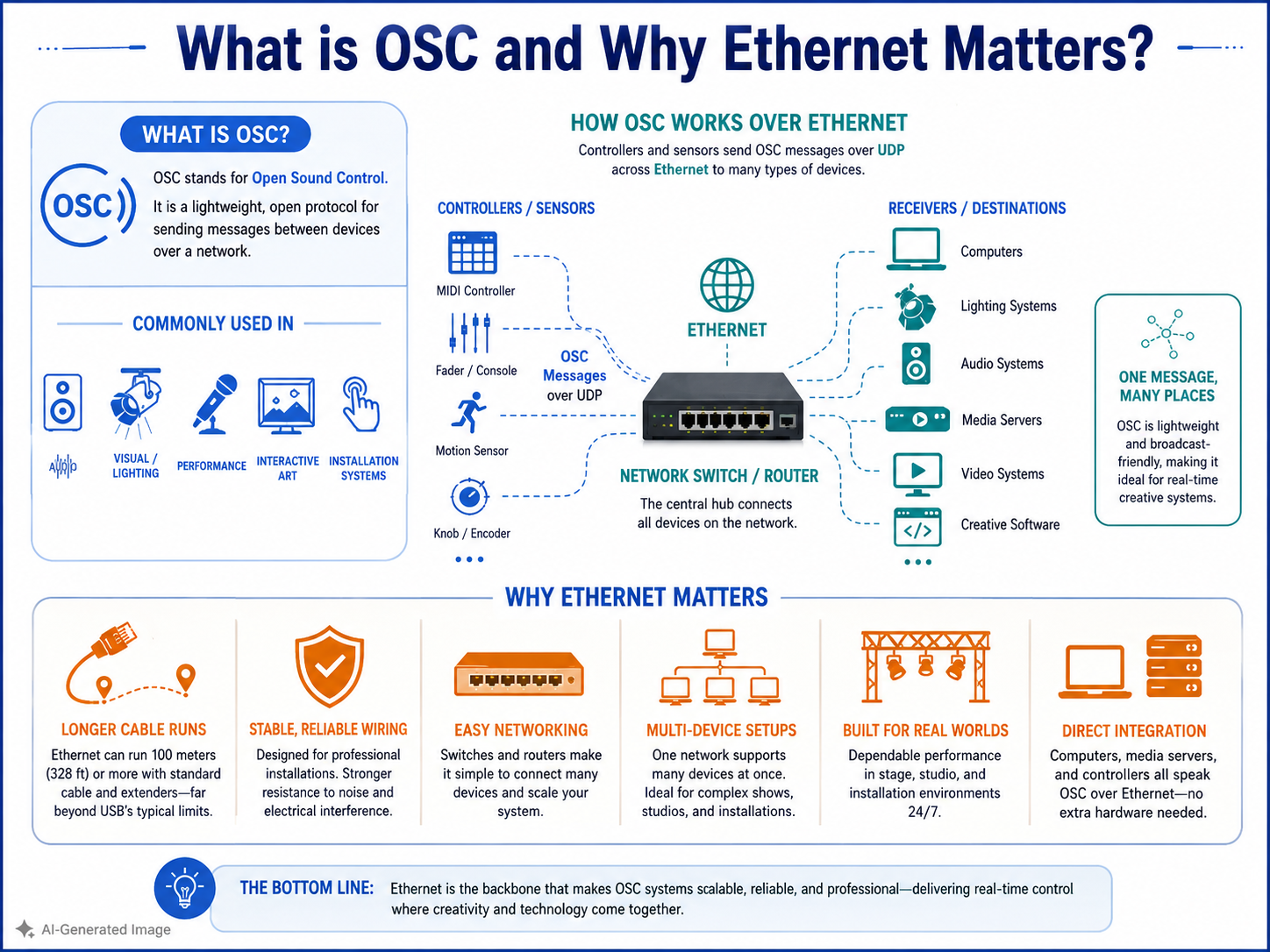
OSC, or Open Sound Control, is a protocol often used in audio, visual, performance, media-art, and interactive installation systems.
Unlike MIDI, OSC is commonly transported over a network, usually through UDP. It can carry structured address paths and data values, making it useful for modern interactive systems where sensors, controllers, computers, lighting tools, and media software communicate over IP networks.
Ethernet is valuable for OSC because it provides:
- Longer cable runs than USB
- Stable installation wiring
- Easy connection to routers and switches
- Multi-device networked setups
- Reliable communication in stage, studio, and installation environments
- Direct integration with computers and media servers
OpenDeck’s Ethernet OSC support makes it useful not only as a MIDI controller platform, but also as a networked sensor and control node platform.
📌 Role and Application of the WIZnet Chip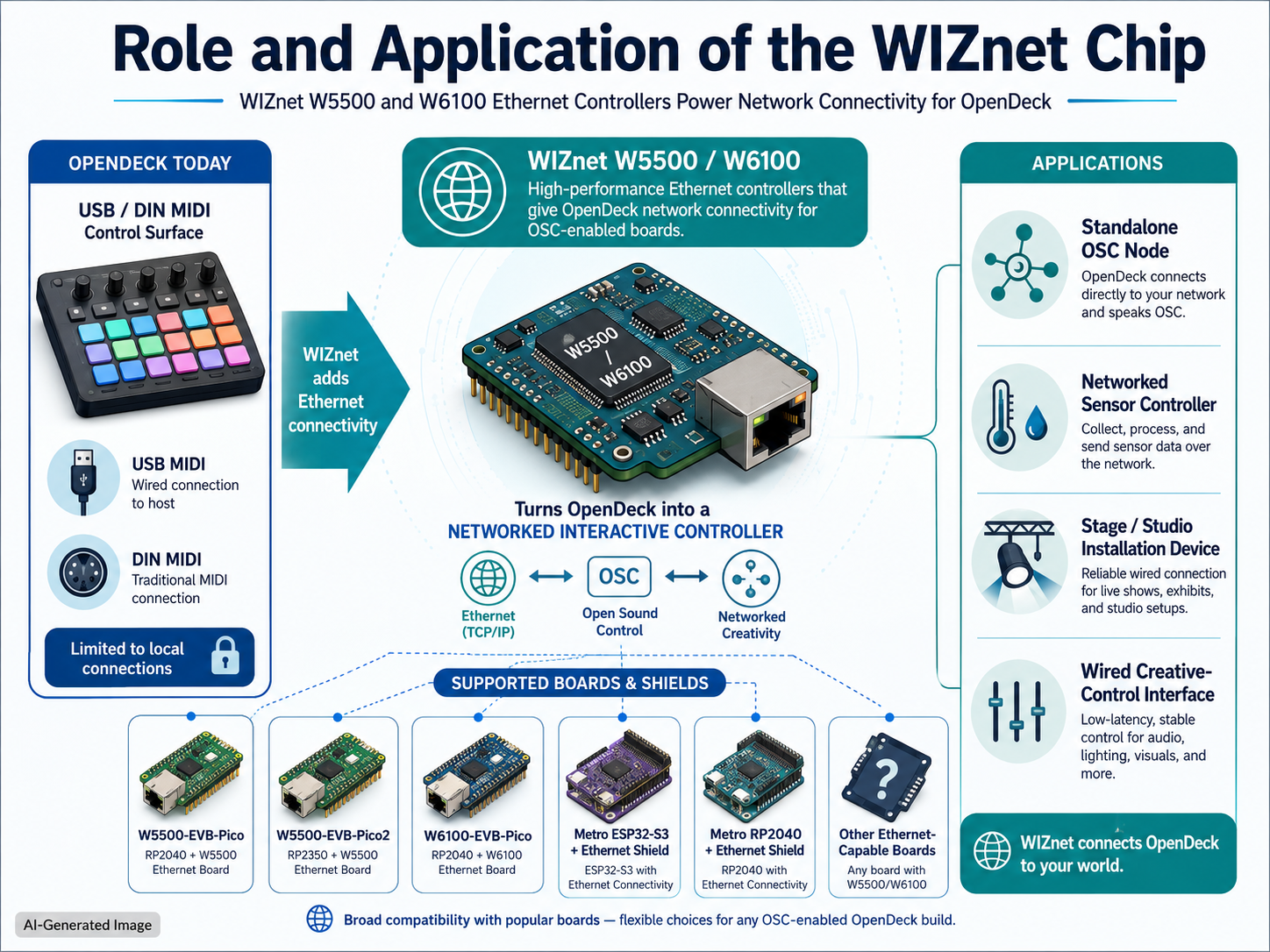
Related WIZnet products: W5500 and W6100
WIZnet Ethernet chips are used in OpenDeck to provide Ethernet connectivity for OSC-enabled boards.
The repository lists several Ethernet-capable boards and combinations, including:
- Adafruit Metro ESP32-S3 + W5500 Ethernet Shield
- Adafruit Metro RP2040 + W5500 Ethernet Shield
- W5500-EVB-Pico
- W5500-EVB-Pico2
- W6100-EVB-Pico
- W6100-EVB-Pico2
- LILYGO T-ETH Elite
- Waveshare ESP32-S3-ETH
- Other Ethernet-capable boards
In W5500-based configurations, the W5500 is used as the Ethernet controller that connects OpenDeck to the network. This allows OpenDeck to send and receive OSC messages over UDP and to participate in network discovery.
The WIZnet chip is important because it turns OpenDeck from a USB/DIN MIDI control surface into a networked interactive controller. With W5500 Ethernet, OpenDeck can be installed as a standalone control or sensor node on a local network.
📌 W5500 Ethernet Data Flow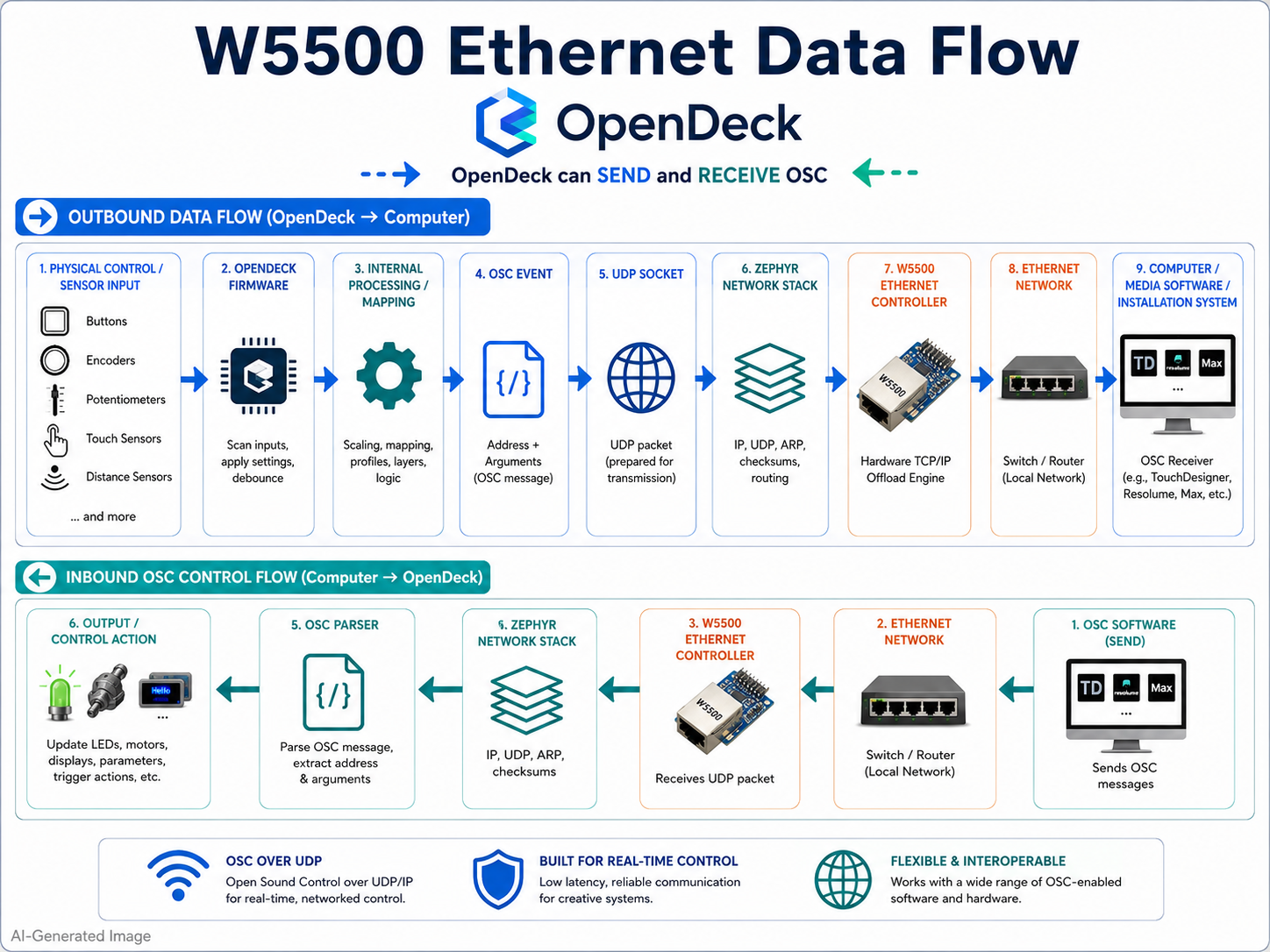
The W5500 data flow in OpenDeck can be understood as a bridge between physical controls and networked OSC software.
1. Physical interaction
A user interacts with hardware connected to an OpenDeck board.
Examples include:
- Pressing a button
- Turning an encoder
- Moving a potentiometer
- Touching a capacitive pad
- Moving near a distance sensor
- Changing orientation on an IMU sensor
- Triggering an external input
2. OpenDeck input processing
OpenDeck firmware reads the input and converts it into an internal signal.
Depending on the hardware type, this may involve:
- Debouncing a button
- Reading an analog value
- Processing an encoder
- Reading I2C sensor data
- Applying smoothing or mapping
- Converting the event into a MIDI or OSC signal
3. OSC packet generation
For OSC-enabled network boards, OpenDeck converts the internal event into an OSC packet.
The OSC implementation supports destination settings, listen port configuration, network identity, device information packets, discovery response, discovery announcement, and UDP packet transmission.
4. W5500 Ethernet transmission
On W5500-based boards, the Ethernet frame is sent through the W5500 network interface.
The flow is:
Physical control / sensor → OpenDeck firmware → OSC event → UDP socket → Zephyr network stack → W5500 Ethernet controller → Ethernet network
5. Networked media or control software
The OSC packet can then be received by software running on a computer or another networked device.
Possible receivers include:
- TouchDesigner
- Max/MSP
- Pure Data
- Ableton Live with OSC bridge
- Lighting control software
- VJ software
- Custom Python / Node.js tools
- Media servers
- Interactive installation systems
6. Incoming OSC control
OpenDeck can also receive OSC messages. Incoming OSC packets can control outputs or trigger configured actions.
The reverse flow is:
OSC software → Ethernet network → W5500 Ethernet controller → Zephyr network stack → UDP socket → OpenDeck OSC parser → output / control action
This makes OpenDeck useful as both an input controller and a network-controlled output device.
📌 Network Stack Note
OpenDeck is built on top of Zephyr RTOS.
For W5500-based boards, W5500 is configured as a Zephyr Ethernet device through board overlays. The firmware then uses Zephyr network sockets for UDP-based OSC communication.
This means the user-facing behavior is simple: OpenDeck appears as a networked OSC device. Internally, the W5500 provides the Ethernet interface, while Zephyr handles the network stack and sockets.
This makes the project different from a small MCU example that directly calls a WIZnet socket API. OpenDeck is closer to a modern RTOS-based embedded networking project.
📌 Supported Boards and WIZnet Relevance
OpenDeck supports many boards, but WIZnet is especially relevant for Ethernet OSC use cases.
The most important WIZnet-related board options are:
W5500-EVB-Pico
This is a WIZnet board based on RP2040 and W5500 Ethernet. In OpenDeck, it supports USB and Ethernet transports, making it suitable for compact OSC nodes and control surfaces.
W5500-EVB-Pico2
This board extends the same idea to a newer Pico-class platform. It supports USB, DIN, and Ethernet according to the OpenDeck supported board list.
Adafruit Metro ESP32-S3 + W5500 Ethernet Shield
This combination allows an ESP32-S3 board to gain W5500 Ethernet support for OSC communication.
Adafruit Metro RP2040 + W5500 Ethernet Shield
This combination allows an RP2040-based board to become an Ethernet OSC controller using the W5500 Ethernet shield.
LILYGO T-ETH Elite / Waveshare ESP32-S3-ETH
These are Ethernet-capable ESP32 boards supported by OpenDeck for OSC-oriented networked control applications.
📌 Features
Browser-based configuration
OpenDeck can be configured through a browser-based configurator, reducing the need for custom firmware work.
No firmware development required
Users can focus on wiring controls, sensors, and outputs instead of manually writing firmware.
MIDI support
OpenDeck supports USB MIDI, DIN MIDI, Bluetooth MIDI, MIDI input control, configurable MIDI channels, NRPN messages, button latching, and encoder modes.
OSC over Ethernet
OpenDeck supports OSC over Ethernet, configurable OSC destinations, sensor data streaming, output control, automatic network discovery through mDNS, network-based configuration, and firmware updates.
Wide hardware support
The project supports multiple MCU families and many board variants, including W5500 and W6100 Ethernet options.
Sensor support
OpenDeck supports sensors such as APDS-9960, CAP1188, VL53L4CX, VL53L5CX, and BNO085, mainly for OSC-focused use cases.
Display support
The platform supports Nextion HMI touchscreen displays and SSD1306 OLED displays.
Output control
OpenDeck can control LEDs, relays, transistor outputs, and other output types.
Network discovery
The OSC implementation includes network identity, device information packets, discovery responses, and mDNS-based service registration.
Open-source platform
OpenDeck source code is released under the Apache License 2.0.
📌 System Architecture
OpenDeck can be understood through five layers: hardware input layer, signal mapping layer, protocol layer, network layer, and configuration layer.
In the hardware input layer, OpenDeck reads buttons, encoders, analog inputs, FSRs, sensors, displays, and outputs.
In the signal mapping layer, OpenDeck maps physical interactions into configurable MIDI or OSC events.
In the protocol layer, OpenDeck sends or receives MIDI and OSC messages. MIDI can be transmitted over USB, DIN, or BLE depending on the board. OSC is transmitted over Ethernet.
In the network layer, W5500-based boards provide Ethernet connectivity. The Zephyr network stack and UDP sockets are used for OSC communication.
In the configuration layer, users configure device behavior through the OpenDeck configurator instead of editing code manually.
📌 Usage, Market, and Application Value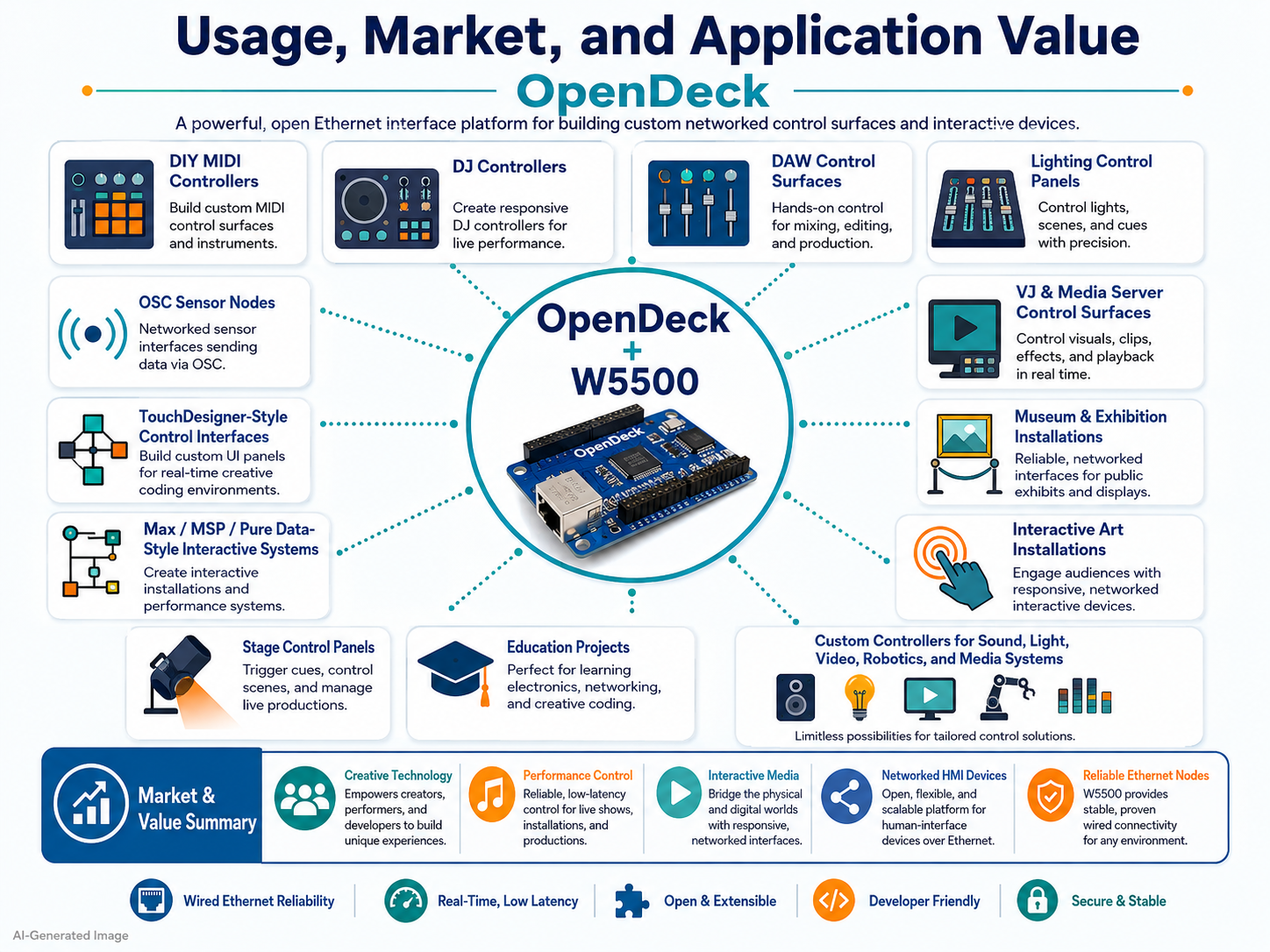
OpenDeck is useful for many types of creative and technical projects.
Possible applications include:
- DIY MIDI controllers
- DJ controllers
- DAW control surfaces
- Lighting control panels
- OSC sensor nodes
- TouchDesigner control interfaces
- Max/MSP and Pure Data controllers
- VJ and media server control surfaces
- Museum and exhibition installations
- Interactive art installations
- Stage control panels
- Networked sensor-to-OSC interfaces
- Education projects for MIDI / OSC / embedded interaction design
- Custom hardware controllers for sound, light, video, robotics, and media systems
From a WIZnet Maker Site perspective, this project is valuable because it shows W5500 being used outside typical IoT monitoring or industrial automation. Here, W5500 enables creative technology, performance control, media interaction, and networked human-interface devices.
📌 Similar Existing WIZnet Maker Site Content
It is difficult to find an existing WIZnet Maker Site post that exactly matches OpenDeck as a MIDI / OSC controller platform. However, the following contents are related from the perspectives of Ethernet I/O, sensor data transmission, automation, and networked control.
1. Programmable IoT Edge ESP32 Ethernet IO Module
URL Link:
https://maker.wiznet.io/matthew/resellers/programmable-iot-edge-esp32-ethernet-io-module/
Why it is similar:
This content introduces an ESP32 Ethernet I/O module for remote monitoring, secure I/O control, MODBUS TCP, MQTT, Ethernet, Wi-Fi, Bluetooth, utilities monitoring, process monitoring, alarm applications, and PLC / SCADA applications.
OpenDeck is also a network-connected control and I/O platform. Both projects deal with connecting physical inputs and outputs to a network.
Difference:
The ESP32 Ethernet IO Module is focused on industrial monitoring, facility automation, and PLC / SCADA-style applications.
OpenDeck is focused on creative control surfaces, MIDI, OSC, sensor interfaces, and media installations. Instead of industrial process data, it maps human interaction and sensor data into MIDI or OSC messages.
Expansion value:
The ESP32 Ethernet IO Module shows Ethernet I/O in industrial automation. OpenDeck expands the same “networked I/O” idea into music, performance, interactive media, and installation art.
2. Alert System Using W5100S-EVB-Pico & AWS SNS
URL Link:
https://maker.wiznet.io/gemma/projects/alert-system-using-w5100s-evb-pico-aws-sns/
Why it is similar:
This project uses a W5100S-EVB-Pico to send sensor data to AWS IoT Core and trigger SNS alerts when a threshold is exceeded.
OpenDeck also sends sensor and control data over a network, especially in OSC mode. Both projects connect embedded sensor or input data to networked software.
Difference:
The AWS SNS project focuses on cloud alerts and threshold-based notification.
OpenDeck focuses on real-time interaction. Instead of sending alerts to the cloud, OpenDeck sends OSC messages to creative software or receives OSC messages to control outputs.
Expansion value:
The AWS SNS project shows sensor-to-cloud communication. OpenDeck shows sensor/control-to-OSC communication for real-time media and interaction systems.
3. WizOnOff
URL Link:
https://maker.wiznet.io/nk_maker/contest/wizonoff/
Why it is similar:
WizOnOff is an automation controller with relays and a temperature sensor. It is similar to OpenDeck because both projects turn physical inputs and outputs into configurable networked behavior.
Difference:
WizOnOff is a standalone IoT automation controller for relay and temperature-based use cases.
OpenDeck is a flexible controller platform for MIDI, OSC, sensors, buttons, encoders, displays, and media-control workflows.
Expansion value:
WizOnOff shows IoT automation through relay and temperature control. OpenDeck expands the idea of configurable hardware I/O into performance, audio, visual, and interactive installation systems.
📌 Difference and Expansion Value Compared with Existing Maker Site Content
OpenDeck is different from many WIZnet Maker Site projects because it is not primarily a sensor monitoring project, cloud alert project, or industrial I/O project.
It is a human-interface and media-control platform.
Its main expansion value is:
First, OpenDeck brings WIZnet Ethernet into the creative technology field.
Many WIZnet projects focus on IoT, automation, energy, or industrial monitoring. OpenDeck applies Ethernet to MIDI, OSC, DJ controllers, DAW surfaces, sensor interfaces, and media installations.
Second, OpenDeck connects physical interaction to network protocols.
Buttons, encoders, potentiometers, sensors, and outputs can become MIDI or OSC messages without the user writing firmware from scratch.
Third, OpenDeck uses W5500 as an Ethernet path for OSC.
W5500-based boards make it possible to build reliable Ethernet-connected OSC nodes for studios, stages, installations, and performance environments.
Fourth, OpenDeck supports many hardware platforms.
The same firmware ecosystem can support USB MIDI boards, DIN MIDI boards, BLE MIDI boards, and Ethernet OSC boards.
Fifth, OpenDeck is highly configurable.
The browser-based configurator makes it accessible to hardware builders, musicians, artists, and designers who may not be embedded firmware developers.
OpenDeck can be positioned as:
Physical controls and sensors → configurable MIDI / OSC mapping → W5500 Ethernet transport → creative software / media system / installation control
📌 Additional Insight for W5500 Makers
OpenDeck is a valuable W5500 example because it shows Ethernet being used for real-time creative control, not only monitoring or cloud communication.
W5500 can be especially useful in this context because:
- Ethernet is more stable than USB extensions in large installations.
- Ethernet works well with routers, switches, and long cable runs.
- OSC is naturally suited for IP networks.
- Multiple OpenDeck nodes can be placed around a stage, studio, or exhibition.
- Sensors and controls can be distributed across a physical space.
- Media software can receive OSC messages over a predictable wired network.
This gives W5500 a strong role in interactive systems where timing, reliability, and physical installation flexibility matter.
📌 Things to Know Before Building
Before using OpenDeck, users should check the following:
- Choose a supported board that matches the intended transport: USB MIDI, DIN MIDI, BLE MIDI, or Ethernet OSC.
- For W5500 Ethernet, select a supported W5500 board or shield combination.
- OSC functionality is available on supported Ethernet-enabled boards.
- The official OpenDeck L board focuses on USB and DIN MIDI and does not provide OSC support.
- Sensor support is mainly useful for OSC workflows.
- Network configuration should match the destination software and IP/port setup.
- For Ethernet OSC installations, use reliable cabling and proper network switching.
- Use the OpenDeck configurator to map inputs, outputs, sensors, and protocol behavior.
- Verify compatibility with the target software such as TouchDesigner, Max/MSP, Pure Data, or DAW/lighting tools.
📌 Summary
OpenDeck is an open-source MIDI and OSC platform for building interactive control and sensing devices. It supports USB MIDI controllers, DAW control surfaces, Ethernet-connected OSC nodes, sensor interfaces, and media installations.
WIZnet is relevant because OpenDeck supports several W5500-based and WIZnet Ethernet-capable boards, including Adafruit Metro ESP32-S3 + W5500 Ethernet Shield, Adafruit Metro RP2040 + W5500 Ethernet Shield, W5500-EVB-Pico, W5500-EVB-Pico2, and other Ethernet boards.
In OpenDeck, W5500 is used as an Ethernet interface for OSC communication. Physical controls and sensors are converted into OSC packets and transmitted over UDP through the network. Incoming OSC messages can also control outputs.
This makes OpenDeck a strong WIZnet Maker Site UCC candidate for expanding WIZnet content into MIDI, OSC, creative control surfaces, media installations, and networked human-interface devices.
📌 FAQ
Q1. What is OpenDeck?
OpenDeck is an open-source platform for building MIDI and OSC control devices such as DJ controllers, DAW control surfaces, sensor interfaces, and Ethernet-connected OSC nodes.
Q2. Which WIZnet chip is related?
W5500 is strongly related. OpenDeck supports W5500-based boards and W5500 Ethernet shield combinations.
Q3. What does W5500 do in OpenDeck?
W5500 provides Ethernet connectivity for OSC communication. It allows OpenDeck to send and receive OSC messages over a wired network.
Q4. Is OpenDeck only for MIDI?
No. It supports MIDI and OSC. USB/DIN/BLE MIDI depends on the selected board, while OSC is available on supported Ethernet-enabled boards.
Q5. What can users build with OpenDeck?
Users can build MIDI controllers, DAW surfaces, OSC sensor nodes, interactive art controllers, lighting panels, media installation controllers, and networked input/output devices.
Q6. Does the official OpenDeck L board support OSC?
The official L board focuses on USB and DIN MIDI and does not have OSC support. OSC is available on supported Ethernet-enabled boards.
Q7. Why is this meaningful for WIZnet Maker Site?
Because it shows W5500 being used in a creative interaction platform, not just in sensor monitoring or industrial networking. It expands WIZnet use cases into MIDI, OSC, performance, media art, and interactive installations.