Streamer audio Ethernet multicast/multiroom 48 KHz/24 bits sans compression
Streamer audio Ethernet multicast/multiroom 48 KHz/24 bits sans compression
0
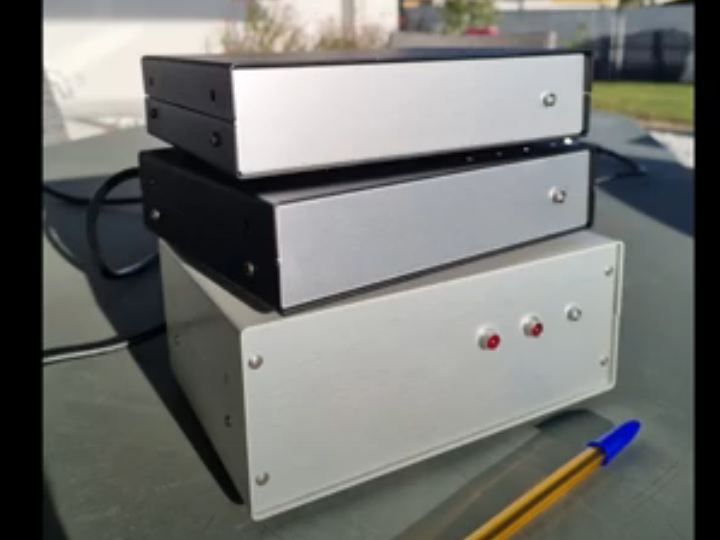
Project description
🚀 WIZnet W5500-based DIY HIFI Audio over Ethernet Streaming System: Low-Latency, High-Quality Multicast Solution
1. Project Overview: Key Features and Technology Summary
This project aims to implement a professional-grade, losslessly compressed audio streaming solution in a wired Ethernet environment using low-cost hardware.
Lossless Audio Streaming: Transmits 48 kHz / 24-bit stereo lossless audio via UDP multicast.
Ultra-Low Latency Performance: Achieves an end-to-end latency of only 57 ms due to the W5500's hardware UDP stack.
Diverse I/O Support: Supports both Analog (WM8783 ADC) and SPDIF/TOSLINK (WM8804 digital transceiver) inputs, with the receiver featuring a WM8521 DAC for analog output.
Real-time Remote Control: An Android App (Kotlin) sends JSON commands to enable real-time adjustment of Volume, Balance, and a 3-band Parametric EQ (TDA7418).
Open Source Commitment: The VHDL, Assembler, and Kotlin source codes are released under the GPL license, making customization and learning straightforward.
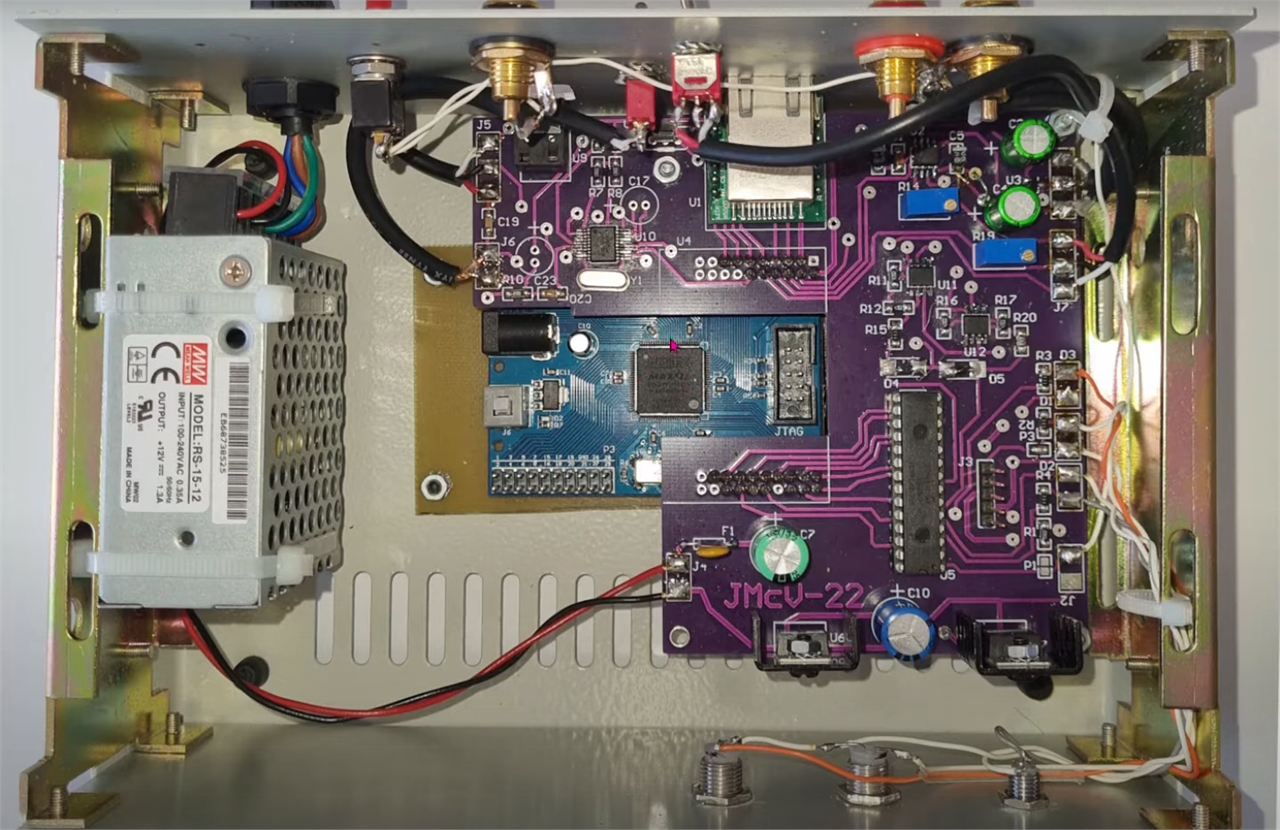
2. The Role of W5500: The Core Engine for Low-Latency Multicast ✨
The W5500 Wiznet module is the critical component that allows this system to achieve professional network audio performance using only a low-cost MCU and CPLD. The W5500's hardware stack provides decisive advantages in performance, efficiency, and simplicity.
2.1. Key Advantages of Choosing W5500
Requirement | Advantage Provided by W5500 |
|---|---|
Low Latency & Reliability | Hardware UDP Stack minimizes the load on the PIC MCU, achieving a total latency of 57 ms. |
Multicast/IGMP Implementation | Features Multicast filtering per socket and IGMP auto-management. This easily enables a "Multi-Room" configuration that is compatible with network switches. |
Bandwidth Overhead | The system requires only approx 2.304Mbps for uncompressed audio, leaving ample headroom on the 100 Mbps Full-Duplex link for scaling up to dozens of receivers. |
Simplified Interface | High-speed 4-wire SPI interface, single 3.3 V power supply, and integrated PHY reduce board space and simplify the design. |
2.2. Ultra-High-Speed SPI Communication via W5500
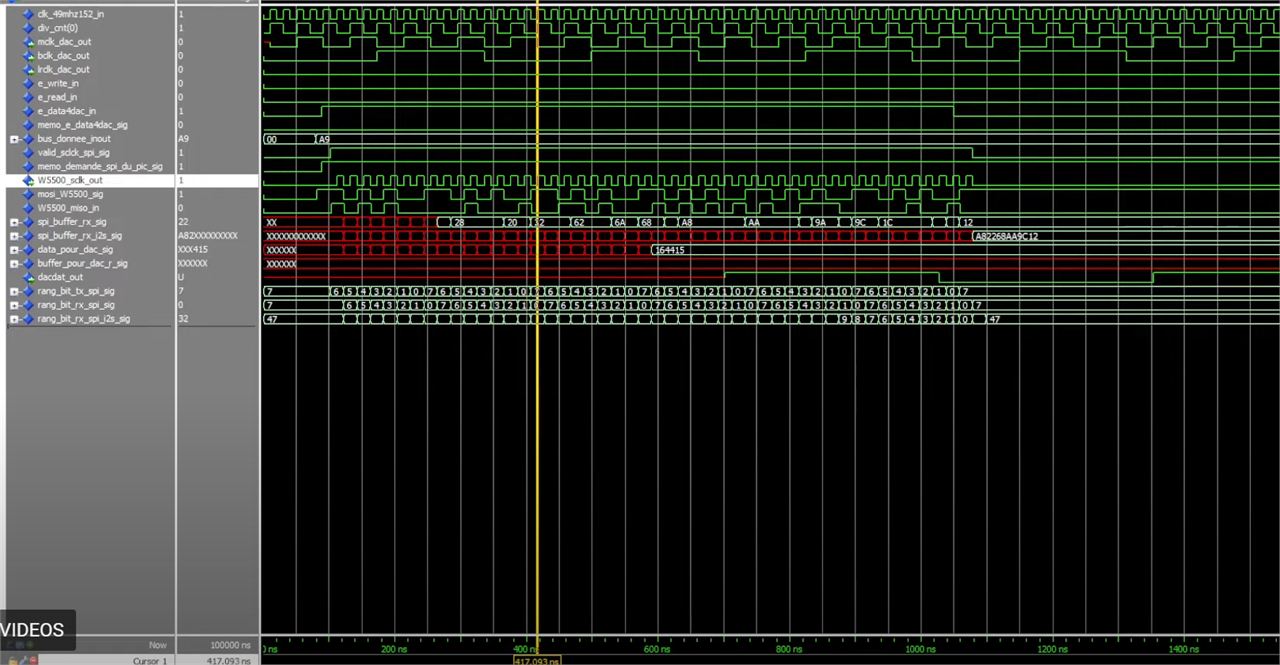
The W5500 enables high-speed data transfer by communicating with an SPI Master implemented within the CPLD, bypassing the limitations of the PIC MCU.
- SPI Speed: The SPI communication between the CPLD and the W5500 operates at the system clock speed of 49.152 MHz, or 49.152 Mbps.
- Data Throughput:
- Transmitter: Transferring the 48-bit audio data (2 x 24-bit) to the W5500's FIFO takes only 970 ns.
- Receiver: Retrieving the 48-bit audio data from the W5500's receive FIFO and preparing it for the DAC takes just 966 ns.
3. Hardware and Firmware Technology Stack Breakdown 🛠️
Block | Key Components/ | Role |
|---|---|---|
Audio Input | WM8783 ADC, WM8804 Digital Transceiver | Converts multi-format inputs to 24-bit I²S output. |
Clock/I/O | CPLD MAX II (VHDL) | Uses a single 49.152 MHz clock to minimize jitter. Aligns I²S frames and arbitrates high-speed SPI communication with the W55005555. |
Network | WIZnet W5500 + PIC18F26K22 (Assembler) | Handles hardware UDP/IGMP processing, and 100 Mbps low-jitter stream transmission. The PIC manages the packet buffer using an interrupt routine triggered every $20.83 \mu s$. |
Output/Control | TDA7418 Audio Processor | Provides digital mixing for 3-band Parametric EQ, Volume, and Balance (controlled via I²C). |
App Layer | Android (Kotlin) | Uses JSON/UDP to control multiple receiver groups. |
4. Industrial Value and Broad Applications 🌐
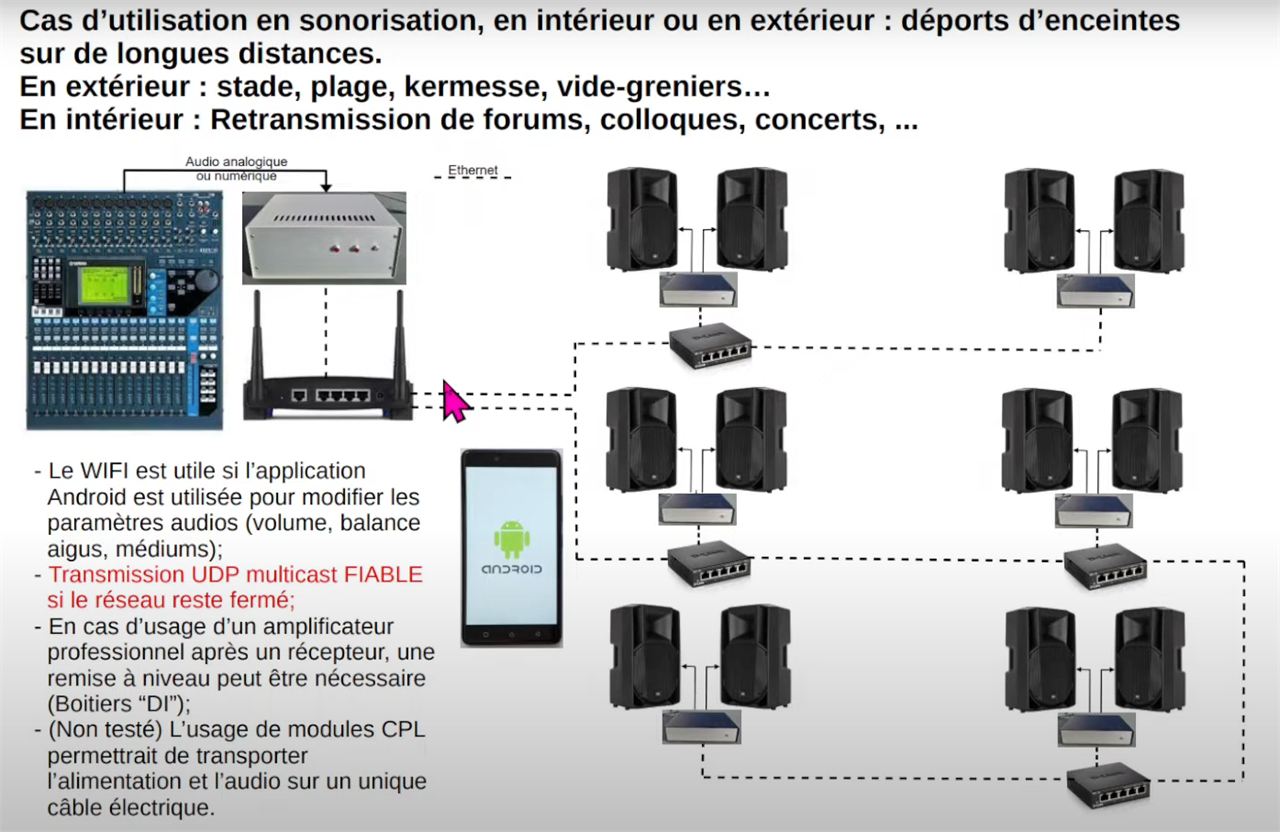
This W5500-based solution delivers high industrial value by utilizing the chip's hardware AoIP capabilities to fill the "price-technology gap" between expensive commercial solutions and traditional analog PA systems.
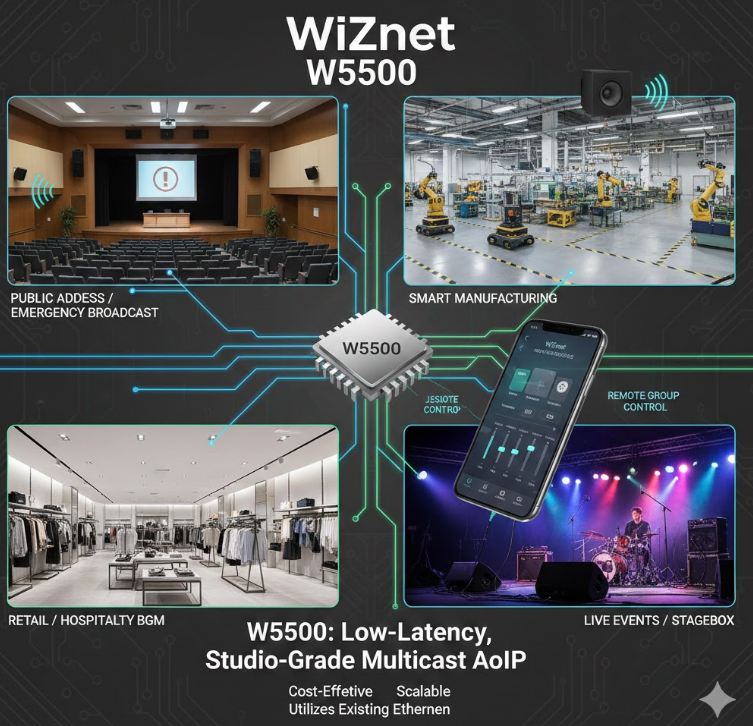
4.1. The Significance of the Project (Value Proposition) ✨
Value Point | Impact of the W5500-based System |
|---|---|
Studio-Grade Lossless, Low-Latency AoIP | End-to-end latency is only 57 ms for $48\text{ kHz}/24\text{-bit}$ uncompressed streaming, eliminating the need for expensive DSPs or quality-degrading compression. |
W5500 Hardware UDP/IGMP Offload | The W5500 offloads IGMP group joining/leaving and UDP checksums. This allows the 8-bit MCU + CPLD combination to reliably service dozens of receivers, significantly reducing the high SoC and licensing costs associated with commercial Dante/AES67 equipment. |
100% Utilization of Existing Ethernet Infrastructure | It relies solely on standard Ethernet equipment (Cat5e, Fiber-media converters, PoE switches), eliminating the cost of 'snake cables' and analog wiring in large-scale installations. |
Remote and Group Control | The Android app uses JSON packets for real-time remote adjustment of Volume, Balance, and 3-band Parametric EQ, allowing zone-specific sound tuning without on-site visits. |
GPL Open Source for Scalability | The open source nature enables OEMs/SIs to easily add custom features like AES67/RTP compatibility, encryption, or PoE-Plus power management. |
4.2. Industry-Specific Application Scenarios 🏢
The low-latency multicast AoIP technology is immediately applicable across various industrial sectors.
Industry/Sector | Application Method | Achieved Benefits |
|---|---|---|
Public/Enterprise PA / Emergency Broadcast | Implemented as a multi-zone announcement/alert system in schools, hospitals, and factories. Integrates with existing IP IoT devices like CCTV and access control. | Reduces emergency response time by integrating network audio with existing sensor systems, enabling automated voice alerts upon video analytics events. |
Smart Manufacturing & Logistics Warehouses | Multicasts production line alerts, work instructions, and AGV path guidance audio. | Reduces CAPEX on wiring in smart factories where equipment is frequently rearranged and facilitates noise regulation compliance via zone-specific volume control. |
Live Events & A/V Rental | Replaces analog multicore cables between the stage and console with a 'Virtual LAN' (1 GbE) to configure 8x8 stageboxes. | Achieves studio-grade audio quality without noise or loss over long-distance ($>100\text{ m}$) cables, while reducing setup and teardown time. |
Campus/Complex Facilities | Links classrooms, libraries, and gyms into a unified AoIP network for broadcasting, real-time interpretation, and audio sharing for online conferences. | Scales up to hundreds of terminals without traffic congestion, provided IGMP Snooping is enabled on the switches. |
4.3. Market Impact and Value Summary 📈
The W5500-based solution drives innovation by reducing costs and expanding service capabilities.
CAPEX Reduction: Replaces dedicated audio wiring, multicore cables, and analog distribution amps with generic Ethernet switches.
Service Innovation: Enables high-value add-ons like software-defined audio zones, automation (Video analytics $\rightarrow$ voice alert), and real-time translation/AI voice synthesis.
"Affordable yet Studio-Grade, Simple yet Massively Scalable." The W5500's hardware UDP/IGMP capability allows the same circuit and firmware to address everything from public PA to live stageboxes. This fills the market gap between high-cost commercial solutions and traditional analog PA, proving its high potential for product commercialization in the global SI market.
이더넷 멀티캐스트/멀티룸 오디오 스트리머 (48 KHz/24 bits, 비압축)
1. 프로젝트 개요: WIZnet W5500 기반 DIY Hi-Fi 오디오 스트리밍 시스템
이 프로젝트는 저렴한 하드웨어를 사용하여 유선 이더넷 환경에서 전문가 수준의 무손실 오디오 스트리밍 솔루션을 구현하는 것을 목표로 합니다.
주요 기술: UDP 멀티캐스트를 사용한 48 kHz / 24-bit 스테레오 무손실 오디오 전송
핵심 성능: W5500의 하드웨어 UDP 스택을 통해 57 ms의 초저지연(Ultra-Low Latency) 성능 달성
입/출력 지원: 아날로그 입력(WM8783 ADC) 및 디지털 입력(SPDIF/TOSLINK - WM8804), 수신기에는 아날로그 출력(WM8521 DAC) 기능 탑재
원격 제어: 안드로이드 앱(Kotlin)을 통해 **볼륨, 밸런스, 3밴드 파라메트릭 EQ(TDA7418)**를 실시간으로 조정하는 기능 제공
오픈 소스: VHDL, 어셈블러, Kotlin 소스 코드가 GPL 라이선스로 공개됨
2. W5500의 역할: 저지연 멀티캐스트의 핵심 엔진
WIZnet W5500 모듈은 저렴한 MCU와 CPLD만으로 전문 네트워크 오디오 성능을 달성하게 해주는 핵심 부품입니다.
요구 사항 | W5500이 제공하는 이점 |
|---|---|
저지연 및 신뢰성 | 하드웨어 UDP 스택을 통해 PIC MCU의 부하를 최소화하여 총 지연 시간 57 ms 달성 |
멀티캐스트/IGMP 구현 | 소켓별 멀티캐스트 필터링 및 IGMP 자동 관리 기능으로 네트워크 스위치와 호환되는 "멀티룸" 환경을 쉽게 구현 |
대역폭 효율성 | 비압축 오디오에 약 2.304 Mbps만 요구되어 100 Mbps 전이중(Full-Duplex) 링크에서 수십 대의 수신기까지 확장 가능 |
인터페이스 단순화 | 고속 4선 SPI 인터페이스, 단일 3.3V 전원, 통합 PHY로 보드 공간 축소 및 설계 간소화 |
3. 하드웨어 및 펌웨어 기술 스택 분석
블록 | 주요 컴포넌트/기술 | 역할 |
|---|---|---|
오디오 입력 | WM8783 ADC, WM8804 디지털 트랜시버 | 다중 포맷 입력을 24-bit I²S 출력으로 변환 |
클럭/I/O | CPLD MAX II (VHDL) | 49.152 MHz 단일 클럭을 사용하여 지터(Jitter) 최소화 및 W5500과의 고속 SPI 통신 중재 |
네트워크 | WIZnet W5500 + PIC18F26K22 (어셈블러) | 하드웨어 UDP/IGMP 처리 및 저지연 스트림 전송 담당. PIC는 인터럽트 루틴을 사용하여 패킷 버퍼 관리 |
출력/제어 | TDA7418 오디오 프로세서 | I²C를 통해 3밴드 파라메트릭 EQ, 볼륨, 밸런스를 제어하는 디지털 믹싱 제공 |
앱 계층 | 안드로이드 (Kotlin) | JSON/UDP를 사용하여 다중 수신기 그룹 제어 |
4. 산업적 가치 및 광범위한 응용 분야
이 W5500 기반 솔루션은 고가의 상용 AoIP 솔루션과 기존 아날로그 PA 시스템 간의 "가격-기술 격차"를 해소하여 높은 산업적 가치를 제공합니다.
스튜디오급 무손실, 저지연 AoIP: 48kHz/24bit 비압축 스트리밍에 대해 57 ms의 지연 시간만을 제공하여 고가 DSP나 품질 저하 압축이 필요 없음.
W5500 하드웨어 오프로드: W5500이 IGMP/UDP 체크섬을 처리하여 저렴한 8-bit MCU와 CPLD 조합으로도 상용 Dante/AES67 장비 대비 비용을 크게 절감하며 안정적인 서비스 제공.
주요 응용 시나리오:
공공/기업 PA / 비상 방송: 기존 IP IoT 장치와 통합되어 학교, 병원, 공장 등에서 다중 구역 안내 및 경보 시스템으로 사용.
스마트 제조 및 물류 창고: 생산 라인 경보, 작업 지침 등을 멀티캐스트하여 배선 비용 절감 및 구역별 볼륨 제어를 통한 소음 규제 준수.
라이브 이벤트 A/V: 무대와 콘솔 간의 아날로그 멀티코어 케이블을 대체하여 장거리에서도 노이즈 없는 스튜디오급 오디오 품질 달성.
"저렴하면서도 스튜디오급 품질, 단순하면서도 대규모 확장 가능." W5500의 하드웨어 UDP/IGMP 기능은 이 솔루션을 공공 PA부터 라이브 무대 박스까지 광범위하게 적용할 수 있게 합니다.
