


SUNTEC UECS Sensor Unit
SUNTEC UECS Sensor Unit
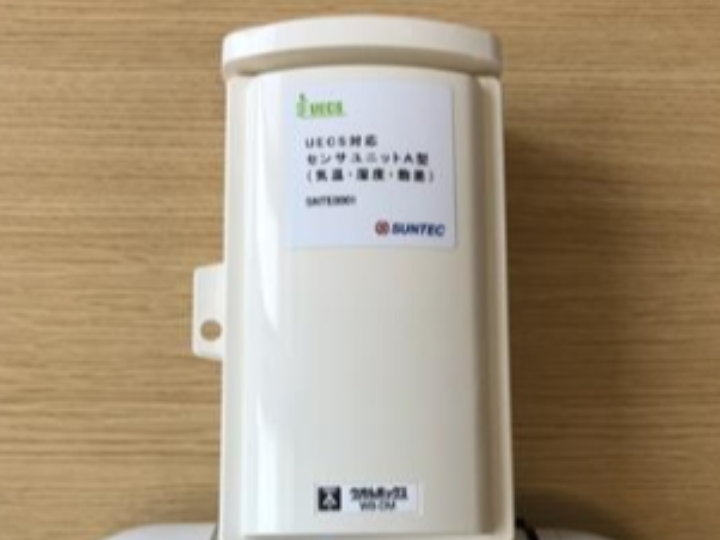
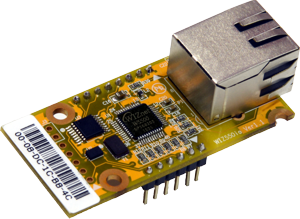
WIZnet - WIZ550io
x 1

📌 A Kyoto Board House Sells a Greenhouse Node Whose LAN Side Is a WIZ550io
The SUNTEC UECS Sensor Unit Type A measures the air around a greenhouse crop and broadcasts every reading onto the house LAN, and the part that puts those readings on the wire is a WIZnet WIZ550io, a W5500-based Ethernet module, one per unit.
SUNTEC Co., Ltd. (株式会社サンテック), a printed circuit board and EMS house in Fushimi, Kyoto, manufactures and sells the unit. The product page carries a single product line and says plainly that SUNTEC did not design it: the Type A unit was developed by NARO.
One Type A unit reports to a greenhouse network:
- Air temperature and relative humidity, from a Sensirion SHT31 in an aspirated duct
- Vapour pressure deficit, computed in firmware from those two readings
- Carbon dioxide, from an ELT Sensor S300G on the SNTE0001C model
- Solar radiation, from an optional PV array pyranometer
- Two waterproof probe temperatures and two analog voltages, on optional inputs
- Duct fan speed in rpm, a health check on the aspiration
- Date, time, latitude, longitude and satellite count, from an onboard GPS receiver
Every reading leaves the box over wired Ethernet in UECS format, and the public bill of materials makes the chip claim checkable rather than assumed.
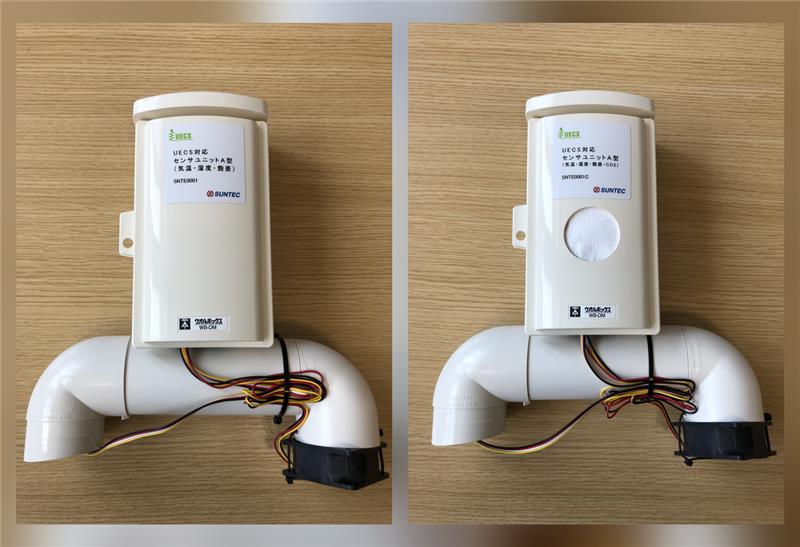
The two catalogue models. The right-hand unit adds the round CO2 membrane vent. Photos: SUNTEC Co., Ltd. product page.
What UECS Is, and Why a Greenhouse Node Needs a Common Format
UECS, the Ubiquitous Environment Control System, is a Japanese standard in which every piece of greenhouse equipment broadcasts its readings onto a local network and every other device is free to act on them. No central controller and no server are required, so a vent controller listens for a temperature value and decides for itself.
NARO built the Type A sensor unit because, as its build manual explains, commercial greenhouse sensors mostly emit proprietary signals, which makes mixing brands and writing your own analysis software difficult. NARO Western Region Agricultural Research Center published the design on 1 June 2020, and the current build manual carries an internal PDF date of 20 July 2021. SUNTEC's leaflet, generated on 2 February 2023, adds the consequence for a grower: no cloud contract is required.
Vendor, Availability, and Price
SUNTEC Co., Ltd. is the legal seller and manufacturer, founded in October 1990, with 43 staff as of March 2026 and a second plant in Shigaraki, Shiga. The registered address is 79 Takeda Waraya-cho, Fushimi-ku, Kyoto, the telephone 075-603-3551 and the president Shinji Izumi. SUNTEC states that it has held ISO 9001 since March 2002 and ISO 14001 since April 2005 under registration numbers 13373-A and 13373-B, and that its Shiga plant holds a medical device manufacturing licence. No certificates are published, so those three remain vendor statements.
Price is not published. Checked on 27 August 2026, neither the product page nor the leaflet PDF carries a figure, a currency, a tax note or a cart, and orders and quotations go through the enquiry form at suntecweb.com/contact/contact-products.
Stock is not published either: no quantity, no lead time, no shipping terms. The document the product page links as warranty terms, generated on 22 June 2022, is headed as terms of use, disclaims liability in four clauses and defers to the conditions NARO sets as copyright holder. A printed warranty card ships in the box.
The listing is younger than the design: the product URL carried no UECS item in captures from 16 April and 24 June 2021, and today's wording was already in place on 30 May 2023.
⚙️ Role of the WIZ550io in the Type A Sensor Unit
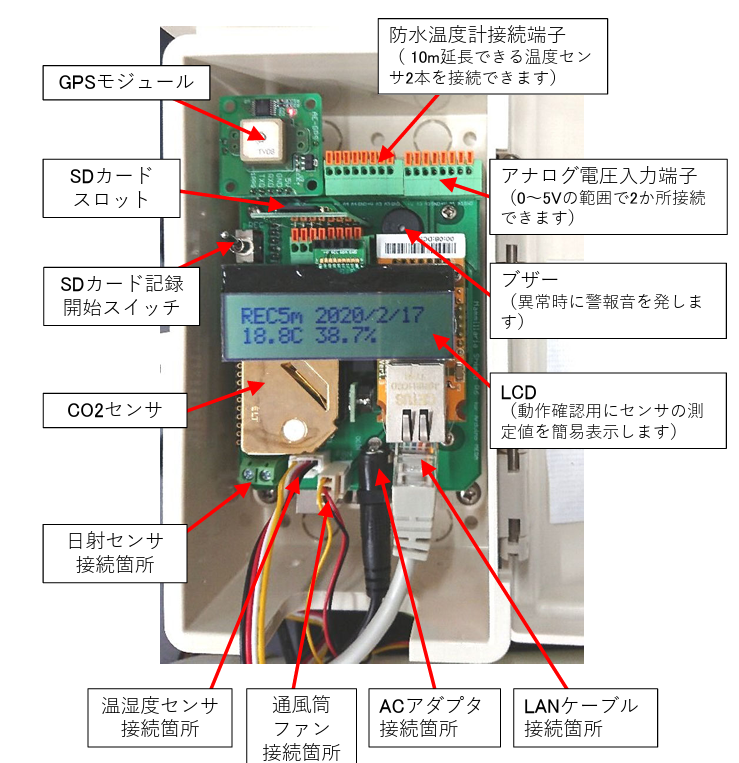
The WIZ550io is standard in the Type A design, not a paid option. The NARO build manual shows it as item 14 of the finished-board legend on page 68, labelled "⑭WIZ550IOモジュール接続箇所", the WIZ550IO module connection point, and the parts table on page 13 names WIZ550io V1.3, an embedded Ethernet module, one required, from Switch Science or Strawberry Linux.
The spreadsheet version of that parts table adds the one thing the PDF never prints, the manufacturer name WIZnet, in the maker column beside Arduino, Panasonic and Murata. The firmware confirms the part from the software side: the Ethernet2 library in NARO's attachment archive carries the header "Copyright (c) 2010 by WIZnet" in src/utility/w5500.h, and that file defines the W5500 socket registers Sn_MR at 0x0000, Sn_CR at 0x0001, Sn_SR at 0x0003 and Sn_DIPR at 0x000C, with MAX_SOCK_NUM set to 8.
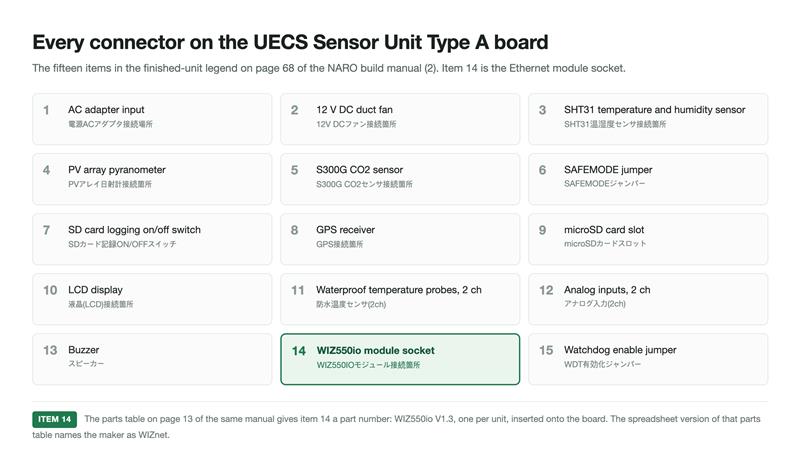
Generated technical diagram: the finished-board legend from page 68 of the NARO build manual, redrawn. Item 14 is the Ethernet module socket.
Page 32 has the builder read the string printed under the barcode on the WIZ550io and type it into the sketch two characters at a time, because that string is the unit's MAC address, which must differ for every unit built.
Three Sockets, Two UDP Ports and One Web Page
An Arduino MEGA 2560 R3 polls the sensors over I2C and 1-Wire, computes vapour pressure deficit, logs a record to microSD every five minutes, and hands the network side to the WIZ550io over SPI, with no separate processor between the sensor and the wire.
The UARDECS_MEGA library opens three network endpoints at once and keeps them open. The first lines of Uardecs_mega.cpp declare two EthernetUDP objects and one EthernetServer on port 80, and the startup routine binds UDP 16520 and UDP 16529. Port 16520 carries the UECS CCM broadcasts, port 16529 answers node searches so a new device is found without a server, and port 80 serves the setup pages Network Config, Node Status, CCM Status and CCM Edit.
| Reading | CCM type | Resolution | Send interval |
|---|---|---|---|
| Air temperature | InAirTemp.mIC | 0.1 C | 10 s |
| Relative humidity | InAirHumid.mIC | 0.1 % | 10 s |
| Vapour pressure deficit | InAirHD.mIC | 0.01 g/m3 | 10 s |
| CO2 concentration | InAirCO2.mIC | 1 ppm | 10 s |
| Solar radiation | InRadiation.mIC | 0.005 kW/m2 | 10 s |
| Soil temperature 1 and 2 | SoilTemp.1.mIC, SoilTemp.2.mIC | 0.1 C | 10 s |
| Fan speed | FanRPM.mIC | 1 rpm | 60 s |
| Time of day | Time | 1 s | 1 s |
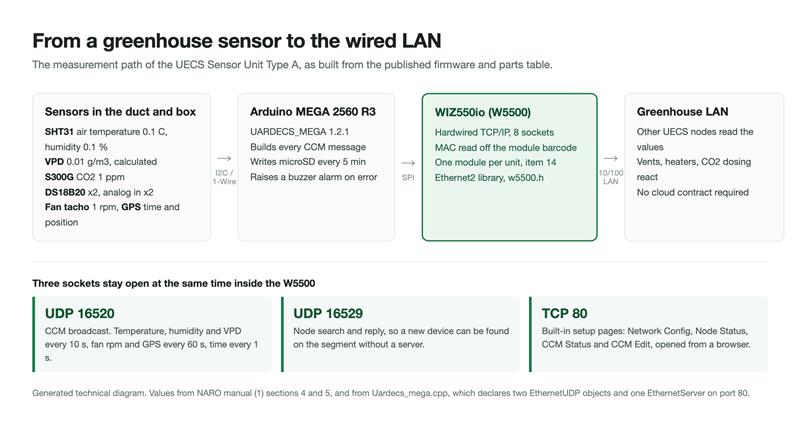
Generated technical diagram: the path from sensor to LAN, and the three sockets the W5500 holds open at the same time.
Wired Ethernet is not a stylistic choice here. A note in the NARO manual accepts Wi-Fi relaying of UECS traffic but warns that the radio is easily blocked by plants, so a wireless hop must keep clear line of sight.
The Product Family: SNTE0001, SNTE0001C and SNTS0001
SUNTEC lists three items. Model SNTE0001 covers air temperature, humidity and vapour pressure deficit, and the product page notes that its CO2 sensor is not fitted; model SNTE0001C adds carbon dioxide through an ELT Sensor S300G behind a round white membrane vent on the enclosure front.
Both models ship with a unit, an AC adapter, a CR2032 cell and a warranty card, measure 290 by 290 by 100 mm at 630 g and 640 g, and draw 3.3 W from a 12 V 1 A adapter. The third item, SNTS0001, is the SHT31 probe on its own, on a Grove four-pin cable, its head inside a Tyvek dust and splash cover.
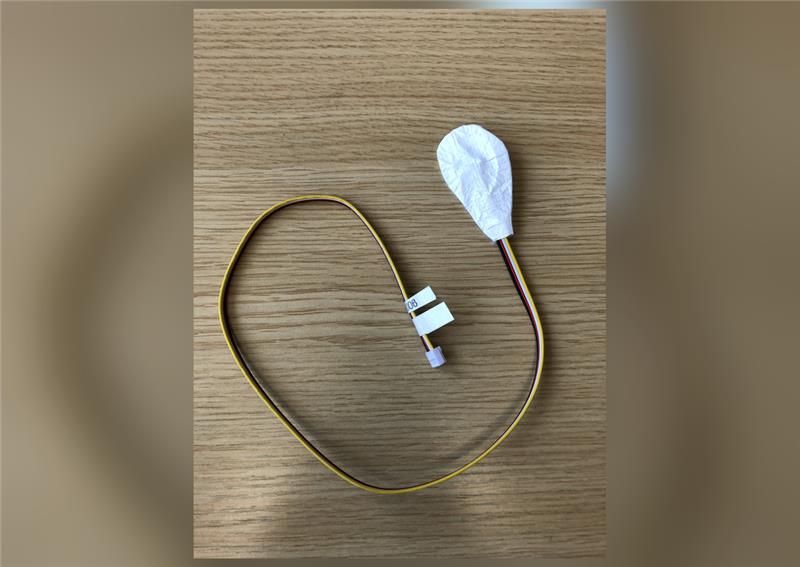
SNTS0001, the SHT31 probe sold separately. The sleeve is a Tyvek dust and splash cover specified in the design. Photo: SUNTEC Co., Ltd. product page.
The option list needs care because the official documents differ. The product page, read on 27 August 2026, marks CO2, solar radiation, the two waterproof probes and the two analog inputs all as options, while the leaflet treats CO2 as the model split for SNTE0001C and prints the analog inputs unmarked. The NARO spreadsheet sits closer to the leaflet, so a buyer should confirm the fit list with SUNTEC.
Build It or Buy It
NARO publishes everything needed for a home build, and section 7 of the introductory manual counts the effort: 29 tools, 45 part numbers for the minimum build and 49 with every option, and 221 solder joints split as 187 on the main board and 34 on sub-assemblies. Every part is through-hole, but the builder still orders the PCB from the gerber files.
There is a legal reason a commercial version exists. The usage conditions in the same manual place the sale of finished or semi-finished units made from the published files outside the licence grant, with individual arrangements possible on request. SUNTEC's terms document points back to those conditions, and a firmware comment adds that hardware sold commercially must carry a valid UECSID issued by the UECS Consortium.
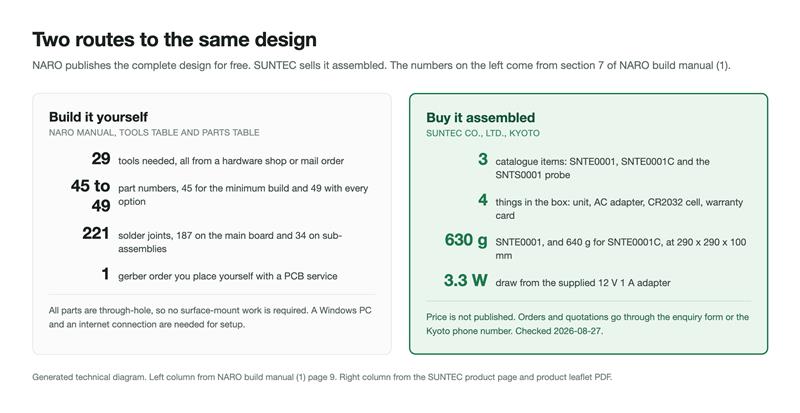
Generated technical diagram: the same design as a weekend build and as a catalogue item.
Where It Fits, and What the Sources Do Not Say
Two supplier-external pages recognise SUNTEC in this ecosystem. The UECS Consortium member list on uecs.jp carries 株式会社サンテック alongside Kaneko Seeds, Fujitsu Japan and Sakata Seed, and the NARO-linked UECS Platform project site names Mr. Kurosaki of NARO as the designer and links SUNTEC as the seller. Both were checked on 27 August 2026.
What no source provides is a buyer. Searches in Japanese for installation reports, reviews or case studies of SNTE0001 returned nothing beyond the vendor page and NARO's own material, so this article claims nothing about how many units are in greenhouses.
SUNTEC's own documents never name the Ethernet module maker or model either, so the WIZ550io evidence rests on the NARO documents that SUNTEC designates as the product specification. No CE, FCC or equivalent declaration is published, and the product page limits the unit to greenhouse interiors, not outdoor use.
Related WIZnet Maker Projects
UARDECS_PICO is the same lineage moved forward. H-Kurosaki, who wrote the sketch and the library inside this sensor unit, ported UARDECS to the Raspberry Pi Pico, where the README requires a W5500 and suggests W5500-EVB-Pico or W5500-EVB-Pico2. Created 6 March 2024, pushed 2 July 2026.
UECS node middleware uardecs covers the protocol library itself, which the SUNTEC unit shows boxed, labelled and sold.
Connect WIZ550io and Arduino Mega2560 / Arduino Due pairs the same module with the same microcontroller family as a wiring guide, not a sealed product.
W5500 PoE Drainage Gauge for Smart Irrigation is a UECS node on the water side, reporting drainage volume over UECS-CCM and MQTT and drawing power from PoE, unlike the mains-powered Type A.
UARDECS W55RP20 envsensor runs the same protocol on a W55RP20-EVB-Pico.
❓ FAQ
Q. What does the WIZ550io do in the SUNTEC UECS Sensor Unit Type A? The WIZ550io is the unit's only network interface: an Arduino MEGA 2560 hands it finished readings over SPI, and the module puts them on wired Ethernet as UECS broadcasts while also serving the setup pages on port 80.
Q. Which WIZnet part is inside, and how many? One WIZ550io V1.3, a W5500-based Ethernet module, per unit. The module is item 14 in the board legend of the NARO build manual, and the spreadsheet parts table names WIZnet as the maker.
Q. How much does the SUNTEC UECS Sensor Unit Type A cost? No price is published. As of 27 August 2026 the product page and leaflet carry no figure and no cart, and orders go through the SUNTEC enquiry form or telephone 075-603-3551.
Q. What is the difference between SNTE0001 and SNTE0001C? SNTE0001 measures air temperature, humidity and vapour pressure deficit, with no CO2 sensor fitted. SNTE0001C adds an ELT Sensor S300G and a round membrane vent on the enclosure front.
Q. Can I build this sensor unit myself instead of buying one? Yes, and NARO publishes the manuals, spreadsheets, gerbers and firmware for free, though the build needs 29 tools, up to 49 part numbers and 221 solder joints. Selling units built from those files for profit needs an individual arrangement with NARO.
📌 교토의 PCB 제조업체가 WIZ550io를 LAN 인터페이스로 사용하는 온실 센서 노드를 판매하다
SUNTEC UECS Sensor Unit Type A는 온실 작물 주변의 환경을 측정하고, 측정한 모든 데이터를 온실 내부 LAN으로 브로드캐스트하는 장치입니다.
이 데이터를 네트워크로 전송하는 역할은 W5500 기반 Ethernet 모듈인 WIZnet WIZ550io가 담당하며, 장치 한 대당 WIZ550io 한 개가 사용됩니다.
교토 후시미에 위치한 PCB 및 EMS 업체 SUNTEC Co., Ltd.(株式会社サンテック)가 이 장치를 제조하고 판매합니다. 다만 SUNTEC이 직접 설계한 제품은 아니며, 제품 페이지에서도 Type A 장치는 NARO(National Agriculture and Food Research Organization)가 개발했다고 명시하고 있습니다.
실제 개발자는 NARO의 Kurosaki 이고 이 연구자는 2016년도에 Arduino로 구성한 UECS node 패킷 처리 능력에 관한 논문을 작성했는데 이때도 W5500,W5100을 사용었습니다.
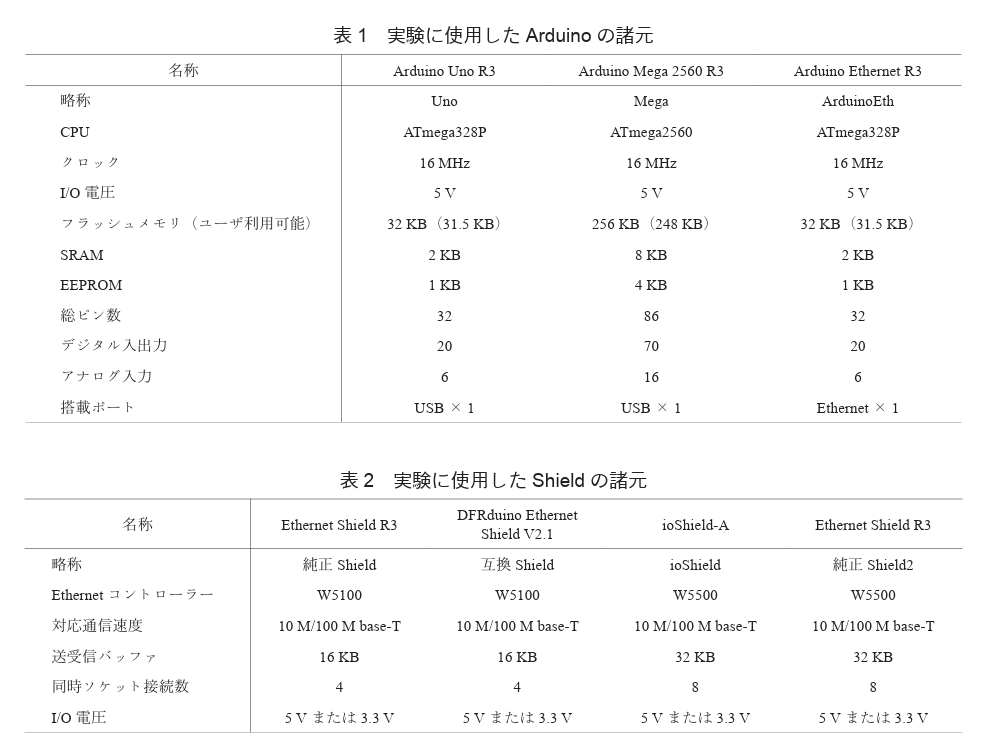
Type A 장치 한 대에서 온실 네트워크로 제공하는 정보는 다음과 같습니다.
- Sensirion SHT31을 이용한 공기 온도 및 상대습도
- 온도와 습도로부터 펌웨어에서 계산한 VPD(Vapour Pressure Deficit, 증기압 부족량)
- SNTE0001C 모델의 ELT Sensor S300G를 이용한 CO₂ 농도
- 옵션 PV 어레이 일사계를 이용한 일사량
- 옵션 입력을 통한 방수형 온도 프로브 2개와 아날로그 전압 2개
- 흡기 팬의 정상 동작 확인을 위한 팬 회전속도(RPM)
- 내장 GPS 수신기를 통한 날짜, 시간, 위도, 경도 및 위성 수
모든 측정값은 UECS 형식으로 유선 Ethernet을 통해 전송됩니다.
The two catalogue models. The right-hand unit adds the round CO2 membrane vent. Photos: SUNTEC Co., Ltd. product page.
UECS란 무엇이며, 왜 온실 노드에 공통 데이터 형식이 필요한가
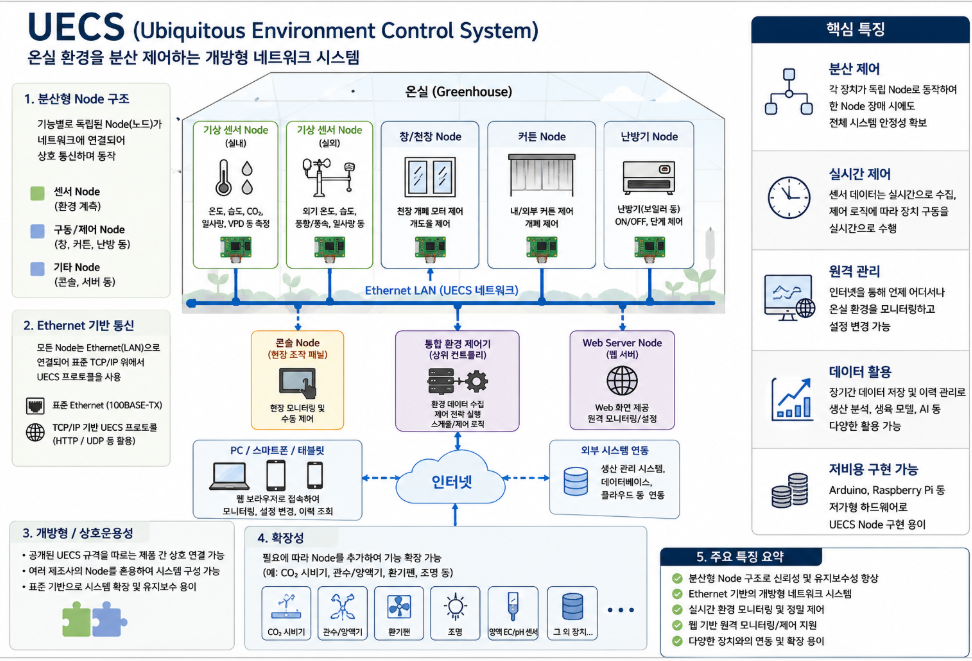
UECS는 Ubiquitous Environment Control System의 약자로, 일본에서 개발된 시설원예용 개방형 환경제어 표준입니다.
UECS에서는 온실에 설치된 센서와 제어장치를 각각 독립적인 Node로 구성하고, Ethernet 기반의 로컬 네트워크를 통해 서로 데이터를 주고받습니다. 각 Node는 온도, 습도, CO₂ 농도, 일사량 등의 측정값이나 장치 상태를 UECS-CCM(Common Correspondence Message)이라는 공통 형식으로 네트워크에 전달하며, 다른 Node들은 필요한 데이터를 선택적으로 수신하여 동작합니다.
예를 들어 온도 센서 Node가 현재 온도를 네트워크에 브로드캐스트하면 환기창, 난방기, 데이터 로거 등 여러 장치가 동일한 데이터를 동시에 사용할 수 있습니다. 환기창 컨트롤러는 수신한 온도를 기준으로 자체적으로 창을 열거나 닫을 수 있고, 데이터 로거는 같은 데이터를 저장할 수 있습니다.
따라서 UECS는 모든 장치를 하나의 중앙 컨트롤러에 종속시키는 방식이 아니라 각 Node가 독립적으로 동작하는 분산형 구조를 가집니다. 중앙 컨트롤러나 서버가 반드시 필요하지 않으며, 일부 Node에 장애가 발생하더라도 다른 Node들이 독립적으로 동작할 수 있다는 장점이 있습니다.
또한 UECS는 특정 제조사의 전용 통신방식에 종속되지 않도록 장치 간 데이터 형식과 통신 방법을 공통화한 것이 특징입니다. UECS 규격을 지원한다면 서로 다른 제조사의 센서, 환기창, 난방기, CO₂ 공급장치, 관수장치 등을 하나의 네트워크에서 연동할 수 있습니다.
통신에는 일반적인 Ethernet, IPv4, UDP/TCP, HTTP 등의 기술을 사용합니다. 따라서 전용 네트워크 하드웨어를 사용하지 않고 기존 Ethernet 인프라를 활용할 수 있으며, Arduino나 Raspberry Pi 같은 범용 플랫폼을 이용한 비교적 저렴한 UECS Node 구현도 가능합니다.
또한 새로운 센서나 제어장치가 필요할 경우 기존 시스템 전체를 변경하기보다는 새로운 Node를 네트워크에 추가하는 방식으로 시스템을 확장할 수 있습니다. 예를 들어 기존 온습도 모니터링 시스템에 CO₂ 센서, 일사량 센서, 관수 제어기 등을 단계적으로 추가할 수 있습니다.
NARO가 Type A 센서 장치를 개발한 배경에도 이러한 문제가 있었습니다. 기존 상용 온실 센서와 환경제어 장치들은 제조사별 고유 신호나 프로토콜을 사용하는 경우가 많아 서로 다른 제조사의 장비를 함께 사용하거나 사용자가 직접 데이터 분석 및 제어 소프트웨어를 개발하기 어려웠습니다. UECS는 이러한 Vendor Lock-in을 줄이고 장치 간 상호운용성을 확보하는 것을 주요 목적으로 합니다.
NARO Western Region Agricultural Research Center는 2020년 6월 1일 UECS 대응 센서 유닛 A형의 제작 방법을 공개했습니다. 이 장치는 온도, 습도, VPD, CO₂ 등의 환경 데이터를 측정하여 SD Card에 장기간 저장할 수 있으며, Ethernet을 통해 UECS 네트워크에도 데이터를 제공할 수 있습니다.
SUNTEC가 NARO의 설계를 기반으로 상용화한 제품에서도 이러한 UECS의 특징을 활용하고 있으며, 특히 클라우드 서비스 계약 없이 로컬 네트워크만으로 환경 데이터를 수집·저장하고 장치를 연동할 수 있다는 점을 장점으로 강조하고 있습니다.
UECS의 주요 특징을 정리하면 다음과 같습니다.
분산형 제어 구조: 센서와 제어장치가 각각 독립적인 Node로 동작
중앙 서버가 필수적이지 않음: 로컬 네트워크만으로 데이터 공유 및 제어 가능
상호운용성: 공통 UECS 규격을 이용하여 서로 다른 제조사의 장비를 연동 가능
Ethernet/IP 기반: 범용 Ethernet 인프라와 UDP/TCP, HTTP 등의 표준 기술 활용
UECS-CCM 기반 데이터 공유: 온도, 습도, CO₂ 등 데이터의 의미와 전달 방식을 공통화
1:N 데이터 공유: 하나의 센서 데이터를 여러 제어장치와 로거가 동시에 활용 가능
높은 확장성: 기존 시스템을 크게 변경하지 않고 새로운 Sensor/Control Node 추가 가능
장애 영향 최소화: 특정 Node의 장애가 전체 시스템의 정지로 직접 이어지지 않는 분산 구조
Vendor Lock-in 완화: 특정 제조사의 독자적인 센서 및 제어 시스템에 대한 종속성 감소
로컬 운용 가능: 인터넷이나 Cloud 연결 없이 온실 내부 LAN만으로 운용 가능
저비용 구현 가능: Arduino, Raspberry Pi 및 범용 Ethernet 장치를 활용한 Node 구현 가능
데이터 활용 용이: 측정 데이터를 PC, Logger 및 분석 소프트웨어에서 수집하여 생산관리와 환경 분석에 활용 가능
즉 UECS는 단순한 농업용 센서 통신 프로토콜이라기보다, 온실의 센서와 제어장치를 Ethernet 네트워크상의 독립적인 Node로 구성하고, 제조사에 관계없이 데이터를 공유하고 연동할 수 있도록 만든 시설원예용 분산 환경제어 규격이라고 볼 수 있습니다.
제조사, 판매 여부 및 가격
SUNTEC Co., Ltd.가 법적인 판매자이자 제조업체입니다.
회사는 1990년 10월 설립되었으며, 2026년 3월 기준 직원 수는 43명입니다. 교토 외에 시가현 시가라키에도 공장을 운영합니다.
가격은 공개되어 있지 않습니다.
2026년 8월 27일 기준 제품 페이지와 제품 브로슈어 어디에도 가격, 통화, 세금 정보 또는 온라인 구매 기능이 없습니다. 제품 주문 및 견적은 SUNTEC 문의 페이지를 통해 진행해야 합니다.
재고 수량, 납기 및 배송 조건 역시 공개되어 있지 않습니다.
⚙️ Type A Sensor Unit에서 WIZ550io의 역할
WIZ550io는 옵션이 아니라 Type A 설계의 기본 구성품입니다.
NARO 제작 매뉴얼의 완성 PCB 구성도에서 WIZ550io는 14번 부품으로 표시되어 있으며,
「⑭ WIZ550IOモジュール接続箇所」
→ ⑭ WIZ550io 모듈 연결 위치
라고 명시되어 있습니다.
부품 목록에서도 다음과 같이 지정합니다.
WIZ550io V1.3 / Embedded Ethernet Module / 1개 필수
스프레드시트 버전의 BOM에는 제조사가 WIZnet이라고 명시되어 있습니다.
펌웨어에서도 이를 확인할 수 있습니다. NARO에서 제공하는 Ethernet2 라이브러리의 w5500.h에는 WIZnet 저작권 표시가 있으며 W5500의 Socket Register가 정의되어 있습니다.
예를 들면:
Sn_MR: 0x0000Sn_CR: 0x0001Sn_SR: 0x0003Sn_DIPR: 0x000CMAX_SOCK_NUM: 8
또한 제작 매뉴얼에서는 WIZ550io의 바코드 아래에 적힌 문자열을 읽어 펌웨어에 두 글자씩 입력하도록 안내합니다.
이 값이 바로 WIZ550io의 MAC Address이며 각 장치마다 서로 다른 MAC 주소를 사용해야 하기 때문입니다.
3개의 소켓, 2개의 UDP 포트, 1개의 웹페이지
전체 구조는 다음과 같습니다.
Sensors → Arduino MEGA 2560 R3 → SPI → WIZ550io → Ethernet LAN
Arduino MEGA 2560 R3가 I²C 및 1-Wire를 이용해 센서 데이터를 읽고, VPD를 계산하며, 5분마다 microSD에 데이터를 기록합니다.
네트워크 통신은 SPI로 연결된 WIZ550io가 담당합니다.
중간에 별도의 네트워크 프로세서는 없습니다.
UARDECS_MEGA 라이브러리는 동시에 3개의 네트워크 Endpoint를 사용합니다.
| 프로토콜 | 포트 | 용도 |
|---|---|---|
| UDP | 16520 | UECS CCM Broadcast |
| UDP | 16529 | UECS Node Search |
| TCP | 80 | 설정 Web UI |
UDP 16520
UECS의 CCM(Common Correspondence Message) 데이터를 브로드캐스트합니다.
UDP 16529
네트워크에 연결된 UECS Node를 검색하는 데 사용합니다. 따라서 별도의 중앙 서버 없이 새로운 장치를 찾을 수 있습니다.
TCP 80
장치 설정용 웹페이지를 제공합니다.
- Network Config
- Node Status
- CCM Status
- CCM Edit
대표적인 데이터 전송 주기는 다음과 같습니다.
| 측정값 | UECS CCM | 해상도 | 주기 |
|---|---|---|---|
| 공기 온도 | InAirTemp.mIC | 0.1°C | 10초 |
| 상대습도 | InAirHumid.mIC | 0.1% | 10초 |
| VPD | InAirHD.mIC | 0.01 g/m³ | 10초 |
| CO₂ | InAirCO2.mIC | 1 ppm | 10초 |
| 일사량 | InRadiation.mIC | 0.005 kW/m² | 10초 |
| 토양 온도 1/2 | SoilTemp.1/2.mIC | 0.1°C | 10초 |
| Fan RPM | FanRPM.mIC | 1 rpm | 60초 |
| 시간 | Time | 1초 | 1초 |
유선 Ethernet을 사용한 것도 의도적인 선택입니다.
NARO 매뉴얼에서는 Wi-Fi를 이용한 UECS 트래픽 중계도 가능하다고 설명하지만, 식물 때문에 무선 신호가 쉽게 차단될 수 있으므로 무선 구간에서는 명확한 Line-of-Sight를 확보해야 한다고 경고합니다.
제품군: SNTE0001, SNTE0001C, SNTS0001
SUNTEC은 총 3개 제품을 등록하고 있습니다.
SNTE0001
- 공기 온도
- 상대습도
- VPD
를 측정하며 CO₂ 센서는 장착되어 있지 않습니다.
SNTE0001C
SNTE0001 기능에 추가로 ELT Sensor S300G CO₂ 센서가 들어갑니다.
전면의 둥근 흰색 멤브레인 통풍구가 CO₂ 센서가 추가된 모델을 외관상 구분할 수 있는 특징입니다.
두 모델 모두:
- 본체
- AC Adapter
- CR2032
- Warranty Card
가 제공됩니다.
크기는 290 × 290 × 100 mm, 무게는 각각 약 630 g / 640 g, 전력 소비는 12 V 1 A 어댑터에서 3.3 W입니다.
SNTS0001
SHT31 온습도 프로브만 별도로 판매하는 제품입니다.
Grove 4-pin 케이블을 사용하며 센서 헤드는 먼지와 물 튀김을 막기 위한 Tyvek 커버 안에 들어 있습니다.
직접 제작할 수도 있는가?
가능합니다.
NARO가 직접 제작할 수 있도록 필요한 자료를 공개하고 있습니다.
최소 구성 기준:
- 필요한 공구: 29개
- 최소 부품 종류: 45개
- 모든 옵션 포함: 49개
- 총 납땜 포인트: 221개
- Main PCB: 187개
- Sub Assembly: 34개
모든 부품이 Through-hole 방식이지만 PCB 자체는 공개된 Gerber 파일을 이용해 별도로 제작해야 합니다.
다만 상업적으로 판매하려는 경우에는 라이선스 문제가 있습니다.
공개 자료를 이용하여 제작한 완제품 또는 반제품을 판매하는 것은 기본 라이선스 범위에 포함되지 않으며 NARO와 별도 협의가 필요합니다.
또한 펌웨어 주석에 따르면 상업적으로 판매되는 UECS 하드웨어는 UECS Consortium에서 발급한 유효한 UECSID를 사용해야 합니다.
이 제품을 어떻게 봐야 하는가
SUNTEC은 UECS Consortium 회원사로 등록되어 있으며 NARO 관련 UECS Platform 사이트에서도 SUNTEC을 해당 장치의 판매업체로 연결하고 있습니다.
다만 실제 설치 사례나 판매량에 관한 자료는 확인되지 않았습니다.
즉,
"실제로 몇 대가 온실에 설치되어 사용되고 있다"
같은 주장을 할 수 있는 근거는 현재 자료에는 없습니다.
또한 SUNTEC 자체 문서에서는 Ethernet 모듈의 제조사나 모델을 직접 명시하지 않습니다. WIZ550io 사용 근거는 SUNTEC이 제품 사양으로 지정한 NARO 공식 문서에서 확인되는 것입니다.
CE, FCC 등의 인증 Declaration 역시 공개되어 있지 않으며 제품 사용 범위는 온실 내부로 제한되어 있습니다.
관련 WIZnet Maker 프로젝트
이 프로젝트와 기술적으로 연결되는 WIZnet 프로젝트들도 있습니다.
이 센서 장치에서 사용된 Sketch와 Library를 만든 H-Kurosaki가 UARDECS를 Raspberry Pi Pico로 포팅한 프로젝트입니다.
README에서는 W5500 사용을 요구하며 다음 보드를 권장합니다.
- W5500-EVB-Pico
- W5500-EVB-Pico2
즉 기존 구조가
Arduino Mega + WIZ550io
였다면 최근에는
RP2040 + W5500
구조로 발전한 셈입니다.
그 밖에:
- UECS node middleware uardecs
- Connect WIZ550io and Arduino Mega2560 / Arduino Due
- W5500 PoE Drainage Gauge for Smart Irrigation
- UARDECS W55RP20 envsensor
등의 관련 프로젝트가 있습니다.
핵심만 요약하면
이 자료에서 가장 중요한 포인트는 WIZ550io가 단순히 테스트용으로 사용된 Maker 프로젝트가 아니라는 점입니다.
NARO가 개발한 실제 온실 환경 센서 설계에 WIZ550io가 표준 Ethernet 인터페이스로 채택되어 있고, SUNTEC이라는 PCB/EMS 업체가 그 설계를 기반으로 완제품을 제조·판매하고 있습니다.
구조도 상당히 명확합니다.
온습도 / CO₂ / 일사량 / 토양온도 등 → Arduino Mega → SPI → WIZ550io(W5500) → Wired Ethernet → UECS LAN
그리고 W5500은 단순히 데이터를 한 번 전송하는 것이 아니라 UDP 16520의 센서 데이터 Broadcast + UDP 16529의 Node Discovery + TCP 80의 설정 Web Server를 동시에 처리하는 핵심 네트워크 인터페이스로 사용됩니다.