



IPEM-S3 AI Ethernet Energy Monitor
Monitor voltage, current, power and energy in real time using ESP32-S3, AI-ready analytics and Ethernet connectivity for industrial IoT applications.
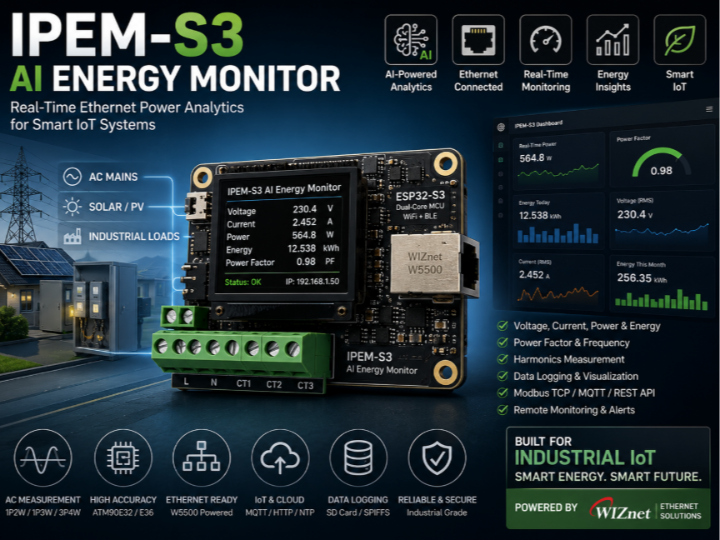
Overview
Energy monitors live in the worst possible place for Wi-Fi: inside metal consumer units, plant rooms, and DIN-rail cabinets, often far from any access point. Yet a mains power monitor is exactly the kind of always-on, safety-adjacent device you never want dropping off the network.
The DitroniX IPEM S3-AI answers this by pairing an Espressif ESP32-S3 (with on-device edge-AI capability) and a Microchip ATM90E36A high-accuracy metering IC with a WIZnet W5500 hardwired TCP/IP controller for reliable wired Ethernet. The ESP32-S3 has no built-in Ethernet MAC, so the W5500 over SPI is what turns this from a Wi-Fi-only gadget into a cabinet-grade, wired IoT instrument — with Wi-Fi still available as a fallback.
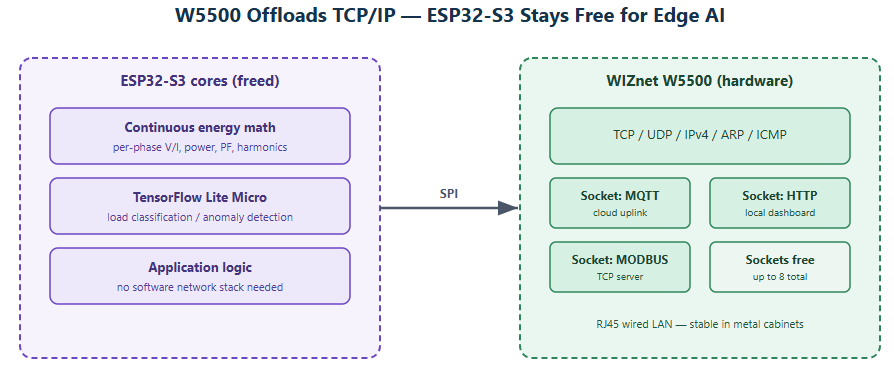
The interesting angle for a WIZnet audience: the W5500's hardwired stack doesn't just add a wired port — it offloads all of TCP/IP from the ESP32-S3, leaving the dual-core LX7 free to run continuous energy math and TensorFlow Lite Micro inference without the network stack stealing cycles.
What the Project Implements
The IPEM S3-AI is a complete STEM/maker-grade mains energy-monitoring board:
- High-accuracy metering — Microchip ATM90E36A measuring active energy to ±0.1% and reactive energy to ±0.2%, with a 6000:1 dynamic range.
- Multi-phase support — single-phase, split-phase, and 3-phase 4-wire systems; tracks both import and export energy (solar/grid feed-in friendly).
- Full electrical telemetry — per-phase RMS voltage and current, active/reactive/apparent power, power factor, phase angles, harmonic and fundamental power, and mains frequency.
- Wired Ethernet via WIZnet W5500 — full hardwired TCP/IP stack on a dedicated SPI port, for installs where Wi-Fi is unreliable or undesirable.
- RS-485 / MODBUS — integrate with industrial sensors and building-management devices.
- Edge AI — ESP32-S3 dual-core Xtensa LX7 (240 MHz) with vector instructions, 16 MB flash and 8 MB PSRAM, runs TensorFlow Lite Micro for offline inference (e.g. load classification, anomaly detection).
- Field-ready form factor — DIN-mountable, 12 V AC low-voltage input (bell-transformer compatible), terminal blocks for CT current clamps.
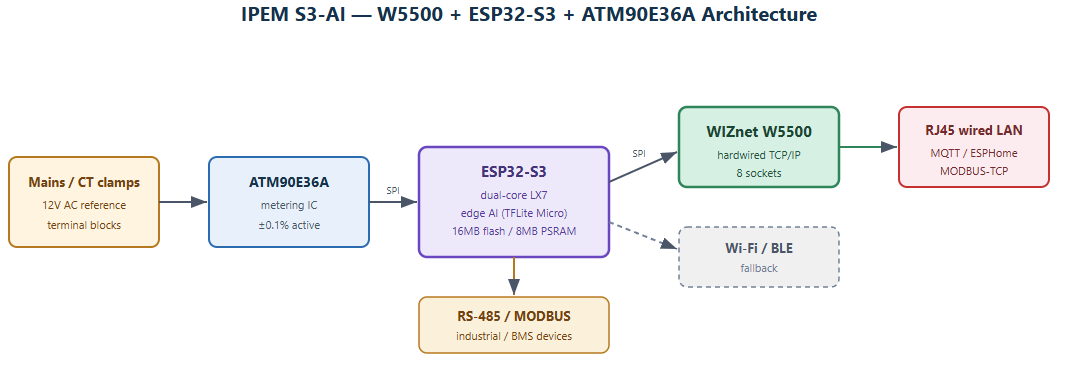
W5500 + ESP32-S3 + ATM90E36A Architecture
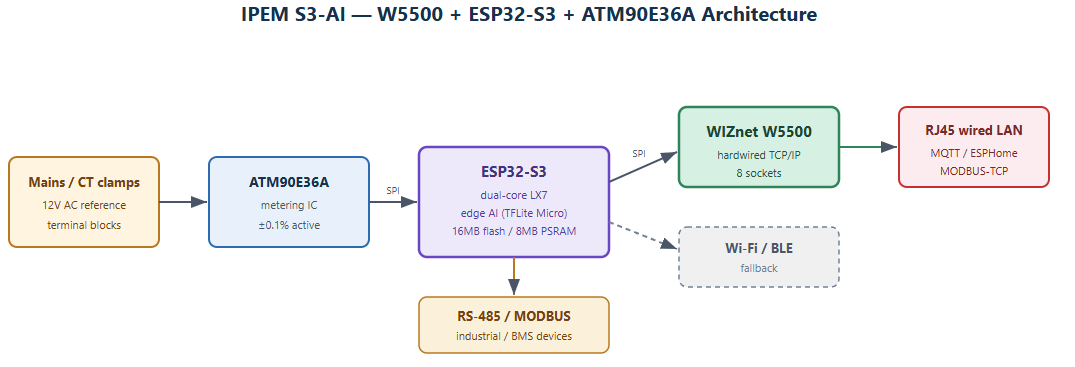
   Mains / CT clamps ──▶ ATM90E36A ──SPI──┐
   12V AC reference   metering IC          │
                                           ▼
                                    ESP32-S3-WROOM
                                 (edge AI + app logic)
                                     │          │
                                 SPI │          │ Wi-Fi / BLE (fallback)
                                     ▼          ▼
                              WIZnet W5500    wireless
                          (hardwired TCP/IP)
                                     │
                                RJ45 wired LAN ──▶ MQTT / ESPHome / MODBUS-TCP
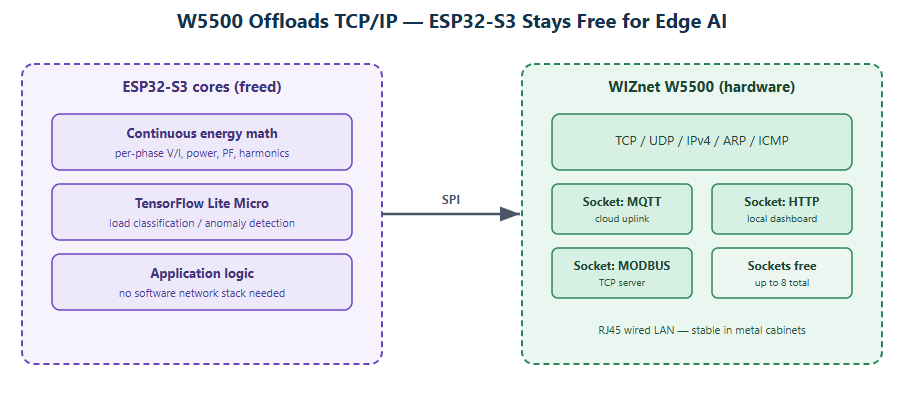
Why the W5500 is the right Ethernet choice here
- No EMAC on ESP32-S3 — unlike the original ESP32, the S3 has no internal Ethernet MAC. A SPI-attached hardwired controller is the clean path to wired Ethernet, and the W5500 is the proven option.
- Stack offload — the W5500 runs the full TCP/IP stack in hardware (TCP, UDP, IPv4, ARP, ICMP), so the ESP32-S3 spends its cycles on energy computation and AI inference, not on packet processing.
- Cabinet reliability — wired Ethernet eliminates the Wi-Fi dropouts that plague metal-enclosure installs, while the ESP32-S3 keeps Wi-Fi as a secondary path.
- 8 hardware sockets — comfortably covers concurrent flows: an MQTT/cloud uplink, a local dashboard, and MODBUS-TCP, each on its own socket.
Embedded-Design Reference Value
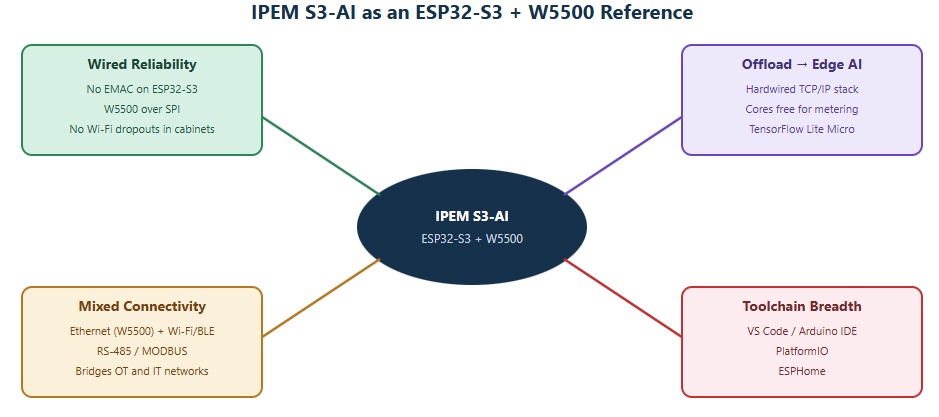
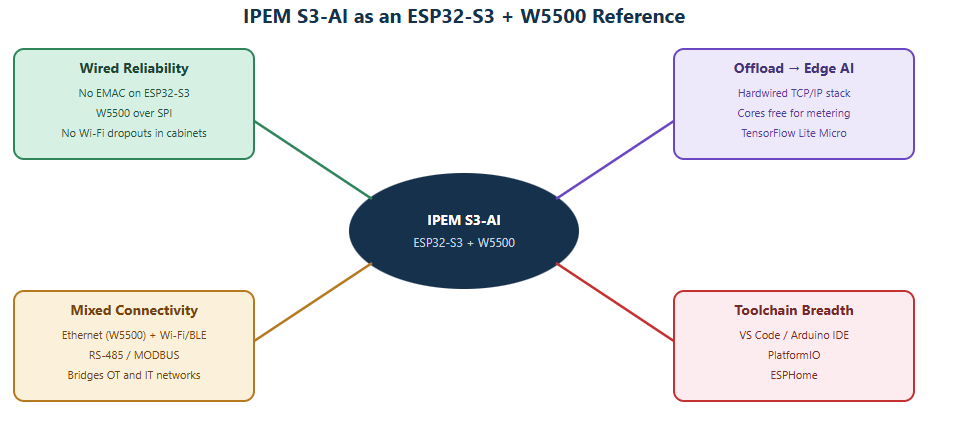
For developers building wired, always-on industrial IoT instruments, this board is a useful reference:
- ESP32-S3 + W5500 over SPI — a clean reference pairing for any S3-based product that needs wired Ethernet, since the S3 has no native EMAC.
- Offloaded networking enables edge AI — a concrete example of why a hardwired stack matters: the MCU is free to run TensorFlow Lite Micro alongside continuous metering.
- Mixed connectivity — Ethernet (W5500) + Wi-Fi/BLE + RS-485 on one board shows how to bridge OT (MODBUS) and IT (MQTT/TCP) networks.
- Tool-chain breadth — buildable from VS Code, Arduino IDE, PlatformIO, and ESPHome, lowering the barrier for makers and integrators alike.
Practical Limits
To set expectations honestly:
- It is a monitoring board — measurement and telemetry, not a protective relay or breaker.
- Mains wiring and CT-clamp installation involve line voltages; deployment should follow local electrical regulations and qualified-person rules.
- The exact W5500 part and pin mapping should be confirmed from the repository schematics before porting firmware.
- Dedicated FLeX firmware is still in development; current use relies on the open-source example libraries and ESPHome.
Where It Fits
This board suits:
- Home and prosumer energy monitoring — whole-home, solar import/export, and EV-charging visibility over reliable wired Ethernet.
- Commercial / industrial sub-metering — DIN-rail installs in cabinets where Wi-Fi is impractical, integrating via MODBUS and MQTT.
- Embedded developers — anyone wanting a real-world ESP32-S3 + WIZnet W5500 reference that also demonstrates on-device edge AI.
Application examples from the project include homes, farms, commercial buildings, solar installations, EV charging stations, greenhouses, and industrial facilities.
Setup at a Glance
- Inputs: CT current clamps + 12 V AC voltage reference into the terminal blocks; DIN-mount the board in the cabinet.
- Toolchains: Visual Studio Code, Arduino IDE, PlatformIO, or ESPHome — open-source libraries are provided for the ATM90E36A, W5500 Ethernet, and RS-485.
- Network: connect RJ45 for wired Ethernet (W5500); Wi-Fi/BLE available as fallback. Publish to MQTT / ESPHome, or expose MODBUS-TCP.
- Datasheets, schematics, and code examples are included in the repository.
Related WIZnet Maker / DitroniX Projects
WIZnet Maker projects that pair an ESP32/ESP32-S3 with W5500 for wired energy/IoT monitoring — useful side-by-side references:
- Power Monitoring — CircuitSetup 6-Channel ESP32 Energy Meter — The closest cousin on WIZnet Maker: an ESP32 + W5500 + ATM90E32 energy meter publishing V/I/power/PF over MQTT — almost the same domain as IPEM S3-AI.
- MultiSensor: ESP32-S3 + W5500 PoE Smart-Home Board — Same ESP32-S3 + W5500-over-SPI pairing, with ESPHome/MQTT/Home Assistant integration — a direct reference for the networking side.
- ESPHome W5500 Ethernet on ESP32 Boards — Exactly the ESPHome + W5500 path the IPEM S3-AI supports; handy for bring-up.
- MBusino — M-Bus to MQTT Gateway — A W5500-equipped meter gateway bridging M-Bus energy meters to MQTT/Home Assistant — a complementary metering-to-IoT pattern.
- ESP32 Ethernet W5500 MQTT — A minimal ESP32 + W5500 + MQTT starting point.
DitroniX sibling boards (GitHub):
- DitroniX EPEM — Ethernet Power Energy Monitor (ESP32 + ATM90E32/36) — the sibling board that explicitly adds WIZnet W5500 Ethernet and RS-485 to the proven IPEM metering core; the closest direct hardware reference.
- DitroniX IPEM — IoT Power Energy Monitor (ESP32 ATM90E32/36) — the original Wi-Fi-centric IPEM platform this S3-AI board evolves from.
FAQ
Q. Why add Ethernet if the ESP32-S3 already has Wi-Fi?
Energy monitors are often mounted inside metal cabinets or plant rooms far from access points, where Wi-Fi is unreliable. Wired Ethernet via the W5500 gives a stable, secure link, and Wi-Fi remains as a fallback.
Q. Why a W5500 specifically?
The ESP32-S3 has no internal Ethernet MAC, so it needs an external controller over SPI. The W5500's hardwired TCP/IP stack is a proven, low-overhead fit — and the same DitroniX EPEM board already uses it.
Q. Does the W5500 help with the edge-AI side?
Yes, indirectly but importantly: because the W5500 handles TCP/IP in hardware, the ESP32-S3's cores stay free to run metering math and TensorFlow Lite Micro inference instead of a software network stack.
Q. How accurate is the metering?
The ATM90E36A measures active energy to within ±0.1% and reactive energy to ±0.2%, across a 6000:1 dynamic range, for single- through 3-phase 4-wire systems.
Q. Can it talk to industrial systems?
Yes — it includes RS-485 for MODBUS devices, and the W5500 enables MODBUS-TCP / MQTT over wired Ethernet, bridging OT and IT networks.
한국어 (Korean)
개요
전력 모니터는 Wi-Fi에 가장 불리한 곳에 설치됩니다 — 금속 분전반, 기계실, DIN 레일 캐비닛 안, 그리고 액세스 포인트에서 먼 곳이죠. 그러나 주전원 전력 모니터는 절대 네트워크에서 끊겨서는 안 되는, 상시 동작하고 안전과 맞닿은 장치입니다.
DitroniX IPEM S3-AI는 온디바이스 엣지 AI가 가능한 Espressif ESP32-S3와 고정밀 계측 IC인 Microchip ATM90E36A를, 안정적인 유선 이더넷을 위한 WIZnet W5500 하드와이어드 TCP/IP 컨트롤러와 결합해 이 문제를 풉니다. ESP32-S3는 내장 이더넷 MAC이 없기 때문에, SPI로 연결된 W5500이 이 보드를 Wi-Fi 전용 장치에서 캐비닛급 유선 IoT 계측기로 바꿔줍니다 — Wi-Fi는 폴백으로 유지하면서요.
WIZnet 독자에게 흥미로운 지점: W5500의 하드와이어드 스택은 단순히 유선 포트를 더하는 게 아니라, TCP/IP 전체를 ESP32-S3에서 떼어내 듀얼코어 LX7가 연속적인 전력 연산과 TensorFlow Lite Micro 추론을, 네트워크 스택에 코어를 빼앗기지 않고 동시에 돌릴 수 있게 해줍니다.
구현된 기능
IPEM S3-AI는 완성형 STEM/메이커급 주전원 에너지 모니터링 보드입니다.
- 고정밀 계측 — Microchip ATM90E36A, 유효전력 ±0.1% / 무효전력 ±0.2%, 6000:1 다이내믹 레인지
- 다상 지원 — 단상, 분상(split-phase), 3상 4선식; 수전·역송(import/export) 양방향 추적(태양광 연계 친화)
- 전기 텔레메트리 일체 — 상별 RMS 전압·전류, 유효/무효/피상 전력, 역률, 위상각, 고조파·기본파 전력, 주파수
- WIZnet W5500 유선 이더넷 — 전용 SPI 포트의 하드와이어드 TCP/IP 스택, Wi-Fi가 불안정하거나 부적합한 설치 환경용
- RS-485 / MODBUS — 산업용 센서·BMS 장비 연동
- 엣지 AI — ESP32-S3 듀얼코어 Xtensa LX7(240 MHz), 벡터 명령어, 16 MB 플래시 + 8 MB PSRAM, TensorFlow Lite Micro 오프라인 추론(부하 분류, 이상 탐지 등)
- 현장 적용 폼팩터 — DIN 레일 장착, 12 V AC 저전압 입력(벨 트랜스 호환), CT 클램프용 단자대
W5500 + ESP32-S3 + ATM90E36A 아키텍처
   주전원 / CT 클램프 ──▶ ATM90E36A ──SPI──┐
   12V AC 기준전압      계측 IC            │
                                           ▼
                                    ESP32-S3-WROOM
                                  (엣지 AI + 앱 로직)
                                     │          │
                                 SPI │          │ Wi-Fi / BLE (폴백)
                                     ▼          ▼
                              WIZnet W5500     무선
                          (하드와이어드 TCP/IP)
                                     │
                              RJ45 유선 LAN ──▶ MQTT / ESPHome / MODBUS-TCP
여기서 W5500이 올바른 이더넷 선택인 이유
- ESP32-S3에는 EMAC가 없음 — 초기 ESP32와 달리 S3는 내장 이더넷 MAC이 없습니다. SPI로 붙는 하드와이어드 컨트롤러가 유선 이더넷의 깔끔한 해법이며, W5500이 검증된 선택지입니다.
- 스택 오프로드 — W5500이 전체 TCP/IP 스택(TCP, UDP, IPv4, ARP, ICMP)을 하드웨어로 처리하므로, ESP32-S3는 패킷 처리가 아니라 전력 연산과 AI 추론에 코어를 씁니다.
- 캐비닛 신뢰성 — 유선 이더넷은 금속 함체 설치에서 흔한 Wi-Fi 끊김을 제거하고, ESP32-S3는 Wi-Fi를 보조 경로로 유지합니다.
- 8개 하드웨어 소켓 — MQTT/클라우드 업링크, 로컬 대시보드, MODBUS-TCP 등 동시 흐름을 각자의 소켓으로 여유 있게 처리합니다.
임베디드 설계 레퍼런스 가치
유선·상시 동작 산업용 IoT 계측기를 만드는 개발자에게 좋은 참고가 됩니다.
- SPI로 연결한 ESP32-S3 + W5500 — 네이티브 EMAC가 없는 S3 기반 제품에 유선 이더넷이 필요할 때의 깔끔한 레퍼런스 조합
- 네트워킹 오프로드가 엣지 AI를 가능케 함 — 하드와이어드 스택이 왜 중요한지에 대한 구체적 예시: MCU가 계측과 TFLite Micro를 함께 돌릴 여유 확보
- 혼합 연결성 — 한 보드에 이더넷(W5500) + Wi-Fi/BLE + RS-485, OT(MODBUS)와 IT(MQTT/TCP) 네트워크를 잇는 방법 제시
- 툴체인 폭 — VS Code, Arduino IDE, PlatformIO, ESPHome로 빌드 가능해 메이커·통합업체 모두 진입장벽이 낮음
실용적 한계
- 어디까지나 모니터링 보드입니다 — 계측·텔레메트리이지 보호 계전기나 차단기가 아닙니다.
- 주전원 배선과 CT 클램프 설치는 선간 전압을 다루므로, 지역 전기 규정과 유자격자 규칙을 따라야 합니다.
- 펌웨어 포팅 전 정확한 W5500 파트와 핀 매핑을 저장소 스키매틱에서 확인하세요.
- 전용 FLeX 펌웨어는 아직 개발 중이며, 현재는 오픈소스 예제 라이브러리와 ESPHome에 의존합니다.
어디에 적합한가
- 가정·프로슈머 에너지 모니터링 — 전가구, 태양광 수전/역송, EV 충전 가시화를 안정적인 유선 이더넷으로
- 상업·산업 부분 계측(sub-metering) — Wi-Fi가 비현실적인 캐비닛 내 DIN 레일 설치, MODBUS·MQTT 연동
- 임베디드 개발자 — 온디바이스 엣지 AI까지 보여주는 실전 ESP32-S3 + WIZnet W5500 레퍼런스를 찾는 경우
프로젝트의 적용 예: 가정, 농장, 상업 건물, 태양광 설비, EV 충전소, 온실, 산업 시설.
한눈에 보는 설치
- 입력: CT 전류 클램프 + 12 V AC 기준 전압을 단자대에 연결, 보드를 캐비닛에 DIN 장착
- 툴체인: VS Code, Arduino IDE, PlatformIO, ESPHome — ATM90E36A·W5500 이더넷·RS-485용 오픈소스 라이브러리 제공
- 네트워크: RJ45로 유선 이더넷(W5500) 연결, Wi-Fi/BLE는 폴백. MQTT/ESPHome 게시 또는 MODBUS-TCP 노출
- 데이터시트·스키매틱·코드 예제는 저장소에 포함
관련 WIZnet Maker / DitroniX 프로젝트
ESP32/ESP32-S3와 W5500을 결합해 유선 에너지/IoT 모니터링을 구현한 WIZnet Maker 프로젝트들 — 나란히 비교해 볼 레퍼런스입니다.
- Power Monitoring — CircuitSetup 6채널 ESP32 에너지 미터 — WIZnet Maker에서 가장 가까운 사촌: ESP32 + W5500 + ATM90E32 에너지 미터가 V/I/전력/역률을 MQTT로 게시. IPEM S3-AI와 거의 동일한 영역
- MultiSensor: ESP32-S3 + W5500 PoE 스마트홈 보드 — 동일한 ESP32-S3 + SPI W5500 조합에 ESPHome/MQTT/Home Assistant 연동 — 네트워킹 측면의 직접적 레퍼런스
- ESPHome W5500 Ethernet on ESP32 Boards — IPEM S3-AI가 지원하는 ESPHome + W5500 경로 그대로. 초기 구동에 유용
- MBusino — M-Bus to MQTT Gateway — W5500 탑재 미터 게이트웨이로 M-Bus 에너지 미터를 MQTT/Home Assistant에 연결 — 보완적인 계측→IoT 패턴
- ESP32 Ethernet W5500 MQTT — 최소 구성의 ESP32 + W5500 + MQTT 출발점
DitroniX 형제 보드 (GitHub):
- DitroniX EPEM — Ethernet Power Energy Monitor (ESP32 + ATM90E32/36) — 검증된 IPEM 계측 코어에 WIZnet W5500 이더넷과 RS-485를 명시적으로 더한 형제 보드. 가장 직접적인 하드웨어 레퍼런스
- DitroniX IPEM — IoT Power Energy Monitor (ESP32 ATM90E32/36) — 이 S3-AI 보드가 진화해 나온 원조 Wi-Fi 중심 IPEM 플랫폼
FAQ
Q. ESP32-S3에 Wi-Fi가 있는데 왜 이더넷을 추가하나요?
전력 모니터는 액세스 포인트에서 먼 금속 캐비닛·기계실에 설치되는 경우가 많아 Wi-Fi가 불안정합니다. W5500 유선 이더넷이 안정적이고 안전한 링크를 제공하며, Wi-Fi는 폴백으로 남습니다.
Q. 왜 하필 W5500인가요?
ESP32-S3는 내장 이더넷 MAC이 없어 SPI로 외부 컨트롤러가 필요합니다. W5500의 하드와이어드 TCP/IP 스택은 검증된 저부하 해법이며, 같은 DitroniX EPEM 보드도 이미 이를 사용합니다.
Q. W5500이 엣지 AI에도 도움이 되나요?
간접적이지만 중요하게 그렇습니다 — W5500이 TCP/IP를 하드웨어로 처리하므로, ESP32-S3 코어는 소프트웨어 네트워크 스택 대신 계측 연산과 TFLite Micro 추론에 집중할 수 있습니다.
Q. 계측 정확도는 어느 정도인가요?
ATM90E36A는 유효전력 ±0.1%, 무효전력 ±0.2%, 6000:1 다이내믹 레인지로, 단상~3상 4선식까지 측정합니다.
Q. 산업 시스템과 통신할 수 있나요?
네 — MODBUS 장비용 RS-485를 갖췄고, W5500으로 유선 이더넷 상의 MODBUS-TCP / MQTT가 가능해 OT와 IT 네트워크를 잇습니다.