



Digital Lock-in Amplifier on FPGA
Cyclone V FPGA에 구현한 2채널 디지털 락인 증폭기. 잡음 속 미약 신호의 크기·위상차를 실시간 측정해 W5500 TCP로 호스트 PC에 스트리밍합니다.
프로젝트가 하는 일
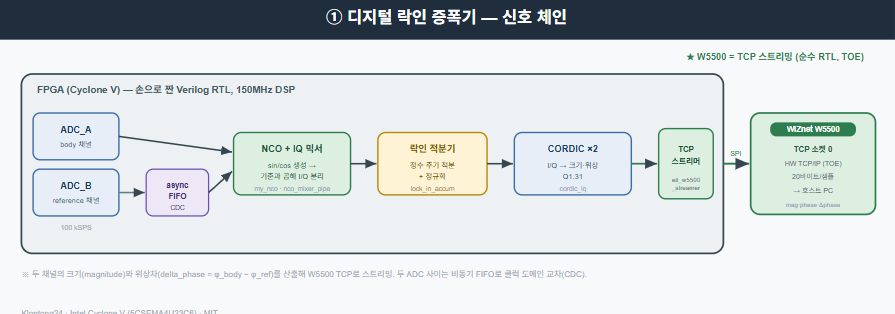
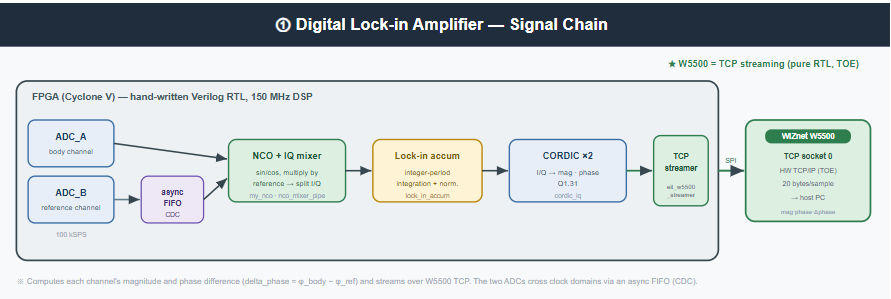
락인 증폭기(Lock-in Amplifier) 는 잡음에 파묻힌 미약한 신호를, 기준(reference) 주파수에 동기시켜 뽑아내는 계측 기법입니다. 이 프로젝트는 그것을 FPGA 디지털 로직으로 구현한 2채널 DLIA입니다.
- 측정 대상: 두 입력 신호 — body 채널과 reference 채널 — 의 크기(magnitude) 와 위상차(phase difference, delta_phase = φ_body − φ_ref) 를 실시간 측정
- 신호 체인(전부 손으로 짠 Verilog RTL):
- NCO(수치제어발진기,
my_nco.v) — sin/cos 생성 (32-bit 위상 누산기) - IQ 믹서(
nco_mixer_pipe.v) — 입력을 기준 신호와 곱해 I/Q 분리 - 락인 적분기(
lock_in_accum.v) — 정수 주기 적분 + 정규화 - CORDIC(
cordic_iq.v) — I/Q 쌍에서 크기·위상 산출 (Q1.31)
- NCO(수치제어발진기,
- 클럭 도메인 교차: 두 ADC 사이를 그레이 포인터 비동기 FIFO(
async_fifo_gray.v)로 안전하게 건넘 - 검증: cocotb 골든모델(Python+NumPy 기준값 대조) + Verilog 테스트벤치(ModelSim/Questa)
- 호스트 도구: Python으로 20바이트 프레임 파싱 → 실시간 Vpp·위상 표시(
dlia_w5500_host.py), N샘플 CSV 수집(dlia_w5500_collect.py), SNR·주파수응답 분석
COMPONENTS
| Component | Notes | Qty |
|---|---|---|
| Intel Cyclone V SoC 보드 | 5CSEMA4U23C6 (예: DE10-Nano 계열), 최상위 eit_system_top | x 1 |
| WIZnet W5500 이더넷 모듈 | 측정 결과 TCP 스트리밍 — FPGA가 순수 RTL로 직접 구동(SPI) | x 1 |
| 2채널 ADC | body 채널 + reference 채널 입력 (100 kSPS) | x 1 |
| 호스트 PC | Python 수신·분석 도구(실시간 표시·CSV 수집) | x 1 |
WIZnet이 들어가는 위치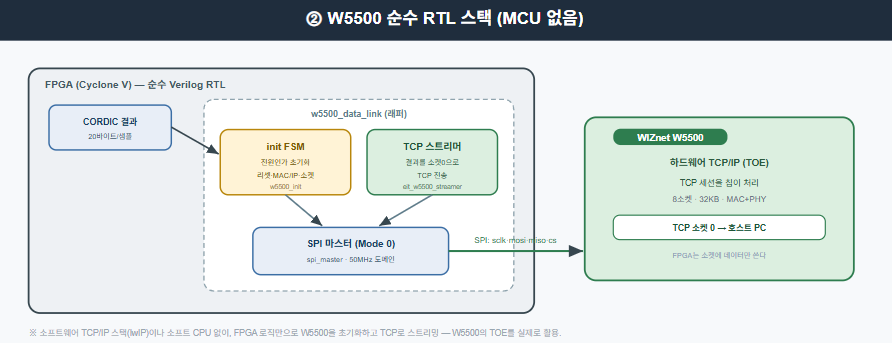
이 프로젝트에서 W5500은 측정 결과를 호스트 PC로 실어 나르는 TCP 스트리밍 인터페이스이며, 특징적으로 MCU 없이 순수 Verilog RTL로 W5500을 직접 구동합니다.
- 역할: FPGA가 CORDIC로 계산한 결과(샘플당 20바이트: mag_body, phase_body, mag_ref, phase_ref, delta_phase)를 W5500의 TCP 소켓 0으로 스트리밍합니다.
- 연결: SPI (Mode 0). 범용 SPI 마스터(
spi_master.v)가 물리 계층을 담당합니다. SPI·W5500 도메인은 50MHz. - 순수 RTL W5500 스택 (핵심 차별점):
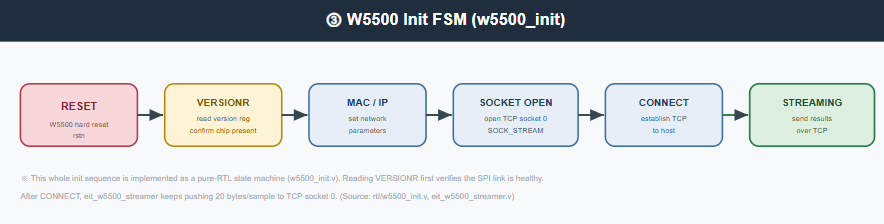
w5500_init.v— 전원인가 초기화 FSM: 리셋 → VERSIONR 읽어 칩 확인 → MAC/IP 설정 → 소켓 open + connecteit_w5500_streamer.v— CORDIC 결과를 TCP로 스트리밍w5500_data_link.v— init FSM + streamer 래퍼w5500_bringup.v— 초기 SPI/링크 테스트 루틴
- 핀맵: W5500 SPI 물리핀은 Quartus 핀 배정(
DAQ1.qsf)·constraints/에 정의됩니다(README에는 미기재 → 소스 확인).
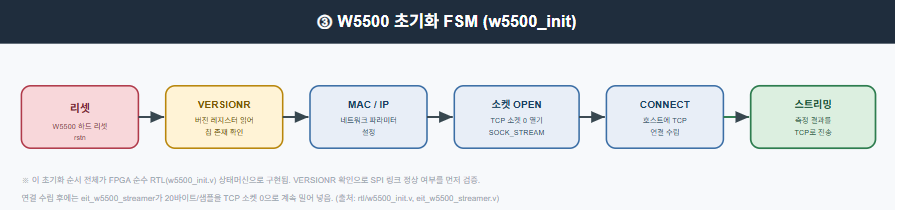
TOE(하드웨어 TCP/IP)를 실제로 활용합니다. 이 프로젝트는 W5500의 하드웨어 TCP 소켓을 열어 세션을 칩이 처리하게 하고, FPGA는 그 소켓에 측정 데이터만 밀어 넣습니다. 소프트웨어 TCP/IP 스택(lwIP 등)이나 소프트 CPU 없이, FPGA 로직만으로 100 kSPS 측정 → TCP 전송을 완결하는 구조라, W5500의 "TCP/IP를 칩에 오프로드" 장점이 극대화됩니다.
주요 사양
| 항목 | 값 |
|---|---|
| FPGA | Intel Cyclone V SoC 5CSEMA4U23C6 |
| 최상위 엔티티 | eit_system_top (Quartus 프로젝트 DAQ1) |
| 클럭 | 50MHz 입력 → PLL → 150MHz DSP 클럭 / SPI·W5500 50MHz |
| 샘플레이트 | 100 kSPS |
| 스트림 페이로드 | 20바이트/샘플, TCP 소켓 0 |
| CORDIC 위상 | Q1.31 부호, 범위 [−π, +π) |
구현 메모
- 툴체인: Intel Quartus Prime (Cyclone V 지원, 20.1+).
DAQ1.qpf열고 컴파일 →DAQ1.sof프로그래밍. - 저장소명 주의: 저장소는
dlia-fpga이지만 Quartus 프로젝트(DAQ1)·최상위 엔티티(eit_system_top)는 빌드·테스트 참조 유지를 위해 그대로 둡니다. - 언어: Verilog(RTL 중심) + Python(호스트·cocotb).
- 초기 단계: 커밋 3·스타 0의 개인 프로젝트.
docs/에 매뉴얼·그림 추가 예정.
유사 프로젝트 (maker.wiznet.io)
FPGA가 W5500을 직접 구동해 계측 데이터를 네트워크로 스트리밍하는, 성격이 가까운 글들입니다.
- FPGA Slow Control Interlock System / SCIS (irina) — https://maker.wiznet.io/irina/projects/fpga-slow-control-interlock-system-scis/ FPGA가 W5500(SPI)을 구동해 계측 데이터를 네트워크로 처리. 구조("FPGA 계측 → W5500 스트리밍")가 가장 유사(SCIS는 UDP, 이쪽은 TCP).
- FPGA + W5500 Control Unit (mark) — https://maker.wiznet.io/mark/projects/fpga-w5500-control-unit/ FPGA가 W5500을 중앙 제어로 쓰는 다채널 계측·제어 시스템.
- pComputer (irina) — https://maker.wiznet.io/irina/projects/pcomputer-a-minimal-computer-on-fpga/ FPGA 안에 W5500 SPI 마스터를 직접 구현. "순수 로직으로 W5500 구동"이라는 점이 통함.
- TCP/IP stack design based on FPGA and W5500 (WIZnet Makers) — https://maker.wiznet.io/2019/04/26/tcp-ip-stack-design-based-on-fpga-and-embedded-ethernet-w5500/ FPGA가 W5500을 TCP/IP 서버로 구동하는 기본 예제. dlia-fpga의 TCP 스트리밍과 개념이 같음.
| 항목 | dlia-fpga | SCIS | FPGA+W5500 Control Unit | pComputer |
|---|---|---|---|---|
| 성격 | 락인 증폭기(계측) | 계측 집약+인터록 | 다채널 계측·제어 | 자작 RISC-V 컴퓨터 |
| FPGA | Cyclone V | GateMate | Spartan-6 | 다양(Zynq 등) |
| W5500 구동 | 순수 RTL, TCP | 순수 RTL, UDP·듀얼 | 중앙 제어 | RTL SPI 마스터 |
| 전송 | TCP 소켓0 스트림 | UDP 8소켓 | 이더넷 | MMIO 매핑 |
FAQ
Q: 이 프로젝트는 무엇인가요? A: Cyclone V FPGA에 2채널 디지털 락인 증폭기를 구현해, 미약 신호의 크기·위상차를 측정하고 W5500 TCP로 PC에 스트리밍합니다.
Q: W5500은 어떻게 쓰이나요? A: FPGA가 순수 RTL로 W5500을 초기화(리셋·VERSIONR·MAC/IP·소켓 open/connect)하고, 측정 결과(20바이트/샘플)를 TCP 소켓 0으로 스트리밍합니다.
Q: 하드웨어 TCP/IP(TOE)를 쓰나요? A: 네. W5500의 하드웨어 TCP 소켓을 써서 세션을 칩이 처리하고, FPGA는 소켓에 데이터만 씁니다. 소프트웨어 스택이나 소프트 CPU 없이 동작합니다.
Q: W5500 핀은 무엇인가요? A: Quartus 핀 배정 파일 DAQ1.qsf·constraints/에 정의돼 있습니다. 소스를 확인하세요.
What the Project Does
A lock-in amplifier extracts a weak signal buried in noise by synchronizing to a reference frequency. This project implements that as a two-channel digital lock-in amplifier (DLIA) in FPGA logic.
- Measures: the magnitude and phase difference (delta_phase = φ_body − φ_ref) between two inputs — a body channel and a reference channel — in real time
- Signal chain (all hand-written Verilog RTL):
- NCO (
my_nco.v) — sin/cos, 32-bit phase accumulator - IQ mixer (
nco_mixer_pipe.v) — multiplies input by the reference to split I/Q - Lock-in accumulator (
lock_in_accum.v) — integer-period integration + normalization - CORDIC (
cordic_iq.v) — magnitude and phase from the I/Q pair (Q1.31)
- NCO (
- Clock-domain crossing: a gray-pointer async FIFO (
async_fifo_gray.v) bridges the two ADCs safely - Verification: cocotb golden model (Python/NumPy reference) + Verilog testbenches (ModelSim/Questa)
- Host tools: Python parses the 20-byte frames for live Vpp/phase readout, N-sample CSV capture, and SNR/frequency-response analysis
Where WIZnet Fits
Here the W5500 is the TCP streaming interface that carries results to the host PC, and notably the FPGA drives it with pure Verilog RTL — no MCU.
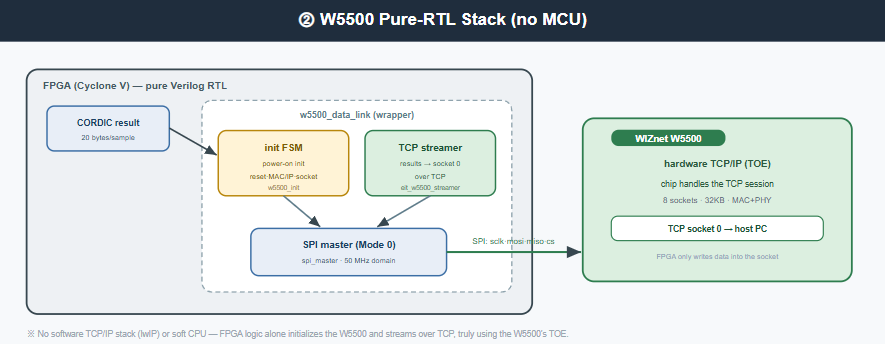
- Role: the FPGA streams each CORDIC result (20 bytes/sample: mag_body, phase_body, mag_ref, phase_ref, delta_phase) to the W5500 TCP socket 0.
- Connection: SPI (Mode 0) via a generic master (
spi_master.v); the SPI/W5500 domain runs at 50 MHz. - Pure-RTL W5500 stack (the key differentiator):
w5500_init.v— power-on init FSM: reset → read VERSIONR to confirm the chip → set MAC/IP → socket open + connecteit_w5500_streamer.v— streams CORDIC results over TCPw5500_data_link.v— wrapper tying init FSM + streamerw5500_bringup.v— initial SPI/link bring-up
- Pin map: W5500 SPI pins are defined in the Quartus assignments (
DAQ1.qsf) andconstraints/(not in the README — check the source).
It genuinely uses the hardware TCP/IP (TOE). The design opens a W5500 hardware TCP socket so the chip handles the session, while the FPGA just pushes measurement data into the socket. With no software TCP/IP stack (lwIP) or soft CPU, the whole "100 kSPS measure → TCP send" path is completed in FPGA logic — maximizing the W5500's "offload TCP/IP to the chip" advantage.
Specifications
| Item | Value |
|---|---|
| FPGA | Intel Cyclone V SoC 5CSEMA4U23C6 |
| Top entity | eit_system_top (Quartus project DAQ1) |
| Clocking | 50 MHz → PLL → 150 MHz DSP; SPI/W5500 at 50 MHz |
| Sample rate | 100 kSPS |
| Stream payload | 20 bytes/sample, TCP socket 0 |
| CORDIC phase | Q1.31 signed, range [−π, +π) |
Implementation Notes
- Toolchain: Intel Quartus Prime (Cyclone V, 20.1+). Open
DAQ1.qpf, compile →DAQ1.sof, program. - Naming: the repo is
dlia-fpga, but the Quartus project (DAQ1) and top entity (eit_system_top) are kept as-is to preserve build/testbench references. - Languages: Verilog (RTL) + Python (host, cocotb).
- Early stage: 3 commits, 0 stars; manual/figures to be added under
docs/.
Similar Projects (maker.wiznet.io)
Projects that, like dlia-fpga, drive the W5500 from FPGA logic to stream measurement data over the network.
- FPGA Slow Control Interlock System / SCIS (irina) — https://maker.wiznet.io/irina/projects/fpga-slow-control-interlock-system-scis/ — FPGA drives W5500 (SPI) to move measurement data; closest structure ("FPGA measure → W5500 stream"; SCIS uses UDP, this uses TCP).
- FPGA + W5500 Control Unit (mark) — https://maker.wiznet.io/mark/projects/fpga-w5500-control-unit/ — multi-channel measure/control with W5500 as the central interface.
- pComputer (irina) — https://maker.wiznet.io/irina/projects/pcomputer-a-minimal-computer-on-fpga/ — implements a W5500 SPI master inside the FPGA; shares "drive W5500 from pure logic."
- TCP/IP stack design based on FPGA and W5500 (WIZnet Makers) — https://maker.wiznet.io/2019/04/26/tcp-ip-stack-design-based-on-fpga-and-embedded-ethernet-w5500/ — an FPGA driving the W5500 as a TCP/IP server; same concept as dlia-fpga's TCP streaming.
| Item | dlia-fpga | SCIS | FPGA+W5500 Control Unit | pComputer |
|---|---|---|---|---|
| Nature | Lock-in amplifier (measurement) | Measurement + interlock | Multi-channel measure/control | From-scratch RISC-V computer |
| FPGA | Cyclone V | GateMate | Spartan-6 | Various (Zynq etc.) |
| W5500 drive | Pure RTL, TCP | Pure RTL, UDP·dual | Central interface | RTL SPI master |
| Transport | TCP socket 0 stream | UDP 8 sockets | Ethernet | MMIO-mapped |
FAQ
Q: What is this project? A: A two-channel digital lock-in amplifier on a Cyclone V FPGA that measures magnitude/phase difference of weak signals and streams results to a PC over W5500 TCP.
Q: How is the W5500 used? A: The FPGA initializes the W5500 in pure RTL (reset, VERSIONR, MAC/IP, socket open/connect) and streams results (20 bytes/sample) over TCP socket 0.
Q: Does it use hardware TCP/IP (TOE)? A: Yes. It uses a W5500 hardware TCP socket so the chip handles the session, while the FPGA only writes data into the socket — no software stack or soft CPU.
Q: What are the W5500 pins? A: Defined in the Quartus assignments DAQ1.qsf and constraints/. Check the source.
- Programming Language: Verilog (RTL) · Python (host/cocotb)
- Application: FPGA · 계측/DSP · 락인 증폭기 · 데이터 획득(DAQ) · 네트워크 스트리밍
- Tags: W5500, FPGA, Cyclone-V, lock-in-amplifier, DLIA, NCO, CORDIC, DSP, TCP, SPI, measurement, DAQ, MIT