



Design and Experimental Demonstration of an Atmospheric Turbulence Simulation System for Free-Space
A lab simulator that reproduces atmospheric turbulence for free-space optical links, receiving channel data via W5300 hardware TCP/IP.
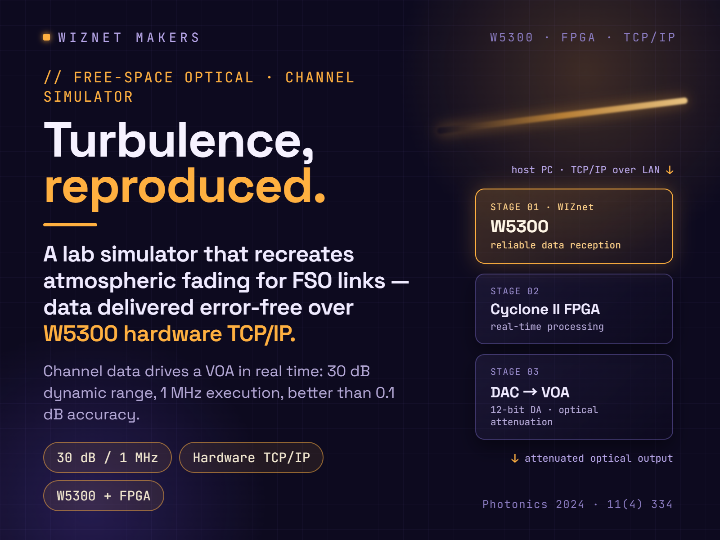
How an Atmospheric Turbulence Simulator for Free-Space Optical Communication Uses WIZnet W5300 for Reliable, High-Throughput Channel Data Delivery
Overview
Free-space optical (FSO) communication carries data on light through the air, but atmospheric turbulence shakes the signal and degrades performance. This project is a lab simulator that precisely reproduces that turbulence. It takes measured or model-generated channel data and uses a variable optical attenuator (VOA) to attenuate the optical signal in real time. (30 dB dynamic range, 1 MHz execution, better than 0.1 dB accuracy.)
The key here is delivering the channel data without error — even a slight deviation throws off the reproduction. WIZnet W5300 handles this transport, using its hardware TCP/IP reliability features (checksum, retransmission, etc.) to guarantee data integrity.
(All hardware components and figures below are values reported in the paper.)
Key Features
- Precise turbulence reproduction (30 dB / 1 MHz / 0.1 dB): The system maps recorded or generated channel data directly to optical attenuation. Reproduction accuracy determines the reliability of the experiment, and that requires the data to arrive undistorted — the W5300 is the gateway for that integrity.
- Reliable TCP/IP transport: The W5300 receives channel data sent by the host PC over TCP/IP. Because TCP reliability mechanisms such as checksum, retransmission, and sliding window are handled in hardware by the W5300, the FPGA can focus on data processing without the burden of error correction.
- Plug-and-play Ethernet interface: The system is designed to receive data over an Ethernet port. Working the moment it's plugged into a standard LAN means it connects to any experiment PC without a dedicated interface card or special cabling — and the W5300 provides that standard Ethernet touchpoint.
- Division of labor with the FPGA: Data processing is handled by an Altera Cyclone II FPGA, and networking by the W5300. By delegating the network to the W5300 instead of running a software TCP/IP stack, the FPGA can spend its limited logic resources on real-time data processing and DA-conversion control.
- The entrance to a high-speed pipeline: Data flows W5300 → FPGA → DAC7821 (12-bit) → VOA. Since the back end runs at 1 MHz, the data supply at the entrance must be uninterrupted, and the W5300's stable reception guards this starting point of the pipeline.
System Architecture
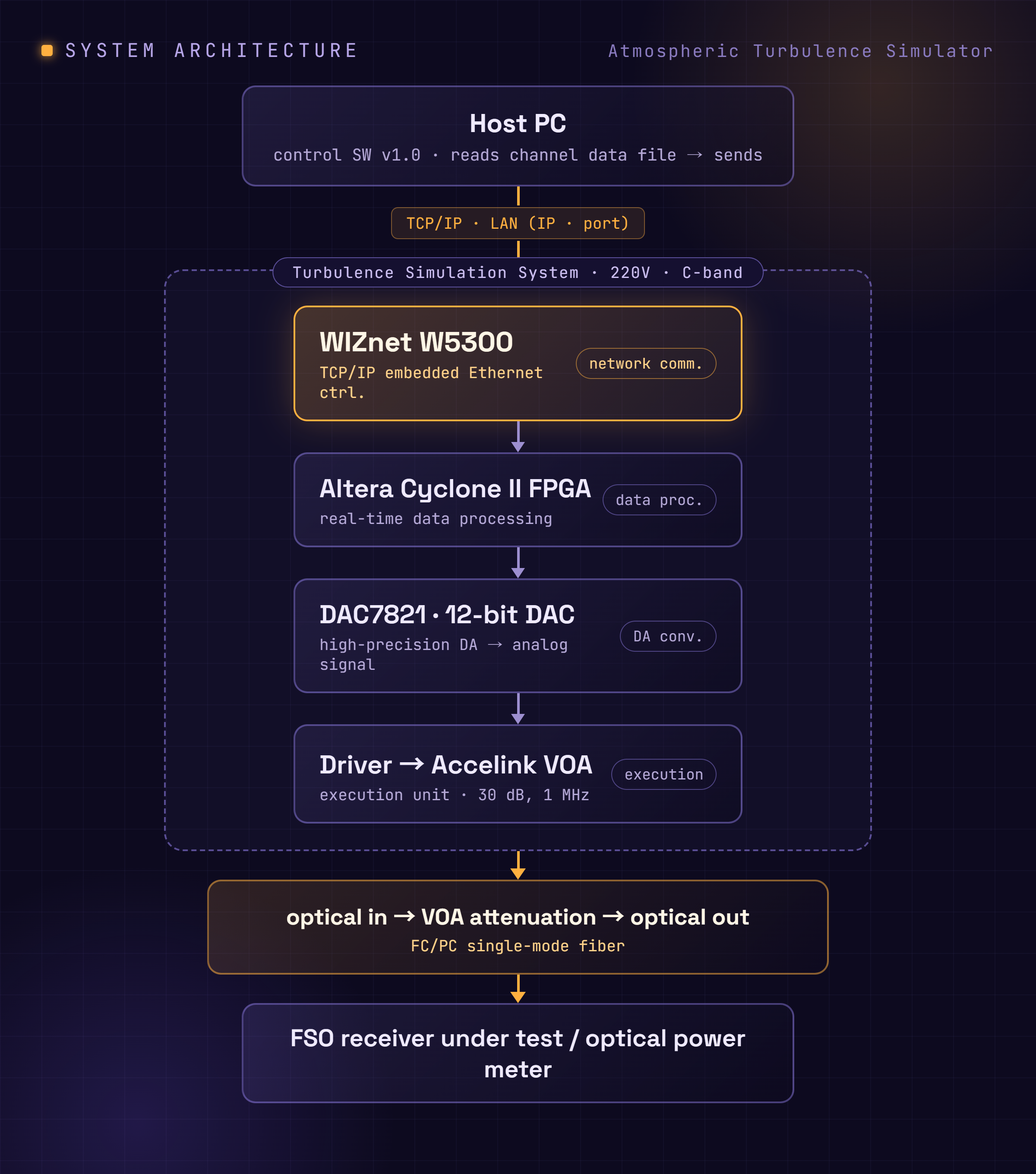
The W5300's role in the data path: The W5300 is the entrance to this pipeline. It's the sole gateway through which the host PC's turbulence-channel data enters the system, and if data is lost or corrupted here, no matter how precise the downstream FPGA, DAC, and VOA are, the reproduction will be wrong. The W5300 guarantees this first stage with reliable TCP/IP transport.
Role and Application of the WIZnet Chip
- Chip used: WIZnet W5300
- Connection: Works with the FPGA (Altera Cyclone II) as the network communication unit. (The W5300 is a high-throughput Ethernet controller with a parallel host-bus interface and hardwired TCP/IP. The paper does not describe the specific bus width or pin wiring of the W5300–FPGA connection — this part is unconfirmed.)
- Its role: Ethernet communication between host PC ↔ simulation system. It receives channel data over TCP/IP and passes it to the FPGA.
- Why wired Ethernet + hardware TCP/IP:
- Integrity: The attenuation waveform reflects the channel data 1:1, so even a single-sample error degrades reproduction accuracy. TCP's checksum and retransmission prevent this.
- Load separation: Since the W5300 handles TCP/IP in hardware, the FPGA focuses on real-time data processing and DA control instead of a protocol stack.
- Versatility: Being standard Ethernet/LAN, it connects plug-and-play to any experiment PC without a dedicated interface.
- What weakens without the W5300: The FPGA would have to implement TCP/IP in software or attach a separate MAC/PHY plus stack. That eats into FPGA resources and leaves the burden of validating reliable-transport logic. Both benefits — data-integrity assurance and development simplification — weaken together.
Related Existing Contents
Two cases on WIZnet Makers, whose content we verified directly, are especially close to this project.
FPGA Based Multichannel Bit Error Rate Tester for Spacecraft DAQ (WIZnet)
Effectively the same category as this project. It uses the same W5300 for Ethernet communication between an FPGA (Altera Stratix II) and a PC — a paper-based measurement instrument, matching right down to using a WIZnet chip for "FPGA↔PC data communication."
- Difference: The BER tester uses UDP unicast and takes a PCI-X card form. This project emphasizes reliable TCP/IP transport and has an optical-attenuation (VOA) execution stage — optical-communication instrumentation.
- Extension value: Together, the two form a strong reference category of "W5300 + FPGA measurement instruments," showing the W5300's proven use in aerospace and optical-communication instrumentation.
High-Speed Ethernet-Based Voltage Acquisition for Long-Distance Industrial Testing (josephsr)
A DAQ that transmits measurement data over Ethernet across distance. Its design philosophy — "treat the network not as a raw pipe but as a deterministic transport layer, and offload TCP/IP to WIZnet to secure timing predictability and signal integrity" — is the same as this project's.
- Difference: It's voltage measurement acquiring 0–5V at 10 kHz with W5500 + MCU + SAR ADC. This project is optical-communication instrumentation processing optical-channel data with W5300 + FPGA.
- Extension value: It broadens the industry/research-common pattern of "precision measurement + WIZnet wired transport" from voltage acquisition to optical-channel reproduction.
The BER Tester in particular can be seen as the same lineage as this project, given the identical chip (W5300) + FPGA + measurement combination.
Market & Application Value
- FSO communication equipment development & validation (B2B/research): Test FSO transceivers under repeatable turbulence conditions in the lab. Performance can be validated without field trials, shortening development cycles.
- Optical component & device testing (industrial): Evaluate how components such as optical amplifiers and receivers behave under turbulent fading, under standardized conditions.
- Research/education measurement platform: Used at universities and institutes for atmospheric optical-propagation research and channel-model validation. Being Ethernet-based, it integrates directly into existing lab PCs.
- Satellite/ground optical link simulation (aerospace): Reproduce fading scenarios of long-distance optical links on the ground.
- System-integration angle: As a standard Ethernet interface, it slots easily into measurement-automation software and LAN-based experiment racks. "Plug and play" reduces setup time and wiring complexity in real lab environments.
Why it's advantageous in real deployment/operation: research measurement equipment lives on reproducibility and connectivity with other equipment. Wired Ethernet + TCP/IP satisfies both data integrity (reproducibility) and standard connectivity (integration) at once.
WIZnet Strategic Value
- A proof reference for the top of the product line (W5300): Unlike the small SPI chips (W5500/W5100S) often seen in IoT and lighting, this case applies the high-throughput parallel-bus W5300 + FPGA combination to research measurement equipment — a rare demonstration. It backs the W5300's positioning (high-performance, low-latency data reception).
- A touchpoint with the FPGA ecosystem: As a case paired with an FPGA rather than an MCU, it becomes a reference for "attaching hardware TCP/IP to an FPGA design," showing the FPGA camp the value of WIZnet's offload.
- Expansion into the measurement/research market: Beyond lighting and home automation, a case where a WIZnet chip is used as a data-integrity solution in high-value fields like optical communication, instrumentation, and aerospace research.
- Reaffirming the core value of hardware TCP/IP: This project explicitly uses the W5300 not as a "MAC/PHY" but as reliable-transport (TCP/IP) offload. It's a good example of the essential strength of WIZnet's hardwired TCP/IP.
- Reference-design potential: The "network (W5300) → processing (FPGA) → high-precision DA → execution" pipeline is an architecture template that ports directly to other precision measurement and control equipment.
Upgrade Path: W5300 → W6300 (Recommended Modern Successor)
This paper uses the W5300, a 2008-generation chip. The W5300 chip is still available on the market, but its large 100-pin LQFP package and 8/16-bit parallel-bus interface are burdensome for new designs. If you were building the same system today, WIZnet's modern successor, the W6300, is a natural alternative. (WIZnet itself positions the W6300 as the compact, more flexible successor to the W5300.)
Comparing the two chips against this project's needs (high throughput + host-bus integration + hardware TCP/IP):
- Inherits hardware TCP/IP (TOE): The W6300 uses the same WIZnet hardwired TCP/IP approach as the W5300, providing 8 hardware sockets and TOE. The core value this project gained from the W5300 — reliable transport without host burden — is preserved.
- Throughput: Where the W5300 delivered up to 80 Mbps over the parallel bus, the W6300 delivers 80–90 Mbps and above over QSPI (150 MHz). It handles high-throughput demands like the 1 MHz execution and multi-channel data stream equally well or better.
- A difference in interface (note): The W5300's primary interface is an 8/16-bit parallel bus, whereas the W6300's primary interface is high-speed QSPI, with parallel offered only as a simplified 8-bit (2-address) system bus as a secondary option. So when moving an FPGA connection that was on the W5300's 16-bit parallel bus to the W6300, it's more natural to modernize to QSPI or redesign for the 8-bit parallel bus rather than keep the parallel connection as-is.
- Package/integration: Versus the W5300's 100-pin LQFP, the W6300 comes in a 48-pin LQFP/QFN, simplifying PCB routing and favoring compact measurement-board designs.
- IPv6 dual stack: The W6300 supports an IPv4/IPv6 dual stack in hardware, adding scalability for modern research and industrial network environments.
In short, for a researcher looking to recreate this paper's architecture today, the W6300 is an upgrade path that inherits the W5300's role (high throughput, hardware TCP/IP) while being smaller and adding IPv6 — with the caveat that the host connection shifts from parallel bus to QSPI-centric, so an interface redesign is presupposed.
(Note: the W5300 and W6300 are separate chips of different generations and are not pin-compatible. This comparison is based on datasheet/product-page specs and is not a case of actually applying the W6300 to this paper's system.)
Limitations / Notes
- The chip used is the W5300 (not the W5500/W5100S). It's a parallel-bus, high-throughput Ethernet controller. The W5300 chip itself is still distributed but is a 2008-generation legacy part; for new designs, the W6300 in the "Upgrade Path" above is recommended. (Note: the W5300-EVB evaluation board is discontinued.)
- W5300–FPGA connection details (bus width, pin wiring, driver): not specifically described in the paper — unconfirmed.
- What the W5300 does not do: optical attenuation (VOA), analog conversion (DAC7821), and data-processing logic (FPGA) are not the W5300's roles. The W5300 is limited to receiving network data.
- Use of hardware TCP/IP: Because the paper explicitly calls the W5300 a "TCP/IP embedded Ethernet controller" and mentions TCP reliability features, this is judged to be a case that actually uses hardware TCP/IP — unlike some earlier projects (via MACRAW / software stack). That said, code-level details of the socket usage are outside the paper's scope.
- Performance figures (30 dB, 1 MHz, 0.1 dB, 9.4 km field experiment, etc.) are all values reported in the paper and are not exaggerated here.
- This article introduces and explains an academic paper; it describes a research demonstration system, not a commercial product.
Source / Reference Links
- Paper: Li et al., "Design and Experimental Demonstration of an Atmospheric Turbulence Simulation System for Free-Space Optical Communication," Photonics 2024, 11(4), 334. https://www.mdpi.com/2304-6732/11/4/334
- DOI: https://doi.org/10.3390/photonics11040334
- WIZnet W5300: https://docs.wiznet.io/Product/Chip/Ethernet/W5300
- WIZnet W6300 (modern successor): https://docs.wiznet.io/Product/Chip/Ethernet/W6300
Related Projects on WIZnet Makers