


How Does W5500 Ethernet Support an AI Grain-Pest Patent?
A Jiangsu University patent uses W5500 Ethernet to move CMOS pest images from an MCU capture node to a PC and cloud MDRN classifier.
WIZnet - W5500
x 1

Ethernet transmission module named in the patent's detailed embodiment for moving stored-grain pest image data from the MCU capture hardware to the PC terminal.
Overview
CN112529043A is a Chinese published patent application titled "MDRN network-based online grain storage pest identification system and method." It was filed on November 19, 2020 and published on March 19, 2021. Google Patents lists Jiangsu University of Science and Technology as the assignee, with Zhong Weibo, Zhang Yingying, Lin Wei, Qi Guoqing, Cao Xiangxiang, Hu Zhiwei, Xu Qiang, Ding Xing, and Yao Zhengya as named inventors.
In practical terms, the disclosure describes an edge-to-cloud inspection pipeline for stored grain. A hardware module uses an MCU-controlled light strip and a CMOS camera to capture pest images near the grain pile. The detailed embodiment then names a W5500 Ethernet transmission module that sends those images to a PC terminal, while the PC software stores and displays the images before uploading them to a cloud GPU server for MDRN-based recognition.
For WIZnet readers, the important point is not that W5500 performs AI inference. It does not. The W5500 appears as the wired image-data bridge between local capture hardware and the PC/cloud software layer. That makes this patent useful as an architecture reference for edge-AI systems where image capture happens near the physical target, but heavier recognition runs on a more capable host or server.
Key takeaway: W5500 does not run MDRN recognition here. It is the wired image-data bridge between the capture hardware and the PC/cloud recognition path.
Project Context and Key Terms
Stored-grain pest recognition is the task of identifying insects that damage harvested grain while it is stored in granaries, silos, or grain piles. The patent background explains the practical problem: traditional pest identification depends heavily on manual visual inspection, worker experience, and specimen comparison, which can be slow and error-prone.
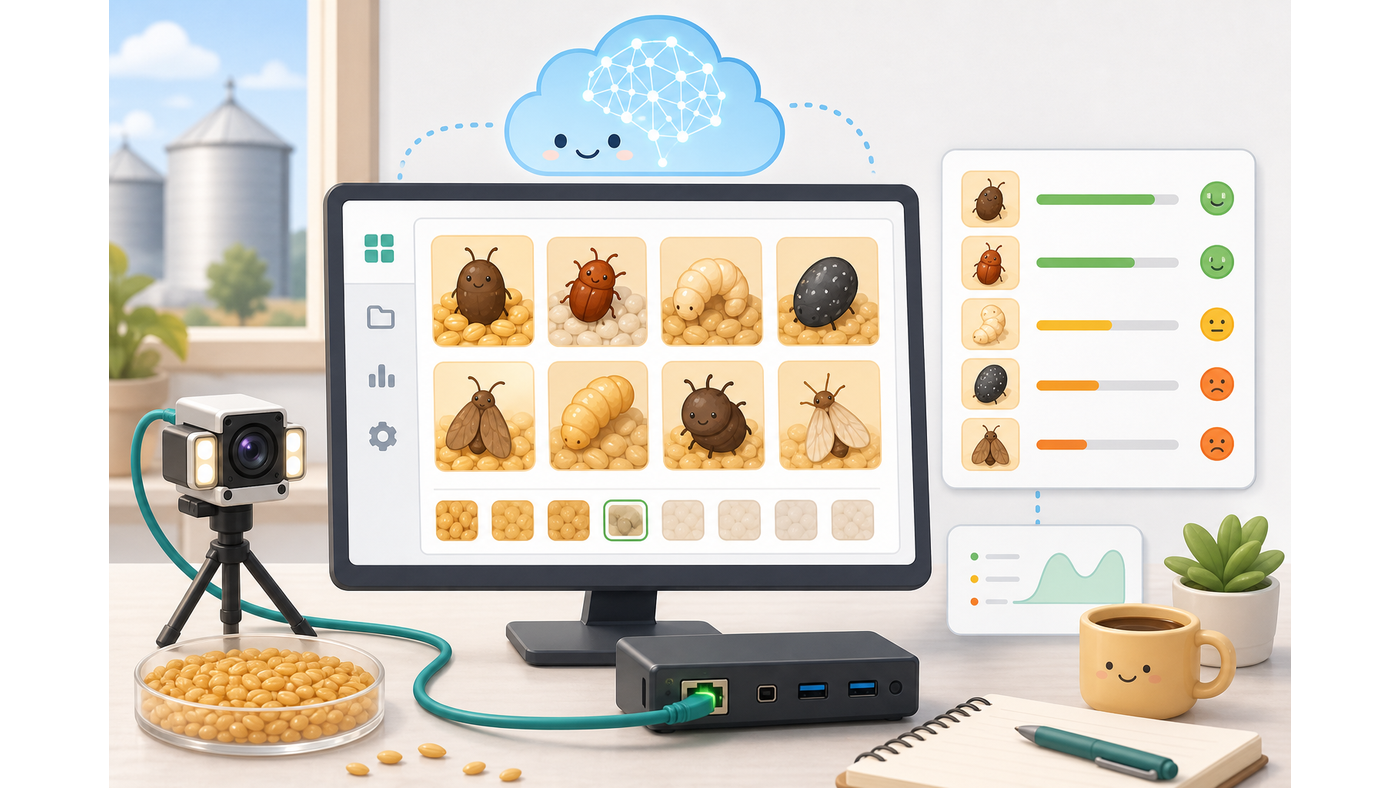
An external stored-grain pest reference deck helps make that visual problem concrete. It groups pests into primary, secondary, internal-feeding, and external-feeding types, and shows field cues such as rice weevil markings, lesser grain borer body shape, boring holes, hollowed kernels, frass, webbing, and surface contamination. This Maker article uses that deck as domain context, while the patent and the MDRN paper remain the technical sources for the W5500 and model discussion.
MDRN is the recognition network described by the patent for classifying the collected pest images. The disclosure places this algorithm on a cloud GPU server, not on the MCU. It describes image standardization, convolution, normalization, residual blocks, pooling, dropout, and a final classifier. For this Maker article, those algorithm details provide context, while the WIZnet focus remains the Ethernet path that moves image data from the capture side to the PC.
The source should also be read as a technical patent disclosure, not as a finished WIZnet build guide. The public patent page gives the system concept and the W5500 role in the detailed embodiment, but it does not include firmware, PCB files, PC software source code, or reproducible hardware test logs.
Why the W5500 Detail Matters
The useful WIZnet angle is the handoff between image acquisition and software processing. In the patent's detailed embodiment, the data transmission module is described as an Ethernet transmission module W5500 that sends image data to the PC terminal. That makes the W5500 the wired transport bridge between the capture node and the PC/cloud stack.
This detail should be read carefully. The numbered claim text describes the data transmission module more generally as an Ethernet transmission module, while the detailed embodiment names W5500. So this curation treats W5500 as source-backed implementation evidence from the disclosed embodiment, not as a legal conclusion about claim scope.
Source evidence: The detailed embodiment names the data transmission module as W5500 and describes image transfer from the capture hardware to the PC terminal.
The W5500 role is also narrower than the AI story. It does not run the MDRN model. It moves image data reliably from a local embedded capture module into the PC software path. That is exactly the kind of practical role a hardwired TCP/IP Ethernet controller can play in edge-AI systems: keep network transport stable while heavier compute happens somewhere else.
System Architecture and Data Flow
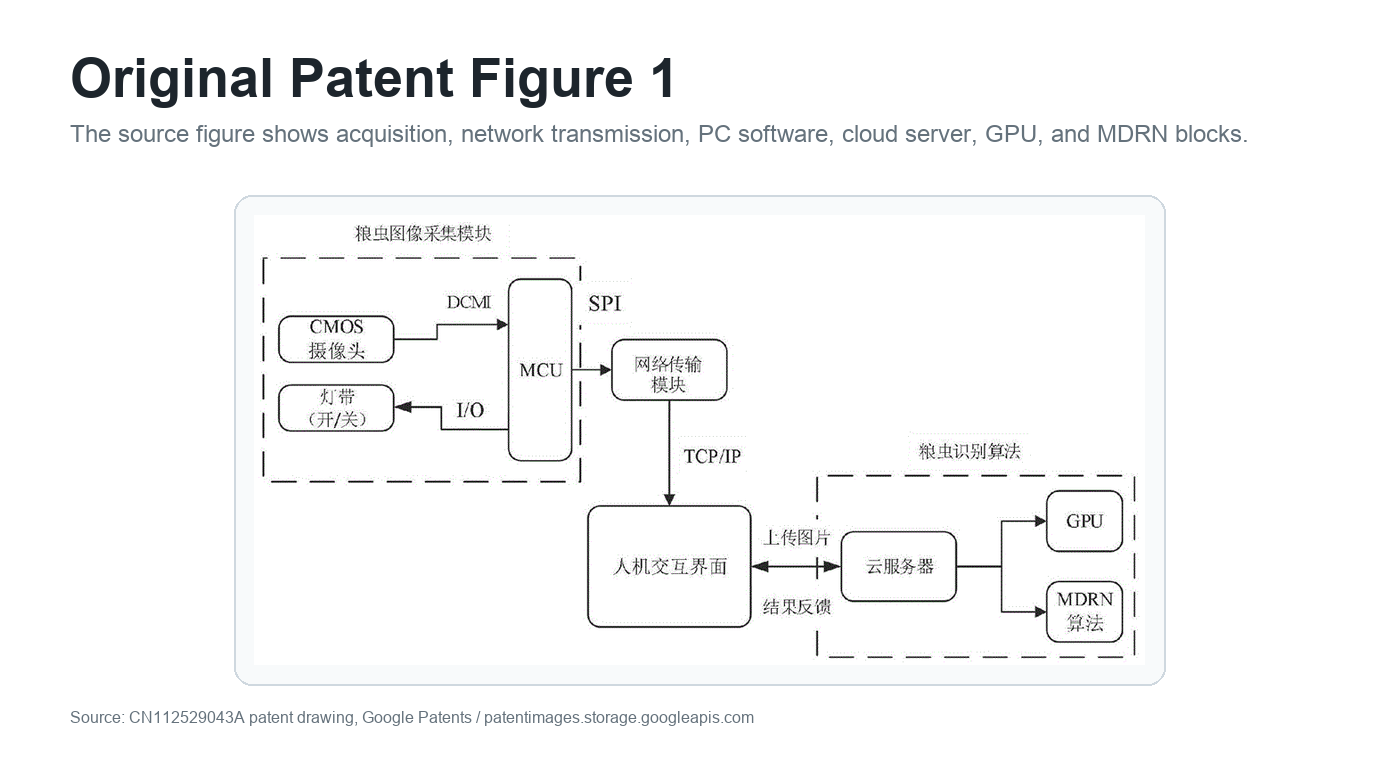
The patent's Figure 1 shows a familiar edge-to-cloud pattern. The image acquisition block sits near the grain sample. A light strip is switched by the MCU to attract stored-grain pests, then a CMOS camera captures the image through a DCMI interface. The MCU sends image data toward the network transmission module over the local hardware path shown in the figure.
From there, the W5500 Ethernet module moves the image data to the PC terminal over TCP/IP. The PC-side human-computer interaction software displays the incoming pest images, stores them locally, and uploads them to the cloud server. The cloud server is described as a GPU computer carrying the MDRN deep-learning algorithm. After recognition, feedback returns to the PC interface.
Role of the WIZnet W5500
For WIZnet readers, the most concrete line is the image-transfer path. Stored-grain pest monitoring is not just a temperature or humidity telemetry problem. Images are larger, more timing-sensitive, and less tolerant of unstable transport if the operator wants repeated online recognition. A wired Ethernet hop gives the capture hardware a predictable route into the PC software layer.
The patent does not disclose firmware, socket calls, buffer sizing, PCB layout, or test logs. So this article does not speculate about driver implementation details. What is public is the system-level role: W5500 is the Ethernet image-data bridge from the embedded hardware module to the PC.
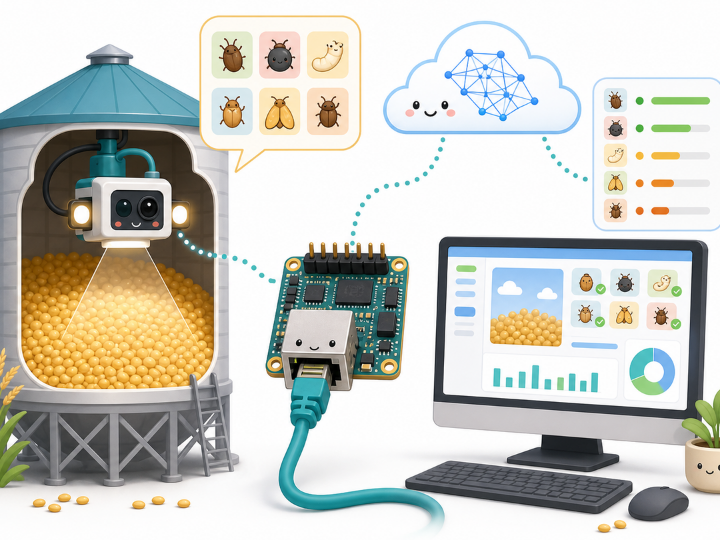
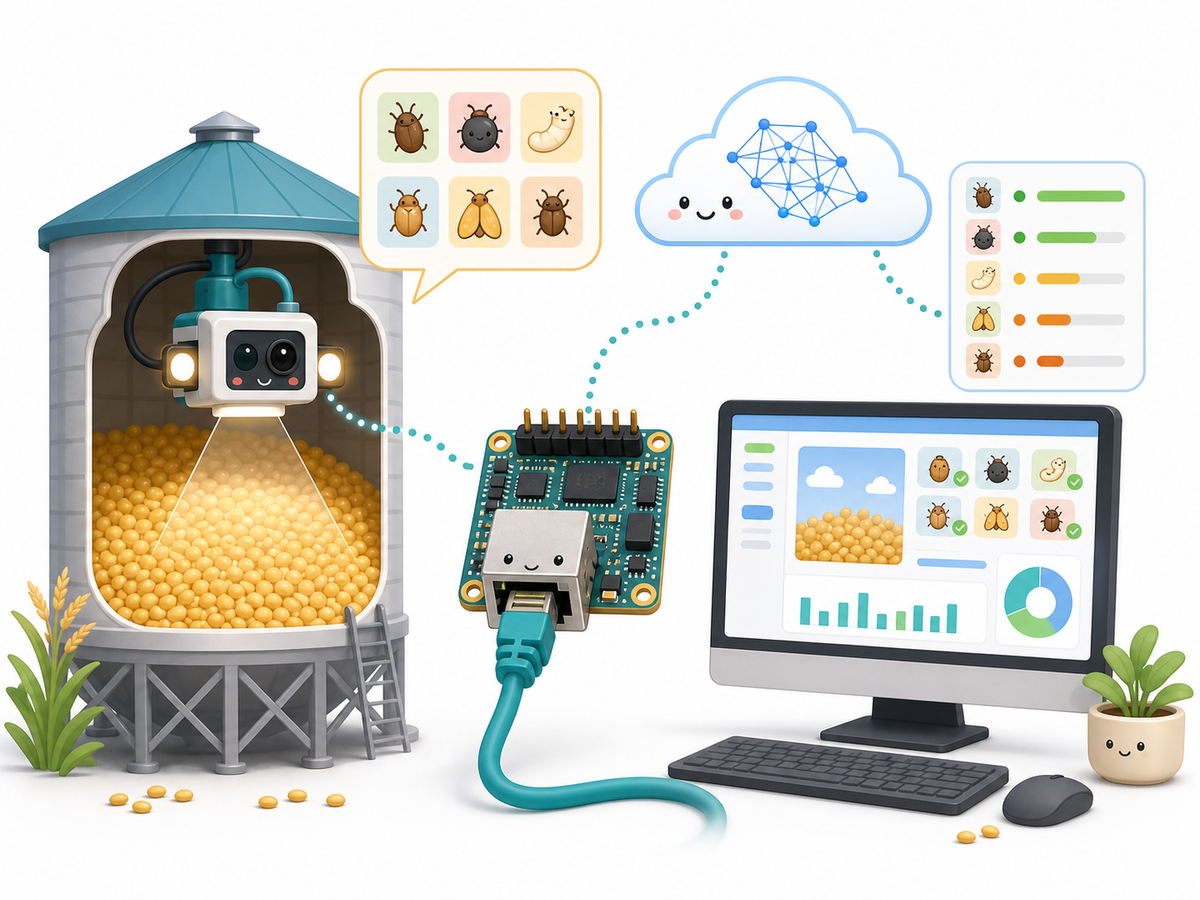
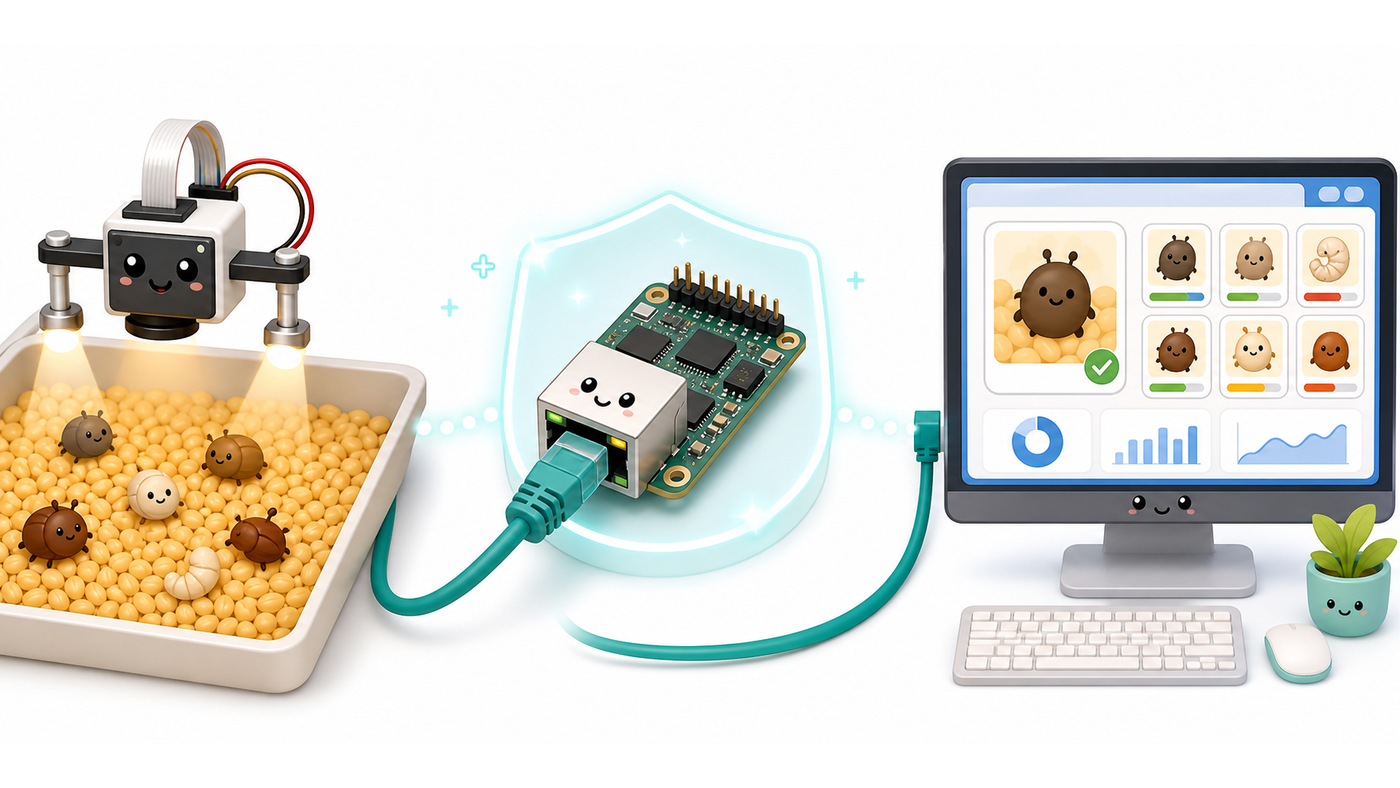
The generated illustration above turns that handoff into a simpler visual cue. W5500 is the transport bridge in the middle of the scene, not the camera, PC, or AI model.
MDRN Algorithm Context
The algorithm side is also interesting, but it should be separated from the W5500 evidence. The patent describes an MDRN recognition algorithm running on the cloud server. It uses residual blocks, convolution, normalization, activation functions, pooling, and classifier output to identify stored-grain pests from collected images.
For readers familiar with tools such as Roboflow, the closest mental model is an image-classification workflow rather than WIZnet-side AI. A camera image is captured, training images have known pest labels, the model learns visual features, and a new image is assigned to a pest class. Roboflow is a platform around datasets, annotation, model training, and deployment. MDRN is the neural-network architecture used in the paper and patent context.
A closely related paper, "Identification of stored grain pests by modified residual network," was published in Computers and Electronics in Agriculture in 2021 by Yingying Zhang, Weibo Zhong, and Hui Pan. The paper describes six pest classes: Sitophilus oryzae, Sitotroga cerealella, Rhyzopertha dominica, Oryzaephilus surinamensis, Cryptolestes pusillus, and Sitophilus zeamais. It reports 8,111 RGB images expanded to 31,481 images through augmentation, then evaluated with 5-fold cross-validation.
The reported model-level averages on the original datasets are ACC 96.72%, TPR 90.17%, TNR 98.03%, F1 score 90.17%, and AUC 97%. In plain terms, ACC is the overall correct-classification rate, TPR is sensitivity, TNR is specificity, F1 balances precision and recall, and AUC summarizes how well the model separates classes across thresholds.
These numbers explain why the MDRN model is relevant to an image-capture patent. They should not be treated as verified performance of the complete W5500 hardware system. The public patent page does not provide a reproducible W5500 firmware test, physical device photos, camera calibration data, PC software source, field dataset, or an end-to-end benchmark package.
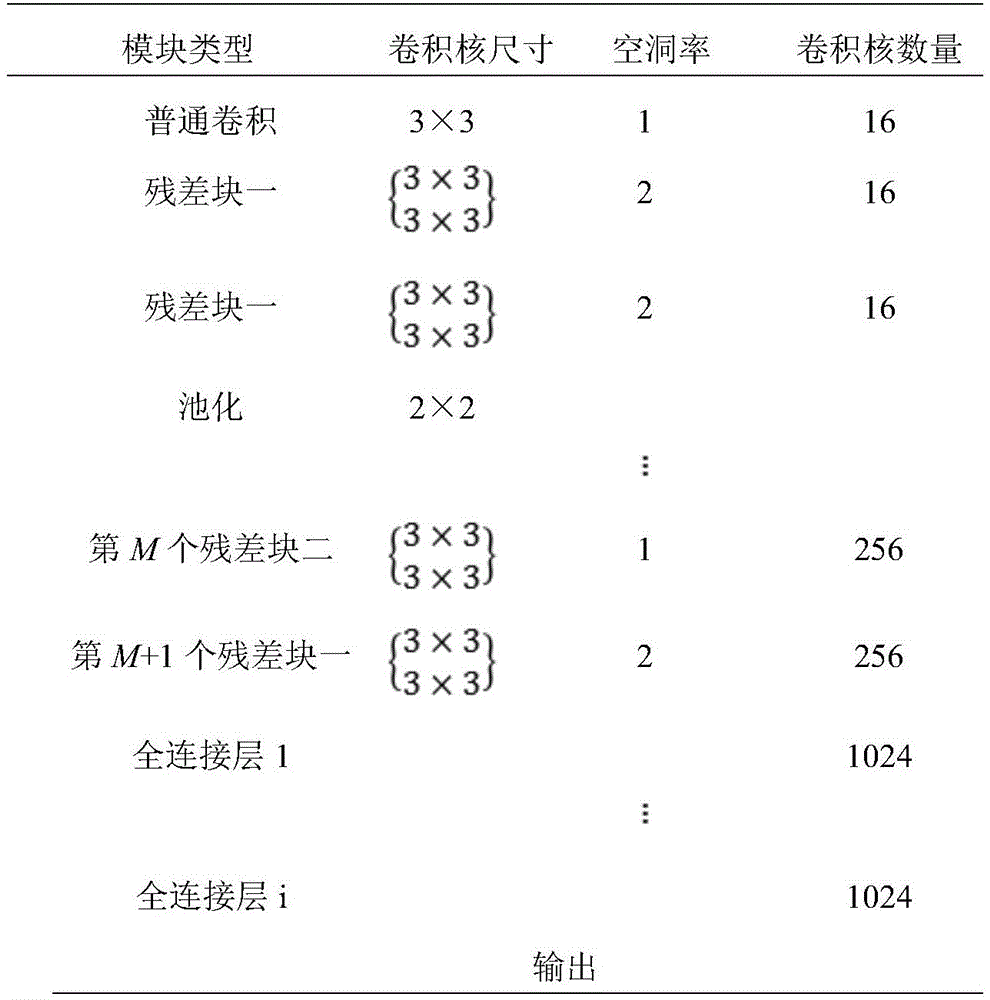
The exact trainable parameter count and model file size are not disclosed in the patent page or the accessible paper metadata used for this article. They also cannot be calculated reliably from the public patent alone, because the table uses symbolic depth such as M residual blocks and does not provide every feature-map size, channel transition, fully connected stack count, or implementation detail.
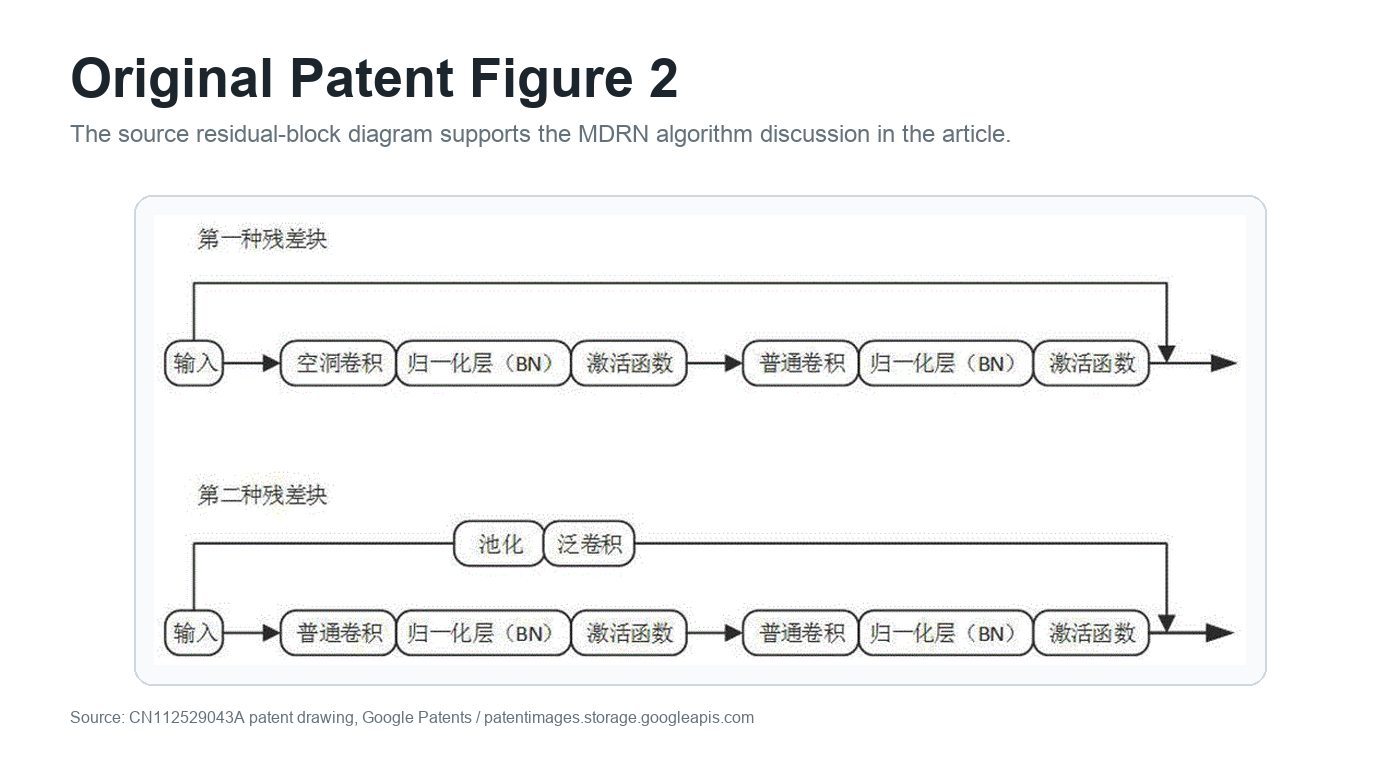
Still, the public disclosure gives useful model-capacity clues. The patent standardizes input images to 128 x 128 pixels, starts with a normal 3 x 3 convolution with 16 kernels, then uses two residual-block types. One block combines dilated convolution with a 3 x 3 convolution, while the other uses two 3 x 3 convolutions and helps handle dimension changes with pooling and Zero-Padding. Table 1 also shows later residual blocks reaching 256 convolution kernels and fully connected layers with 1024 units before the output.
That means the safest way to describe MDRN is not by a parameter count, but by its design idea: a modified residual network that uses dilated convolution to enlarge the receptive field without simply adding more convolution kernels. The patent states that this reduces the number of parameters and computation compared with a naive expansion, but it does not give a final parameter total.
Strengths and Source Limits
The strongest part of this disclosure is the clean partitioning. The camera node captures images, W5500 handles the wired transfer to the PC, and the cloud server performs recognition. That is a practical split for agricultural monitoring systems, because the hardware near the grain pile can stay focused on capture and transport while the deep-learning model runs on a more capable GPU machine.
The missing pieces are equally important. There is no public source code, no board design, no bill of materials, no PC software screenshot, no model file size, no total parameter count, and no independent hardware validation. The patent page also should not be used as legal advice about current patent status or ownership. For Maker purposes, the value is the disclosed engineering pattern: W5500 can serve as the reliable wired image-transfer link inside an AI-assisted grain-storage monitoring pipeline.
Source limit: This is a technical patent disclosure, not a reproducible build package. Firmware, PCB files, PC software source, and hardware validation are not public in the source.
Related WIZnet Maker Reading Path
If the reader wants the closest camera-node precedent, start with the K210 camera node with W5500 Ethernet. That Maker post shows W5500 used beside an embedded vision node to move image-related data into a Raspberry Pi measurement system. It is a practical companion to this patent because it turns the same broad idea, camera-side capture plus wired Ethernet into a host, into a more maker-facing implementation context.
For the agriculture and cloud-IoT side, the leisure agriculture sensing network gives a broader monitoring-system backdrop. It is not an image-recognition project, but it helps place W5500 in agricultural field data collection, where local sensing hardware, a network path, and a remote software layer need to work together.
For the image-transport problem itself, etherView is a useful technical neighbor. It receives RAW image data over Ethernet, so it gives readers another way to think about visual payloads on wired links. The hardware is different, but the reader takeaway is similar: when image data leaves a capture device, the network path becomes part of the system design, not just a convenience feature.
FAQ
Q. Is this a build guide? No. It is a patent disclosure, so this article treats it as an architecture reference rather than a step-by-step build.
Q. What exactly is the WIZnet part? The detailed embodiment names W5500 as the Ethernet transmission module that sends stored-grain pest image data from the embedded capture hardware to the PC terminal.
Q. Does W5500 run the AI model? No. The patent places MDRN recognition on a GPU cloud server. W5500 handles the wired Ethernet image-transfer path.
Q. How large is the MDRN model? The public sources used here do not disclose the final trainable parameter count or model file size. The patent does disclose structural clues: 128 x 128 input, 3 x 3 convolutions, dilated residual blocks, later 256-kernel blocks, 1024-unit fully connected layers, dropout, and Softmax output.
Q. Is this like Roboflow? It is similar only at the high-level computer-vision workflow level: collect labeled pest images, train a model, then classify new images. Roboflow is a platform; MDRN is the recognition model architecture described by the related paper and patent.
한국어
개요
CN112529043A는 중국 공개 특허 출원이며, 제목은 "MDRN network-based online grain storage pest identification system and method"입니다. 2020년 11월 19일에 출원되었고 2021년 3월 19일에 공개되었습니다. Google Patents 기준 양수인은 Jiangsu University of Science and Technology이며, 발명자는 Zhong Weibo, Zhang Yingying, Lin Wei, Qi Guoqing, Cao Xiangxiang, Hu Zhiwei, Xu Qiang, Ding Xing, Yao Zhengya로 표시되어 있습니다.
실제 구조로 보면 이 공개 자료는 저장 곡물 검사를 위한 에지-클라우드 이미지 인식 파이프라인을 설명합니다. 하드웨어 모듈은 MCU가 제어하는 조명과 CMOS 카메라를 사용해 곡물 더미 근처의 해충 이미지를 촬영합니다. 상세 실시예에서는 W5500 이더넷 전송 모듈이 이 이미지 데이터를 PC 단말로 보내고, PC 소프트웨어는 이미지를 저장·표시한 뒤 클라우드 GPU 서버로 업로드합니다. 인식은 클라우드 쪽 MDRN 알고리즘에서 수행됩니다.
WIZnet 관점에서 중요한 점은 W5500이 AI 추론을 수행한다는 뜻이 아니라는 점입니다. W5500은 로컬 촬영 하드웨어와 PC/클라우드 소프트웨어 계층 사이에서 이미지 데이터를 보내는 유선 Ethernet 브리지로 등장합니다. 그래서 이 특허는 이미지 취득은 현장 가까이에서 하고, 무거운 인식은 PC나 서버로 넘기는 edge-AI 구조 참고 사례로 볼 수 있습니다.
핵심 요약: W5500은 여기서 MDRN 인식을 수행하지 않습니다. 촬영 하드웨어와 PC/클라우드 인식 경로 사이에서 이미지 데이터를 보내는 유선 Ethernet 브리지입니다.
프로젝트 맥락과 핵심 용어
저장 곡물 해충 인식은 수확 후 보관 중인 곡물, 곡물 창고, 사일로, 곡물 더미 안팎에서 발생하는 해충을 식별하는 작업입니다. 특허 배경 설명은 기존 방식의 문제를 수작업 육안 검사, 작업자 숙련도 의존, 표본 대조 과정의 비효율로 설명합니다.
별도의 저장 곡물 해충 참고 자료를 보면 이 문제가 왜 이미지 인식 문제인지 더 직관적으로 이해할 수 있습니다. 해당 자료는 해충을 1차/2차 해충, 내부 가해/외부 가해 해충으로 나누고, 쌀바구미의 무늬, 보리나방·곡물좀류의 형태, 구멍, 빈 껍질, 가루, 거미줄, 표면 오염 같은 현장 단서를 보여줍니다. 이 Maker 글에서는 그 자료를 도메인 이해용 참고로 사용하고, W5500과 MDRN의 기술 근거는 특허와 관련 논문을 기준으로 설명합니다.
MDRN은 이 특허에서 수집된 해충 이미지를 분류하기 위해 사용하는 인식 네트워크입니다. 공개 자료에서 이 알고리즘은 MCU가 아니라 클라우드 GPU 서버에 배치됩니다. 특허는 이미지 크기 표준화, 합성곱, 정규화, 잔차 블록, 풀링, 드롭아웃, 최종 분류기 같은 과정을 설명합니다. 이 글에서는 이런 알고리즘 설명을 배경으로 보되, WIZnet 관점의 초점은 촬영부에서 PC로 이미지 데이터를 보내는 Ethernet 경로입니다.
또한 이 자료는 완성형 WIZnet 제작 가이드가 아니라 기술 공개 특허로 읽어야 합니다. 공개 특허 페이지에는 시스템 개념과 상세 실시예의 W5500 역할은 나오지만, 펌웨어, PCB 파일, PC 소프트웨어 소스 코드, 재현 가능한 하드웨어 테스트 로그는 포함되어 있지 않습니다.
W5500 포인트가 중요한 이유
WIZnet 관점의 핵심은 이미지 취득부와 소프트웨어 처리부 사이의 연결입니다. 특허의 상세 실시예에는 데이터 전송 모듈이 이더넷 전송 모듈 W5500이며, 이미지 데이터를 PC 단말로 전송한다고 설명되어 있습니다. 즉 W5500은 촬영 노드와 PC/클라우드 스택 사이의 유선 전송 브리지 역할을 합니다.
다만 이 부분은 정확히 읽어야 합니다. 청구항 본문은 데이터 전송 모듈을 더 넓게 이더넷 전송 모듈이라고 표현하고, W5500이라는 명칭은 상세 실시예에서 등장합니다. 그래서 이 글은 W5500을 특허의 공개 실시예에 근거한 구현 증거로 다루며, 법적 청구범위에 대한 판단으로 다루지 않습니다.
원문 근거: 상세 실시예는 데이터 전송 모듈을 W5500으로 명명하고, 촬영 하드웨어에서 PC 단말로 이미지 데이터를 전송한다고 설명합니다.
또한 W5500의 역할은 AI 자체가 아닙니다. MDRN 모델을 실행하는 장치는 클라우드 GPU 서버입니다. W5500은 로컬 임베디드 촬영 모듈에서 PC 소프트웨어 경로로 이미지 데이터를 안정적으로 보내는 유선 네트워크 경로를 담당합니다.
시스템 구조와 데이터 흐름
특허의 Figure 1은 에지에서 클라우드로 이어지는 전형적인 구조를 보여줍니다. 이미지 취득 블록은 곡물 샘플 가까이에 있습니다. MCU가 조명을 켜 해충을 유인하고, CMOS 카메라가 DCMI 인터페이스를 통해 이미지를 촬영합니다. 이후 MCU는 도면에 표시된 로컬 하드웨어 경로를 통해 네트워크 전송 모듈로 이미지 데이터를 보냅니다.
그 다음 W5500 이더넷 모듈이 TCP/IP로 PC 단말에 이미지 데이터를 전달합니다. PC 측 인간-컴퓨터 상호작용 소프트웨어는 들어온 해충 이미지를 표시하고 저장하며, 이를 클라우드 서버로 업로드합니다. 클라우드 서버는 MDRN 딥러닝 알고리즘을 탑재한 GPU 컴퓨터로 설명되어 있습니다. 인식 결과는 다시 PC 인터페이스로 돌아옵니다.
WIZnet W5500의 역할
이 특허에서 가장 구체적인 WIZnet 포인트는 이미지 전송 경로입니다. 저장 곡물 해충 모니터링은 단순 온도나 습도 텔레메트리와 다릅니다. 이미지는 데이터량이 크고, 반복적인 온라인 인식을 하려면 전송 안정성이 중요합니다. 유선 이더넷은 촬영 하드웨어가 PC 소프트웨어 계층으로 들어가는 예측 가능한 경로를 제공합니다.
특허에는 펌웨어, 소켓 호출, 버퍼 설정, PCB 레이아웃, 테스트 로그가 공개되어 있지 않습니다. 따라서 이 글은 드라이버 구현 세부를 추정하지 않습니다. 공개된 것은 시스템 수준의 역할입니다. W5500은 임베디드 하드웨어 모듈에서 PC로 이미지 데이터를 보내는 이더넷 브리지입니다.
생성 일러스트는 이 전달 구조를 더 쉽게 읽도록 돕습니다. 장면의 가운데에 있는 W5500 이더넷 전달부는 카메라나 PC, AI 모델이 아니라 전송 브리지입니다.
MDRN 알고리즘 맥락
알고리즘 부분도 흥미롭지만, W5500 근거와는 분리해서 봐야 합니다. 특허는 클라우드 서버에서 MDRN 인식 알고리즘을 실행한다고 설명합니다. 수집된 곡물 해충 이미지를 식별하기 위해 잔차 블록, 합성곱, 정규화, 활성 함수, 풀링, 분류 출력 등이 사용됩니다.
Roboflow 같은 도구에 익숙한 독자라면, 이 구조는 WIZnet 쪽에서 AI를 돌리는 것이 아니라 이미지 분류 워크플로우에 가깝다고 보면 됩니다. 카메라가 이미지를 촬영하고, 학습 데이터에는 정답 해충 라벨이 있으며, 모델은 시각적 특징을 학습한 뒤 새 이미지를 특정 해충 클래스로 분류합니다. Roboflow는 데이터셋, 라벨링, 학습, 배포를 돕는 플랫폼에 가깝고, MDRN은 이 논문과 특허 맥락에서 쓰이는 신경망 모델 구조입니다.
2021년에 Computers and Electronics in Agriculture에 게재된 관련 논문 "Identification of stored grain pests by modified residual network"는 MDRN과 저장 곡물 해충 이미지 인식에 대한 모델 수준의 배경을 제공합니다. 이 논문은 Sitophilus oryzae, Sitotroga cerealella, Rhyzopertha dominica, Oryzaephilus surinamensis, Cryptolestes pusillus, Sitophilus zeamais 등 6종의 저장 곡물 해충을 대상으로 설명합니다. 또한 8,111장의 RGB 이미지를 수집하고, 데이터 증강으로 31,481장까지 늘린 뒤 5-fold cross-validation으로 평가했다고 보고합니다.
논문이 보고한 원본 데이터셋 기준 평균 모델 성능은 ACC 96.72%, TPR 90.17%, TNR 98.03%, F1 score 90.17%, AUC 97%입니다. 쉽게 말해 ACC는 전체 정답률, TPR은 민감도, TNR은 특이도, F1은 precision과 recall의 균형, AUC는 여러 기준값에서 모델이 클래스를 얼마나 잘 구분하는지를 나타내는 지표입니다.
이 수치들은 MDRN 모델이 왜 이미지 촬영 특허와 연결되는지 설명하는 데 유용합니다. 하지만 이 성능을 특허의 전체 W5500 하드웨어 시스템에서 검증된 결과로 해석하면 안 됩니다. 공개 특허 페이지에는 W5500 펌웨어 테스트, 실제 장치 사진, 카메라 보정 데이터, PC 소프트웨어 소스, 현장 데이터셋, 엔드투엔드 벤치마크 패키지가 포함되어 있지 않습니다.
정확한 학습 파라미터 수와 모델 파일 용량은 공개되어 있지 않습니다. 이 글에서 확인한 특허 페이지와 접근 가능한 논문 메타데이터만으로는 신뢰성 있게 계산할 수도 없습니다. 특허의 네트워크 표가 M개의 잔차 블록처럼 상징적인 깊이를 사용하고, 모든 feature-map 크기, 채널 전환, fully connected stack 수, 구현 세부를 제공하지 않기 때문입니다.
그래도 공개 자료는 모델의 규모감을 설명할 단서를 줍니다. 특허는 입력 이미지를 128 x 128 픽셀로 표준화하고, 처음에 3 x 3 일반 합성곱과 16개 convolution kernel을 사용합니다. 이후 두 종류의 잔차 블록을 사용합니다. 첫 번째 블록은 dilated convolution과 3 x 3 convolution을 조합하고, 두 번째 블록은 두 개의 3 x 3 convolution을 사용하면서 pooling과 Zero-Padding으로 차원 변화 문제를 처리합니다. Table 1은 후반 잔차 블록에서 256개 convolution kernel, 출력 전 fully connected layer에서 1024 unit을 사용하는 구조도 보여줍니다.
따라서 MDRN은 파라미터 수로 설명하기보다는 설계 의도로 설명하는 것이 안전합니다. 이 모델은 dilated convolution으로 receptive field를 넓히는 modified residual network입니다. 특허는 단순히 convolution kernel 수를 늘리는 방식보다 파라미터 수와 계산량을 줄이는 효과를 말하지만, 최종 파라미터 총량은 제시하지 않습니다.
강점과 공개 자료의 한계
이 공개 자료의 강점은 역할 분리가 선명하다는 점입니다. 카메라 노드는 이미지를 취득하고, W5500은 PC로 유선 전송을 맡고, 클라우드 서버는 인식을 수행합니다. 곡물 저장 모니터링 같은 농업 시스템에서는 현실적인 구조입니다. 곡물 더미 근처의 하드웨어는 촬영과 전송에 집중하고, 무거운 딥러닝 연산은 더 강한 GPU 장비에서 처리할 수 있기 때문입니다.
한계도 분명합니다. 공개 소스 코드, 보드 설계, BOM, PC 소프트웨어 화면, 모델 파일 용량, 전체 파라미터 수, 독립적인 하드웨어 검증 자료가 없습니다. 또한 특허 페이지를 현재 법적 상태나 소유권에 대한 조언으로 사용해서는 안 됩니다. Maker 관점의 가치는 공개된 엔지니어링 패턴입니다. W5500은 AI 기반 곡물 저장 모니터링 파이프라인 안에서 신뢰성 있는 유선 이미지 전송 링크가 될 수 있습니다.
자료 한계: 이 자료는 기술 공개 특허이지 재현 가능한 제작 패키지가 아닙니다. 펌웨어, PCB 파일, PC 소프트웨어 소스, 하드웨어 검증 자료는 공개되어 있지 않습니다.
함께 읽으면 좋은 WIZnet Maker 글
가장 가까운 카메라 노드 사례를 먼저 보고 싶다면 W5500을 더한 K210 카메라 노드 글이 좋습니다. 이 글은 임베디드 비전 노드 주변에서 W5500을 사용해 이미지 관련 데이터를 Raspberry Pi 측정 시스템으로 보내는 사례입니다. 카메라 쪽 취득 장치와 유선 Ethernet을 호스트로 연결한다는 점에서, 이 특허의 구조를 더 메이커다운 구현 맥락으로 이어서 볼 수 있습니다.
농업과 클라우드 IoT의 더 넓은 배경을 보려면 레저 농업용 클라우드 센싱 네트워크가 이어집니다. 이미지 인식 프로젝트는 아니지만, 농업 현장의 로컬 센싱 하드웨어, 네트워크 경로, 원격 소프트웨어 계층을 함께 보는 데 도움이 됩니다.
이미지 전송이라는 기술 문제만 따로 보고 싶다면 etherView도 같이 읽을 만합니다. RAW 이미지 데이터를 Ethernet으로 받아 표시하는 프로젝트라서, 촬영 장치에서 나온 시각 데이터가 네트워크를 통과할 때 전송 경로 자체가 시스템 설계의 일부가 된다는 점을 이해하기 좋습니다.
FAQ
Q. 빌드 가이드인가요? 아닙니다. 특허 공개 자료이므로, 이 글은 단계별 제작 가이드가 아니라 구조 참고 사례로 다룹니다.
Q. WIZnet 부품은 정확히 무엇인가요? 상세 실시예에서 W5500이 이더넷 전송 모듈로 명시되어 있으며, 저장 곡물 해충 이미지 데이터를 임베디드 촬영 하드웨어에서 PC 단말로 보냅니다.
Q. W5500이 AI 모델을 실행하나요? 아닙니다. MDRN 인식은 GPU 클라우드 서버에서 수행됩니다. W5500은 유선 이더넷 이미지 전송 경로를 담당합니다.
Q. MDRN 모델은 얼마나 큰가요? 이 글에서 확인한 공개 자료는 최종 학습 파라미터 수나 모델 파일 용량을 공개하지 않습니다. 다만 특허는 128 x 128 입력, 3 x 3 합성곱, dilated residual block, 후반 256-kernel block, 1024-unit fully connected layer, dropout, Softmax 출력 같은 구조 단서를 제공합니다.
Q. Roboflow와 비슷한 구조인가요? 큰 흐름만 보면 라벨이 붙은 해충 이미지를 모으고, 모델을 학습하고, 새 이미지를 분류한다는 점에서 비슷합니다. 다만 Roboflow는 플랫폼이고, MDRN은 관련 논문과 특허에서 설명하는 인식 모델 구조입니다.
-
CN112529043A patent page
Original Google Patents page for the MDRN-based online stored-grain pest identification system.

-
CN112529043A patent PDF
Downloadable patent PDF with figures and claims.
-
Related MDRN paper DOI
Identification of stored grain pests by modified residual network, related model context.
-
Stored grain insect pest identification reference deck
External visual context for stored-grain pest identification and damage cues; used as domain context, not as patent evidence.
-
Jiangsu University of Science and Technology
Official English site for the assignee shown on the patent page.
-
WIZnet W5500 documentation
Official W5500 documentation for the hardwired TCP/IP Ethernet controller.


