


How Does MultiSensor-V2 Use W5500 PoE for HA Voice?
MultiSensor-V2 combines W5500 PoE Ethernet, ESPHome, sensors, microWakeWord, and Home Assistant voice in one open-source ceiling node.
WIZnet - W5500
x 1

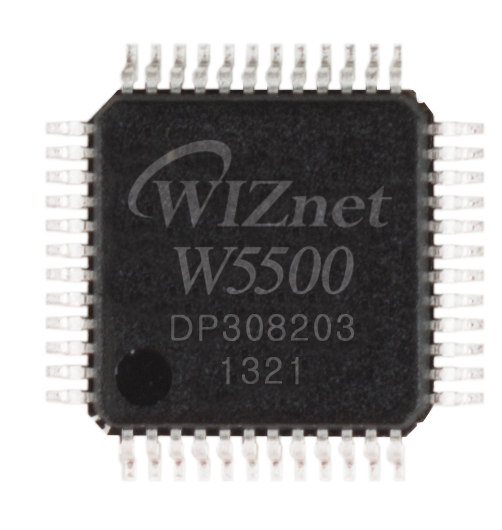
SPI Ethernet controller used for the PoE-powered ESPHome Home Assistant voice satellite.
Overview
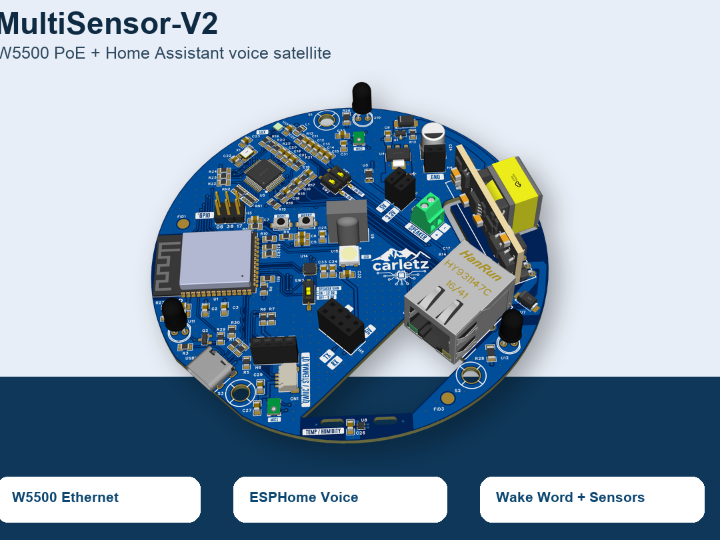
MultiSensor-V2 is an open-source ESP32-S3 ceiling node by GitHub maker pkhodak. It combines a WIZnet W5500 Ethernet controller, integrated PoE power, Home Assistant voice satellite firmware, room sensors, IR control, local audio output, and ESPHome configuration in one board.
The project is also interesting because it sits at the intersection of wired smart-home hardware and AI-assisted voice control. The device does not try to run a large language model on the ESP32-S3. Instead, it gives Home Assistant a reliable wired microphone, speaker, wake-word, and sensor endpoint, then lets the Home Assistant voice pipeline connect to local or cloud AI services.
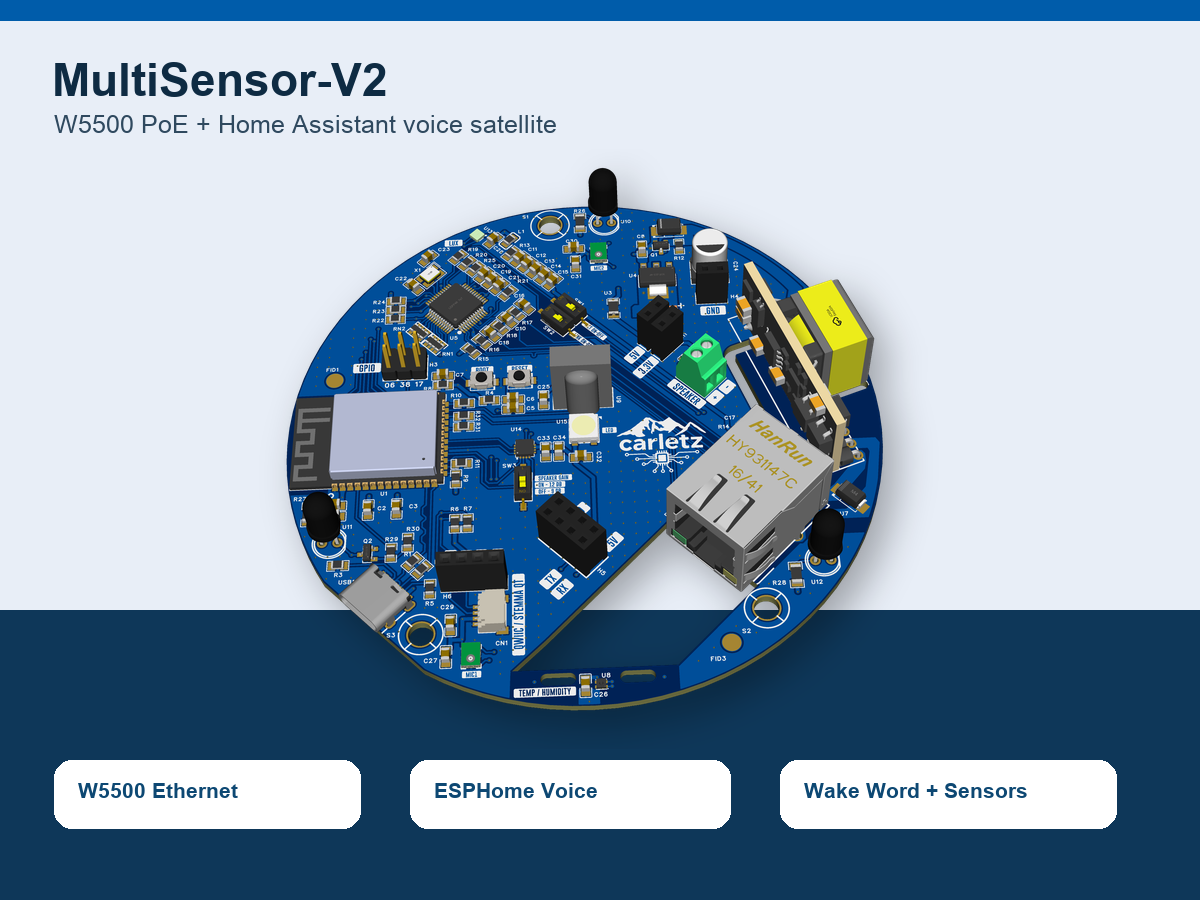
The repository describes the board as beta and actively changing, but it is not just a diagram. The README says the board is real and running in the maintainer's home. That makes it useful for makers who want to study a complete W5500 PoE smart-home node, while still treating the design as an early open-source hardware project rather than a finished product.
System Configuration
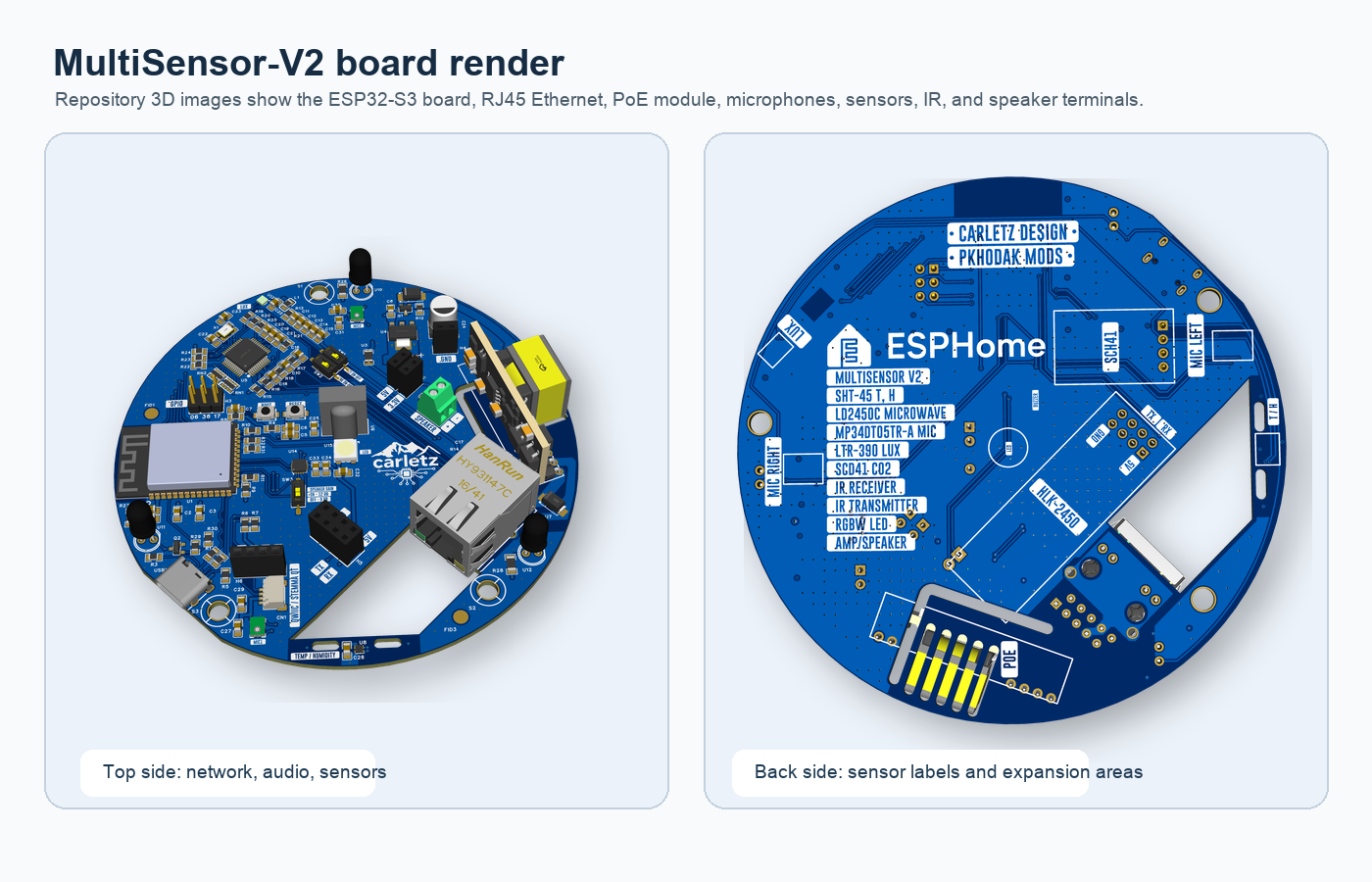
The core controller is an ESP32-S3-WROOM-1 running ESPHome. Around it, the board places an LD2450 mmWave presence sensor, SHT45 temperature and humidity sensor, LTR-390 light and UV sensor, SCD41 CO2 sensor, SK6812 RGBW status LED, IR blaster and receiver, stereo PDM microphone, MAX98357A I2S amplifier, and a small speaker output.
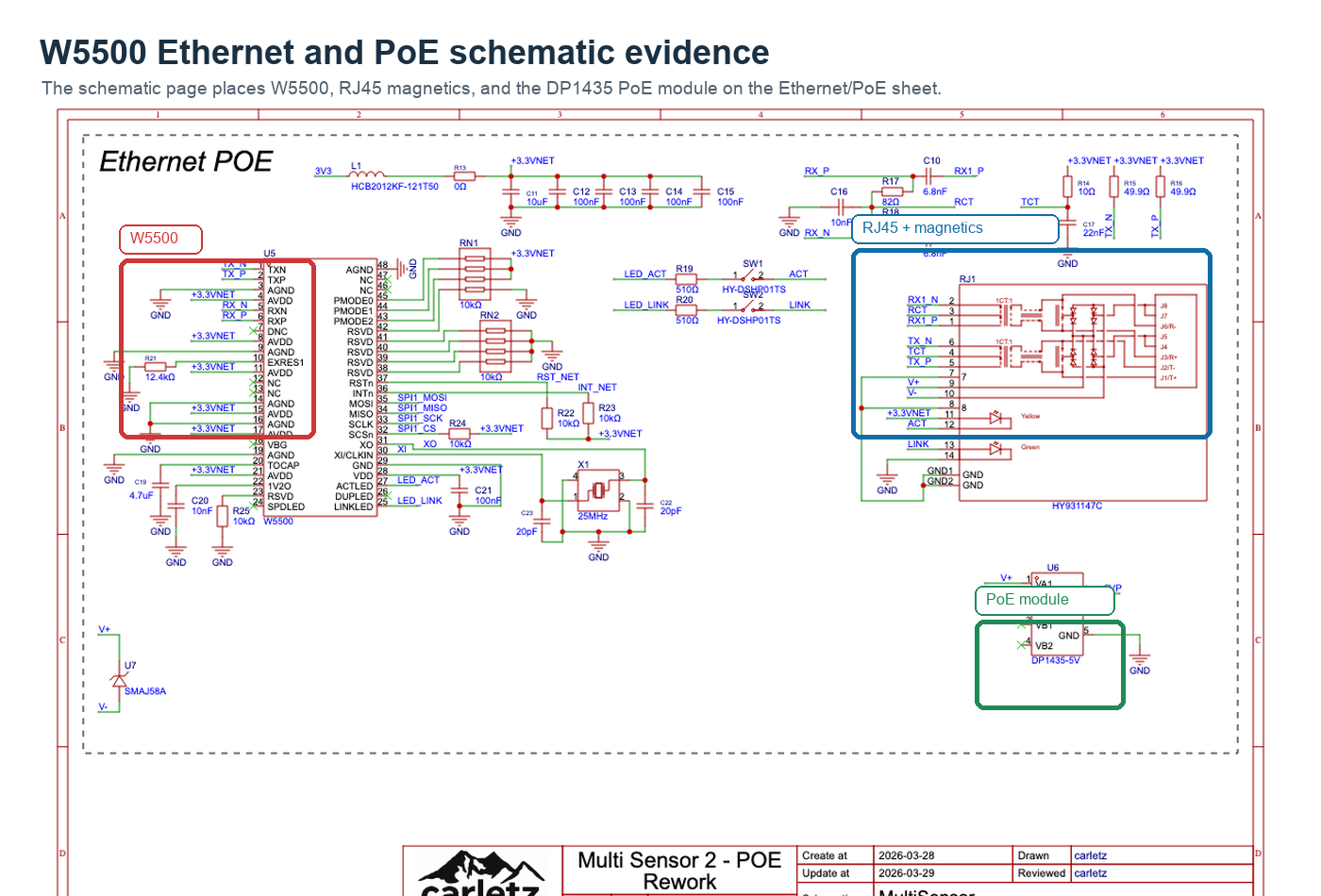
For networking and power, the board uses W5500 over SPI plus an integrated PoE section. The firmware's Ethernet section configures W5500 with GPIO43 for clock, GPIO44 for MOSI, GPIO42 for MISO, GPIO41 for chip select, GPIO2 for interrupt, and GPIO1 for reset. The same ceiling Ethernet cable can provide both data and power through the PoE front end.
The firmware is organized as reusable ESPHome YAML sections. The repository recommends example-room-ethernet.yaml for the PoE wired build and describes it as the extensively tested path. That template pulls network, sensor, voice assistant, wake-word, LED, IR, diagnostics, and Home Assistant integration sections from the repository.
System Architecture and Data Flow
At room level, MultiSensor-V2 collects presence, temperature, humidity, light, UV, CO2, microphone, and IR input. ESPHome turns those into Home Assistant entities and voice-assistant events. W5500 carries the ESPHome API traffic over wired Ethernet to the PoE switch and Home Assistant server.
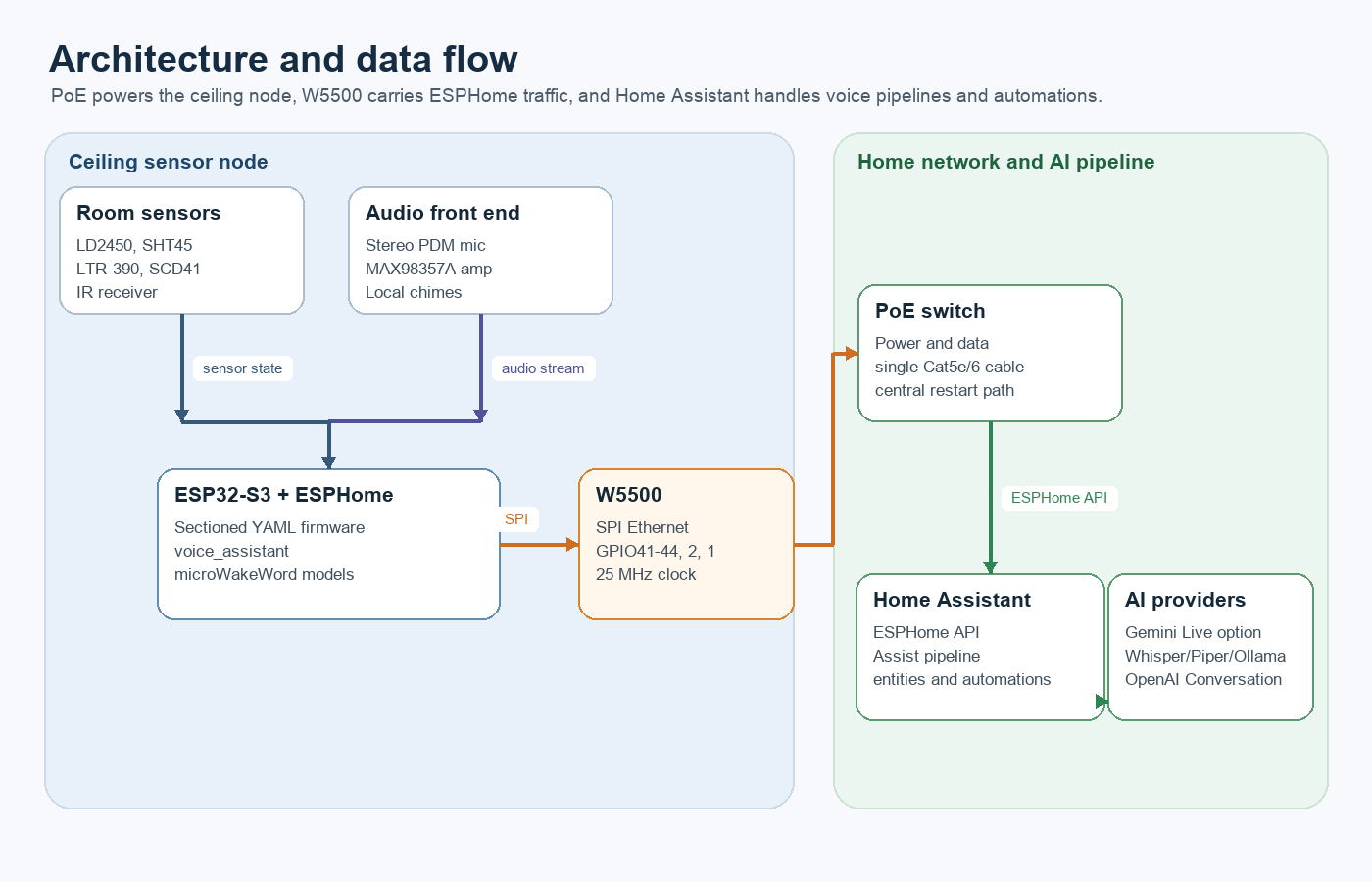
The audio path is deliberately split. The ESP32-S3 handles the microphone, local speaker, wake-word model, and ESPHome voice-assistant component. Home Assistant then runs the Assist pipeline and can route speech recognition, text-to-speech, conversation handling, or automation logic through local services or external AI providers.
Hardware Evidence
The repository includes manufacturing-oriented hardware files: Gerbers, BOM, pick-and-place output, schematics, EasyEDA files, 3D STEP files, and board renders. That is stronger evidence than a README-only concept because the W5500 and PoE hardware can be inspected directly in the released design files.
The Ethernet and PoE schematic page places the W5500, RJ45 magnetics, and DP1435-5V PoE module in the same network and power section. The BOM also lists W5500 as the Ethernet controller. Together with the ESPHome W5500 firmware section, this gives clear source-backed evidence for the WIZnet role.
Role of the WIZnet Chip
W5500 is the board's wired Ethernet controller. In this design, that matters because a ceiling sensor and voice satellite may be far from a WiFi access point, mounted in a place where battery maintenance is inconvenient, and expected to respond quickly to Home Assistant automations. A single Cat5e or Cat6 run can carry both power and network data.
The project does not expose a direct WIZnet socket API in its application code. It uses ESPHome's Ethernet abstraction with type: W5500. So the practical value for makers is not a bare-metal W5500 driver example. It is a complete ESPHome smart-home node showing how W5500 can make a dense ESP32-S3 sensor and voice device feel like fixed home infrastructure.
AI and Voice Assistant Path
The AI angle is strongest on the Home Assistant side. MultiSensor-V2 gives Home Assistant a wired voice satellite with local wake-word handling through micro_wake_word, a stereo PDM microphone, MAX98357A speaker output, local chimes, and ESPHome's voice_assistant component. From there, Home Assistant can use Assist, Whisper, Piper, Ollama, OpenAI Conversation, or other configured services.
The README also says the project was designed with heavy help from Gemini and Claude, and that AI assistance helped the maker complete a first PCB project. That makes MultiSensor-V2 a useful example for WIZnet makers who are exploring AI-assisted hardware development, not only AI-enabled runtime features.
One limitation is worth stating clearly: the README references a companion Gemini Live Bridge, but its linked GitHub repository was not reachable during this review. This post therefore focuses on the verified MultiSensor-V2 repository, its ESPHome voice firmware, and the Home Assistant AI pipeline options described in the source.
Where It Fits - Value and Limits
MultiSensor-V2 is a good reference for smart-home builders who want one wired ceiling device per room instead of separate presence sensors, environmental sensors, IR blasters, and voice satellites. W5500 plus PoE makes that idea more practical because the node can be installed like fixed low-voltage infrastructure rather than a WiFi gadget that also needs USB power.
The limits are also practical. This is a beta open-source hardware project. Reuse requires PCB fabrication, assembly choices, ESPHome adoption, Home Assistant configuration, and awareness that the WiFi template is less tested than the PoE Ethernet template. Makers should treat it as a rich design to study or adapt, not as a plug-and-play commercial sensor.
Related WIZnet Maker Projects
ESPHome MultiSensor Board is the closest lineage reference. It covers the original Carletz MultiSensor source that MultiSensor-V2 credits as its base. The V2 repository adds the Home Assistant voice satellite work, wake-word assets, revised firmware structure, audio hardware, IR features, and integrated PoE direction.
MultiSensor: ESP32-S3 + W5500 PoE Smart Home Multi-Sensor Board is related through the same smart-home multisensor family and W5500 PoE concept. MultiSensor-V2 is different because the requested source is a newer GitHub repository focused on V2 firmware, voice satellite behavior, and AI-assisted development notes.
Esparagus Echo: ESP32-S3-Based Voice Control Devices for Home Assistant is the closest voice-assistant comparison. Esparagus Echo focuses on ESP32-S3 Home Assistant voice control devices, while MultiSensor-V2 combines voice with W5500 PoE, mmWave presence, environmental sensing, IR control, and a ceiling-room form factor.
FAQ
Q. What does this project use W5500 for? It uses W5500 as the SPI Ethernet controller for the PoE-powered ESPHome node. The firmware configures W5500 pins and uses it as the wired network path to Home Assistant.
Q. Does MultiSensor-V2 need WiFi? The recommended and best-tested template is the PoE Ethernet configuration. The repository includes a WiFi-oriented path, but the source states that development and production deployment have happened on the wired PoE version.
Q. Does the ESP32-S3 run an LLM locally? No. The ESP32-S3 handles ESPHome, sensors, audio I/O, and wake-word behavior. Larger AI services run through Home Assistant or connected providers.
Q. Is the board production-ready? The README describes the board as beta and actively iterated. It is real hardware used by the maintainer, but makers should expect changes until a stable release.
Q. Can another maker reuse the design? Yes. The repository provides MIT-licensed firmware and hardware files, including schematics, manufacturing files, BOM, renders, and ESPHome configuration. Reuse still requires PCB fabrication and system integration work.
한국어 (Korean)
개요
MultiSensor-V2는 GitHub 제작자 pkhodak이 공개한 오픈소스 ESP32-S3 천장형 노드입니다. WIZnet W5500 Ethernet 컨트롤러, 통합 PoE 전원, Home Assistant 음성 위성 펌웨어, 실내 센서, IR 제어, 로컬 오디오 출력, ESPHome 설정을 하나의 보드에 묶었습니다.
이 프로젝트는 유선 스마트홈 하드웨어와 AI 기반 음성 제어가 만나는 지점에 있습니다. ESP32-S3에서 대형 언어 모델을 직접 실행하는 구조는 아닙니다. 대신 Home Assistant가 안정적인 유선 마이크, 스피커, 웨이크워드, 센서 엔드포인트를 갖도록 하고, Home Assistant의 음성 파이프라인이 로컬 또는 클라우드 AI 서비스와 연결되게 합니다.
저장소는 이 보드가 베타이며 계속 변경 중이라고 설명합니다. 다만 단순한 개념도는 아닙니다. README는 보드가 실제로 제작되었고 관리자의 집에서 동작 중이라고 설명합니다. 따라서 완제품이라기보다는 W5500 PoE 스마트홈 노드를 공부하고 응용하려는 제작자에게 유용한 오픈소스 하드웨어 사례로 보는 것이 적절합니다.
시스템 구성
중심 컨트롤러는 ESPHome을 실행하는 ESP32-S3-WROOM-1입니다. 주변에는 LD2450 mmWave 재실 센서, SHT45 온습도 센서, LTR-390 조도 및 UV 센서, SCD41 CO2 센서, SK6812 RGBW 상태 LED, IR 송수신부, 스테레오 PDM 마이크, MAX98357A I2S 앰프, 소형 스피커 출력이 배치됩니다.
네트워크와 전원 쪽은 SPI 방식 W5500과 통합 PoE 섹션을 사용합니다. 펌웨어의 Ethernet 섹션은 W5500에 대해 GPIO43 clock, GPIO44 MOSI, GPIO42 MISO, GPIO41 chip select, GPIO2 interrupt, GPIO1 reset을 설정합니다. 같은 천장 Ethernet 케이블 하나로 PoE 전원과 데이터 통신을 함께 처리할 수 있습니다.
펌웨어는 재사용 가능한 ESPHome YAML 섹션으로 구성되어 있습니다. 저장소는 PoE 유선 빌드에는 example-room-ethernet.yaml을 권장하며, 이 구성이 가장 많이 테스트된 경로라고 설명합니다. 이 템플릿은 네트워크, 센서, 음성 비서, 웨이크워드, LED, IR, 진단, Home Assistant 통합 섹션을 저장소에서 불러옵니다.
시스템 아키텍처와 데이터 흐름
실내에서는 MultiSensor-V2가 재실, 온도, 습도, 조도, UV, CO2, 마이크, IR 입력을 수집합니다. ESPHome은 이를 Home Assistant 엔티티와 음성 비서 이벤트로 변환합니다. W5500은 ESPHome API 트래픽을 유선 Ethernet으로 PoE 스위치와 Home Assistant 서버까지 전달합니다.
오디오 경로는 의도적으로 분리되어 있습니다. ESP32-S3는 마이크, 로컬 스피커, 웨이크워드 모델, ESPHome voice_assistant 컴포넌트를 처리합니다. 이후 Home Assistant가 Assist 파이프라인을 실행하고, 음성 인식, 음성 합성, 대화 처리, 자동화 로직을 로컬 서비스나 외부 AI 제공자에 연결할 수 있습니다.
하드웨어 근거
저장소에는 Gerber, BOM, pick-and-place 출력, 회로도, EasyEDA 파일, 3D STEP 파일, 보드 렌더 등 제조에 가까운 하드웨어 파일이 포함되어 있습니다. README만 있는 개념 프로젝트보다 근거가 강한 이유는 W5500과 PoE 하드웨어를 공개된 설계 파일에서 직접 확인할 수 있기 때문입니다.
Ethernet 및 PoE 회로도 페이지에는 W5500, RJ45 magnetics, DP1435-5V PoE 모듈이 같은 네트워크 및 전원 섹션에 배치되어 있습니다. BOM에도 W5500이 Ethernet controller로 기재되어 있습니다. 여기에 ESPHome W5500 펌웨어 섹션까지 함께 보면 WIZnet 역할에 대한 근거가 명확합니다.
WIZnet 칩의 역할
W5500은 이 보드의 유선 Ethernet 컨트롤러입니다. 천장형 센서와 음성 위성 장치는 WiFi AP에서 멀리 떨어질 수 있고, 배터리 관리가 불편한 위치에 설치되며, Home Assistant 자동화에 빠르게 반응해야 합니다. Cat5e 또는 Cat6 케이블 하나로 전원과 네트워크 데이터를 함께 전달할 수 있다는 점이 이 설계의 핵심입니다.
이 프로젝트는 애플리케이션 코드에서 WIZnet socket API를 직접 보여주지는 않습니다. ESPHome의 type: W5500 Ethernet 추상화를 사용합니다. 따라서 이 사례의 가치는 bare-metal W5500 드라이버 예제가 아니라, 조밀한 ESP32-S3 센서 및 음성 장치를 W5500으로 고정 인프라처럼 구성하는 ESPHome 스마트홈 노드 사례에 있습니다.
AI 및 음성 비서 경로
AI 관점의 핵심은 Home Assistant 쪽에 있습니다. MultiSensor-V2는 micro_wake_word, 스테레오 PDM 마이크, MAX98357A 스피커 출력, 로컬 차임, ESPHome voice_assistant 컴포넌트를 통해 Home Assistant에 유선 음성 위성을 제공합니다. 이후 Home Assistant는 Assist, Whisper, Piper, Ollama, OpenAI Conversation 또는 사용자가 설정한 다른 서비스를 사용할 수 있습니다.
README는 또한 이 프로젝트가 Gemini와 Claude의 도움을 많이 받아 설계되었고, AI 보조가 제작자의 첫 PCB 프로젝트 완성에 도움을 주었다고 설명합니다. 그래서 MultiSensor-V2는 AI 기능이 붙은 장치일 뿐 아니라, AI를 활용한 하드웨어 개발 사례를 찾는 WIZnet 제작자에게도 참고가 됩니다.
다만 한 가지 제한은 분명합니다. README에는 Gemini Live Bridge 동반 프로젝트가 언급되지만, 검토 시점에 연결된 GitHub 저장소는 접근되지 않았습니다. 따라서 이 글은 검증 가능한 MultiSensor-V2 저장소, ESPHome 음성 펌웨어, Home Assistant AI 파이프라인 선택지를 중심으로 다룹니다.
적합한 용도와 한계
MultiSensor-V2는 방마다 별도의 재실 센서, 환경 센서, IR 블라스터, 음성 위성을 따로 두는 대신 하나의 유선 천장형 장치로 통합하려는 스마트홈 제작자에게 좋은 참고 사례입니다. W5500과 PoE를 사용하면 USB 전원이 필요한 WiFi 장치가 아니라 고정 저전압 인프라처럼 설치할 수 있습니다.
한계도 실무적입니다. 이 프로젝트는 베타 오픈소스 하드웨어입니다. 재사용하려면 PCB 제작, 조립 선택, ESPHome 적용, Home Assistant 설정이 필요하며, WiFi 템플릿은 PoE Ethernet 템플릿보다 덜 테스트되었다는 점도 고려해야 합니다. 완제품 센서라기보다는 공부하고 응용할 수 있는 풍부한 설계 자료로 보는 것이 좋습니다.
관련 WIZnet Maker 프로젝트
ESPHome MultiSensor Board는 가장 가까운 계보의 참고 사례입니다. MultiSensor-V2가 기반으로 밝힌 원래 Carletz MultiSensor 소스를 다룹니다. V2 저장소는 여기에 Home Assistant 음성 위성, 웨이크워드 자료, 수정된 펌웨어 구조, 오디오 하드웨어, IR 기능, 통합 PoE 방향을 더합니다.
MultiSensor: ESP32-S3 + W5500 PoE Smart Home Multi-Sensor Board는 같은 스마트홈 멀티센서 계열과 W5500 PoE 개념에서 관련이 있습니다. MultiSensor-V2는 더 새로운 GitHub 저장소를 원본으로 하며, V2 펌웨어, 음성 위성 동작, AI 보조 개발 기록에 초점이 있다는 점이 다릅니다.
Esparagus Echo: ESP32-S3-Based Voice Control Devices for Home Assistant는 음성 비서 측면에서 가까운 비교 대상입니다. Esparagus Echo가 ESP32-S3 기반 Home Assistant 음성 제어 장치에 집중한다면, MultiSensor-V2는 음성 기능에 W5500 PoE, mmWave 재실 감지, 환경 센싱, IR 제어, 천장형 폼팩터를 함께 묶습니다.
FAQ
Q. 이 프로젝트에서 W5500은 무엇에 쓰이나요? W5500은 PoE 기반 ESPHome 노드의 SPI Ethernet 컨트롤러로 쓰입니다. 펌웨어는 W5500 핀을 설정하고, 이를 Home Assistant까지 이어지는 유선 네트워크 경로로 사용합니다.
Q. MultiSensor-V2는 WiFi가 필요한가요? 권장되고 가장 많이 테스트된 템플릿은 PoE Ethernet 구성입니다. 저장소에는 WiFi 방향도 있지만, 실제 개발과 운용은 유선 PoE 버전에서 이루어졌다고 설명합니다.
Q. ESP32-S3에서 LLM을 로컬로 실행하나요? 아닙니다. ESP32-S3는 ESPHome, 센서, 오디오 입출력, 웨이크워드 동작을 처리합니다. 더 큰 AI 서비스는 Home Assistant 또는 연결된 제공자 쪽에서 실행됩니다.
Q. 이 보드는 바로 양산 가능한 상태인가요? README는 이 보드가 베타이며 계속 변경 중이라고 설명합니다. 실제 하드웨어로 사용 중인 사례이지만, 안정 릴리스 전까지는 변경 가능성을 고려해야 합니다.
Q. 다른 제작자가 설계를 재사용할 수 있나요? 가능합니다. 저장소는 MIT 라이선스의 펌웨어와 하드웨어 파일을 제공하며, 회로도, 제조 파일, BOM, 렌더, ESPHome 설정을 포함합니다. 다만 PCB 제작과 시스템 통합 작업은 별도로 필요합니다.
-
MultiSensor-V2 GitHub Repository
Original source repository with README, hardware files, firmware, and MIT license.

-
W5500 Ethernet ESPHome Section
ESPHome W5500 configuration with SPI pins, interrupt pin, reset pin, and clock speed.
-
Voice Assistant Firmware Section
Voice assistant, microWakeWord, microphone, speaker, and wake-word model configuration.
-
MultiSensor-V2 Hardware Schematics
Schematic PDF including the Ethernet and PoE sheet.


