Room Environment Monitoring
Room Environment Monitoring
0
Project description
Overview
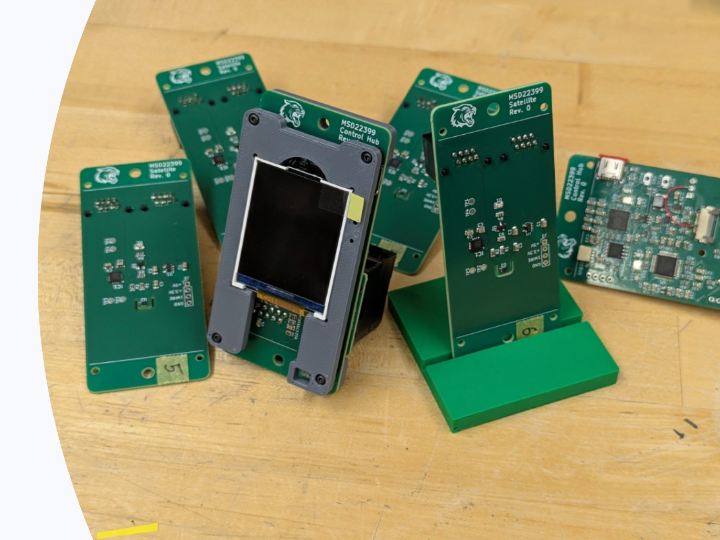
This project introduces a room environment monitoring system developed to monitor the temperature and humidity of computer labs.
The system was designed for the Electrical Engineering and Microelectronic Engineering department at the Rochester Institute of Technology. The department operates computer labs with high-performance workstations used for VLSI design and simulation. However, HVAC failures caused the rooms to overheat, creating discomfort for students and reducing workstation performance.
To solve this problem, the project team developed a custom monitoring system that measures temperature and humidity from multiple locations in each room, displays the current room conditions locally, and exposes the data through SNMP and HTTP for integration with the IT department’s Zabbix monitoring server.
The control hub is built with an RP2040 microcontroller and a WIZnet W5500 Ethernet controller. It is powered over PoE and provides reliable wired Ethernet connectivity for facility monitoring applications.
Background
Computer labs with high-performance workstations generate a significant amount of heat.
In environments such as engineering labs, research rooms, server rooms, and equipment rooms, temperature and humidity must be monitored continuously. If HVAC equipment fails, the room temperature can rise quickly. This can affect user comfort, reduce system performance, and potentially increase the risk of equipment instability.
At RIT, the department needed a system that could monitor environmental conditions in computer labs and integrate with the existing IT infrastructure monitoring system.
This created a clear need for an embedded monitoring system with:
Multiple sensing points per room
Local temperature and humidity display
Ethernet-based data access
SNMP support for IT monitoring
HTTP access for simple data retrieval
PoE support for clean installation
Compact hardware suitable for room installation
Solution
The team developed a custom room environment monitoring system composed of two types of modules:
Control hub
Satellite sensing probes
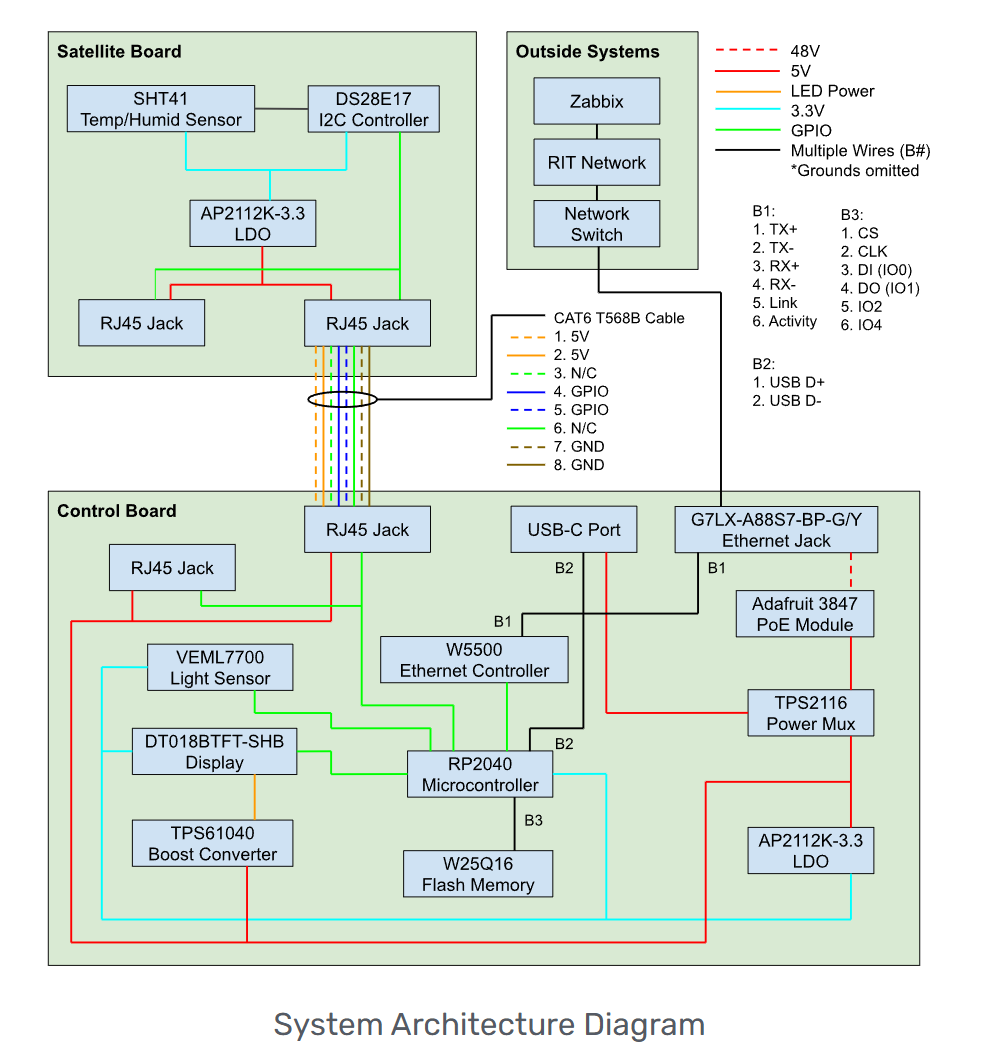
The control hub works as the central data aggregation point in each room. It collects sensor data from satellite probes, displays the current conditions on a color TFT display, and exposes the collected data through SNMP and HTTP.
The satellite sensing probes are placed at different locations in the room to measure temperature and humidity. These probes connect to the control hub over a 1-Wire protocol using CAT6 cable, which also carries power. The satellite nodes can be daisy chained, allowing many independent sensing probes to be installed in a single room.
The basic system structure is as follows:
Satellite Sensing Probe
Temperature / Humidity
        |
        | 1-Wire over CAT6
        |
Satellite Sensing Probe
Temperature / Humidity
        |
        | Daisy Chain
        |
Control Hub
RP2040 + W5500 + PoE + TFT Display
        |
        | Ethernet
        |
Zabbix Monitoring Server / IT Monitoring System
This architecture makes the system flexible because sensing probes can be placed where monitoring is needed, while the control hub provides centralized Ethernet communication and local display.
Why W5500?
The control hub uses the WIZnet W5500 Ethernet controller for wired Ethernet connectivity.
W5500 is well suited for this type of room monitoring system because it provides stable Ethernet communication through a simple embedded interface.
1. Reliable Wired Ethernet
Environmental monitoring systems need to operate continuously.
In computer labs, server rooms, and equipment rooms, reliable communication is more important than wireless convenience. Ethernet provides stable connectivity and is easier to integrate with existing IT infrastructure.
W5500 enables the control hub to communicate with the monitoring server over wired Ethernet.
2. SNMP and HTTP Monitoring
The project exposes room environment data through SNMP and HTTP.
SNMP is widely used by IT departments for network and infrastructure monitoring. By supporting SNMP, the system can integrate with tools such as Zabbix.
HTTP access also makes it easier to retrieve or display environmental data through web-based tools or simple network requests.
3. Suitable for Embedded Systems
The control hub is built around an RP2040 microcontroller.
W5500 provides Ethernet connectivity while allowing the RP2040 to focus on sensor data aggregation, display control, SNMP/HTTP handling, and system logic.
4. PoE-Friendly Installation
The control hub is powered over PoE.
This is useful for room monitoring installations because both power and network connectivity can be delivered through a single Ethernet cable. It reduces wiring complexity and makes installation cleaner.
Main Features
RP2040 Control Hub
The control hub uses an RP2040 microcontroller as the main controller.
It collects sensor data from satellite probes, manages the display, and handles communication with the Ethernet controller.
WIZnet W5500 Ethernet
The system uses W5500 for Ethernet communication.
This allows the monitoring data to be exposed to the IT network through SNMP and HTTP.
PoE Power
The control hub is powered over Power over Ethernet.
PoE simplifies installation because the control hub does not require a separate power adapter.
Temperature and Humidity Monitoring
The system measures room temperature and humidity from multiple locations.
This provides a more accurate view of environmental conditions across the room compared with a single sensor point.
Satellite Sensing Probes
Satellite probes can be placed at different monitoring locations.
They connect to the control hub using a 1-Wire protocol over CAT6 cable. The cable also carries power to the probes.
Daisy Chain Expansion
The satellite nodes can be daisy chained, allowing multiple independent sensing probes to be installed in a single room.
This makes the system extensible for larger rooms or areas that require more measurement points.
Color TFT Display
The control hub includes a color TFT display that shows the current status, temperature, and humidity in each lab.
This allows users in the room to check the current conditions directly.
Light Sensor
The control hub also includes a light sensor.
The light sensor can be used to monitor room occupancy and dim the display backlight.
Rust-Based Firmware
The software running on the control hub is written in Rust using the Embassy embedded async framework.
The project uses a lightweight architecture without a traditional operating system, allowing firmware upgrades through a single binary upload.
System Architecture
The system is divided into three main layers.
1. Sensing Layer
The sensing layer consists of satellite sensing probes installed at multiple locations in the room.
Each probe measures temperature and humidity.
2. Control Hub Layer
The control hub collects data from the satellite probes.
It includes:
RP2040 microcontroller
W5500 Ethernet controller
PoE power
Color TFT display
Light sensor
CAT6 connections for satellite probes
3. Monitoring Layer
The monitoring layer consists of the IT monitoring infrastructure.
The control hub exposes data through SNMP and HTTP, allowing the IT department to aggregate the data with the Zabbix monitoring server.
The complete flow can be described as follows:
Room Environment
---------------------------------
Temperature
Humidity
Light level

Satellite Probe Layer
---------------------------------
Temperature / Humidity sensing
1-Wire communication over CAT6
Daisy-chain expansion

Control Hub Layer
---------------------------------
RP2040
WIZnet W5500 Ethernet
PoE power
TFT display
SNMP / HTTP data access

Monitoring Layer
---------------------------------
Ethernet network
Zabbix monitoring server
IT infrastructure monitoring
Applications
This room environment monitoring architecture can be used in many applications, including:
Computer lab monitoring
Server room monitoring
Equipment room monitoring
Classroom environment monitoring
Research lab monitoring
Office HVAC monitoring
Facility management systems
IT infrastructure monitoring
Building environment monitoring
PoE-powered sensor networks
The same concept can also be extended to other environmental monitoring systems that require multiple sensing points and reliable Ethernet-based data access.
Conclusion
This project shows a practical room environment monitoring system built with RP2040 and WIZnet W5500.
The system was developed to monitor temperature and humidity in computer labs where HVAC failures had caused overheating issues. By using satellite sensing probes, the system can collect environmental data from multiple locations in each room.
The control hub aggregates the sensor data, displays current conditions on a color TFT display, and exposes the data through SNMP and HTTP for integration with Zabbix.
W5500 plays an important role by providing reliable wired Ethernet connectivity, while PoE makes installation simple and clean.
This case is a good example of how W5500 can be applied to environmental monitoring, facility monitoring, and IT infrastructure monitoring systems.
Q1: What is this project?
A1:
This project is a room environment monitoring system designed to monitor temperature and humidity in computer labs.
Q2: Which WIZnet product is used?
A2:
The control hub uses the WIZnet W5500 Ethernet controller.
Q3: What MCU is used in the control hub?
A3:
The control hub uses an RP2040 microcontroller.
Q4: How is the system powered?
A4:
The control hub is powered over PoE, allowing power and Ethernet connectivity to be provided through a single cable.
Q5: How does the system collect sensor data?
A5:
Satellite sensing probes measure temperature and humidity. They connect to the control hub through a 1-Wire protocol over CAT6 cable.
Q6: How is monitoring performed?
A6:
The system exposes data through SNMP and HTTP, allowing integration with the IT department’s Zabbix monitoring server.
Q7: Why is W5500 useful in this project?
A7:
W5500 provides reliable wired Ethernet connectivity for the RP2040-based control hub, making it suitable for continuous room and facility monitoring.
Q8: What applications can use this architecture?
A8:
This architecture can be used for computer lab monitoring, server room monitoring, equipment room monitoring, facility management, HVAC monitoring, and IT infrastructure monitoring.
