


KinCony N Series ESP32-S3 AC Energy Meter Platform
From 10 to 60 Channels, the Network Layer Never Changes — A Structural Analysis of the KinCony N-Series ESP32-S3 Energy Meters
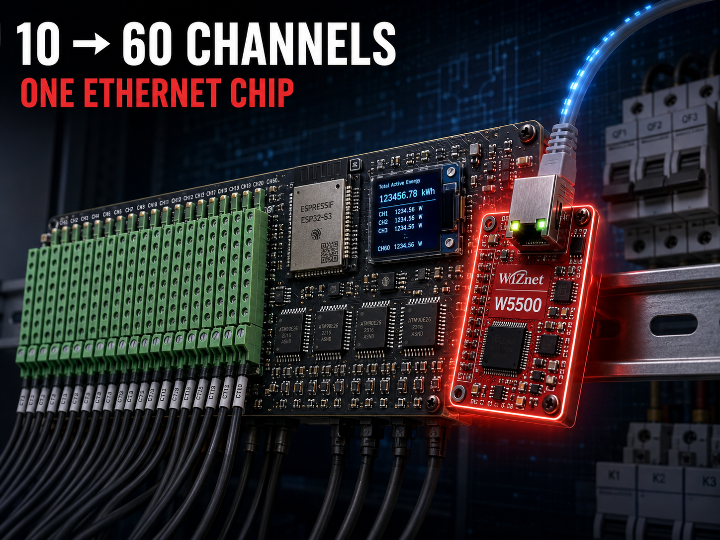
WIZnet - W5500
x 1

요약
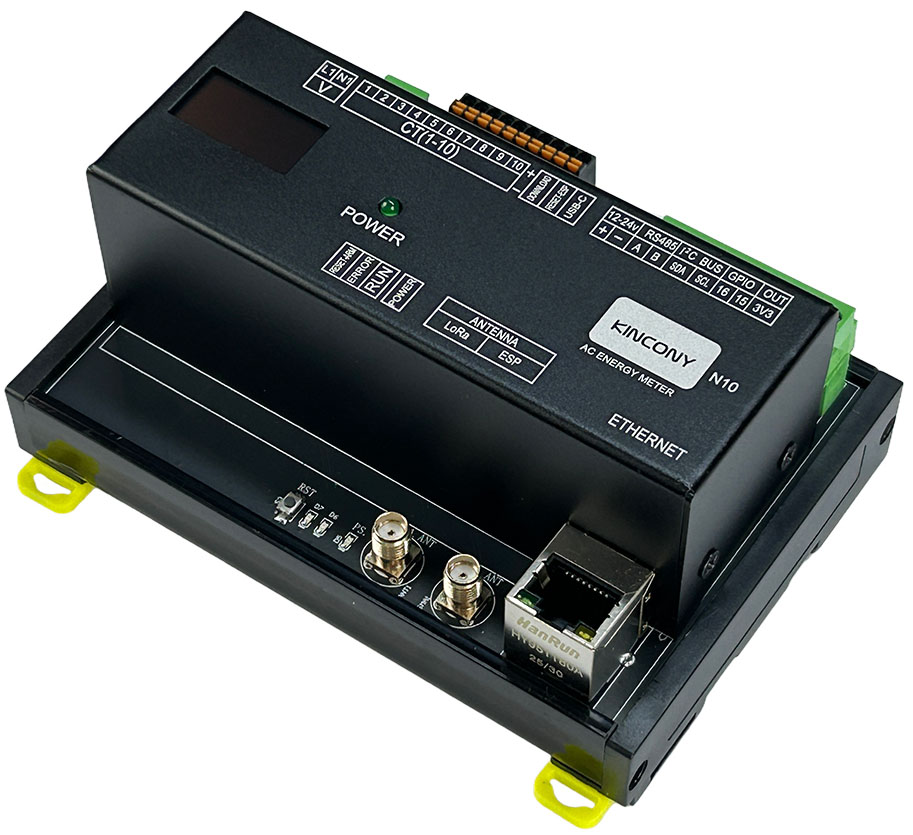
KinCony N 시리즈(N10·N20·N30·N60)는 CT 클램프로 최대 60개 회로의 AC 전력을 개별 계측하는 DIN 레일형 에너지 미터입니다. 계측 채널은 6배까지 확장되지만 MCU와 네트워크 계층은 ESP32-S3 + WIZnet W5500 조합 그대로 고정된다는 점이 이 제품군의 설계 핵심입니다. 분전반이라는 무선 최악의 환경에서 수십 개 채널의 계측값을 끊김 없이 내보내는 역할을 W5500이 전담합니다.
개요
이 보드를 처음 만난 곳은 제조사 홈페이지가 아니라 ESPHome 공식 디바이스 데이터베이스였습니다. Open Home Foundation이 운영하고 GitHub로 관리되는 이 카탈로그에는 제품 홍보 문구 대신 바로 복사해 쓸 수 있는 YAML 한 벌이 올라와 있습니다.
그 YAML의 상단은 이렇게 시작합니다.
ethernet:
  type: W5500
  clk_pin: GPIO42
  mosi_pin: GPIO43
  miso_pin: GPIO44
  cs_pin: GPIO41
  interrupt_pin: GPIO2
  reset_pin: GPIO1
데이터시트를 열기도 전에 네트워크 계층이 W5500이라는 사실과 계측값이 Modbus 레지스터로 노출된다는 구조가 먼저 드러납니다. 그리고 같은 형식의 문서가 N10뿐 아니라 N20·N30에도 존재한다는 사실을 확인하면서, 이 글의 관심은 개별 보드에서 제품군 전체의 확장 설계로 옮겨갔습니다.
→ ESPHome 등재 페이지: https://devices.esphome.io/devices/kincony-n10/
도입 배경 — 회로 단위 계측은 왜 필요한가
규제가 요구하는 서브미터링 구조
미국 캘리포니아 Title 24 Part 6 §130.5(California Energy Commission)는 비주거·호텔 건물의 전력 배전 설계를 규정합니다. 특히 §130.5(b) "계측을 위한 회로 분리" 조항은 조명·HVAC 모터·엘리베이터·재생에너지·EV 충전 등 부하 유형별로 계측이 가능하도록 배전반을 설계하도록 요구하며, 서비스 용량이 커질수록 요구 수준이 강화됩니다.
즉 "한 대에 수십 회로"라는 N 시리즈의 형태는 취미 수요의 결과가 아니라, 부하 유형별 계측이라는 규제 요구의 물리적 구현에 가깝습니다.
→ 규정 원문 정리: https://energycodeace.com/content/section-1305-electrical-power-distribution-systems-nonreside
한편 이 제품군이 실제로 상업 건물에 도입된 사례를 다룬 기사나 케이스 스터디는 확인되지 않았습니다. 확인 가능한 것은 ESPHome 카탈로그 등재, 제3자 리테일러 유통, 그리고 제조사 포럼의 실사용자 로그 수준입니다. 규제 수요는 확인됨, 도입 실적은 확인 불가 — 두 결론을 그대로 병기합니다.
커뮤니티가 먼저 움직였는가
오픈소스 하드웨어 진영의 산업 시장 진입은 이미 흐름이 되었습니다. Raspberry Pi는 2023년 기준 SBC·컴퓨트 모듈 매출의 72%가 산업·임베디드였고, 2024년 11월 임베디드 전용 CM5를 출시했습니다. Arduino는 2025년 10월 Qualcomm에 인수되며 산업 IoT 상용화 경로에 편입됐습니다. KinCony 자신도 2026년 6월 Raspberry Pi CM5 기반 IoT 게이트웨이(Pi5R/Pi5M 시리즈) 를 연달아 내놓았습니다.
N 시리즈가 2025년 8~10월에 공개된 점을 감안하면, 커뮤니티용 계측 보드가 기업들의 산업 진출과 같은 시기에 나란히 움직였다고 볼 수 있습니다.
→ Raspberry Pi CM5: https://techcrunch.com/2024/11/27/raspberry-pi-launches-compute-module-5-for-embedded-applications
→ Qualcomm–Arduino: https://www.controldesign.com/industry-news/news/55321941/qualcomm-technologies-acquires-arduino-gains-open-source-hardware-and-software
아키텍처 — 하나의 플랫폼, 네 가지 규모
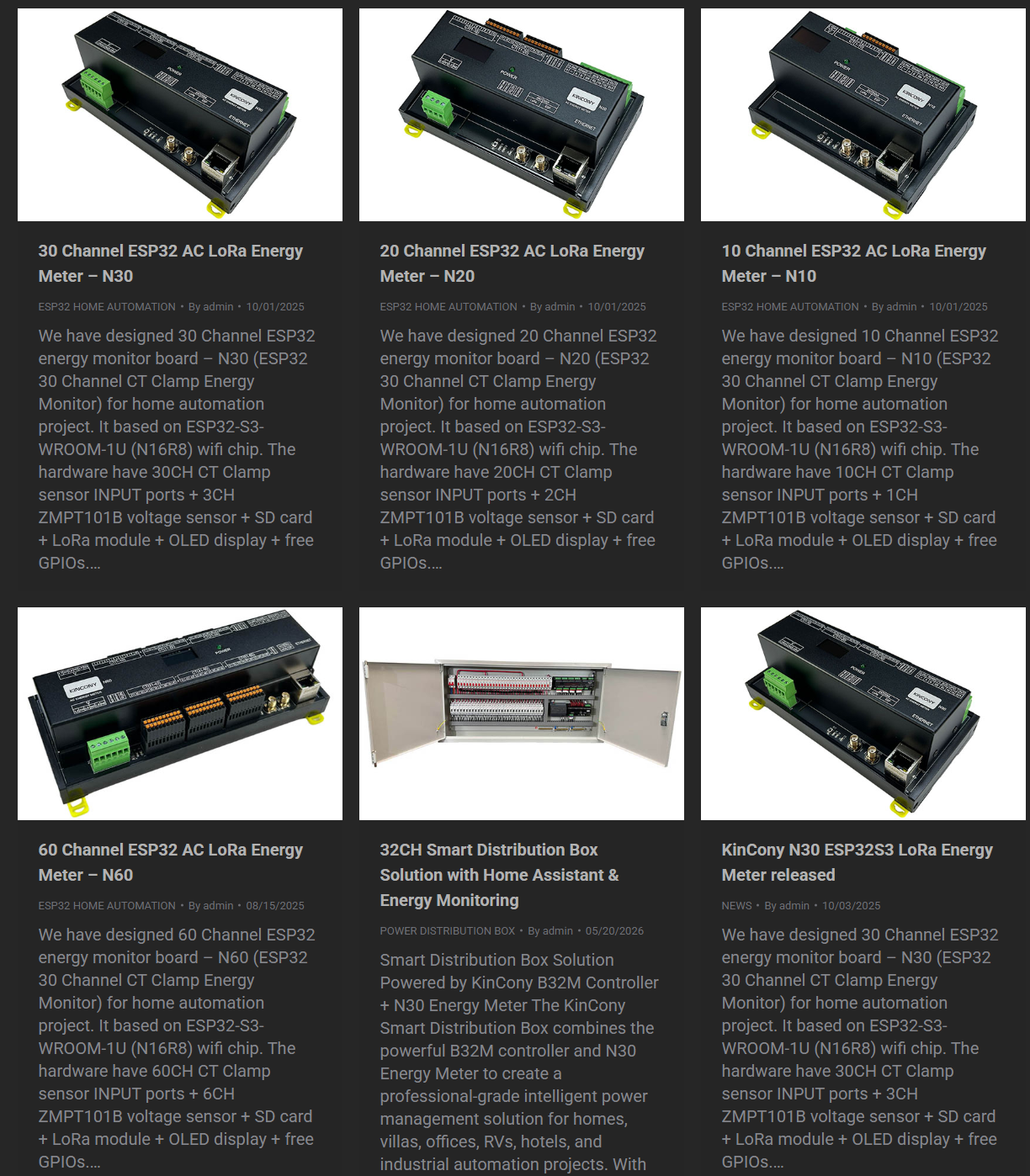
시리즈 라인업
| 항목 | N10 | N20 | N30 | N60 |
|---|---|---|---|---|
| CT 채널 | 10 | 20 | 30 | 60 |
| 전압 채널(ZMPT101B) | 1 | 2 | 3 | 6 |
| BL0910 계량 IC | 1 [추정] | 2 [추정] | 3 [추정] | 6 (확인됨) |
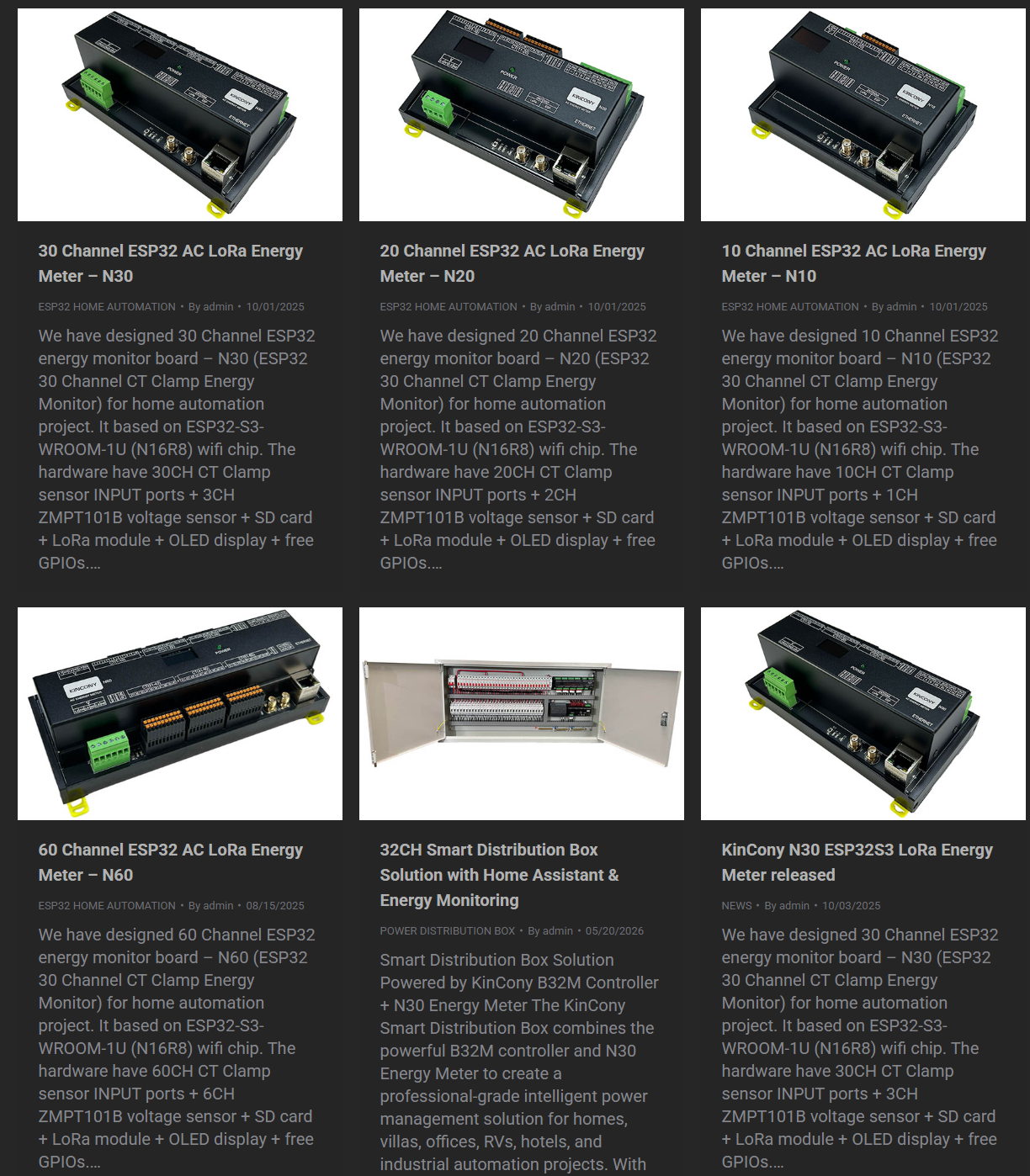
| 크기(mm) | 122×83×60 | 140×83×60 | 165×83×60 | 202×83×56 |
| MCU / 이더넷 | ESP32-S3 / W5500 | 동일 | 동일 | 동일 |
| ESPHome 센서 수 | 34 | 68 [추정] | 102 [추정] | 204 (확인됨) |
각 모델의 상세 사양과 핀 정의, ESPHome 설정 파일은 제조사 제품 페이지에서 확인할 수 있습니다.
N10: https://www.kincony.com/10-channel-esp32-ac-lora-energy-meter-n10.html
N20: https://www.kincony.com/20-channel-esp32-ac-lora-energy-meter-n20.html
N30: https://www.kincony.com/30-channel-esp32-ac-lora-energy-meter-n30.html
N60: https://www.kincony.com/60-channel-esp32-ac-lora-energy-meter.html
확장 규칙은 단순합니다. BL0910 한 개 = CT 10채널 + 전압 1채널이 한 세트이고, 채널을 늘리려면 세트를 추가한 뒤 Modbus 레지스터 베이스를 100씩 밀어(100·200·300·400·500·600) 붙이면 됩니다. MCU·이더넷·SPI 핀맵은 전 모델이 동일합니다.
시스템 구성과 데이터 흐름
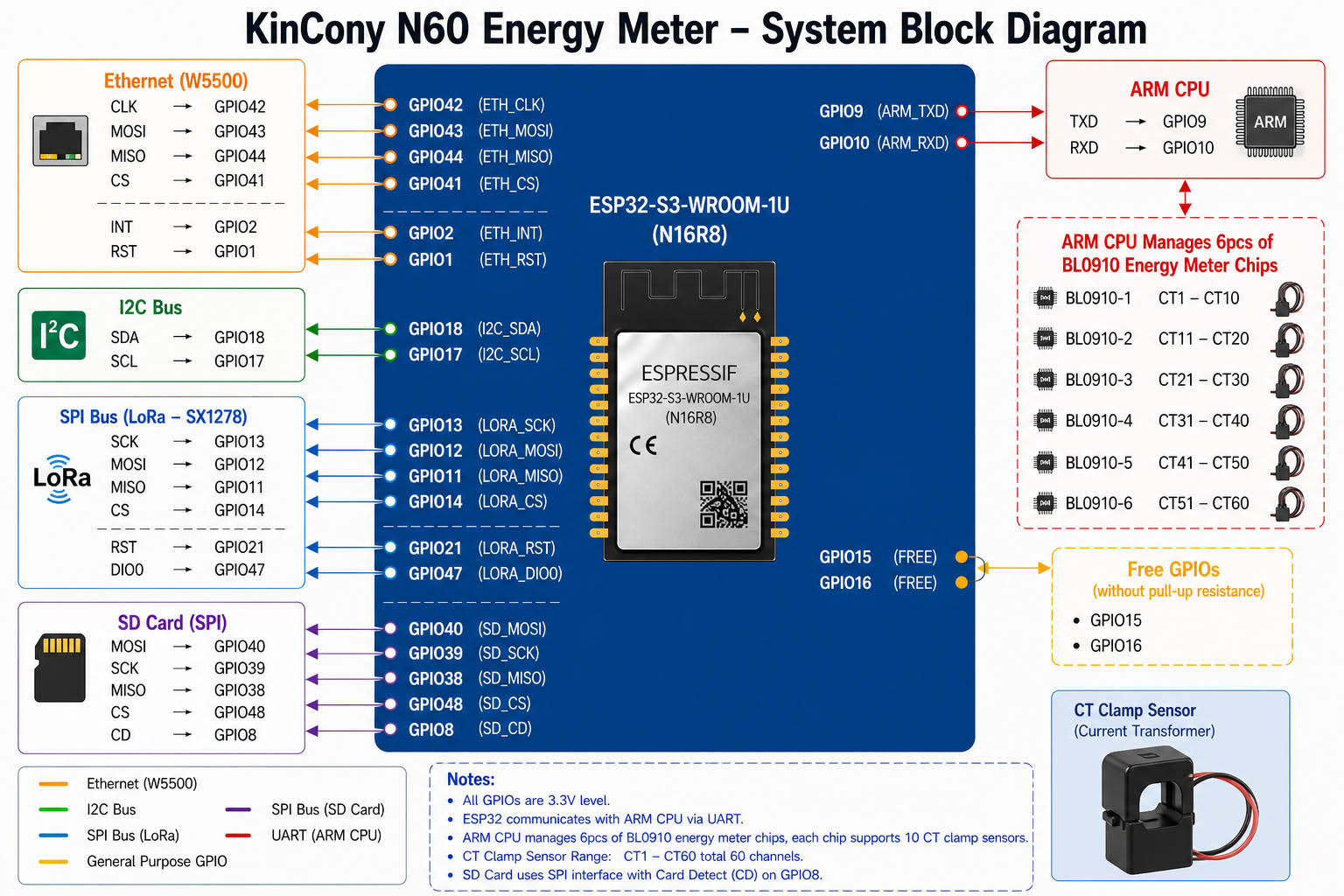
기술 배경
CT 클램프와 전용 계량 IC
CT(Current Transformer) 클램프는 전선을 자르지 않고 감싸기만 해 전류를 측정하는 비침습 센서입니다. N 시리즈가 쓰는 2000:1 변류비는 1차측 200 A가 흐를 때 2차측에 100 mA를 유도한다는 뜻이며, 최대 250 A까지 대응합니다.
여기서 중요한 선택은 MCU의 ADC로 파형을 직접 샘플링하지 않는다는 점입니다. 유효전력을 구하려면 전압·전류 파형을 수 kHz로 동시 샘플링하고 위상차를 곱적분해야 하는데, 이를 60채널로 확장하면 MCU 혼자로는 불가능합니다. N 시리즈는 Shanghai Belling의 BL0910(10채널 폴리페이즈 계량 IC, 내부 ΣΔ ADC + DSP)에 이 계산을 통째로 맡기고, MCU는 완성된 숫자만 받습니다.
→ BL0910 사양: https://jlcpcb.com/partdetail/BL_Shanghai_Belling-BL0910/C2841006
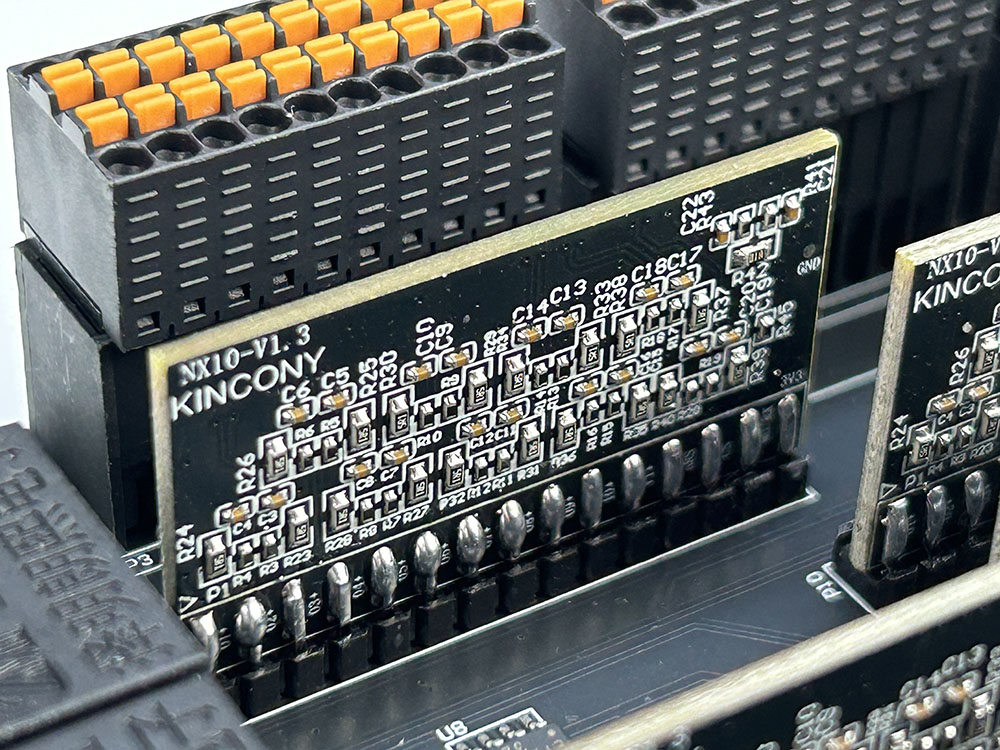
Modbus RTU 레지스터 맵과 폴링
Modbus RTU는 산업 현장의 사실상 표준 직렬 프로토콜로, 슬레이브의 메모리를 레지스터 주소로 노출하고 마스터가 주기적으로 읽어가는 단순한 모델입니다.
N 시리즈에서 계량 결과는 홀딩 레지스터에 정렬되어 있습니다. 채널별 전류는 100번부터 2개씩(32비트), 전력은 120번부터, 전력량은 140번부터, 그리고 162~164번에 전압·주파수·온도가 놓입니다. ESPHome은 이를 5초 주기로 폴링해 Home Assistant 엔티티로 바꿉니다. 폴링 모델이기 때문에 채널이 늘수록 한 주기에 읽어야 할 레지스터도 비례해 늘어난다는 점이 뒤에서 다룰 병목의 출발점입니다.
같은 제조사 보드의 Modbus 데이터를 MQTT로 중계하는 커뮤니티 구현도 WIZnet Makers에 공개돼 있습니다. → https://maker.wiznet.io/Lihan__/projects/esp32-modbus-mqtt-bridge/
LoRa 서브기가 링크
LoRa는 처프 확산 스펙트럼(CSS) 변조로 낮은 데이터율을 대가로 극단적인 통신 거리와 관통력을 얻는 서브기가 대역 기술입니다. N 시리즈는 SX1278 모듈을 별도 SPI 버스에 두어, LAN이 닿지 않는 별동·창고·인버터실의 보드를 게이트웨이 보드로 묶습니다.
다만 제조사 문서는 LoRa를 켜면 SD 카드 로깅이 중단된다고 명시합니다. 두 기능은 동시에 쓸 수 없으며, 이는 원거리 전송과 로컬 기록 사이의 선택을 강제합니다.
기술 특징 — 확장의 부담을 아날로그 계층에만 남긴 설계
- 디지털 계층 고정: 10채널이든 60채널이든 MCU·이더넷·저장·표시 구성이 동일 → 펌웨어·통합 로직·검증 자산을 그대로 재사용
- SPI 버스 3중 분리: W5500·LoRa·SD가 각각 독립 버스를 점유해 대량 폴링 중에도 네트워크 전송이 버스 경합에 걸리지 않음
- 연산 3단 분업: 계량 IC가 계산 → ARM CPU가 레지스터로 정리 → ESP32-S3는 통신과 애플리케이션만 담당
- 데이터 소유권: 정전 대비 외장 플래시에 누적 전력량 보존, SD 카드에 1시간 주기 Excel 로그, 자체 MQTT 브로커 연결 지원
- 펌웨어 선택권: 제조사 KCS v3(HA 자동 검색·로컬 IFTTT)와 ESPHome, Arduino/ESP-IDF 직접 개발 중 선택

W5500이 놓인 자리 — 채널이 6배가 되어도 바뀌지 않는 계층
N 시리즈 전 모델에서 유선 네트워크는 WIZnet W5500이 담당하며, 핀맵까지 동일합니다(CLK GPIO42 / MOSI 43 / MISO 44 / CS 41 / INT 2 / RST 1). Home Assistant가 N60의 데이터를 읽어갈 때 실제로 벌어지는 일은 다음과 같습니다.
- 요청 도착 — HA가 보드의 IP(DHCP 할당)와 포트로 TCP 연결을 요청합니다.
- W5500이 연결을 종결 — ARP 응답, TCP 3-way 핸드셰이크, 체크섬 검증, 재전송, 윈도 관리가 칩 내부의 하드와이어드 스택에서 처리됩니다. 8개 소켓과 32 KB 버퍼가 이를 병렬로 감당합니다.
- MCU는 결과만 수신 — ESP32-S3는 SPI로 완성된 페이로드만 읽습니다.
- MCU는 값 준비에 집중 — Modbus로 받은
bl0910_1_current_1 = 0.126 A같은 값 204개를 엔티티로 갱신해 SPI로 W5500 송신 버퍼에 밀어 넣습니다. - 송출은 다시 칩의 몫 — 패킷 분할, 순서 보장, 재전송을 W5500이 처리합니다.
비유하자면 분전반 옆에 상주하는 발송 창구입니다. MCU는 "무엇을 보낼지"만 정하고, 주소 확인·포장·재발송 같은 반복 업무는 창구가 알아서 끝냅니다. MCU가 하지 않는 일은 TCP 상태 관리와 재전송이고, 하는 일은 계측값 해석과 애플리케이션 로직뿐입니다.
만약 이 칩이 없었다면, 문제는 부하가 아니라 가능 여부입니다. ESP32-S3에는 이더넷 MAC이 없어 유선 LAN 자체가 성립하지 않습니다. 남는 선택지는 Wi-Fi인데, 금속 분전함 내부는 전파 감쇠와 노이즈가 가장 심한 환경입니다. W5500은 성능 최적화가 아니라 유선 연결을 가능하게 만드는 전제 조건입니다.
여기서 한 가지 더 짚을 점이 있습니다. N60은 N10보다 계측 데이터가 6배지만, 네트워크 부담은 W5500 한 개로 충분합니다. 5초마다 갱신되는 204개 값은 수 KB 수준이고, 병목은 115200 bps UART Modbus 구간에 생깁니다. 확장의 압력이 네트워크가 아닌 내부 직렬 링크로 향한다는 점이 이 설계의 특징입니다.
WIZnet Makers의 유사 사례
CircuitSetup Expandable 6 Channel ESP32 Energy Meter — CT 클램프 + ATM90E32AS 계량 IC 2개(IC당 3채널) + W5500 + MQTT로 전압·전류·와트·역률·온도를 2초 주기 계측. "계량 IC를 늘려 채널을 확장한다"는 논리가 N 시리즈와 동일하며, 차이는 채널 밀도(6 대 최대 60)와 계측값 전달 경로(MCU 직접 SPI 대 ARM 코프로세서 Modbus)입니다.
→ 프로젝트 링크: https://maker.wiznet.io/jaden/projects/power-monitoring-circuitsetup-expandable-6-channel-esp32-energy-meter-main-board/
W5300 Based Highly Secure & Reliable Smart Home Hub — PZEM-004T 모듈이 CT로 전압·전류·전력·역률·주파수를 자체 계산하고 MCU는 UART로 결과만 받으며, 네트워크는 WIZnet TOE가 담당. 계측부와 통신부를 분리한 3단 분업이 N 시리즈의 ARM CPU 구조와 정확히 겹칩니다.
→ 프로젝트 링크: https://maker.wiznet.io/Taifur/contest/w5300-based-highly-secure-reliable-smart-home-hub/
MBusino — M-Bus to MQTT Gateway — 전기·수도·가스·열량 계량기 최대 5대의 telegram을 파싱해 MQTT로 발행하며 W5500으로 유선 안정성을 확보. 기존 미터를 읽는 방식과 직접 계측하는 방식의 대비를 보여주지만, 최종 산출물이 MQTT 토픽 위의 계량값이라는 점은 같습니다. → 프로젝트 링크: https://maker.wiznet.io/Hannah/projects/mbusino--m-bus-to-mqtt-gateway/
세 사례 모두 "전용 계량 IC가 계산 → 애플리케이션 MCU는 결과만 수신 → WIZnet 칩이 유선으로 송출" 이라는 동일한 골격을 공유합니다. N 시리즈는 이 검증된 패턴을 보드 한 장에 통합한 형태입니다.
| 항목 | KinCony N 시리즈 | CircuitSetup 6CH | W5300 Smart Home Hub | MBusino |
|---|---|---|---|---|
| 계측 방식 | CT 직접 계측 | CT 직접 계측 | CT + PZEM 모듈 | M-Bus 미터 판독 |
| 계량 IC·모듈 | BL0910 ×1~6 | ATM90E32AS ×2 | PZEM-004T | 미상 |
| 채널 수 | 10~60 | 6(확장형) | 1 | 미터 5대 |
| 계측부 분리 | ARM CPU + Modbus | MCU 직접 SPI | UART 모듈 | UART 판독 |
| 네트워크 | W5500 | W5500 모듈 | W5300 TOE | W5500 Lite |
| 통합 경로 | MQTT / HA / Modbus | MQTT | MQTT | MQTT |
공통 설계 철학은 "측정은 전용 실리콘에, 통신은 전용 실리콘에" 입니다. N 시리즈의 차별점은 이 분업을 채널 수에 따라 모듈 단위로 복제해 하나의 제품군으로 만들었다는 데 있습니다.
비즈니스 가치
외부 관점 — 적용 시나리오
- 규제 대응 서브미터링: 부하 유형별 계측이 요구되는 신축·리모델링 건물에서 한 대로 다수 회로를 커버. 규제가 만든 수요이므로 경기와 무관하게 지속되는 구조적 시장입니다.
- 다세대·상가 과금 분리: 임차인별 회로를 개별 집계해 실사용 기반 정산
- 태양광 자가소비 최적화: 생산과 소비를 동시에 계측하고, 나아가 인버터 출력 제어까지 연결 (OpenDTU-OnBattery 사례가 그 확장형입니다)
→ 참고: https://maker.wiznet.io/irina/projects/opendtu-onbattery/ - 설비 이상 감지: 회로별 전류 추이로 모터·히터의 열화나 이상 부하를 조기 포착
내부 관점 — WIZnet 포지셔닝
무선 옵션(Wi-Fi·LoRa)을 모두 갖춘 제품이 기본 인터페이스로 유선 이더넷을 선택했다는 사실은, 계량처럼 누락이 곧 손실인 데이터에서 유선이 여전히 기준선임을 보여줍니다.
더 주목할 점은 플랫폼 경쟁의 결과와 무관한 수요 구조입니다. Arduino가 Qualcomm 아래로 들어가든, Raspberry Pi가 산업 매출로 무게중심을 옮기든, ESP32가 스마트홈을 지키든 — 이들 보드가 산업 현장에 들어가는 순간 필요한 것은 결정론적인 유선 링크입니다. N 시리즈가 채널을 6배로 늘리면서도 네트워크 계층을 바꾸지 않은 것처럼, 어느 플랫폼이 이기든 네트워크 계층은 WIZnet 칩으로 수렴합니다. 골드러시의 곡괭이에 해당하는 자리입니다.
한계 및 개선 방향
N 시리즈는 회로 단위 계측의 진입 장벽을 크게 낮췄지만, 실사용 과정에서 드러난 지점들도 있습니다.
- 저부하 구간 적산 지연 — 제조사 포럼에서 한 사용자는 24시간 이상 운용에도 전력량 레지스터가 0을 유지한다고 보고했고, 약 2000 W 부하를 30분 걸어야 값이 생성됐습니다. 사용자는 데이터 이산도가 높다고 지적했습니다. 계량 IC의 무부하 판정 임계값 조정과 소수점 자리 확대가 개선 여지입니다.
→ 출처: https://www.kincony.com/forum/showthread.php?tid=8645 - 채널 확장 시 직렬 병목 — N60의 204개 값을 5초마다 115200 bps UART로 옮기는 구조는 여유가 크지 않습니다. UART 속도 상향이나 배치 읽기 최적화가 가장 효과적인 개선점입니다.
- 북미 split-phase 합산 미지원 — 240 V 부하의 L1·L2 합산 문의에 한쪽 CT만 쓰라는 안내에 그쳐, 합산은 HA 측 구현이 필요합니다.
- LoRa와 SD 로깅의 배타 관계 — 원거리 전송과 로컬 기록 중 하나를 포기해야 합니다.
- 네트워크 계층 확장 여지 — PoE 도입은 분전반 내 별도 전원 배선을 없애는 가장 실질적인 개선입니다. W5500 + PoE로 단일 케이블 설치를 구현한 사례가 이미 존재하며, IPv6 요구가 명확해지면 W6100으로의 이행도 자연스러운 선택지입니다.
→ 참고: https://maker.wiznet.io/Benjamin/projects/esphome-triple-water-meter-esp32-s3-poe-eth/
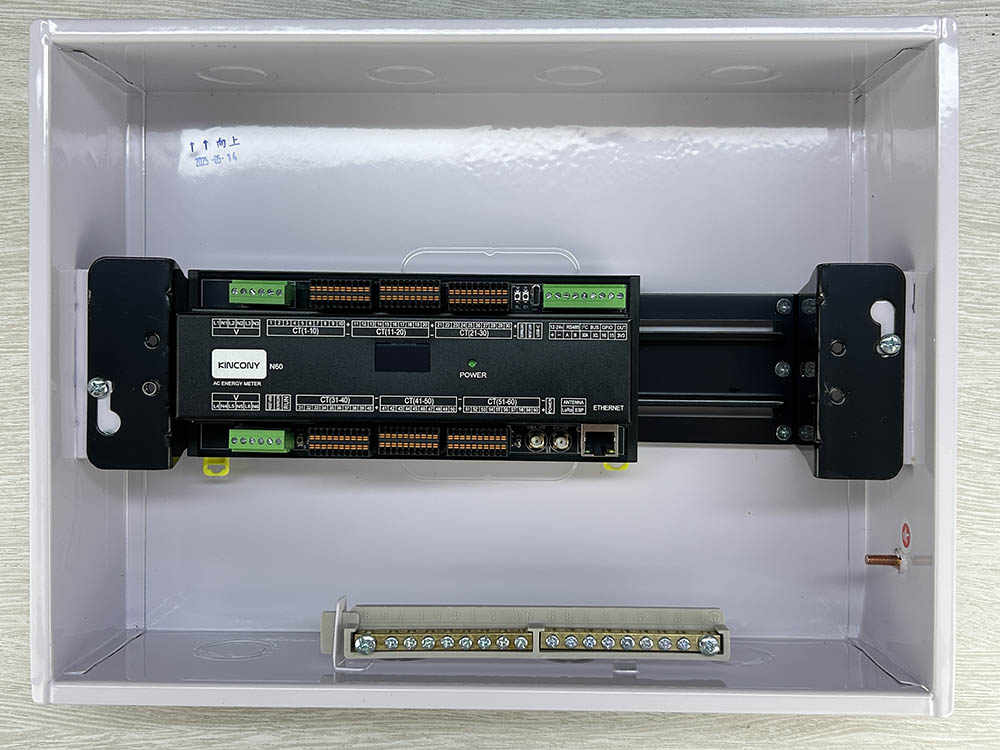
FAQ
Q1. 어느 모델을 골라야 하나요? 회로 수가 아니라 전압 계통 수를 먼저 보십시오. 계량 IC 블록당 전압 채널이 하나이므로, 단상 주택은 N10, 3상 설비는 N30 이상, 다중 계통 건물은 N60이 맞습니다.
Q2. Wi-Fi만으로는 부족한가요? 분전반은 금속 함체와 전력 노이즈로 무선 조건이 나쁜 편입니다. 계량 데이터는 누락 시 누적값이 어긋나므로, W5500 유선 링크를 기본으로 두고 Wi-Fi를 예비 경로로 쓰는 구성을 권합니다.
Q3. ESPHome과 제조사 KCS v3 중 무엇을 쓰나요? YAML을 직접 다루고 통합을 세밀하게 통제하려면 ESPHome, 설정 없이 Home Assistant 자동 검색으로 빠르게 붙이려면 KCS v3가 유리합니다. 두 경로 모두 W5500 이더넷을 그대로 사용합니다.
Q4. 과금 근거로 사용할 수 있나요? 계량 IC 자체는 고정밀 등급이지만, 법정 계량 인증(MID·OIML 등) 취득 여부는 확인되지 않았습니다. 참고용 분석·내부 정산에는 적합하나, 법적 과금 근거로 쓰려면 관할 규정 확인이 필요합니다.
Q5. BOM에서 네트워크 부분의 비중은? W5500은 SPI 한 벌과 RJ45 마그네틱만 추가하면 되고, 소프트웨어 TCP/IP 스택이 요구하는 MCU 메모리와 개발 공수를 상쇄합니다. ESP32-S3처럼 MAC이 없는 MCU에서는 선택이 아니라 필수 부품에 가깝습니다.
Summary
The KinCony N-Series (N10, N20, N30, N60) is a family of DIN-rail AC energy meters that measure up to 60 individual circuits through CT clamps. What defines this product family is a single design decision: the measurement channels scale sixfold, but the MCU and network layers stay fixed at ESP32-S3 plus a WIZnet W5500. Inside an electrical panel — arguably the worst possible environment for wireless — the W5500 carries every channel's readings out without interruption.
Overview
I did not find this board on the manufacturer's website. I found it in the official ESPHome device database — a catalog run by the Open Home Foundation and maintained through GitHub, where entries contain no marketing copy at all, just a YAML file you can copy and use immediately.
That YAML opens like this:
ethernet:
  type: W5500
  clk_pin: GPIO42
  mosi_pin: GPIO43
  miso_pin: GPIO44
  cs_pin: GPIO41
  interrupt_pin: GPIO2
  reset_pin: GPIO1
Before opening a single datasheet, two facts are already visible: the network layer is a W5500, and the measurement values are exposed as Modbus registers. Discovering that identical entries exist for the N20 and N30 as well shifted my interest from one board to the scaling design of an entire product family.
→ ESPHome device entry: https://devices.esphome.io/devices/kincony-n10/
Why Circuit-Level Metering Matters
Regulations That Demand Submetering Structure
California Title 24, Part 6, §130.5 (California Energy Commission) governs electrical power distribution design in nonresidential and hotel buildings. In particular, §130.5(b), "Separation of Electrical Circuits for Electrical Energy Monitoring," requires distribution systems to be designed so that measurement devices can monitor energy usage by load type — lighting, HVAC motors, elevators, renewable sources, EV charging — with requirements tightening as service capacity grows.
In other words, the "dozens of circuits in one box" form factor of the N-Series is not a hobbyist quirk. It is the physical expression of a regulatory requirement for load-type metering.
→ Regulation summary: https://energycodeace.com/content/section-1305-electrical-power-distribution-systems-nonreside
That said, no press coverage or case study documenting an actual commercial deployment of this product family could be confirmed. What is verifiable stops at the ESPHome catalog listing, third-party retail distribution, and user logs on the manufacturer's forum. Regulatory demand: confirmed. Deployment record: unconfirmed. Both conclusions stand as they are.
Did the Community Move First?
Open-source hardware moving into industry is now an established pattern. Raspberry Pi derived roughly 72% of its SBC and Compute Module sales from industrial and embedded customers as of 2023, and launched the embedded-focused CM5 in November 2024. Arduino was acquired by Qualcomm in October 2025, folding it into an industrial IoT commercialization path. KinCony itself released a run of Raspberry Pi CM5-based IoT gateways (Pi5R/Pi5M series) in June 2026.
Given that the N-Series appeared between August and October 2025, a community-oriented metering board moved in step with these corporate pushes into industry rather than trailing behind them.
→ Raspberry Pi CM5: https://techcrunch.com/2024/11/27/raspberry-pi-launches-compute-module-5-for-embedded-applications
→ Qualcomm–Arduino: https://www.controldesign.com/industry-news/news/55321941/qualcomm-technologies-acquires-arduino-gains-open-source-hardware-and-software
Architecture — One Platform, Four Sizes
The Lineup
| Item | N10 | N20 | N30 | N60 |
|---|---|---|---|---|
| CT channels | 10 | 20 | 30 | 60 |
| Voltage channels (ZMPT101B) | 1 | 2 | 3 | 6 |
| BL0910 metering ICs | 1 [Inferred] | 2 [Inferred] | 3 [Inferred] | 6 (confirmed) |
| Size (mm) | 122×83×60 | 140×83×60 | 165×83×60 | 202×83×56 |
| MCU / Ethernet | ESP32-S3 / W5500 | Same | Same | Same |
| ESPHome sensors | 34 | 68 [Inferred] | 102 [Inferred] | 204 (confirmed) |
Full specifications, pin definitions, and ESPHome configuration files for each model are available on the manufacturer's product pages.
N10: https://www.kincony.com/10-channel-esp32-ac-lora-energy-meter-n10.html
N20: https://www.kincony.com/20-channel-esp32-ac-lora-energy-meter-n20.html
N30: https://www.kincony.com/30-channel-esp32-ac-lora-energy-meter-n30.html
N60: https://www.kincony.com/60-channel-esp32-ac-lora-energy-meter.html
The scaling rule is simple. One BL0910 equals 10 CT channels plus 1 voltage channel. To add channels, you add another set and shift the Modbus register base by 100 (100, 200, 300, 400, 500, 600). The MCU, Ethernet controller, and SPI pin map are identical across every model.
System Composition and Data Flow
Technology Background
CT Clamps and Dedicated Metering ICs
A CT (current transformer) clamp measures current by wrapping around a conductor without cutting it — a fully non-invasive sensor. The 2000:1 turns ratio used by the N-Series means 200 A on the primary side induces 100 mA on the secondary, and the boards accept clamps rated up to 250 A.
The critical choice here is that the design does not sample waveforms with the MCU's ADC. Computing active power requires sampling voltage and current simultaneously at several kHz, then integrating their product with phase alignment. Scale that to 60 channels and a single MCU cannot keep up. The N-Series hands the entire calculation to the BL0910 from Shanghai Belling — a 10-channel polyphase metering IC with internal ΣΔ ADCs and a DSP core — and the MCU receives only finished numbers.
→ BL0910 specifications: https://jlcpcb.com/partdetail/BL_Shanghai_Belling-BL0910/C2841006
Modbus RTU Register Maps and Polling
Modbus RTU is the de facto serial standard on the plant floor. It exposes slave memory as numbered registers and lets a master read them on a schedule — a deliberately simple model.
In the N-Series, metering results sit in holding registers in a fixed layout. Per-channel current starts at register 100 in two-register (32-bit) pairs, power at 120, accumulated energy at 140, with voltage, frequency, and temperature at 162 through 164. ESPHome polls these every 5 seconds and turns them into Home Assistant entities. Because the model is poll-based, the register count per cycle grows in direct proportion to channel count — the origin of the bottleneck discussed later.
A community implementation that bridges Modbus data from the same manufacturer's boards to MQTT is also published on WIZnet Makers.
→ https://maker.wiznet.io/Lihan__/projects/esp32-modbus-mqtt-bridge/
LoRa Sub-GHz Links
LoRa uses chirp spread spectrum modulation to trade data rate for exceptional range and penetration in sub-GHz bands. The N-Series places an SX1278 module on its own dedicated SPI bus, letting boards in detached buildings, warehouses, or inverter rooms link back to a gateway board where LAN cabling does not reach.
The manufacturer documentation states plainly, however, that enabling LoRa stops SD card logging. The two functions cannot run simultaneously, forcing a choice between long-range transmission and local recording.
Technical Highlights — Scaling Pressure Confined to the Analog Layer
- Fixed digital layer: 10 channels or 60, the MCU, Ethernet, storage, and display remain identical, so firmware, integration logic, and validation work carry over unchanged.
- Three separate SPI buses: W5500, LoRa, and SD each own a bus, so heavy polling never contends with network transmission.
- Three-stage division of labor: the metering IC computes, the ARM CPU organizes registers, and the ESP32-S3 handles only communication and application logic.
- Data ownership: onboard flash preserves cumulative energy through power loss, the SD card writes hourly Excel logs, and the firmware supports private MQTT brokers.
- Firmware choice: the vendor's KCS v3 (HA auto-discovery, local IFTTT), ESPHome, or direct Arduino/ESP-IDF development.
Where WIZnet Fits — The Layer That Never Changes
Every model in the N-Series handles wired networking with a WIZnet W5500, down to identical pin assignments (CLK GPIO42, MOSI 43, MISO 44, CS 41, INT 2, RST 1). Here is what actually happens when Home Assistant reads data from an N60:
- A request arrives. HA opens a TCP connection to the board's DHCP-assigned IP and port.
- The W5500 terminates the connection. ARP responses, the TCP three-way handshake, checksum validation, retransmission, and window management all execute inside the chip's hardwired stack. Eight sockets and a 32 KB buffer handle this in parallel.
- The MCU receives only results. The ESP32-S3 reads a finished payload over SPI.
- The MCU focuses on preparing values. It updates 204 entities from Modbus readings like
bl0910_1_current_1 = 0.126 Aand pushes them into the W5500's transmit buffer over SPI. - Transmission belongs to the chip again. Segmentation, ordering, and retransmission are the W5500's job.
Think of it as a shipping desk stationed beside the electrical panel. The MCU decides only what to send; the desk handles address verification, packaging, and re-delivery on its own. What the MCU does not do is manage TCP state or retransmission. What it does is interpret measurements and run application logic.
Without this chip, the question is not performance but feasibility. The ESP32-S3 has no Ethernet MAC, so wired LAN simply does not exist as an option. The remaining choice is Wi-Fi — inside a metal enclosure surrounded by power-line noise, the worst RF environment in the building. The W5500 is not an optimization here; it is the precondition for wired connectivity.
One more point deserves attention. The N60 carries six times the measurement data of the N10, yet a single W5500 handles it comfortably. The 204 values refreshed every 5 seconds amount to a few kilobytes, and the real constraint appears on the 115200 bps UART Modbus link. Scaling pressure lands on the internal serial path, not the network — a telling characteristic of this design.
Similar Projects on WIZnet Makers
CircuitSetup Expandable 6 Channel ESP32 Energy Meter — CT clamps feeding two ATM90E32AS metering ICs (three channels each), paired with a W5500 and MQTT, sampling voltage, current, watts, power factor, and temperature every 2 seconds. The "add metering ICs to add channels" logic matches the N-Series exactly; the differences are channel density (6 versus up to 60) and the data path (direct MCU SPI versus an ARM co-processor over Modbus).
→ Project link: https://maker.wiznet.io/jaden/projects/power-monitoring-circuitsetup-expandable-6-channel-esp32-energy-meter-main-board/
W5300 Based Highly Secure & Reliable Smart Home Hub — a PZEM-004T module computes voltage, current, power, power factor, and frequency from a CT, the MCU receives results over UART, and a WIZnet TOE shield handles the network. This three-stage separation of metering and communication maps directly onto the N-Series ARM CPU structure.
→ Project link: https://maker.wiznet.io/Taifur/contest/w5300-based-highly-secure-reliable-smart-home-hub/
MBusino — M-Bus to MQTT Gateway — parses telegrams from up to five M-Bus meters (electricity, water, gas, heat) and publishes them to MQTT, with a W5500 providing wired stability. It illustrates the contrast between reading existing meters and measuring directly, though the end product — metering values flowing through MQTT topics — is the same.
→ Project link: https://maker.wiznet.io/Hannah/projects/mbusino--m-bus-to-mqtt-gateway/
All three share one skeleton: a dedicated metering IC computes, the application MCU receives only results, and a WIZnet chip ships them out over wire. The N-Series packs that proven pattern onto a single board.
| Item | KinCony N-Series | CircuitSetup 6CH | W5300 Smart Home Hub | MBusino |
|---|---|---|---|---|
| Measurement method | Direct CT metering | Direct CT metering | CT + PZEM module | M-Bus meter reading |
| Metering IC/module | BL0910 ×1–6 | ATM90E32AS ×2 | PZEM-004T | Unknown |
| Channels | 10–60 | 6 (expandable) | 1 | 5 meters |
| Metering separation | ARM CPU + Modbus | Direct MCU SPI | UART module | UART reading |
| Network | W5500 | W5500 module | W5300 TOE | W5500 Lite |
| Integration path | MQTT / HA / Modbus | MQTT | MQTT | MQTT |
The shared philosophy is "measurement to dedicated silicon, communication to dedicated silicon." What sets the N-Series apart is that it replicates that division of labor in modular units to build an entire product family around channel count.
Business Value
Customer and Market Perspective
- Regulatory submetering: one unit covers many circuits in new or renovated buildings where load-type metering is required. Because the demand originates in code requirements, it persists structurally regardless of economic cycles.
- Tenant billing separation: aggregate per-tenant circuits for usage-based settlement in multi-unit residential or retail properties.
- Solar self-consumption optimization: measure generation and consumption together, then extend into inverter output control — the direction OpenDTU-OnBattery demonstrates.
→ Reference: https://maker.wiznet.io/irina/projects/opendtu-onbattery/ - Equipment fault detection: per-circuit current trends surface motor or heater degradation and abnormal loads early.
WIZnet Perspective
That a product equipped with both Wi-Fi and LoRa still chooses wired Ethernet as its default interface says something concrete: for metering data, where a gap means a permanent gap in the accumulator, wire remains the baseline.
The more interesting point is a demand structure independent of who wins the platform race. Whether Arduino operates under Qualcomm, Raspberry Pi keeps shifting toward industrial revenue, or ESP32 holds the smart home — the moment any of these boards enters an industrial environment, what it needs is a deterministic wired link. Just as the N-Series multiplied its channels sixfold without touching the network layer, whichever platform prevails, the network layer converges on WIZnet silicon. That is the picks-and-shovels position.
Limitations and Future Improvements
The N-Series lowers the barrier to circuit-level metering considerably, though real-world use has surfaced several issues.
- Delayed accumulation at low loads — one forum user reported energy registers stuck at zero after more than 24 hours of operation; values only appeared after applying roughly 2000 W for 30 minutes. The user described the data as excessively coarse. Adjusting the metering IC's no-load threshold and widening decimal resolution would address this.
→ Source: https://www.kincony.com/forum/showthread.php?tid=8645 - Serial bottleneck under channel scaling — moving 204 values every 5 seconds across a 115200 bps UART leaves little headroom on the N60. Raising the UART speed or optimizing batched reads is the highest-leverage improvement.
- No split-phase summation for North America — a request to combine L1 and L2 for a 240 V load received only the advice to clamp one leg, leaving summation to the Home Assistant side.
- LoRa and SD logging are mutually exclusive — users must give up either long-range transmission or local recording.
- Room to extend the network layer — adding PoE would eliminate separate power wiring inside the panel, the most practical improvement available. Projects already combine W5500 with PoE for single-cable installation, and if IPv6 requirements firm up, migrating to the W6100 becomes a natural next step.
→ Reference: https://maker.wiznet.io/Benjamin/projects/esphome-triple-water-meter-esp32-s3-poe-eth/
FAQ
Q1. Which model should I choose?
Start with the number of voltage systems, not the circuit count. Each metering block carries one voltage channel, so single-phase homes fit the N10, three-phase installations need the N30 or above, and buildings with multiple service feeds call for the N60.
Q2. Isn't Wi-Fi enough?
Electrical panels combine metal enclosures with power-line noise — poor conditions for radio. Because a dropped metering sample corrupts the accumulated total, we recommend treating the W5500 wired link as primary and Wi-Fi as the fallback path.
Q3. ESPHome or the vendor's KCS v3?
Choose ESPHome if you want to write YAML and control integration in detail; choose KCS v3 if you want Home Assistant auto-discovery with no configuration. Both paths use the same W5500 Ethernet interface.
Q4. Can I use it for billing?
The metering IC itself is a high-precision part, but legal metrology certification (MID, OIML, and similar) could not be confirmed. It suits internal analysis and settlement, but using it as a legal billing basis requires verification against local regulations.
Q5. How much does the network portion affect BOM cost?
The W5500 needs only an SPI bus and an RJ45 magjack, and it offsets the MCU memory and engineering effort a software TCP/IP stack would demand. On an MCU without a MAC, such as the ESP32-S3, it is less an option than a required component.