


W5500-EVB-Pico+M5Stack用GPSユニット+TM1637でGPSNTPサーバを構築
A Local Stratum-1 Time Infrastructure Powered by W5500
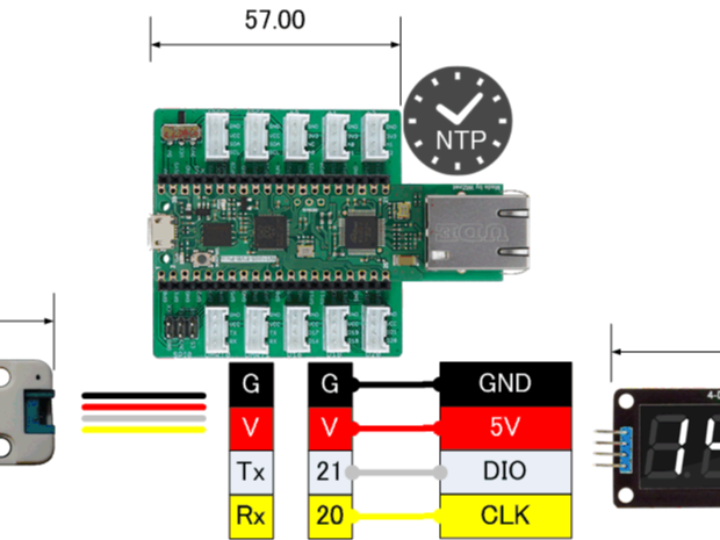
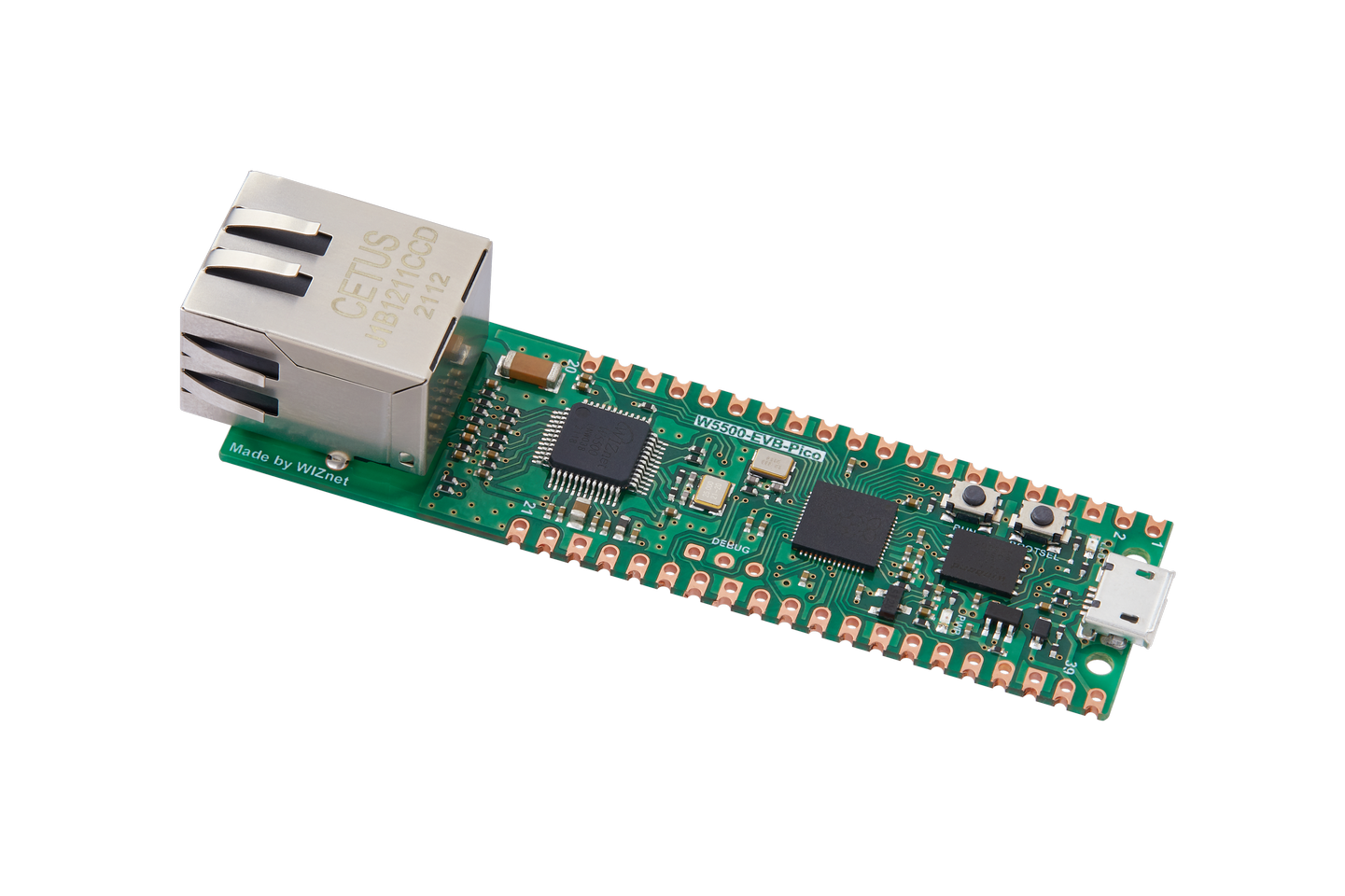
WIZnet - W5500-EVB-Pico
x 1


Arduino - Arduino IDE
x 1
요약
본 프로젝트는 RP2040 기반 Raspberry Pi Pico와 WIZnet W5500 Ethernet 칩을 활용하여 GPS 동기화 NTP 서버를 구현한 사례입니다.
인터넷 연결이 제한된 환경에서도 GPS를 기준으로 정확한 시간을 제공하는 로컬 Stratum-1급 시간 인프라를 목표로 합니다.
하드웨어 TCP/IP 오프로딩을 활용함으로써 MCU 부하를 최소화하고, 저비용·고신뢰의 임베디드 NTP 서버 구성을 제시합니다.
공장, 연구소, 테스트 랩 등 온프레미스 환경에서 즉시 활용 가능한 기준시 서버로서의 실용성을 확인할 수 있습니다.
1. 프로젝트 개요
산업 현장이나 사내 네트워크 환경에서는 외부 인터넷과의 연결이 제한되거나 차단된 경우가 많습니다.
이러한 환경에서는 공용 NTP 서버에 의존하지 않고, 내부 네트워크에서 독립적으로 동작하는 기준시 서버가 필요합니다.
기존 STM32 기반 GPS-NTP 서버 설계는 부품 수급 및 확장성 측면에서 한계가 있었으며, 이를 대체하기 위해 RP2040과 W5500 조합의 새로운 플랫폼이 검토되었습니다.
본 프로젝트는 GPS를 통해 직접 UTC 시간을 수신하고, 이를 기반으로 LAN 내부 단말에 정확한 시간을 제공하는 것을 목표로 합니다.
2. 시스템 아키텍처
시스템은 GPS, MCU, Ethernet 컨트롤러, 클라이언트로 단순하고 명확한 구조를 가집니다.
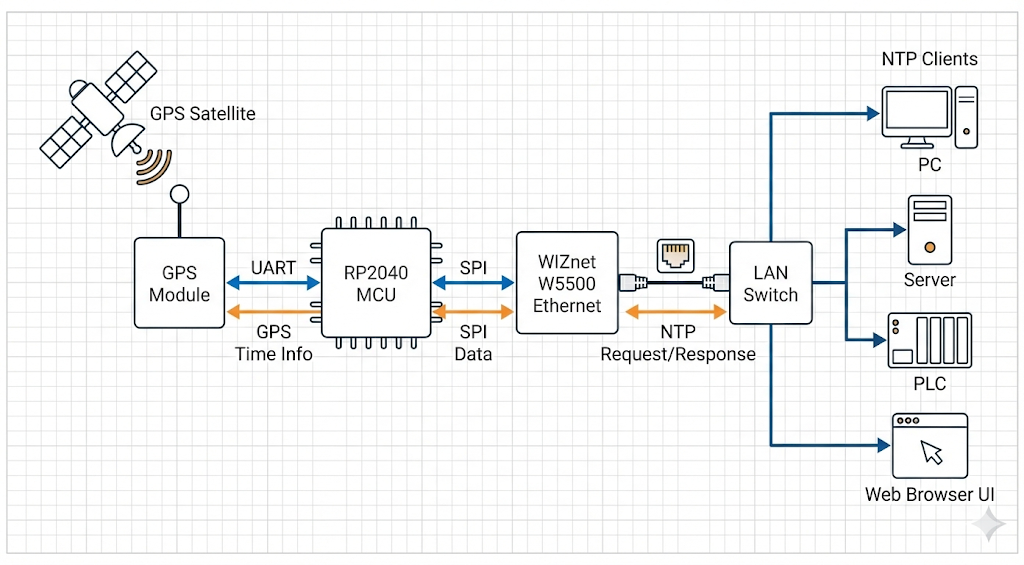
- GPS 모듈은 UART를 통해 NMEA 시각 정보를 RP2040에 전달합니다.
- RP2040은 유효한 GPS 시각을 내부 기준시로 관리합니다.
- W5500은 SPI 인터페이스로 연결되어 NTP(UDP/123) 및 HTTP 통신을 처리합니다.
- 다수의 NTP 클라이언트는 LAN을 통해 시간 동기 요청을 수행합니다.
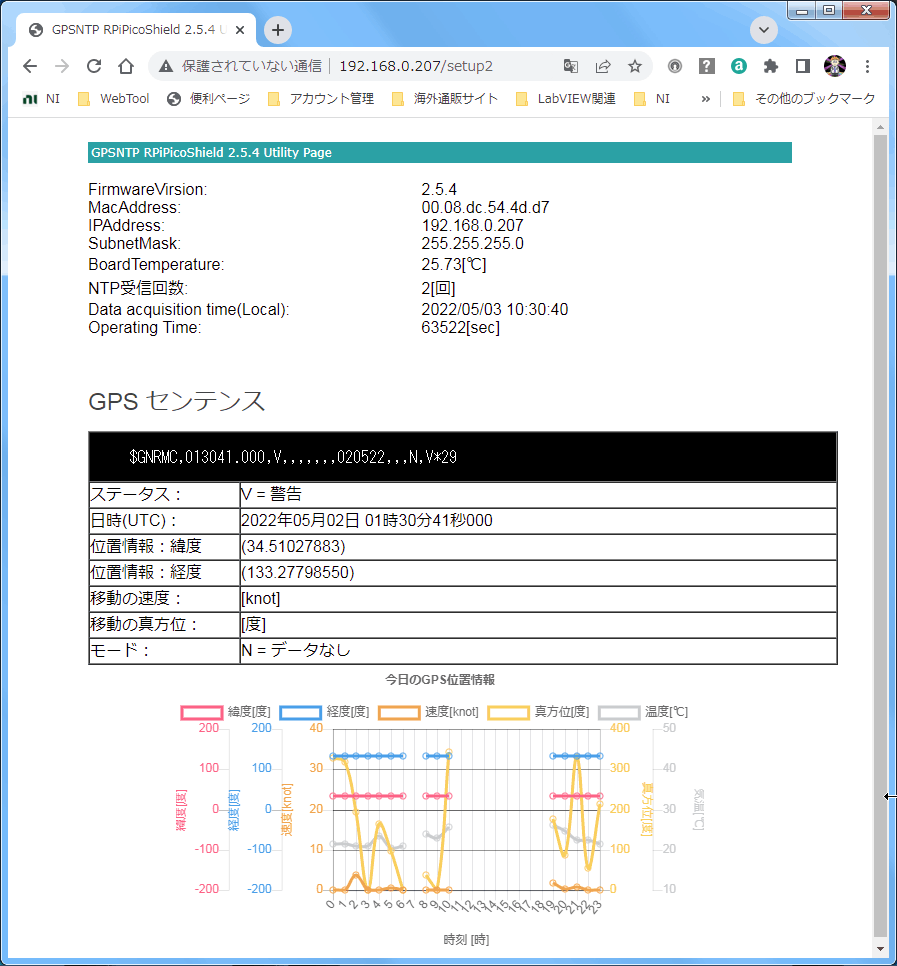
- 웹 브라우저 기반 UI를 통해 설정과 상태 확인이 가능합니다.
이 구조는 시간 정확도, 응답 지연, 유지보수성을 균형 있게 만족시키는 설계입니다.
3. 기술 특징 및 설계 선택
본 프로젝트의 기술 스택은 안정성과 단순성을 최우선으로 선정되었습니다.
- MCU: RP2040
듀얼 코어 구조와 충분한 주변장치로 GPS 파싱, 시간 관리, UI 제어를 동시에 처리합니다. - Ethernet: WIZnet W5500
하드웨어 TCP/IP 스택을 내장하여 네트워크 처리 부담을 MCU에서 분리합니다. - 개발 환경: Arduino-Pico 코어
빠른 프로토타이핑과 유지보수 편의성을 제공합니다. - 부가 기능:
TM1637 7-세그먼트 디스플레이를 통해 GPS 동기 상태와 시간을 직관적으로 표시합니다.
4. WIZnet Insight
이 프로젝트에서 WIZnet W5500은 단순한 Ethernet 인터페이스 이상의 가치를 제공합니다.
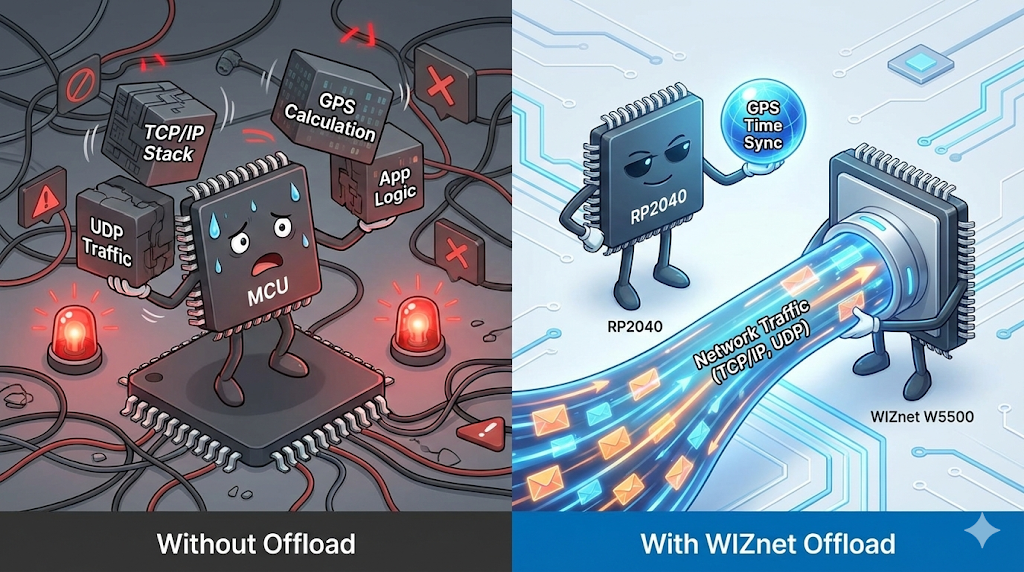
W5500의 하드웨어 TCP/IP 오프로딩 구조는 NTP 서버와 같이 다수의 UDP 요청을 지속적으로 처리해야 하는 환경에 매우 적합합니다.
MCU는 GPS 시각 동기와 시간 계산이라는 핵심 로직에 집중할 수 있으며, 네트워크 패킷 처리로 인한 지연이나 부하 증가를 효과적으로 방지할 수 있습니다.
또한 유선 Ethernet 기반의 통신은 무선 환경 대비 지연 편차가 작아, 로컬 기준시 서버로서의 신뢰성을 높여줍니다.
W5500-EVB-Pico 보드는 RP2040과의 결합을 간소화하여, 하드웨어 설계 없이도 빠른 구현이 가능하다는 장점이 있습니다.
5. 비즈니스 가치 및 활용 시나리오
본 프로젝트는 단순한 메이커 예제를 넘어 실질적인 산업 활용 가치를 가집니다.
- 공장·사내망 기준시 서버
PLC, 산업용 PC, 로거 장비 간 시간 불일치 문제를 해결합니다. - 테스트 랩 및 계측 환경
데이터 로그의 타임스탬프 정합성을 확보하여 분석 신뢰도를 높입니다. - 교육·레퍼런스 플랫폼
임베디드 Ethernet과 시간 동기 시스템을 이해하기 위한 실습용 레퍼런스로 활용 가능합니다. - 저비용 대체 인프라
리눅스 서버 대비 낮은 전력·비용으로 NTP 서비스를 제공합니다.
6. 구현 시 고려사항
실제 구현 과정에서는 몇 가지 실무적인 고려가 필요합니다.
- Grove Shield 사용 시 SPI 핀 충돌 가능성
- GPS 안테나 위치 및 수신 환경에 따른 동기 안정성
- Flash EEPROM 에뮬레이션 사용 시 쓰기 수명 관리
이 요소들은 설계 초기 단계에서 충분히 검토되어야 합니다.
7. 결론
RP2040과 WIZnet W5500을 결합한 GPS-NTP 서버는 저비용, 고신뢰의 로컬 시간 인프라를 구현할 수 있는 현실적인 대안입니다.
하드웨어 TCP/IP 오프로딩과 GPS 기반 기준시는 임베디드 환경에서도 충분한 시간 정확도를 제공합니다.
본 프로젝트는 WIZnet Ethernet 솔루션이 단순 네트워크 연결을 넘어, 임베디드 인프라의 핵심 구성요소로 활용될 수 있음을 보여줍니다.
FAQ
Q1. 이 시스템은 Stratum-1 NTP 서버인가요?
A. GPS를 직접 기준으로 사용하므로 구조적으로 Stratum-1에 해당합니다.
Q2. GPS 수신이 끊기면 어떻게 되나요?
A. 내부 타이머를 기준으로 임시 동작은 가능하나, 정확도는 GPS 재동기 전까지 보장되지 않습니다.
Q3. W5500 대신 W5100S 사용이 가능한가요?
A. 기능적으로 가능하며, 핀 설정과 라이브러리 차이를 고려해야 합니다.
Q4. 동시에 몇 대의 클라이언트를 지원할 수 있나요?
A. 소규모~중규모 LAN 환경에서는 문제없이 대응 가능합니다.
Q5. 리눅스 NTP 서버 대비 장점은 무엇인가요?
A. 낮은 전력 소모, 단순한 구성, 유지보수 용이성이 장점입니다.
Summary
This project presents the implementation of a GPS-synchronized NTP server using the RP2040-based Raspberry Pi Pico and the WIZnet W5500 Ethernet controller.
The system is designed to provide accurate time synchronization within a local network without relying on an external internet connection.
By leveraging hardware TCP/IP offloading, MCU load is minimized while ensuring stable and predictable network performance.
The result is a practical, low-cost, and reliable Stratum-1-class time server suitable for on-premise environments such as factories, laboratories, and test facilities.
1. Project Overview
In many industrial and enterprise environments, access to external internet services is restricted or completely blocked.
In such cases, relying on public NTP servers is not an option, and a locally operated reference time server becomes essential.
The original GPS-NTP server design based on STM32 faced limitations in component availability and scalability.
To address these issues, a new platform based on RP2040 and W5500 was evaluated.
The objective of this project is to receive UTC time directly from GPS and distribute accurate time information to devices within a local Ethernet network.
2. System Architecture
The system follows a simple and well-defined architecture consisting of a GPS module, MCU, Ethernet controller, and network clients.
- The GPS module delivers NMEA time data to the RP2040 via UART.
- The RP2040 validates and maintains GPS-synchronized system time.
- The W5500, connected via SPI, handles NTP (UDP/123) and HTTP communication.
- Multiple NTP clients synchronize their clocks through the local LAN.
- A web-based interface allows configuration and system monitoring.
This architecture provides an optimal balance between timing accuracy, response latency, and maintainability.
3. Technical Characteristics and Design Choices
The technology stack was selected with reliability and simplicity as top priorities.
- MCU: RP2040
Its dual-core architecture and sufficient peripheral set allow simultaneous GPS parsing, time management, and UI control. - Ethernet: WIZnet W5500
The integrated hardware TCP/IP stack offloads network processing from the MCU. - Development Environment: Arduino-Pico Core
Enables rapid prototyping and simplifies long-term maintenance. - Additional Features:
A TM1637 7-segment display provides intuitive visualization of time and GPS synchronization status.
4. WIZnet Insight
In this project, the WIZnet W5500 serves as more than a simple Ethernet interface—it functions as a core enabler of embedded time infrastructure.
A GPS-based NTP server must continuously handle multiple UDP requests while simultaneously maintaining accurate time synchronization and system status.
With a software-based TCP/IP stack, increased network traffic can introduce timing jitter and unpredictable latency.
The W5500 integrates a hardware TCP/IP offloading engine, processing UDP/NTP packets internally.
This allows the RP2040 to focus on time calculation and system control while maintaining consistent and deterministic response characteristics, even under increased network load.
Such predictability is critical for systems where time accuracy is the primary value.
Furthermore, wired Ethernet communication via the W5500 provides lower jitter and higher determinism compared to wireless solutions, making it well suited for local Stratum-1 reference time servers.
The W5500-EVB-Pico board enables immediate integration with RP2040, reducing hardware design effort and lowering development risk during proof-of-concept and pre-production stages.
This project demonstrates that WIZnet Ethernet solutions deliver clear business value by enabling accurate timing, system stability, and reduced implementation risk—far beyond basic network connectivity.
5. Business Value and Application Scenarios
This project extends beyond a maker-level experiment and offers tangible industrial value.
- Reference Time Server for Factories and Private Networks
Resolves time inconsistencies between PLCs, industrial PCs, and data loggers. - Test and Measurement Environments
Ensures timestamp consistency, improving the reliability of data analysis. - Education and Reference Platform
Serves as a practical example for learning embedded Ethernet and time synchronization systems. - Low-Cost Infrastructure Alternative
Provides NTP services with lower power consumption and cost compared to Linux-based servers.
6. Implementation Considerations
Several practical aspects should be considered during implementation.
- Potential SPI pin conflicts when using Grove shields
- GPS antenna placement and signal quality affecting synchronization stability
- Flash EEPROM emulation requires write-cycle management
These factors should be reviewed early in the design phase.
7. Conclusion
The combination of RP2040 and WIZnet W5500 enables a realistic and effective approach to building a low-cost, high-reliability local time infrastructure.
Hardware TCP/IP offloading and GPS-based reference timing deliver sufficient accuracy for embedded environments.
This project illustrates how WIZnet Ethernet solutions can play a critical role not only in connectivity, but also in embedded infrastructure systems where determinism and reliability are essential.
FAQ
Q1. Can this system be considered a Stratum-1 NTP server?
A. Yes. Since it uses GPS directly as the reference time source, it qualifies as a Stratum-1 architecture.
Q2. What happens if GPS reception is lost?
A. The system can continue operating temporarily using its internal timer, but accuracy is not guaranteed until GPS synchronization is restored.
Q3. Can W5100S be used instead of W5500?
A. Yes, with appropriate adjustments for pin configuration and library differences.
Q4. How many clients can it support simultaneously?
A. It is suitable for small to medium-sized LAN environments.
Q5. What are the advantages over a Linux-based NTP server?
A. Lower power consumption, simpler architecture, and easier maintenance.
-
GPS_AT6558


