


Ethernet Shield based Electricty Billing Framework
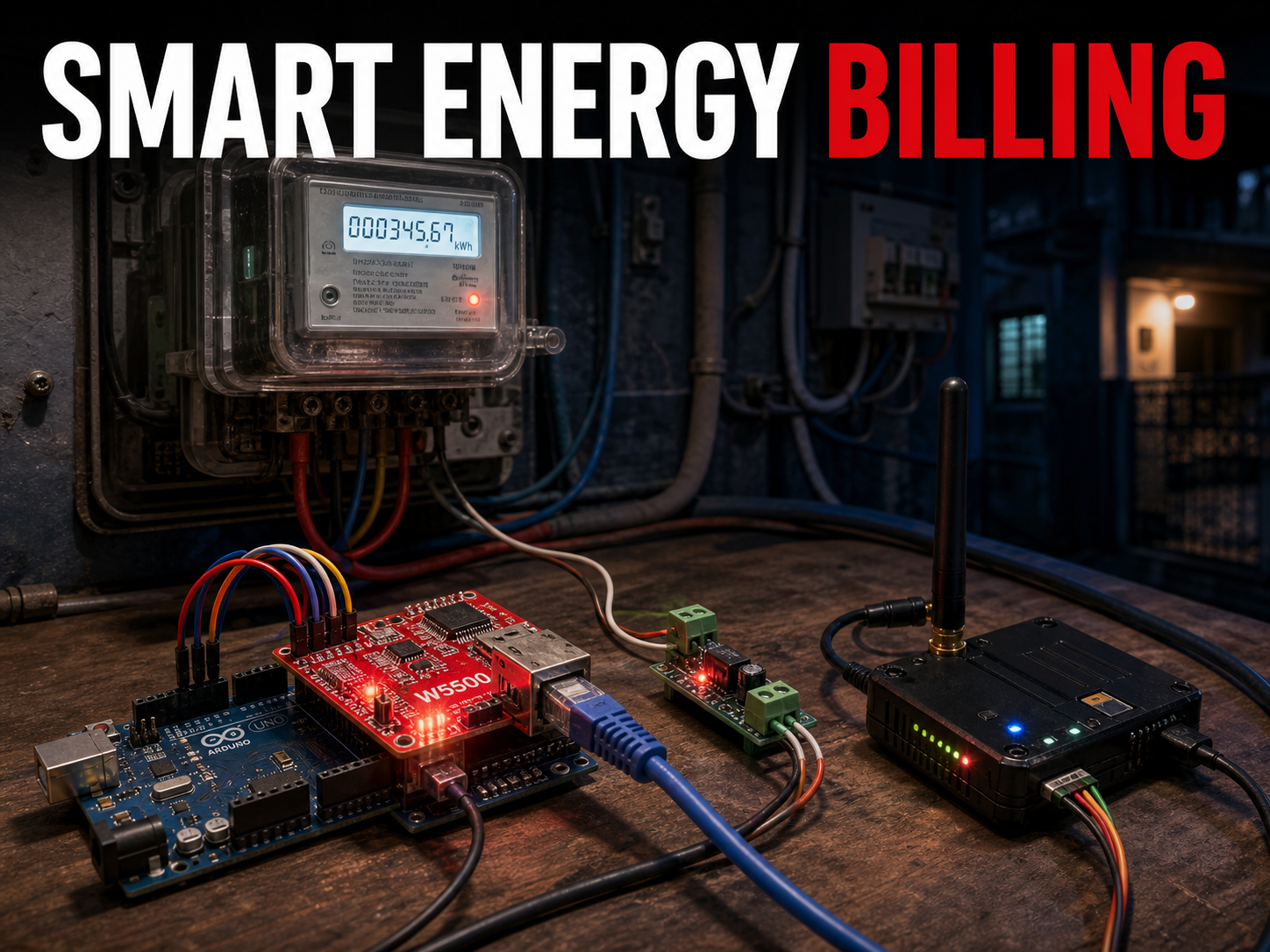
Arduino UNO, 전자식 전력계, 펄스 검출 회로, W5500 Ethernet Shield, GSM 모뎀을 결합해 전력 사용량을 자동 측정하고 서버에서 요금 산정과 온라인 청구를 지원하는 스마트 전력 계량 프레임워크입니다. W5500 Ethernet Shield는 계량 데이터를 전력회사 서버로 전달하는 게이트웨이로 실제 기능에 사용됩니다. ([internationaljournalssrg.org](https://www.internationaljournalssrg.org/IJECE/2017/Volume4-Issue3/IJECE-V4I3P107.pdf))
★ W5500이 단순 선택 옵션이 아니라 전력 사용량 데이터를 서버와 연결하고 원격 조회 및 청구를 가능하게 하는 프로젝트의 핵심 데이터 경로이므로 적극적 사용에 해당합니다. ([internationaljournalssrg.org](https://www.internationaljournalssrg.org/IJECE/2017/Volume4-Issue3/IJECE-V4I3P107.pdf))
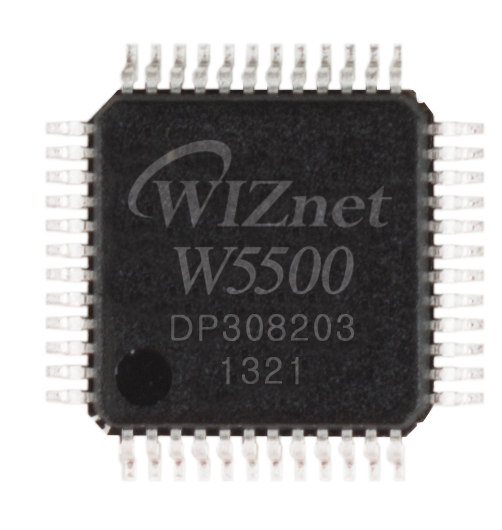
WIZnet - W5500
x 1

검침원 없는 전력 청구, 펄스 하나로 끝내다 — Arduino와 WIZnet 이더넷 실드로 완성한 자동 빌링 게이트웨이
요약
인도 Mepco Schlenk 공과대학 연구팀이 2017년 발표한 이 프레임워크는 에너지미터 LED 펄스를 검출해 소비전력을 계산하고, WIZnet W5500 기반 Arduino Ethernet Shield로 서버에 전송하는 동시에 GSM으로 소비자에게 SMS 청구서를 보냅니다. 검침원 방문 없이 전력 사용량 측정부터 요금 청구까지 자동화한 것이 핵심이며, 유선 이더넷과 무선 GSM이라는 이중 통신 경로 설계가 특히 눈여겨볼 지점입니다.
개요
전통적 검침은 매달 검침원이 방문해 계량기를 육안으로 읽고 전력청에 보고하는 방식입니다. 인건비, 판독 오류, 소비자 부재 시 검침 실패 등의 문제가 반복되어 왔습니다. 이 프레임워크는 Arduino UNO에 펄스 검출 회로를 연결해 계량기 LED의 깜빡임(3200펄스=1kWh)을 직접 세는 방식으로 사람의 개입을 없앴습니다. 계산된 요금은 서버에 저장됨과 동시에 GSM 모뎀을 통해 소비자에게 SMS로 발송됩니다.
도입 배경 / 왜 필요한가
- 저장소 도입 사례: 확인 불가 — 학부생 졸업연구 성격의 프로토타입이며, 실제 전력회사의 채택을 뒷받침하는 근거는 원문에 없습니다.
- 산업적·규제적 필요성: 확인됨 — 인도 Electricity Act 2003 제55조는 정확한 계량기 없는 전력 공급을 금지하며, Central Electricity Authority의 계량기 설치·운영 규정이 스마트미터 도입을 뒷받침합니다. 최근 RDSS(Revamped Distribution Sector Scheme) 하에서 인도 전역 약 25억 대 규모의 재래식 계량기 교체가 진행 중입니다.
- 출처: https://navhindtimes.in/bnc-news/smart-metering-and-energy-sector-reforms/
- 두 결론은 서로 다릅니다: 개별 저장소 차원의 실사용 증거는 없지만, 산업 차원의 수요는 뚜렷합니다. 이 프로젝트는 정책적 필요가 커뮤니티보다 먼저 움직인 사례가 아니라, 반대로 커뮤니티 프로토타입이 정책 의무화보다 앞서 문제를 제기한 사례로 읽을 수 있습니다.
- 산업 트렌드 통찰: 이 프로젝트가 쓰는 Arduino는 2022년 산업용 PLC "Opta"를 출시하며 Pro 라인을 산업 시장으로 확장했고, 2023년 기준 3만 개 이상 기업이 상업적으로 활용 중입니다. 동일한 흐름이 경쟁 오픈소스 하드웨어 진영에서도 확인됩니다 — Raspberry Pi는 2024년 상장 당시 매출의 약 70%가 산업·임베디드 고객에서 발생한다고 밝혔습니다. 두 플랫폼 모두 취미 시장에서 시작해 산업 시장으로 무게중심을 옮기고 있으며, 본 프로젝트처럼 초기부터 전력 인프라라는 산업 영역을 겨냥한 오픈소스 하드웨어 활용은 이 흐름의 초기 신호로 볼 수 있습니다.
아키텍처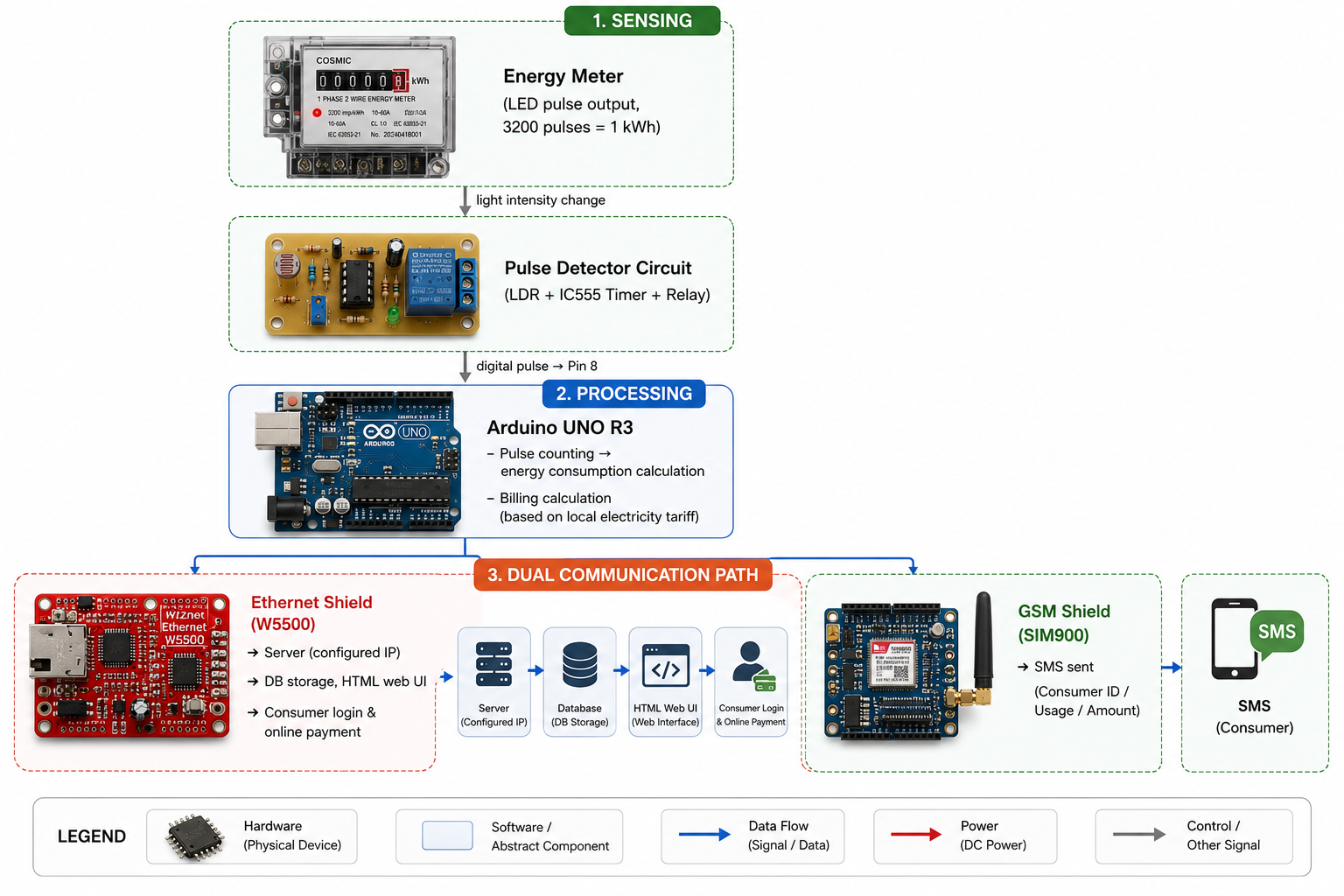
기술 배경
광펄스 기반 전력량 계측
전자식 전력량계는 소비전력에 비례해 LED가 일정 주기로 깜빡이며, 이 펄스 수를 세면 별도의 통신 프로토콜 없이도 정확한 kWh 값을 얻을 수 있습니다. 이 프로젝트는 LDR(광의존저항)이 빛의 변화에 따라 저항값을 바꾸는 광전도성(photoconductivity) 원리로 펄스를 감지하고, IC555 타이머가 이를 안정된 디지털 신호로 정형화해 Arduino가 카운트합니다. 계량기 제조사·통신 규격과 무관하게 어떤 전자식 미터에도 붙일 수 있다는 점이 이 방식의 실용적 가치입니다.
GSM/SMS 기반 원격 통지
GSM 모듈은 AT 커맨드로 이동통신망에 접속해 SMS 송수신을 수행합니다. 별도 인터넷 인프라 없이도 이동통신 커버리지만 있으면 데이터를 주고받을 수 있어, 유선 네트워크가 없는 지역까지 청구서를 전달할 수 있다는 장점이 있습니다. 다만 이 프로젝트가 스스로 지적하듯, 통신 품질이 나쁜 지역에서는 전송 실패 위험이 있어 유선 채널(이더넷)과의 병행이 필요합니다.
기술 특징
- 이중 통신 구조: 유선(서버 저장·조회용)과 무선(즉시 통지용)을 분리해 한쪽 장애가 전체 시스템을 마비시키지 않도록 설계
- 하드웨어 계측: 소프트웨어 폴링 대신 인터럽트 기반 펄스 카운팅으로 MCU 부하를 최소화
- 중앙 서버 집중 관리: HTML 웹 UI로 소비자 조회·납부까지 단일 창구화
WIZnet 적용 섹션
Arduino Ethernet Shield는 WIZnet W5500을 탑재하고 있으며, TCP/UDP를 모두 지원하는 하드와이어드 IP 스택으로 최대 8개 동시 소켓을 지원합니다. 이 프로젝트에서의 역할은 다음과 같습니다.
- 계량기 LED가 3200펄스=1kWh 규칙으로 깜빡이면, 검출회로 출력이 Arduino의 디지털 8번 핀에 HIGH 신호로 들어옵니다.
- Arduino가 펄스를 카운트해 소비전력(kWh)과 요금(타밀나두 전력청 요율)을 계산합니다.
- 계산 결과를 W5500이 처리하는 소켓 1개를 통해, 프로그램에 사전 설정된 서버 IP로 TCP 전송합니다. W5500은 최대 8소켓을 지원하지만, 이 프로젝트는 서버 하나와의 통신에 1개 소켓만 사용합니다.
- 서버가 데이터를 저장하고 HTML 웹 UI로 소비자에게 조회·납부 기능을 제공합니다.
- 동일 데이터가 GSM(SIM900)을 통해 별도로 SMS 청구서로도 전송됩니다 — 이 경로는 W5500과 무관한 독립 채널입니다.
비유하자면, Arduino는 청구 내용을 작성하는 사무원이고 W5500은 우체국 창구 직원입니다. 사무원은 "무엇을 보낼지"만 정하면 되고, 봉투 규격을 맞추고 배송 경로를 관리하는 일(3-way handshake, 패킷 분할·재조립, 소켓 상태 관리)은 전부 창구 직원, 즉 W5500이 전담합니다.
만약 이 칩이 없었다면, UNO의 8비트 ATmega328(RAM 2KB)에서 소프트웨어 TCP/IP 스택을 직접 구동해야 했을 것이고, 재전송·혼잡제어 로직이 얼마 안 되는 RAM을 잠식해 펄스 카운팅용 인터럽트 처리가 지연될 위험이 있었을 것입니다.
WIZnet Makers 유사 사례
- Arduino Mega and IOT based Intelligent Energy Meter to Increase Efficiency and Accuracy Billing meth: Arduino+Ethernet Shield(W5100)+GSM SMS 청구라는 동일한 이중 통신 스택을 사용하며, 미납 시 릴레이로 전원을 차단하는 기능까지 확장한 사례입니다.
→ 프로젝트 링크: https://maker.wiznet.io/annjaison/projects/arduino-mega-and-iot-based-intelligent-energy-meter-to-increase-efficiency-and-accuracy-billing-meth/ - Arduino pulse counting with multiple Energy Meters and logging to Emoncms: 동일한 LED 광펄스 검출 원리로 여러 전력량계를 동시에 측정해 Ethernet Shield로 서버에 로깅합니다. 청구 기능은 없지만 검침 원리가 정확히 일치합니다.
→ 프로젝트 링크: https://maker.wiznet.io/WIZnet/projects/arduino-pulse-counting-with-multiple-energy-meters-and-logging-to-emoncms/ - Designing Prepaid Smart Energy Meter and Deployment in a Network: 인도 현지의 전력 낭비 문제의식에서 출발해 Arduino+Ethernet Shield로 선불형 스마트미터를 네트워크로 구성한 사례입니다. 검침 방식은 다르지만 문제의식과 서버 중앙관리 구조가 동일합니다.
→ 프로젝트 링크: https://maker.wiznet.io/siva_ranjeet/projects/Designing-Prepaid-Smart-Energy-Meter-and-Deployment-in-a-Network/
세 사례 모두 Arduino+WIZnet 이더넷 실드를 전력 계측·청구 도메인의 검증된 조합으로 채택하고 있으며, 이는 본 프레임워크의 아키텍처가 일회성 실험이 아니라 반복적으로 검증된 패턴임을 보여줍니다.
| 항목 | 본 프로젝트 | annjaison | WIZnet(펄스카운팅) | siva_ranjeet |
|---|---|---|---|---|
| WIZnet 칩 | W5500 | W5100 | W5100 | 미상 |
| GSM/SMS 청구 | O | O | X | X |
| 펄스 기반 검침 | O | 미상 | O | X |
| 원격 전원 차단 | X | O | X | X |
공통 설계 철학은 "검침·청구라는 애플리케이션 로직은 MCU가, 네트워크 전송은 이더넷 실드가" 라는 역할 분담이며, 본 프로젝트는 여기에 GSM 이중화를 더한 차별점을 가집니다.
비즈니스 가치
외부 관점
- 검침 인건비 절감 및 오류 제거가 필요한 개발도상국 전력청 대상 저비용 자동화 솔루션
- 통신망이 불안정한 농어촌 지역에서 유선(서버 기록)·무선(즉시 통지)을 병행하는 이중 안전망 모델
- 미납 시 자동 알림으로 회수율 개선 시나리오로 확장 가능
- RDSS 등 정책 주도 스마트미터 확산 흐름과 맞물려, 수요가 일시적이지 않고 구조적으로 지속될 시장 조건에 부합
내부 관점(WIZnet)
- GSM 단독 게이트웨이의 한계(통신 품질 의존)를 이더넷이 보완한다는 점에서, W5500의 가치는 "MCU 오프로딩"보다 "유선 채널의 결정론적 안정성"으로 프레이밍하는 것이 이 프로젝트에는 더 정확합니다.
- Arduino·Raspberry Pi 모두 산업 시장으로 무게중심을 옮기는 흐름 속에서, 어느 플랫폼이 채택되든 네트워크 계층은 결국 하드와이어드 이더넷 칩으로 수렴하는 포지셔닝(픽스 앤 셔블)을 강조할 수 있는 사례입니다.
한계 및 개선 방향
이 프로젝트가 검침원 없는 청구 자동화라는 실질적 문제를 해결한 점은 분명하지만, 몇 가지 발전 기회가 있습니다.
- GSM(SIM900) 신뢰성: Arduino 커뮤니티 포럼에서 전원 불안정, 응답 없음(NO RESP), 저가 보드 품질 문제가 장기간 반복 제기되어 왔습니다.
- 2G 통신망 종료 리스크: 세계 각국 통신사가 2G/3G 망을 순차 종료 중이며, IoT 셀룰러 연결의 절반 이상이 여전히 2G/3G에 의존한다는 분석도 있어, SIM900 기반 SMS 알림은 중장기적으로 대체 필요성이 있습니다.
- 단상 전용: 240V 단상 미터로만 검증되어 3상 산업용 부하로의 확장성은 미확인입니다.
- RTC 역할 불명확: 시스템 구성요소로 언급되나 구체적 활용 서술이 없어 [추정] 과금 주기 관리용 정도로만 짐작할 수 있습니다.
개선 방향으로는 GSM 의존도를 낮추고 유선 이더넷을 1차 채널로, GSM은 백업 채널로 전환하는 구조 조정, 그리고 3상 계측 확장이 있습니다.
FAQ
Q1. 이 시스템은 별도 인터넷 회선이 있어야 하나요? A. 이더넷 실드가 서버와 통신하려면 유선 네트워크 연결이 필요합니다. 다만 GSM 채널은 이동통신 커버리지만 있으면 동작합니다.
Q2. Arduino UNO만으로 충분한가요? A. 본 논문은 UNO 기준이며, 3상 확장이나 추가 센서를 붙일 경우 더 많은 핀·메모리가 필요해 Mega급 보드 검토가 필요할 수 있습니다.
Q3. 3상 전력 계측으로 확장할 수 있나요? A. 원문은 단상 전용으로만 검증되어 있어 3상 확장은 [추정] 영역이며, 별도 검증이 필요합니다.
Q4. GSM 모듈이 단종되면 어떻게 되나요? A. SIM900은 2G 기반이라 통신사의 2G 종료 시 대체 모듈(4G/NB-IoT 등)로 교체가 필요합니다. 유선 채널(이더넷)은 이 영향을 받지 않습니다.
Q5. 유지보수는 어떻게 이루어지나요? A. 원문에 별도 유지보수 절차는 언급되어 있지 않아 확인 불가하며, 실배포 시에는 GSM 모듈 교체 주기 관리가 필요할 것으로 보입니다.
Summary/TL;DR
Developed by a research team at Mepco Schlenk Engineering College in India and published in 2017, this framework detects energy meter LED pulses to calculate consumption, then transmits the data through a WIZnet W5500-based Arduino Ethernet Shield to a server while simultaneously sending an SMS bill to the consumer via GSM. The core idea is eliminating manual meter reading entirely — from measurement to billing. The dual communication path, wired Ethernet plus wireless GSM, is the most notable design choice.
Overview
Traditional meter reading requires a technician to visit each site monthly and record readings by eye. This creates recurring problems: labor costs, reading errors, and failed visits when consumers are absent. This framework connects a pulse-detection circuit to an Arduino UNO, directly counting the meter's LED blinks (3,200 pulses = 1 kWh) to remove human involvement from measurement. The calculated bill is stored on a server and simultaneously sent to the consumer as an SMS via a GSM modem.
Why This Matters
- Repository adoption evidence: Not confirmed — this is an undergraduate capstone-level prototype, and the original paper provides no evidence of adoption by an actual electricity board.
- Industry/regulatory necessity: Confirmed — Section 55 of India's Electricity Act 2003 prohibits electricity supply without an accurate meter, and Central Electricity Authority metering regulations support smart meter adoption. Under the Revamped Distribution Sector Scheme (RDSS), India is currently replacing roughly 250 million conventional meters nationwide.
- Source: https://navhindtimes.in/bnc-news/smart-metering-and-energy-sector-reforms/
- These two findings diverge: there's no evidence this specific project was adopted, but the industry-level demand is clear. Rather than policy driving the community, this reads as a case where a community prototype identified the problem before mandates caught up.
- Industry trend insight: Arduino, the platform this project builds on, launched its industrial PLC "Opta" in 2022, expanding its Pro line into industrial markets, and by 2023 more than 30,000 businesses were using it commercially. The same shift shows up at a competing open-source hardware company — Raspberry Pi disclosed at its 2024 IPO that roughly 70% of revenue came from industrial and embedded customers. Both platforms are shifting their center of gravity from hobbyist to industrial markets, and this project's early focus on power infrastructure — an inherently industrial domain — looks like an early signal of that broader movement.
Architecture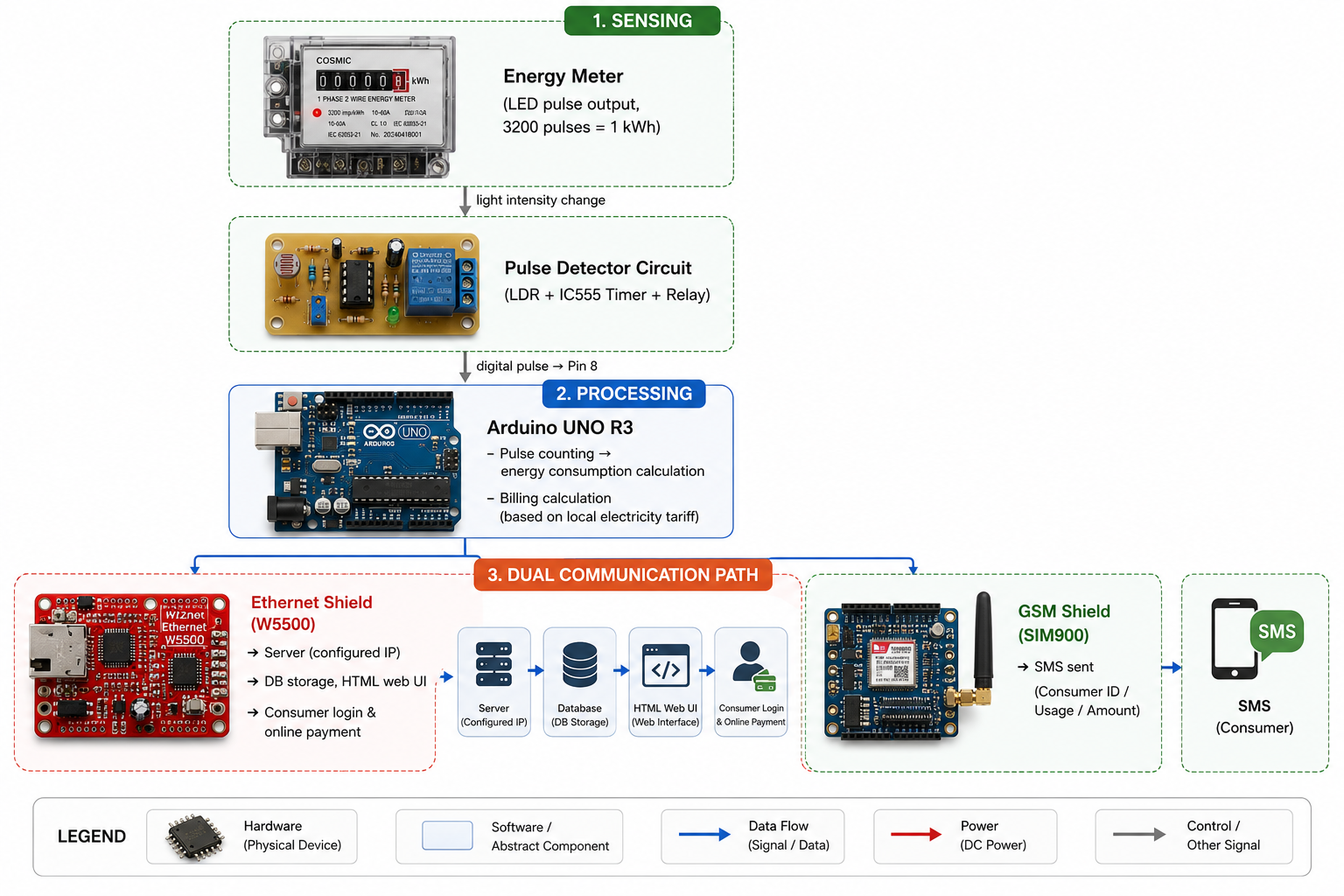
Technology Background
Pulse-Based Energy Metering
Electronic energy meters blink an LED at a rate proportional to power consumption, so counting these pulses yields an accurate kWh value without any communication protocol. This project detects pulses using photoconductivity — the principle by which a light-dependent resistor (LDR) changes resistance with light intensity — and an IC555 timer shapes this into a clean digital signal for the Arduino to count. Because it works independently of meter brand or communication standard, this method can be retrofitted onto virtually any electronic meter.
GSM/SMS-Based Remote Notification
A GSM module connects to the cellular network using AT commands to send and receive SMS messages. It requires no internet infrastructure — only cellular coverage — making it useful for delivering bills to areas without wired network access. However, as the source paper itself notes, poor signal quality creates a real risk of transmission failure, which is why pairing it with a wired channel (Ethernet) matters.
Technical Highlights
- Dual communication design: wired (for server storage/lookup) and wireless (for instant notification) are separated so a failure in one doesn't take down the whole system
- Hardware-based measurement: interrupt-driven pulse counting instead of software polling minimizes MCU load
- Centralized server management: a single HTML web UI handles both consumer lookup and payment
Where WIZnet Fits
The Arduino Ethernet Shield is built around the WIZnet W5500, a hardwired IP stack supporting both TCP and UDP with up to eight simultaneous sockets. Its role in this project breaks down as follows:
- When the meter's LED blinks according to the 3,200-pulses-per-kWh rule, the detector circuit's output goes HIGH on the Arduino's digital pin 8.
- The Arduino counts these pulses to calculate energy consumption (kWh) and the corresponding bill (based on the local electricity tariff).
- The result is sent via TCP to a pre-configured server IP address, using a single socket handled by the W5500. Although the W5500 supports up to eight sockets, this project uses just one for its single server connection.
- The server stores the data and exposes it through an HTML web UI for consumer lookup and payment.
- The same data is separately sent as an SMS bill via GSM (SIM900) — a channel entirely independent of the W5500.
Think of it this way: the Arduino is a clerk drafting the bill's content, and the W5500 is the post office counter clerk. The Arduino only decides what to send; everything about how it gets there safely — the three-way handshake, packet fragmentation and reassembly, socket state management — is handled entirely by the W5500.
Without this chip, the system would have had to run a software TCP/IP stack on the UNO's 8-bit ATmega328 (2KB of RAM). Retransmission and congestion-control logic would compete for that scarce RAM, risking delays in the interrupt handling that pulse counting depends on.
Similar Projects on WIZnet Makers
- Arduino Mega and IOT based Intelligent Energy Meter to Increase Efficiency and Accuracy Billing meth: Uses the same dual-communication stack — Arduino + Ethernet Shield (W5100) + GSM SMS billing — and extends it further with relay-based power cutoff for unpaid accounts.
→ Project link: https://maker.wiznet.io/annjaison/projects/arduino-mega-and-iot-based-intelligent-energy-meter-to-increase-efficiency-and-accuracy-billing-meth/ - Arduino pulse counting with multiple Energy Meters and logging to Emoncms: Uses the identical LED photopulse detection principle to measure multiple meters simultaneously, logging to a server via Ethernet Shield. No billing feature, but the metering method matches exactly.
→ Project link: https://maker.wiznet.io/WIZnet/projects/arduino-pulse-counting-with-multiple-energy-meters-and-logging-to-emoncms/ - Designing Prepaid Smart Energy Meter and Deployment in a Network: Motivated by the same electricity-waste problem observed locally in India, this uses Arduino + Ethernet Shield to build a networked prepaid smart meter system. Different metering method, but the same problem framing and centralized server design.
→ Project link: https://maker.wiznet.io/siva_ranjeet/projects/Designing-Prepaid-Smart-Energy-Meter-and-Deployment-in-a-Network/
All three cases adopt Arduino plus a WIZnet Ethernet shield as a proven combination for power metering and billing, showing this framework's architecture isn't a one-off experiment but a repeatedly validated pattern.
| Item | This Project | annjaison | WIZnet (pulse counting) | siva_ranjeet |
|---|---|---|---|---|
| WIZnet chip | W5500 | W5100 | W5100 | Not confirmed |
| GSM/SMS billing | Yes | Yes | No | No |
| Pulse-based metering | Yes | Not confirmed | Yes | No |
| Remote power cutoff | No | Yes | No | No |
The shared design philosophy is a clear division of labor: the MCU owns the application logic (metering, billing), and the Ethernet shield owns network transport. This project's distinguishing factor is layering GSM redundancy on top of that pattern.
Business Value/Use Cases
External perspective
- A low-cost automation solution for electricity boards in developing regions that need to cut reading labor costs and eliminate errors
- A dual-safety-net model — wired for record-keeping, wireless for instant notification — suited to rural areas with unreliable networks
- A path toward improved collection rates through automatic non-payment alerts
- Aligned with policy-driven smart meter rollouts like RDSS, meaning this is a structurally sustained demand rather than a passing trend
Internal perspective (WIZnet)
- Because Ethernet compensates for the GSM gateway's dependence on signal quality, the W5500's value here is better framed as "deterministic stability of the wired channel" rather than "MCU offloading."
- As both Arduino and Raspberry Pi shift their center of gravity toward industrial markets, this project is a good example for making the case that regardless of which platform wins, the network layer ultimately converges on hardwired Ethernet chips — a picks-and-shovels positioning.
Limitations and Future Improvements
This project clearly solves a real problem — automated billing without a meter reader — but there's room to grow.
- GSM (SIM900) reliability: Arduino community forums show long-running, recurring reports of power instability, unresponsive modules ("NO RESP"), and poor build quality in low-cost boards.
- 2G network sunset risk: Mobile carriers worldwide are progressively shutting down 2G/3G networks, and analysts estimate more than half of cellular IoT connections still rely on 2G/3G — meaning SIM900-based SMS alerts will need a replacement path in the medium to long term.
- Single-phase only: Validated only on a 240V single-phase meter; scalability to three-phase industrial loads is unconfirmed.
- Unclear RTC role: Listed as a system component but never elaborated on in the text — [Inferred] likely used for billing-cycle timestamping, but this is not confirmed.
Recommended improvements include reducing GSM dependence by making Ethernet the primary channel and GSM a backup, plus extending the design to three-phase measurement.
FAQ
Q1. Does this system require a dedicated internet connection? A. The Ethernet shield needs a wired network connection to reach the server. The GSM channel, however, works with cellular coverage alone.
Q2. Is an Arduino UNO sufficient? A. The source paper uses a UNO. Adding three-phase measurement or extra sensors would need more pins and memory, so a Mega-class board may be worth considering.
Q3. Can this scale to three-phase power measurement? A. The source paper validates single-phase only, so three-phase scaling is [Inferred] and would need separate validation.
Q4. What happens if the GSM module is discontinued? A. Since SIM900 relies on 2G, carriers phasing out 2G networks would require swapping in a replacement module (4G/NB-IoT, etc.). The wired Ethernet channel is unaffected.
Q5. What does maintenance look like? A. The source paper doesn't specify a maintenance procedure — not confirmed. In real deployment, periodic GSM module replacement would likely need to be managed.