Wiznet makers

mason

Published December 02, 2025 ©

108 UCC

21 WCC

30 VAR

0 Contests

0 Followers

0 Following

Original Link

W5500 vs ENC28J60: Which SPI Ethernet Controller Wins?

W5500 vs ENC28J60: Which SPI Ethernet Controller Wins?
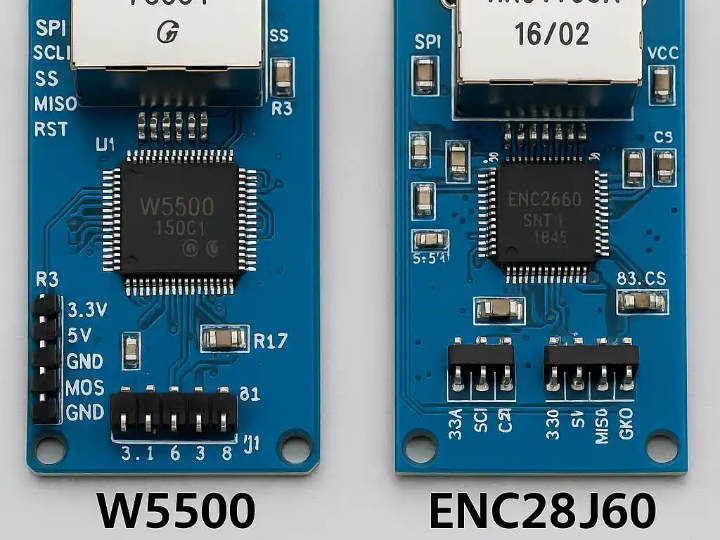
COMPONENTS Hardware components

WIZnet - W5500

x 1


PROJECT DESCRIPTION

개요

임베디드 제품에서 이더넷 컨트롤러 선택은 단순 스펙 경쟁이 아닙니다. 실제로는 펌웨어 복잡도, 개발·검증 기간, 생산 단가, 장기 유지보수 리스크가 성공 여부를 가릅니다. 이 글은 WIZnet W5500과 Microchip ENC28J60를 동일 조건에서 비교해, 숫자 스펙을 넘어 오프로딩 유무(TCP/IP 하드웨어 스택), 버퍼 구조, SPI 효율, EMI·인증 난이도 등 실무 의사결정 요소 다루고 있습니.

우리 MCU·펌웨어 리소스에 맞는 컨트롤러는 무엇인가?
OTA/웹 대시보드/스트리밍 등 응답성·처리량이 중요한 워크로드에서 어느 칩이 유리한가?
총소유비용(TCO) 관점에서 어느 쪽이 개발·생산·유지보수까지 비용을 절감하는가?

결론적으로, 제품화·장기지원·고성능이 핵심이면 W5500이 유리하고, 교육·레트로·브레드보드 중심이면 ENC28J60이 실용적 대안이 됩니다.

참고: 본 글은 Chipmall의 “[W5500 vs ENC28J60]” 내용을 요약한 것입니다. 자세한 기술 사양, 테스트 결과, 비교 표 및 최신 업데이트는 Chipmall 원문을 확인해 주세요.
원문: https://www.chipmall.com/blogs/w5500-vs-enc28j60_122


한눈에 보는 핵심 요약

목표: 데이터시트 스펙이 아닌 펌웨어 난이도·생산 비용·출시 속도 중심 선택
결론: 상용/세미프로 제품 → W5500이 속도·코드 단순성·가격·LTS에서 우세
예외: 8비트 MCU·브레드보드·레트로 하드웨어 → **ENC28J60(DIP)**도 실용


왜 ‘스펙’보다 ‘현실 우선’인가

임베디드에서 체감 성능은 프로토콜 오프로딩, 버퍼 용량, SPI 효율에 크게 좌우됩니다. 단순 Mbps 수치보다 응답성/CPU 점유율/디버깅 리스크가 제품 품질과 일정에 결정적입니다.


W5500 vs ENC28J60: 핵심 비교표

SpecificationW5500ENC28J60
Ethernet StandardIEEE 802.3 / 10/100BASE-TXIEEE 802.3 / 10BASE-T
SPI Clock FrequencyUp to 80 MHzUp to 20 MHz
Internal Buffer32 KB (16 KB TX + 16 KB RX)8 KB (shared TX/RX)
TCP/IP StackBuilt-in (hardware)External (e.g., lwIP)
Socket Support8 simultaneous socketsSoftware-managed
Operating Voltage3.3 V3.1–3.6 V
Current Consumption~132 mA @ 3.3 V~180 mA @ 3.3 V
Package OptionsQFN48, LQFP48DIP28, SSOP28, SOIC
PHY LayerIntegrated 10/100 PHYIntegrated 10 Mbps PHY
Auto-MDIX SupportYesNo
MDI/MDI-X SwitchingSupportedManual
Wake-on-LAN (WoL)YesNo
Jumbo Frame SupportNoNo
RoHS ComplianceYesYes

출처 : https://www.chipmall.com/blogs/w5500-vs-enc28j60_122

펌웨어 영향

W5500: 하드와이어드 TCP/IP(ARP/TCP/UDP)로 MCU는 단순 레지스터 I/O 중심.

ENC28J60: MAC+PHY만 제공 → lwIP 등 스택 구현·튜닝·유지보수 부담.

실무 예: Cortex-M3 기준 ENC28J60+lwIP ≈ 40KB+ 플래시, W5500 ≈ 6KB.

MCU-W5500 vs MCU-ENC28J60  | Chipmall.com Electronic

이미지 출처 : https://www.chipmall.com/blogs/w5500-vs-enc28j60_122


실제 성능: 처리량·지연·CPU 점유

STM32F103(72 MHz) 기준 실험
W5500: 버스트 SPI에서 ~92 Mbps에 근접, 지연 안정적, CPU 인터럽트 최소화
ENC28J60: 표준 SPI(20 MHz)로 ~5 Mbps 수준, 지터↑, 패킷 지연 간헐
의미: OTA, 웹 대시보드, 스트리밍 등에서 W5500이 10–20배 체감 응답성 우위

W5500은 내부 버퍼와 하드웨어 TCP/IP 오프로딩 덕분에, 특히 지속 부하(sustained load) 상황에서 MCU 사이클 사용을 크게 줄여줍니다. 반대로 ENC28J60은 펌웨어 의존 설계이므로, MCU가 모든 패킷 처리·ACK·재전송(retransmission) 까지 직접 담당해야 해 CPU 점유율과 지터가 증가하고 스택 튜닝 부담이 커집니다.

Comparison of Throughput, Average Latency, and CPU Usage on STM32F1 | Chipmall.com Electronic

이미지 출처 : https://www.chipmall.com/blogs/w5500-vs-enc28j60_122


하드웨어 설계: 레이아웃·전력·EMI

W5500: QFN/LQFP로 콤팩트 설계 유리, 모듈(예: W5500-EVB 등) 활용 시 자석소자·Auto-MDIX로 BOM·레이아웃 단순화

ENC28J60: DIP-28은 브레드보드 친화적이나 외부 자석소자·필터 필요, EMI 관리 부담

전력: W5500 ~132 mA(100 Mbps FDX) vs ENC28J60 ~180 mA(10 Mbps)

: 규격 적합성·SI·보드 공간이 중요하면 W5500, 레거시 5V 보드 급조 시연이면 ENC28J60(DIP)


비용(TCO): 칩 가격을 넘어

단가(100pcs 가정): W5500 ≈ $2.29, ENC28J60 ≈ $3.40

총소유비용(TCO)

외부 부품: W5500 감소(모듈/통합요소 활용) vs ENC28J60 증가
펌웨어: W5500 개발·디버깅 시간 단축 vs ENC28J60 스택 튜닝 시간 증가
전력: W5500 효율 우위
유지보수: W5500 리스크↓

FactorW5500ENC28J60
External ComponentsFewer (often integrated magnetics)May need separate magnetics, filtering
Firmware DevelopmentFaster (built-in stack)Longer (manual TCP/IP, lwIP tuning)
Power EfficiencyLower current drawHigher overall draw
Debug & Maintenance TimeMinimalHigher (stack bugs, edge cases)

출처 : https://www.chipmall.com/blogs/w5500-vs-enc28j60_122


용도별 추천

Use CaseBest Choice
High-throughput devices (e.g., cameras, gateways)W5500
Simple sensors or logging (low data, 8-bit MCU)ENC28J60
Breadboarding or retro-hardware emulationENC28J60 (DIP)
Production product with long-term supportW5500
You hate debugging TCP/IP bugsDefinitely W5500

출처 : https://www.chipmall.com/blogs/w5500-vs-enc28j60_122


대안 살펴보기

W6100: W5500급 + IPv6 지원

LAN8720: PHY 전용, **STM32 MAC(RMII)**와 페어

DM9051: SPI 이더넷(ENC28J60보다 통합도↑), 비교적 쉬운 통합


결론

전반적 승자: W5500 — 속도, 코드 단순성, 가격, 장기지원 모두 강점.

ENC28J60의 자리 — 교육용·8비트·취미/브레드보드에서 여전히 유효.

추천 액션 — 요구사항이 모호하면 두 모듈로 프로토타입 후 측정·판단. 그게 엔지니어링입니다.


Overview

Choosing an Ethernet controller for an embedded product isn’t a simple spec-sheet race. In practice, firmware complexity, development/validation time, production cost, and long-term maintenance risk determine success. This article compares WIZnet W5500 and Microchip ENC28J60 under equivalent conditions and, beyond raw numbers, examines real engineering factors such as TCP/IP offload (hardware stack), buffer architecture, SPI efficiency, and EMI/certification difficulty.

Key questions this guide helps you answer:

Which controller best fits our MCU and firmware resources?

For workloads where responsiveness and throughput matter (OTA, web dashboards, streaming), which chip has the edge?

From a total cost of ownership (TCO) standpoint, which one reduces costs across development, production, and maintenance?

Bottom line: if your priorities are productization, long-term support, and high performance, the W5500 is advantageous. If your focus is education, retro projects, or breadboard convenience, the ENC28J60 remains a practical alternative.

Note: This article is a summary of Chipmall’s “W5500 vs ENC28J60” post. For full technical details, test results, comparison tables, and the latest updates, please visit the original article on Chipmall.
Source: https://www.chipmall.com/blogs/w5500-vs-enc28j60_122

Key Takeaways at a Glance

Goal: Choose based on firmware difficulty, production cost, and time-to-market, not just datasheet specs.

Conclusion: For commercial/semi-pro products, the W5500 leads in speed, code simplicity, price, and LTS.

Exception: For 8-bit MCUs, breadboards, and retro hardware, ENC28J60 (DIP) is still practical.

Why “Real-World First” Beats “Specs First”

Perceived performance in embedded systems depends heavily on protocol offload, buffer size, and SPI efficiency. More than headline Mbps, responsiveness/CPU utilization/debug risk drives product quality and schedule.

W5500 vs ENC28J60: Core Comparison Table

SpecificationW5500ENC28J60
Ethernet StandardIEEE 802.3 / 10/100BASE-TXIEEE 802.3 / 10BASE-T
SPI Clock FrequencyUp to 80 MHzUp to 20 MHz
Internal Buffer32 KB (16 KB TX + 16 KB RX)8 KB (shared TX/RX)
TCP/IP StackBuilt-in (hardware)External (e.g., lwIP)
Socket Support8 simultaneous socketsSoftware-managed
Operating Voltage3.3 V3.1–3.6 V
Current Consumption~132 mA @ 3.3 V~180 mA @ 3.3 V
Package OptionsQFN48, LQFP48DIP28, SSOP28, SOIC
PHY LayerIntegrated 10/100 PHYIntegrated 10 Mbps PHY
Auto-MDIX SupportYesNo
MDI/MDI-X SwitchingSupportedManual
Wake-on-LAN (WoL)YesNo
Jumbo Frame SupportNoNo
RoHS ComplianceYesYes

Source: https://www.chipmall.com/blogs/w5500-vs-enc28j60_122

Firmware Impact

W5500: Hard-wired TCP/IP (ARP/TCP/UDP), so the MCU mainly does simple register I/O.

ENC28J60: Provides only MAC+PHY → implementation, tuning, and maintenance of a software stack (e.g., lwIP) fall on you.

Real-world example: On a Cortex-M3, ENC28J60 + lwIP ≈ 40 KB+ of flash; W5500 ≈ 6 KB.

MCU-W5500 vs MCU-ENC28J60  | Chipmall.com Electronic
Image source: https://www.chipmall.com/blogs/w5500-vs-enc28j60_122

Real-World Performance: Throughput, Latency, and CPU Use

Test setup: STM32F103 (72 MHz)

W5500: Near ~92 Mbps in burst SPI, stable latency, minimal CPU interrupts

ENC28J60: About ~5 Mbps with standard 20 MHz SPI, higher jitter, occasional packet delays

Implication: For OTA, web dashboards, and streaming, the W5500 feels 10–20× more responsive.

The W5500’s internal buffer and hardware-managed TCP/IP offload substantially reduce MCU cycles, especially under sustained load. In contrast, the ENC28J60’s firmware-driven approach makes the MCU handle every packet, ACK, and retransmission, increasing CPU utilization and jitter and adding stack-tuning overhead.

Comparison of Throughput, Average Latency, and CPU Usage on STM32F1 | Chipmall.com Electronic
Image source: https://www.chipmall.com/blogs/w5500-vs-enc28j60_122

Hardware Design: Layout, Power, and EMI

W5500: QFN/LQFP favor compact layouts; using modules (e.g., W5500-EVB) with integrated magnetics and Auto-MDIX simplifies BOM and layout.

ENC28J60: DIP-28 is breadboard-friendly but needs external magnetics/filters, raising EMI management effort.

Power: W5500 ~132 mA (100 Mbps FDX) vs. ENC28J60 ~180 mA (10 Mbps).

Tip: If you care about compliance, SI, and board space, pick W5500. For quick demos on legacy 5 V boards, ENC28J60 (DIP) has its charm.

Cost (TCO): Beyond the Chip Price

Indicative unit price (100 pcs): W5500 ≈ $2.29, ENC28J60 ≈ $3.40

Total Cost of Ownership (TCO):

External components: Lower with W5500 (often integrated magnetics) vs Higher with ENC28J60

Firmware: Faster on W5500 (built-in stack) vs Longer on ENC28J60 (manual TCP/IP, lwIP tuning)

Power: More efficient with W5500

Maintenance: Lower risk with W5500

FactorW5500ENC28J60
External ComponentsFewer (often integrated magnetics)May need separate magnetics, filtering
Firmware DevelopmentFaster (built-in stack)Longer (manual TCP/IP, lwIP tuning)
Power EfficiencyLower current drawHigher overall draw
Debug & Maintenance TimeMinimalHigher (stack bugs, edge cases)

Source: https://www.chipmall.com/blogs/w5500-vs-enc28j60_122

Recommendations by Use Case

Use CaseBest Choice
High-throughput devices (e.g., cameras, gateways)W5500
Simple sensors or logging (low data, 8-bit MCU)ENC28J60
Breadboarding or retro-hardware emulationENC28J60 (DIP)
Production product with long-term supportW5500
You hate debugging TCP/IP bugsDefinitely W5500

Source: https://www.chipmall.com/blogs/w5500-vs-enc28j60_122

Alternatives to Consider

W6100: Similar to W5500, plus IPv6 support

LAN8720: PHY-only; pairs with STM32 MAC (RMII)

DM9051: SPI Ethernet with higher integration than ENC28J60; relatively easy to integrate

Conclusion

Overall winner: W5500 — strong in speed, code simplicity, price, and long-term support.

Where ENC28J60 fits — still relevant for education, 8-bit MCUs, and hobby/breadboard builds.

Recommended action — if requirements are unclear, prototype with both modules, measure, and decide. That’s engineering.


Documents
Comments Write

