Wiznet makers

mason

Published January 19, 2026 ©

119 UCC

21 WCC

32 VAR

0 Contests

0 Followers

0 Following

Original Link

Long-range key mouse controls equipment

Long-range key mouse controls equipment
COMPONENTS Hardware components

WIZnet - W5500

x 1


STMicroelectronics - STM32F103RCT6

x 1


PROJECT DESCRIPTION

프로젝트 개요

이 특허는 네트워크로 전달된 입력 이벤트를 현장에서 PS/2 신호로 재구성해 PC에 주입하는 장치를 제안합니다. 제어단 PC가 키 입력·마우스 이벤트를 패킷으로 보내면, 장치가 이를 받아 PS/2 키보드/마우스 포트로 출력해 피제어단 PC가 일반 입력장치처럼 인식하도록 만듭니다. 


Technical analysis

특허의 구성요소는 STM32F103(메인 제어/변환), W5500(이더넷 컨트롤러), RJ45, EEPROM(설정 저장), PS/2 포트 2개(키보드/마우스) 로 정리됩니다. 네트워크로 들어온 입력 패킷은 W5500이 수신하고, STM32F103이 SPI로 데이터를 읽어 명령을 해석한 뒤 PS/2 프레임으로 변환해 각 포트로 내보냅니다.

W5500을 쓰는 설계 포인트는 “MCU 부담 분산”입니다. W5500은 Hardwired TCP/IP 기반의 소켓 인터페이스를 제공해, MCU가 네트워크 스택 전체를 직접 구현하는 방식보다 구현 난이도를 낮추는 방향성을 갖습니다. 또한 최대 80MHz SPI, 32KB 내부 버퍼 같은 특성은 패킷 송수신을 단순화하는 데 유리합니다. 

보안 관점에서 특허는 “PC로 들어가는 경로를 입력 신호로 제한”하는 논리를 내세웁니다. 네트워크는 장치까지만 들어오고, PC에는 PS/2 입력만 전달되므로 USB처럼 범용 데이터 경로가 열리는 형태보다 공격면을 줄일 수 있다는 주장입니다.


Architecture & data flow

[텍스트 블록 다이어그램]
Control PC
→ (Ethernet/LAN, 입력 이벤트 패킷)
RJ45W5500
↔ (SPI) ↔ STM32F103
PS/2 Keyboard → Controlled PC
PS/2 Mouse → Controlled PC

[설정/유지보수 경로]
HMI → STM32F103 → EEPROM(예: IP 저장)
MicroUSB → STM32F103

[단계별 동작 요약]

제어단에서 입력 이벤트를 패킷으로 전송

W5500이 수신 후 MCU가 읽을 수 있게 제공

STM32F103이 이벤트를 PS/2 포맷으로 매핑

키보드/마우스 포트로 분리 출력

피제어단 PC는 로컬 입력장치처럼 처리
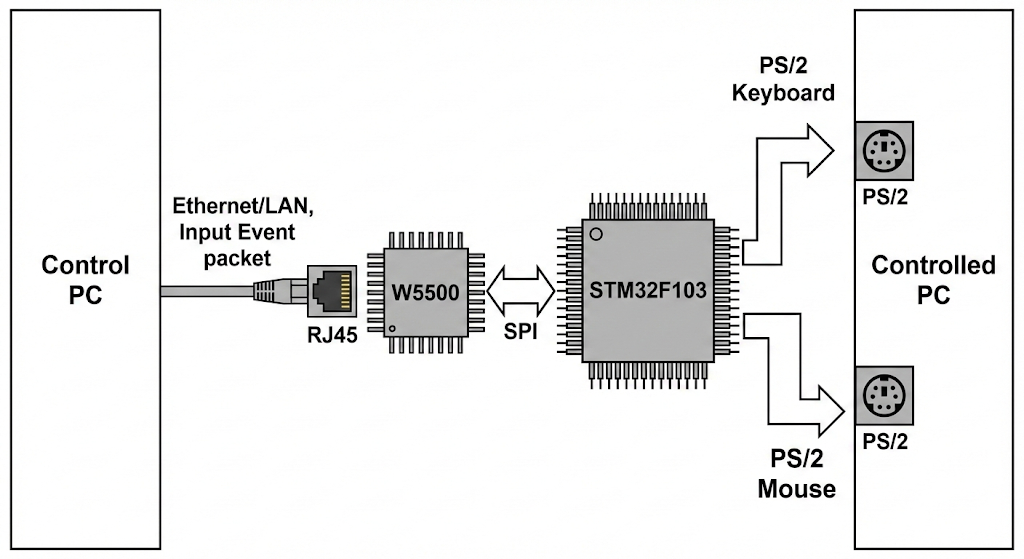
이미지 출처 : AI 생성


적용 가능 사례들

아래는 이 아키텍처가 현실에서 유용해지는 상황을, 특허 구조(유선 이더넷 수신 + PS/2 출력)에 맞춰 정리한 예시입니다.

산업 현장 PC 원격 유지보수(설비 라인/제어실)

생산 라인 옆의 PC는 접근이 어렵거나 안전장비가 필요한 경우가 많습니다. 장치가 PC 가까이에 설치돼 있으면, 제어실에서 네트워크로 입력만 보내 작업자 없이 로그인/설정 변경 같은 최소 조작을 할 수 있습니다. 유선 이더넷(W5500)은 무선 대비 링크 품질이 예측 가능한 편이라 “항상 붙는 입력”에 적합합니다.

보안 구역·격리망에서 “입력만” 허용하는 운영

피제어단 PC에 USB 저장장치/복합 HID 경로를 열기 싫은 환경(규정/감사)에서, PS/2 입력만 전달하는 장치로 운영 정책을 단순화할 수 있습니다(특허의 주장 방향). 데이터 전송이 아니라 “키/마우스 이벤트 전달”로 목적을 좁히는 셈입니다.

서버실·원격지 지점의 구형 장비(PS/2 기반 KVM 대체/보완)

PS/2 포트를 가진 구형 PC/산업용 임베디드 PC는 여전히 존재합니다. 장비 앞에 사람이 갈 수 없는 상황에서 네트워크로 조작이 필요할 때, 이 장치가 “입력 채널”을 제공하는 역할을 할 수 있습니다.

교육/실습실: 한 대의 제어 PC로 여러 실습 PC에 입력 주입

실습 환경에서 강사가 특정 PC에 로그인 절차를 보여주거나, 학생 PC의 입력 상태를 강제로 리셋하는 등 “입력 레벨” 제어가 필요할 때 활용 여지가 있습니다. 설정은 HMI/EEPROM에 저장하는 흐름이라 실습실 재부팅 후에도 네트워크 설정을 유지하는 구성이 가능합니다.

청정실/의료·반도체 공정처럼 현장 접근이 제한된 공간

장비가 있는 공간에 사람 출입이 제한되는 경우, 네트워크를 통해 최소한의 조작(커서 이동/클릭/단축키)을 수행하도록 설계할 수 있습니다. 유선 이더넷 기반은 전파 환경 영향을 받는 무선보다 운영 변수가 줄어듭니다(일반적 트레이드오프).

참고: 위 사례는 “특허에 나온 장치 구조가 어떤 문제에 맞는가”를 기준으로 현실 적용을 풀어쓴 것이고, 특정 산업 표준 적합성(예: 안전/규제 인증)은 별도 설계·검증이 필요합니다.


FAQ (WIZnet 중심)

1) 왜 이 구조에서 W5500이 적합한가요?

W5500은 Hardwired TCP/IP와 소켓 모델을 제공해, MCU가 네트워크 스택 전체를 직접 감당하는 구조보다 구현 부담을 줄이는 데 유리합니다. 입력 브리지는 “수신 안정성 + 이벤트 처리”가 핵심인데, SPI 기반 인터페이스와 내부 버퍼(32KB)는 패킷 처리의 복잡도를 낮추는 방향으로 작동합니다.

2) STM32F103에는 어떻게 물리적으로 연결하나요?

특허는 STM32F103이 SPI로 W5500을 제어한다고 명시합니다. 따라서 MCU의 SPI 신호선(MOSI/MISO/SCK/CS)과 W5500을 연결하고, 이더넷은 RJ45를 통해 W5500 측으로 입력됩니다. IP 같은 설정은 HMI에서 입력해 EEPROM에 저장하는 흐름을 제안합니다.

3) 이 특허에서 W5500이 맡는 역할을 한 문장으로 말하면?

네트워크 입력(이더넷 패킷)을 받아 MCU가 해석할 수 있는 형태로 제공하는 통신 프런트엔드입니다. MCU는 그 위에서 이벤트 파싱과 PS/2 변환을 담당합니다.

4) 초보자에게 난이도는 어떤가요?

네트워크 수신 자체는 W5500 덕분에 접근성이 있지만, 구현 난이도는 PS/2 에뮬레이션(타이밍/프레임)과 “입력 이벤트 매핑 품질”에서 결정됩니다. 또한 설정 저장(EEPROM), 사용자 입력(HMI), 업데이트 경로(MicroUSB 언급)까지 포함하면 펌웨어 구조를 잡는 경험이 있으면 훨씬 수월합니다. 

5) ENC28J60+LwIP나 Wi-Fi(ESP32)와 비교하면?

ENC28J60 계열은 종종 MCU에서 TCP/IP 스택을 더 많이 처리해야 하므로 메모리/CPU 여유가 적을수록 부담이 커질 수 있습니다. W5500은 하드웨어 스택과 버퍼로 그 부담을 줄이는 방향입니다. Wi-Fi는 배선이 쉬운 대신 무선 환경 변수(혼잡/전파/정책)에 영향을 받기 쉬워 “항상 붙어 있어야 하는 입력 장치”에서는 유선 이더넷이 더 예측 가능한 선택이 될 수 있습니다.


Project Overview

This patent proposes a device that reconstructs input events delivered over a network into PS/2 signals on-site and injects them into a PC. When a control PC sends keyboard and mouse events as packets, the device receives them and outputs PS/2 keyboard/mouse signals so the controlled PC recognizes them as normal local input devices.


Technical Analysis

The system can be summarized as: STM32F103 (main control/translation), W5500 (Ethernet controller), RJ45, EEPROM (configuration storage), and two PS/2 ports (keyboard + mouse). Network input packets are received by the W5500, and the STM32F103 reads the data over SPI, interprets the commands, converts them into PS/2 frames, and outputs them through the corresponding ports.

A key design point of using the W5500 is offloading work from the MCU. The W5500 provides a Hardwired TCP/IP socket interface, which reduces implementation complexity compared to building the full network stack in firmware on the MCU. Features such as up to 80 MHz SPI and a 32 KB internal buffer also help simplify packet transmit/receive handling.

From a security perspective, the patent argues for restricting what reaches the controlled PC to input-only signals. The network terminates at the device, while the PC receives only PS/2 input, which (as claimed) can reduce the attack surface compared to USB-based approaches that may expose more general-purpose data paths.


Architecture & Data Flow

[Text Block Diagram]

Control PC
→ (Ethernet/LAN, input-event packets)
→ RJ45 → W5500
↔ (SPI) ↔ STM32F103
→ PS/2 Keyboard → Controlled PC
→ PS/2 Mouse → Controlled PC

[Configuration / Maintenance Path]

HMI → STM32F103 → EEPROM (e.g., IP configuration)
MicroUSB → STM32F103

[Step-by-step Operation Summary]

The control side transmits input events as packets.

The W5500 receives the packets and exposes them for the MCU to read.

The STM32F103 maps events into PS/2 format.

Output is split into keyboard and mouse PS/2 ports.

The controlled PC processes the signals as if they came from local peripherals.

Image source: AI-generated


Applicable Use Cases

Below are practical situations where this architecture (wired Ethernet reception + PS/2 output) can be useful.

1) Remote maintenance for industrial PCs (production line / control room)

PCs located near production equipment can be hard to access or require safety gear. If the device is installed near the PC, operators in the control room can send only input events over the network to perform minimal actions such as logging in or changing settings without physically visiting the site. Wired Ethernet (W5500) typically offers more predictable link stability than wireless, which is beneficial for “always-on” input control.

2) Operating in secured or isolated networks where only “input” is permitted

In regulated environments where administrators want to avoid opening USB storage or composite HID pathways on the controlled PC, a PS/2-only input device can simplify policy enforcement (aligned with the patent’s rationale). The goal is narrowed to keyboard/mouse event delivery rather than general data transfer.

3) Legacy equipment in server rooms or remote branches (PS/2-based KVM replacement/supplement)

Legacy PCs and industrial embedded systems with PS/2 ports still exist. When physical access is difficult but basic control is required, this device can provide an “input channel” over the network without requiring a full KVM stack.

4) Education / lab environments: injecting input to multiple practice PCs from one control PC

In labs, an instructor may need to demonstrate login steps on a specific machine or reset a student workstation’s input state at the “input level.” Because configuration can be stored via HMI/EEPROM, network settings can persist across reboots.

5) Access-restricted spaces such as clean rooms, medical facilities, or semiconductor processes

Where human entry is restricted, remote operation may require only minimal interactions (cursor movement, clicks, hotkeys). Wired Ethernet can reduce operational variability compared to wireless solutions that are sensitive to RF conditions and policy constraints.

Note: These examples interpret how the patented structure maps to real-world needs. Compliance with industry standards (safety/regulatory certification) requires separate design validation and testing.


FAQ (WIZnet-focused)

1) Why is the W5500 a good fit for this design?

The W5500 provides Hardwired TCP/IP and a socket model, which helps reduce firmware complexity versus implementing a full TCP/IP stack on the MCU. For an input bridge, the core requirements are reliable reception and timely event handling; the SPI-based interface and internal buffer (32 KB) support a simpler packet-processing path.

2) How is it physically connected to an STM32F103?

The patent states that the STM32F103 controls the W5500 via SPI. In practice, this means wiring MOSI/MISO/SCK/CS between the MCU and the W5500, while Ethernet traffic enters through RJ45 into the W5500 side. Network parameters such as IP address are entered via HMI and stored in EEPROM.

3) In one sentence, what is the W5500’s role in this patent?

It acts as the Ethernet communications front-end that receives network input packets and presents them in a form the MCU can interpret; the MCU then performs event parsing and PS/2 signal generation.

4) Is this beginner-friendly?

Network reception becomes more approachable thanks to the W5500, but overall difficulty is mainly determined by PS/2 emulation (timing/frame correctness) and the quality of input-event mapping. Adding EEPROM configuration storage, HMI handling, and a MicroUSB-based maintenance path increases firmware-architecture demands, so prior embedded experience helps.

5) How does it compare to ENC28J60 + LwIP or Wi-Fi (ESP32)?

ENC28J60-based solutions often require the MCU to handle more of the TCP/IP stack (e.g., via LwIP), which can increase CPU/RAM pressure and implementation complexity. The W5500 reduces that burden through its hardware stack and buffering. Wi-Fi simplifies cabling but is more exposed to RF congestion, policy restrictions, and environmental variability; for an “always-connected” input bridge, wired Ethernet can be a more predictable choice.


Documents
Comments Write