


hip_MINI
hip_MINI
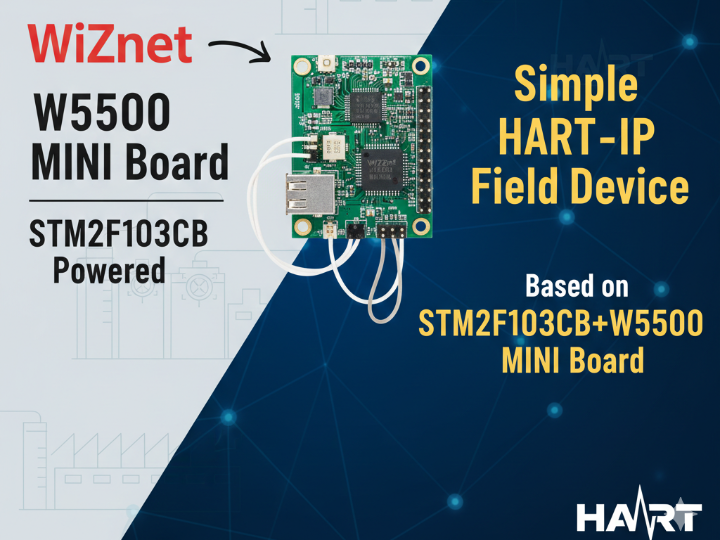
STMicroelectronics - STM32F103RCT6
x 1

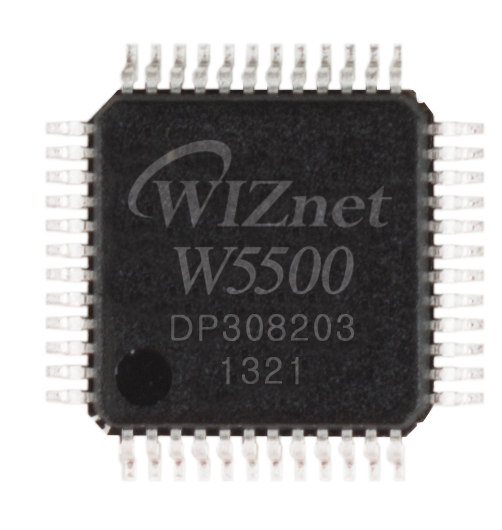
WIZnet - W5500
x 1
1) HART 개요
HART(Highway Addressable Remote Transducer)는 4 ~ 20 mA 전류 루프 위에 디지털 신호를 얹어 데이터를 주고받는 방식으로, 아날로그 신호를 유지하면서 추가 정보를 교환할 수 있는 기술이다. FieldComm Group은 HART가 프로세스 산업에서 가장 널리 배포된 디지털 통신 기술이며, 전 세계 설치 기반이 4천만 대 이상이라고 설명한다.
동작 방식 측면에서 HART는 요청 응답 구조이며, 호스트가 요청할 때 필드 디바이스가 응답하는 형태가 기본이다. 디지털 신호는 4 ~ 20 mA 신호 위에 낮은 레벨로 중첩되며, FSK 방식으로 1200 bps 통신을 수행한다. 이 덕분에 기존 배선과 아날로그 루프를 유지하면서 설정값, 진단, 상태 같은 추가 데이터를 교환할 수 있다.
2) HART IP 개요
HART IP는 HART의 요청 응답 개념을 IP 네트워크로 확장한 것으로, TCP IP와 Ethernet 환경에서 클라이언트 서버 모델로 동작한다. FieldComm Group의 기술 문서는 필드 기기와 게이트웨이 같은 리소스 제공 장치가 서버가 되고, 컨트롤러나 소프트웨어 시스템이 클라이언트가 된다고 설명한다. 서버는 다중 동시 클라이언트를 지원하며 최소 5개 클라이언트를 지원하도록 안내한다.
최근 규격 흐름에서는 보안과 감사 요구가 강화되었고, 적합성 관점에서 TLS, DTLS, syslog, audit logs 지원이 요구된다고 FieldComm Group이 명시한다. 또한 Ethernet APL 환경에서 10Mb/s급 링크로 1MB 파일을 약 1초에 전송할 수 있다는 비교를 통해, 기존 4에서 20 mA 기반 전송 대비 대용량 데이터 전송 이점도 강조한다.
3) HART IP 사용사례
현장에서 HART IP가 유리해지는 대표 시나리오는 다음과 같다.
원격 커미셔닝과 설정
표준 IP 네트워크를 통해 노트북 툴이나 자산관리 시스템이 필드 디바이스에 접속해 태그, 레인지, 댐핑, 경보 설정 등을 수행한다. 클라이언트 서버 구조가 이를 전제로 한다.
자산관리와 상태 감시
호스트가 주기적으로 HART 커맨드를 요청해 상태와 진단을 수집하고, 예지보전과 운영 최적화에 활용한다. HART 자체가 진단과 추가 데이터 교환을 위한 채널을 제공해 왔고, HART IP는 이를 IP 기반으로 확장한다.
대용량 데이터와 업데이트
진단 로그, 감사 이벤트, 파일 형태의 데이터가 늘어나는 환경에서 전송 속도 이점이 커진다. FieldComm Group은 Ethernet APL 기반 HART IP가 1MB 파일을 약 1초에 전송할 수 있다고 설명한다.
인프라 장비와 결합
HART 멀티플렉서, WirelessHART 게이트웨이 같은 인프라 장비도 HART IP 서버가 될 수 있으며, 보안 자격증명과 syslog 설정까지 프로비저닝 대상이 된다고 기술 문서가 다룬다.
4) 산업 규모와 성장률
공개 자료만으로 HART IP 단일 시장 규모를 신뢰도 높게 확정하기는 어렵다. 다만 HART IP가 주로 포함되는 상위 시장인 프로세스 자동화와 프로세스 계측 시장 규모는 다음과 같이 제시된다.
Grand View Research는 프로세스 자동화 및 계측 시장이 2024년 744억 5천만 달러에서 2030년 1천 64억 9천만 달러로 성장하며 2025년부터 2030년까지 연평균 성장률 5.9%라고 추정한다.
Mordor Intelligence는 프로세스 계측 시장이 2025년 190억 8천만 달러에서 2031년 231억 7천만 달러로 성장하며 2026년부터 2031년까지 연평균 성장률 3.29%라고 제시한다.
이 상위 시장의 성장 요인인 디지털 전환, 원격 운영, 보안 요구 강화는 HART IP가 겨냥하는 필드 디바이스 연결성과도 맞물린다. 특히 보안과 감사 기능이 적합성에서 요구된다는 점은, 산업 현장에서 단순 연결을 넘어 운영 신뢰성과 규정 준수를 요구한다는 신호로 해석할 수 있다.
5) hip_MINI 프로젝트 구조와 레이어 흐름
저장소는 HART IP 필드 디바이스 데모를 목표로 하며, 폴더 구조에서 네트워크 레이어, 애플리케이션 레이어, 커맨드 레이어를 분리했다고 설명한다. Ethernet 통신은 WIZnet ioLibrary Driver를 사용해 W5500 소켓 기반 TCP 서버를 구성하는 방식으로 안내한다.
하드웨어 구성에서 W5500은 SPI2로 연결되며, 설정 덤프에는 SPI2 핀 PB13, PB14, PB15와 W5500 RST, SCS, INT 핀이 정리되어 있다.
핵심은 hip_svr가 네트워크 종단을 담당하고, hip_app이 디바이스 상태 모델과 저장 데이터를 담당하며, hip_cmd가 HART 명령 처리 책임을 갖는다는 점이다. 이런 분리는 산업용 필드 디바이스 설계에서 테스트와 확장을 단순화한다.
6) FAQ
Q1. 왜 HART IP 필드 디바이스에 W5500을 쓰나요
이 저장소는 W5500 드라이버와 TCP 서버용 소켓 API로 WIZnet ioLibrary Driver를 사용한다고 밝힌다. W5500을 쓰면 MCU 애플리케이션은 소켓 기반 송수신 흐름에 집중할 수 있고, 네트워크 처리를 단순화한 구조로 데모를 빠르게 구성하기 유리하다. 프로젝트 목표가 최소 구현인 만큼, 네트워크 스택 부담을 낮추는 선택이 합리적이다.
Q2. 이 프로젝트에서 HART IP 서버 레이어 hip_svr는 무엇을 담당하나요
FieldComm Group 문서가 설명하는 HART IP는 클라이언트 서버 프로토콜이며, 필드 기기 쪽이 서버 역할을 맡는다. hip_svr는 이 서버 역할을 구현하는 위치로, TCP 세션 수립과 유지, 수신 프레임 처리, 상위 레이어 전달을 담당하는 구성이 자연스럽다. 서버는 다중 동시 클라이언트를 지원해야 하므로 세션 관리와 자원 관리가 중요해진다.
Q3. hip_app 레이어는 무엇을 담아야 하나요
README는 hip_app에 애플리케이션 레이어와 NVM 데이터를 포함한다고 설명한다. HART 환경에서 애플리케이션 레이어는 태그, 상태, 진단, 설정값 같은 디바이스 모델을 관리하고, 전원 재가동 후에도 유지되어야 하는 값은 NVM로 저장하는 정책이 필요하다. 이 레이어가 안정적이어야 커맨드 처리 결과가 일관되게 나온다.
Q4. hip_cmd 레이어에서 가장 중요한 설계 포인트는 무엇인가요
HART는 요청 응답 기반이며 호스트가 요청할 때 디바이스가 응답한다. 따라서 hip_cmd는 커맨드 디코딩, 파라미터 검증, 응답 구성의 품질이 곧 상호운용성과 안정성을 좌우한다. 특히 잘못된 요청에 대한 에러 응답 일관성, 경계값 처리, 상태 코드 관리가 중요하다.
Q5. 이 데모를 현장 적용에 가깝게 만들려면 무엇을 추가해야 하나요
FieldComm Group은 HART IP 적합성에서 TLS, DTLS, syslog, audit logs 지원이 요구된다고 밝힌다. 따라서 우선순위는 보안 프로비저닝, 감사 이벤트 기록, syslog 전송, 키 관리다. 그 다음은 다중 클라이언트 동시 접속을 고려한 세션 안정성, 장시간 운전에서의 메모리와 버퍼 관리, 예외 처리 강화가 된다. README의 제한 사항이 바로 이 격차를 요약한다.
HART Overview
HART is a communication method that superimposes a digital signal on top of a 4–20 mA current loop, enabling the exchange of additional information while preserving the analog signal. FieldComm Group describes HART as the most widely deployed digital communication technology in the process industries, with a global installed base of more than 40 million devices.
In terms of operation, HART follows a request–response model: the host sends a request and the field device returns a response. The digital signal is overlaid at a low level on the 4–20 mA signal and uses FSK modulation to communicate at 1200 bps. This allows existing wiring and analog loops to remain in place while exchanging extra data such as configuration parameters, diagnostics, and device status.
HART-IP Overview
HART-IP extends HART’s request–response concept to IP networks and operates as a client–server model over TCP/IP and Ethernet. FieldComm Group’s technical documentation explains that resource-providing devices such as field devices and gateways act as servers, while controllers or software systems act as clients. The server supports multiple concurrent clients and is guided to support at least five clients.
In recent specification trends, security and audit requirements have been strengthened. FieldComm Group states that, from a conformance perspective, support for TLS, DTLS, syslog, and audit logs is required. FieldComm Group also highlights the advantage of transferring large data by noting that, in an Ethernet-APL environment, a 10 Mb/s-class link can transfer a 1 MB file in about one second—emphasizing the throughput benefits compared to traditional 4–20 mA-based transmission.
HART-IP Use Cases
Representative scenarios where HART-IP becomes advantageous in the field are as follows.
Remote commissioning and configuration
Using a standard IP network, a laptop tool or an asset management system connects to a field device to perform tag, range, damping, and alarm configuration. The client–server structure assumes this workflow.
Asset management and condition monitoring
A host periodically requests HART commands to collect status and diagnostic information and uses it for predictive maintenance and operational optimization. HART has long provided a channel for diagnostics and additional data exchange, and HART-IP extends this capability over IP networks.
Large data transfer and updates
As diagnostic logs, audit events, and file-based data increase, the benefits of higher transfer speeds become more significant. FieldComm Group explains that Ethernet-APL-based HART-IP can transfer a 1 MB file in about one second.
Integration with infrastructure devices
Infrastructure devices such as HART multiplexers and WirelessHART gateways can also act as HART-IP servers, and technical documentation covers that security credentials and syslog settings can be part of what is provisioned.
Industry Scale and Growth Rate
It is difficult to determine a highly reliable market size for HART-IP alone using only publicly available materials. However, the size and growth of higher-level markets that commonly include HART-IP—process automation and process instrumentation—are presented as follows.
Grand View Research estimates that the process automation and instrumentation market will grow from USD 74.45 billion in 2024 to USD 106.49 billion in 2030, with a CAGR of 5.9% from 2025 to 2030.
Mordor Intelligence suggests that the process instrumentation market will grow from USD 19.08 billion in 2025 to USD 23.17 billion in 2031, with a CAGR of 3.29% from 2026 to 2031.
Key growth drivers in these higher-level markets—digital transformation, remote operations, and stronger security requirements—align with the field-device connectivity targeted by HART-IP. In particular, the fact that security and audit functions are required for conformance can be interpreted as a signal that industrial deployments demand operational trustworthiness and regulatory compliance beyond basic connectivity.
hip_MINI Project Structure and Layer Flow
The repository aims to provide a HART-IP field device demo and explains that its folder structure separates the network layer, application layer, and command layer. For Ethernet communication, it indicates using the WIZnet ioLibrary Driver to build a W5500 socket-based TCP server.
In the hardware configuration, the W5500 is connected via SPI2, and the configuration dump lists SPI2 pins PB13, PB14, PB15 along with W5500 RST, SCS, and INT pins.
The architecture is as follows.
The key point is that hip_svr handles the network endpoint, hip_app is responsible for the device state model and stored data, and hip_cmd owns HART command processing. This separation simplifies testing and extension in industrial field device design.
FAQ
Q1. Why use the W5500 in a HART-IP field device?
This repository states that it uses the WIZnet ioLibrary Driver as the W5500 driver and socket API for a TCP server. With the W5500, the MCU application can focus on the socket-based send/receive flow, making it easier to build a demo quickly with a simplified network processing structure. Since the project targets a minimal implementation, reducing the network stack burden is a reasonable choice.
Q2. What does the HART-IP server layer hip_svr do in this project?
FieldComm Group describes HART-IP as a client–server protocol in which the field-device side takes the server role. hip_svr naturally fits this role by handling TCP session establishment and maintenance, received frame processing, and forwarding to upper layers. Because the server must support multiple concurrent clients, session management and resource management become important.
Q3. What should the hip_app layer contain?
The README explains that hip_app includes the application layer and NVM data. In a HART context, the application layer manages the device model—such as tag, status, diagnostics, and configuration values—and needs a policy for storing values that must persist across power cycles in NVM. The stability of this layer is critical to producing consistent command results.
Q4. What are the most important design points in the hip_cmd layer?
HART is request–response based: the host requests and the device responds. Therefore, the quality of command decoding, parameter validation, and response construction in hip_cmd directly affects interoperability and stability. In particular, consistent error responses for invalid requests, boundary-condition handling, and status code management are important.
Q5. What should be added to make this demo closer to a field-deployable HART-IP device?
FieldComm Group states that HART-IP conformance requires support for TLS, DTLS, syslog, and audit logs. Accordingly, top priorities are security provisioning, audit event recording, syslog transmission, and key management. Next are session stability for multi-client concurrency, memory and buffer management for long-duration operation, and stronger exception handling. The README’s limitations summarize this gap.
-
Github Code


