


Exploring esp-idf-svc: Building Type-Safe Rust Applications on ESP32
Exploring esp-idf-svc: Building Type-Safe Rust Applications on ESP32
Espressif - ESP32
x 1

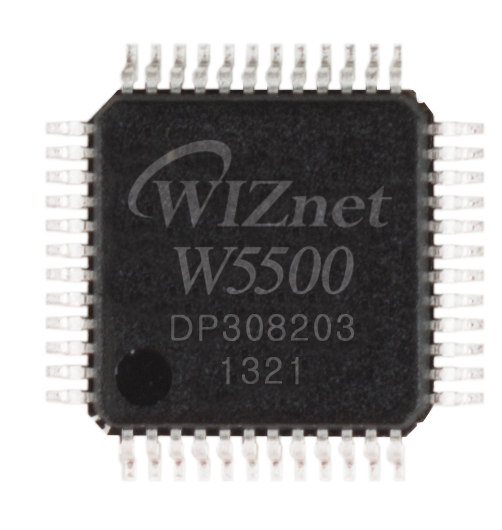
WIZnet - W5500
x 1
Introducing esp-rs/esp-idf-svc: Type-safe Rust access to ESP-IDF “services”
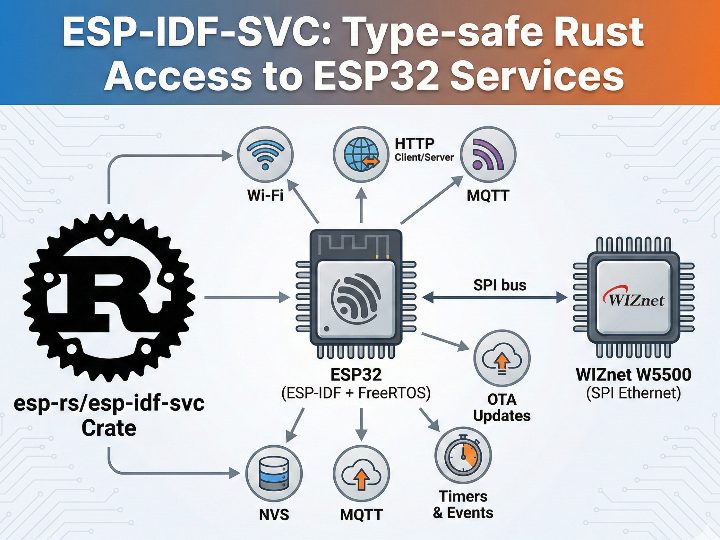
esp-rs/esp-idf-svc is a high-level Rust crate that provides safe, idiomatic wrappers around ESP-IDF services—things you actually use in real products such as timers, event loop, Wi-Fi, Ethernet, HTTP client/server, MQTT, NVS, OTA, and more. It does this largely by implementing the embedded-svc traits on top of ESP-IDF, so Rust applications can consume ESP-IDF capabilities with a more consistent, type-safe API surface.
Is it an official Espressif repository?
Not in the “owned by Espressif” sense. The repository lives under the esp-rs GitHub organization, not espressif. The project’s own README explicitly states that the esp-idf-* crates are a community effort, and that Espressif puts little to no paid developer time into them.
That said, Espressif does actively support Rust on their platforms in broader ways:
They publish “The Rust on ESP Book” on their official documentation domain, positioning it as a guide to using their tools and ecosystem.
They maintain an official “esp-rs Documentation and Resources” page that links to key crates and training resources (including esp-hal).
So the most accurate framing is: esp-idf-svc is community-operated, but it sits within a Rust-on-Espressif ecosystem that Espressif publicly documents and supports.
Why does W5500 show up here, and what is it used for?
Because esp-idf-svc targets ESP-IDF “services,” it naturally fits the ESP-IDF networking model: attach an Ethernet driver at L2, then use ESP-IDF’s TCP/IP stack (esp-netif/lwIP) for IP networking and sockets.
In that context, WIZnet W5500 is a very practical external Ethernet option:
It’s a SPI-based 10/100 Ethernet controller with MAC+PHY, making hardware integration simpler than many parallel/RMII designs.
Espressif’s own W5500 driver documentation notes that while W5500 includes a “hardwired TCP/IP stack,” that stack is not used in the ESP driver—instead, the chip is used as the Ethernet interface while ESP-IDF provides the IP stack.
Espressif even distributes W5500 support as an ESP-IDF component (espressif/w5500) and points users back to the ESP-IDF Ethernet driver flow.
In short: within the esp-idf-svc world, W5500 is typically used to add wired Ethernet over SPI, then route networking through ESP-IDF’s normal network stack so Rust code can leverage higher-level services (HTTP/MQTT/OTA, etc.).
What operating systems does Espressif support—and how does that relate to esp-idf-svc?
1) ESP-IDF + FreeRTOS (the “default” axis)
ESP-IDF ships with a modified FreeRTOS implementation (“IDF FreeRTOS”), including SMP-related modifications for dual-core targets.
➡️ esp-idf-svc is designed specifically for ESP-IDF, so it is most directly relevant in this ESP-IDF/FreeRTOS environment.
2) Zephyr RTOS
Espressif maintains an ESP-Zephyr page and a Zephyr support status portal, emphasizing active participation and tracking device/peripheral support.
➡️ Zephyr is a different stack from ESP-IDF, so esp-idf-svc is not typically the direct fit there.
3) NuttX
Espressif has also publicly discussed its ongoing work with NuttX and Zephyr communities to develop ESP32 support.
➡️ Same story: NuttX is not ESP-IDF, so esp-idf-svc is not the usual layer.
One-paragraph takeaway
esp-rs/esp-idf-svc is a community-maintained but highly practical crate that makes it much easier to build real ESP-IDF-based products in Rust by wrapping core services like networking, storage, and OTA in a safer API. It commonly pairs with external Ethernet options like W5500 because SPI Ethernet integrates cleanly into ESP-IDF’s networking architecture (using ESP-IDF’s IP stack rather than W5500’s onboard TCP/IP). And while Espressif supports multiple OS paths (ESP-IDF/FreeRTOS, Zephyr, NuttX, and community ports like RIOT), esp-idf-svc is fundamentally most relevant when you’re on the ESP-IDF + FreeRTOS track.
FAQ (Direct Q&A)
Is esp-rs/esp-idf-svc an official Espressif repository?
No. It is hosted under the esp-rs organization rather than espressif, so it is not an Espressif-owned “official” repository. It is typically described as a community effort, even though it sits within a Rust-on-Espressif ecosystem that Espressif documents and promotes.
Who maintains esp-rs/esp-idf-svc, and why?
It’s maintained by the esp-rs community (often including contributors who care about Rust on ESP). The goal is to make real ESP-IDF product features—Wi-Fi/Ethernet, HTTP, MQTT, NVS, OTA—available through safe and ergonomic Rust APIs, rather than requiring direct low-level C bindings.
What is esp-idf-svc used for?
Use it when you want:
ESP-IDF “batteries included” features (network stack, TLS, provisioning patterns, OTA, NVS)
Rust ergonomics and type safety
A practical path to build networked products in Rust on ESP hardware using ESP-IDF as the underlying runtime
Why is WIZnet W5500 used with esp-idf-svc?
W5500 is a common choice because it provides wired Ethernet over SPI, which is often simpler to integrate than parallel/RMII PHY designs. In the typical ESP-IDF integration model, W5500 acts as the Ethernet interface and ESP-IDF’s networking stack handles IP and sockets, enabling Rust apps to use higher-level services like HTTP/MQTT/OTA.
Does Espressif “recommend” Rust?
Espressif supports Rust through official documentation and ecosystem guidance, but practical support can differ by stack. In general:
Rust is increasingly supported and documented.
Some Rust tracks are more “officially emphasized” than others depending on the toolchain and HAL vs. IDF-based approach.
What operating systems does Espressif support?
Common OS options across the Espressif ecosystem include:
ESP-IDF + FreeRTOS (primary/default for ESP-IDF-based development)
Zephyr RTOS (separate stack; OS-level alternative)
NuttX (another OS alternative with its own ecosystem)
Which OS is esp-idf-svc most compatible with?
esp-idf-svc is most directly aligned with ESP-IDF + FreeRTOS, because it specifically wraps ESP-IDF services. Other OS stacks (Zephyr/NuttX/RIOT) generally require different integration approaches and do not use esp-idf-svc as the primary service layer.
-
esp-idf-svc


