


How to implement ultra-compact Ethernet with WIZnet W5500 on Propeller
Deploy a standalone web/FTP server using IoT5500. This W5500-based module for Propeller offloads TCP/IP for high-speed, 80MHz SPI IoT networking.
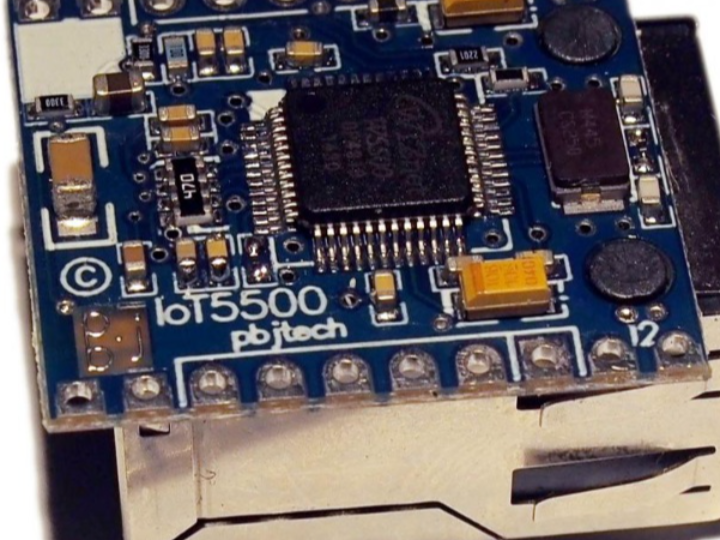
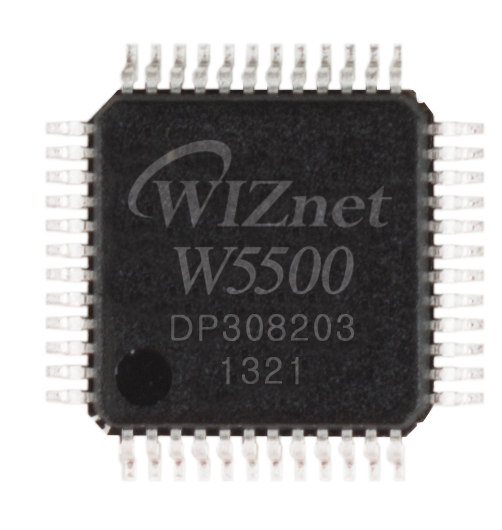
WIZnet - W5500
x 1

Parallax - Propeller P1
x 1
Step 1: Understanding the Hardware
The IoT5500 is an ultra-compact networking module designed as a high-performance, footprint-compatible replacement for the WIZ820io. It utilizes the WIZnet W5500 Hardwired TCP/IP controller, which supports up to 8 independent sockets and features a 32KB internal buffer. The design allows for a "PCB sandwich" stack where an optional Propeller P1 (+P8) or Cortex M4 CPU is mounted directly over the Ethernet section, significantly reducing the physical footprint to roughly the size of an RJ45 MagJack.
Technical Specifications:
Interface: High-speed SPI (up to 80MHz supported by W5500).
Storage: Onboard 16Mbit serial Flash and microSD half-socket.
Clocking: 6MHz oscillator on the +P8 module (boosted to 96MHz system clock).
Communication: Serial command channel supporting up to 3M baud for host interaction.
Step 2: Software/Firmware Setup
The module is optimized for the Tachyon Forth server software, which implements full HTTP, FTP, Telnet, and SNTP protocols. This setup allows the Propeller to act as a smart peripheral, handling the entire network stack and filesystem (FAT32) internally so that the host MCU’s memory remains free for applications.
// Conceptual integration example based on WIZnet ioLibrary (not project-specific)
// IoT5500 initialization typically handled via Tachyon Forth shell
wizchip_init(tx_size, rx_size); // Set 32KB buffer allocation across 8 sockets
wiz_set_ip(ip_addr);           // Configure static or DHCP-assigned address
FAQ
Q1: Why use WIZnet W5500 instead of a software-based stack?
A: The W5500 features a Hardwired TCP/IP stack, which offloads protocol processing from the MCU. This saves approximately 30KB of RAM and significantly reduces CPU load, ensuring deterministic timing and stability for industrial IoT applications compared to software-based solutions like LwIP.
Q2: How is the W5500 connected to the host platform?
A: The IoT5500 uses a high-speed SPI interface (Mode 0 or 3) for data transfer. In the +P8 stack configuration, it also provides a serial command channel that allows a host MCU to control the network and filesystem via simple serial strings at speeds up to 3M baud.
Q3: What performance benefits does the W5500 offer?
A: It provides up to 10/100 Mbps Ethernet speeds with much higher effective throughput than earlier chips like the W5100. By using an 80MHz SPI clock and hardware-managed buffers, it eliminates jitter and handles bursty traffic efficiently without dropping packets.
Q4: Does this module provide security or stability advantages?
A: Yes, the hardwired logic gates handle the transport and network layers, making the system immune to common software-based network attacks like "Ping of Death." This deterministic hardware stack ensures that network activity does not interfere with time-critical local MCU tasks.
Q5: How does the IoT5500 compare to alternatives like the ENC28J60?
A: Unlike the ENC28J60, which only handles the MAC/PHY and requires the host to run a complex TCP/IP stack, the W5500 handles the entire stack in silicon. The IoT5500 is also significantly smaller and more integrated than standard WIZnet evaluation boards.


