


How to Build a Web Server with W5500 on STM32 NUCLEO476RG
Run a lightweight HTTP web server on STM32 NUCLEO476RG using W5500 via SPI with hardware TCP/IP offload and multi-socket support.
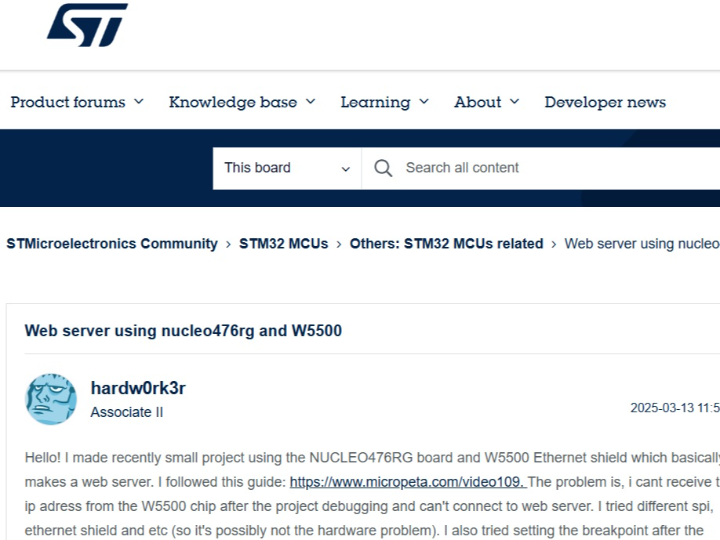
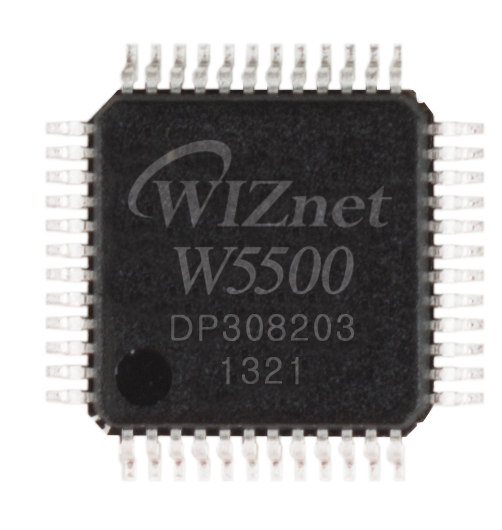
WIZnet - W5500
x 1

STMicro - NUCLEO476RG
x 1
Step 1: Understanding the Hardware
This project demonstrates a practical embedded web server using:
STM32 NUCLEO476RG (ARM Cortex-M4)
W5500 Ethernet controller (hardwired TCP/IP)
Key W5500 specifications:
SPI interface (commonly 10–80 MHz depending on MCU)
100 Mbps Ethernet support
8 hardware sockets for parallel connections
32 KB internal TX/RX buffer
The W5500 connects to STM32 via SPI:
SCK / MOSI / MISO (data lines)
CS (chip select)
Optional RESET and INT pins
This architecture removes the need for a software TCP/IP stack, allowing STM32 to focus on application logic while W5500 handles networking.
Step 2: Software/Firmware Setup
The project uses WIZnet’s ioLibrary-based approach to implement a simple HTTP web server.
Typical setup flow:
Initialize SPI and W5500
Configure network (static IP or DHCP)
Open TCP socket
Listen for HTTP requests
Serve simple web pages (e.g., LED control)
Example structure:
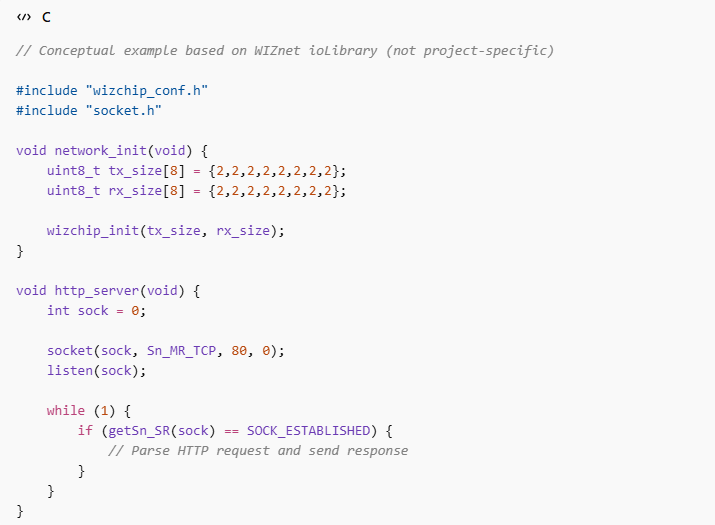
The implementation typically serves:
Static HTML pages
Simple control interfaces (e.g., GPIO toggle)
Basic request parsing (GET/POST)
Similar implementations show that STM32 + W5500 can host web pages and control hardware via browser interaction.
FAQ
Q1: Why use W5500 for STM32 web server instead of lwIP?
A: The W5500 provides hardware TCP/IP offload, eliminating the need for lwIP and reducing RAM usage significantly. It simplifies development by handling sockets internally and ensures deterministic network timing, which is critical for embedded systems requiring stable and predictable communication under load.
Q2: How is W5500 connected to STM32 NUCLEO476RG?
A: The W5500 connects via SPI using SCK, MOSI, MISO, and a CS pin, with optional RESET and INT lines. STM32 configures SPI through HAL or LL drivers, and the WIZnet ioLibrary manages communication, enabling quick integration without implementing a full Ethernet stack.
Q3: What performance benefits does W5500 provide in this setup?
A: The W5500 supports up to 100 Mbps Ethernet and 8 simultaneous sockets, allowing concurrent connections. By offloading TCP/IP processing, it reduces CPU load and enables stable throughput even on mid-range MCUs like STM32F4, making it suitable for real-time web interfaces and control systems.
Q4: What are the stability and reliability advantages?
A: W5500’s hardware TCP/IP stack ensures consistent behavior without stack crashes or memory fragmentation common in software stacks. Its deterministic execution improves uptime and reliability, which is essential for industrial and long-running embedded systems deployed in the field.
Q5: How does this compare to Wi-Fi or other Ethernet solutions?
A: Compared to Wi-Fi modules, W5500 offers lower latency, no RF interference, and higher reliability. Compared to software Ethernet (lwIP on STM32), it reduces complexity and MCU resource usage. While it lacks wireless flexibility, it excels in industrial, IoT, and mission-critical wired networking applications.


