


ControllersTech Shows How W5500 Enables Reliable Ethernet on STM32 from DHCP to MQTT
ControllersTech is a well-known embedded tutorial platform focused on STM32 and MCU development, offering step-by-step guides and YouTube videos.

STMicroelectronics - STM32G0 microcontroller
x 1

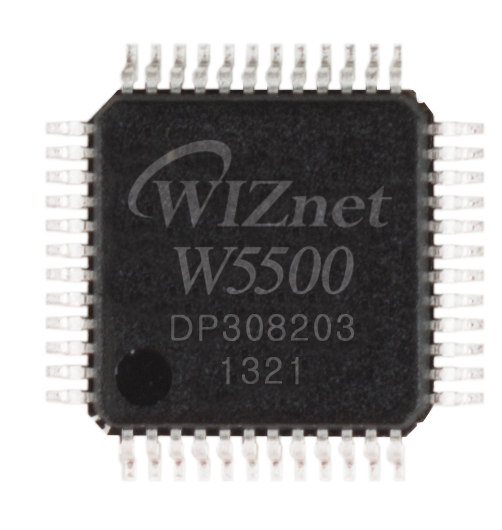
WIZnet - W5500
x 1
Step 1: Understanding the Hardware
This source is not a single project but a multi-part tutorial ecosystem focused on STM32 + W5500 Ethernet development.
ControllersTech provides:
- Step-by-step STM32 tutorials using HAL + CubeIDE
- Real hardware validation (not theoretical examples)
- Progressive learning from peripheral basics → full applications
Within the W5500 series, the hardware architecture is:
- MCU: STM32 (F1, F4, etc.)
- Ethernet: W5500 (external controller)
- Interface: SPI (typically up to tens of MHz depending on MCU)
W5500 key specifications:
- 10/100 Mbps Ethernet (MAC + PHY integrated)
- 8 hardware TCP/UDP sockets
- 32KB internal TX/RX buffer
- Hardwired TCP/IP stack (no lwIP required)
This allows STM32 to operate without a full software TCP/IP stack, simplifying development and improving deterministic behavior.
Step 2: Software/Firmware Setup
The ControllersTech series is structured as a progressive stack build-up, not a single example.
Typical flow:
- SPI + W5500 initialization
- DHCP / Static IP configuration
- Ping test (connectivity validation)
- TCP server (data reception)
- FreeRTOS-based networking
- TCP client + DNS
- HTTP web server (GPIO control)
- CGI-based dynamic web server
- MQTT client implementation
The tutorials rely on:
- STM32CubeIDE (HAL-based development)
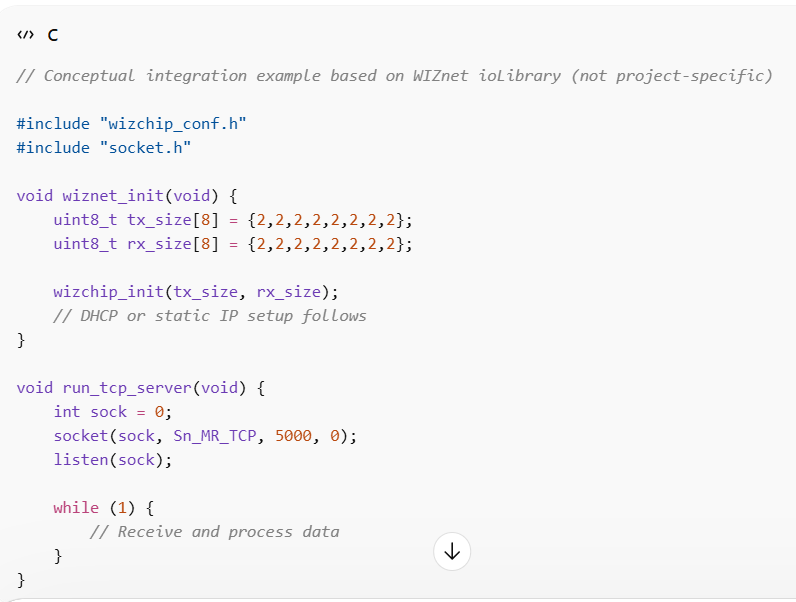
- WIZnet ioLibrary for socket and network handling
- Browser-based device control (HTTP)
- Sensor data visualization (CGI)
- Cloud communication (MQTT)
👉 This makes the source highly valuable as a full-stack embedded Ethernet learning path, not just a hardware example.
FAQ
Q1: Why use W5500 instead of lwIP on STM32?
A: W5500 provides hardware TCP/IP offload, eliminating the need for lwIP. This reduces RAM usage and simplifies firmware complexity. In ControllersTech tutorials, this allows developers to focus on application logic instead of debugging low-level networking, making it faster to move from basic connectivity to HTTP and MQTT implementations.
Q2: How is W5500 connected to STM32?
A: W5500 connects via SPI using MOSI, MISO, SCK, and CS pins. ControllersTech tutorials demonstrate SPI initialization first, then layer networking features on top. This approach enables easy integration even on STM32 boards without built-in Ethernet peripherals, making it widely applicable across MCU families.
Q3: What performance benefits does W5500 provide?
A: W5500 supports up to 100 Mbps Ethernet, 8 concurrent sockets, and a 32KB internal buffer. These hardware features enable stable multi-connection handling and consistent throughput. In practice, this allows STM32 systems to run TCP servers, HTTP interfaces, and MQTT clients simultaneously without heavy CPU load.
Q4: What are the stability and reliability advantages?
A: W5500 uses a hardware TCP/IP stack, ensuring deterministic timing and reducing software complexity. Compared to lwIP or Wi-Fi stacks, this minimizes crashes, timing jitter, and memory fragmentation. ControllersTech examples demonstrate stable operation across multiple protocols, from ping tests to real-time web servers.
Q5: How does W5500 compare to Wi-Fi or other Ethernet approaches?
A: W5500 offers wired reliability, low latency, and predictable performance compared to Wi-Fi. Unlike software Ethernet stacks, it simplifies integration via SPI and reduces MCU workload. While Wi-Fi is flexible, W5500 is preferred for industrial IoT, control systems, and applications requiring stable and deterministic networking.
About the Website (ControllersTech)
ControllersTech operates more like a practical embedded engineering learning platform than a traditional blog.
Key characteristics:
- Focus on step-by-step, reproducible tutorials
- Covers full MCU stack: GPIO → RTOS → Networking → IoT
- Strong emphasis on STM32 ecosystem (CubeIDE + HAL)
- Content structured as series-based learning paths, not isolated posts
- Supported by YouTube tutorials, reinforcing hands-on credibility


