



AC control timer
Rpi pico timer
How to Build a 4-Channel AC Timer Switch with W5500 and Raspberry Pi Pico?
Summary
This project implements a programmable 4-channel AC timer switch using Raspberry Pi Pico, WIZnet W5500 Ethernet, DS3231 RTC, SSD1306 OLED, and a joystick interface. The W5500 is used for NTP-based network time synchronization, allowing the controller to maintain accurate schedules while the DS3231 provides backup timekeeping during network outages.
What the Project Does
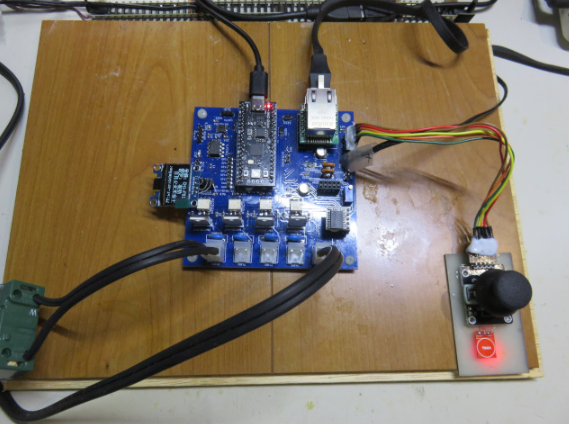
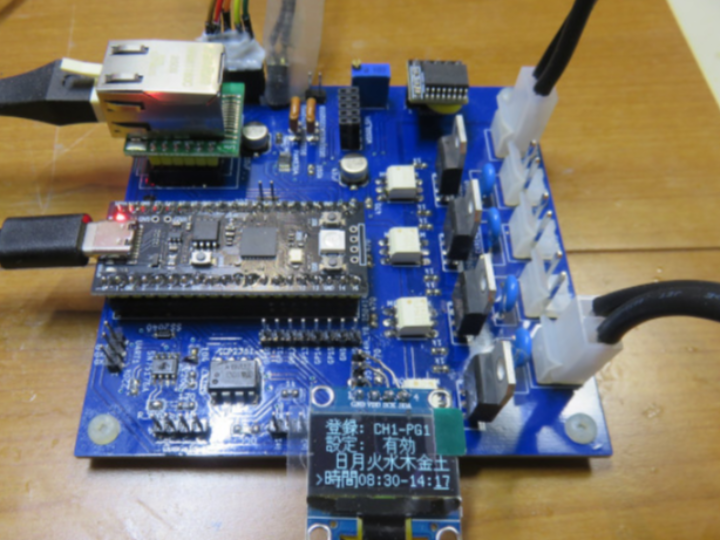
The system controls four independent AC outputs through photo-triac and triac circuits.
The hardware consists of:
Raspberry Pi Pico
WIZnet W5500 Ethernet module
DS3231 RTC
SSD1306 128×64 OLED
Analog joystick
4-channel photo-triac output stage
Each channel supports two independent timer programs, resulting in eight programmable schedules. The scheduler evaluates multiple programs using OR logic, allowing overlapping schedules without conflict.
Configuration data is stored as CSV files and can be edited directly from a PC through the Pico USB mass-storage interface.
Key functions include:
NTP network time synchronization
RTC backup clock
OLED-based user interface
CSV configuration storage
Four-channel AC load switching
Where WIZnet Fits
The W5500 provides Ethernet connectivity for automatic time synchronization.
According to the original project description, the SPI pin assignment follows the W5500-EVB-Pico-PoE design:
GP16
GP17
GP18
GP19
GP20
GP21
The primary role of the W5500 is to connect to an NTP server and obtain accurate network time. This removes the need for manual clock adjustment and allows the DS3231 RTC to remain synchronized.
For timer-based control systems, network-synchronized time is important because schedule accuracy directly affects switching behavior. The W5500 provides a stable wired Ethernet connection that is less susceptible to interference than Wi-Fi.
Implementation Notes
The project uses the following architecture:
W5500 Ethernet
→ NTP Server
→ Raspberry Pi Pico
→ DS3231 RTC Update
→ Timer Evaluation Engine
→ Photo-Triac Driver
→ AC Load Control
Timer configuration is stored in CSV format:
ch,prg,enabled,sun,mon,tue,wed,thu,fri,sat,startHour,startMin,endHour,endMin
0,0,1,1,1,1,1,1,1,1,8,30,17,15
Each channel contains two timer programs.
The scheduler combines the results using logical OR evaluation, allowing multiple active periods for the same output.
The OLED display provides local configuration while the joystick handles menu navigation and parameter editing.
Practical Tips / Pitfalls
Verify NTP synchronization before enabling critical schedules.
Use a battery-backed DS3231 to preserve time during power outages.
Ensure proper heat sinking for triacs when switching high-current loads.
Confirm isolation spacing around AC mains circuitry.
Avoid editing CSV files simultaneously from both USB host and Pico firmware.
Check Ethernet link status before requesting NTP updates.
FAQ
Why use W5500 in this project?
The W5500 provides reliable Ethernet connectivity for NTP time synchronization. Accurate time is essential for timer-based switching applications.
How does W5500 connect to Raspberry Pi Pico?
The module uses SPI. The project follows the same SPI assignment used by W5500-EVB-Pico-PoE, simplifying software reuse.
What role does W5500 play in this timer controller?
It retrieves accurate network time from an NTP server and keeps the timer schedules synchronized.
Can beginners reproduce this project?
Intermediate embedded development experience is recommended because the project combines Ethernet, RTC, OLED UI, file storage, and AC power control.
Why use Ethernet instead of Wi-Fi?
A wired Ethernet connection provides predictable connectivity and avoids wireless interference, which is beneficial for long-term automation systems.
Source
Original Project:
https://seisaku-memocyou.blog.jp/archives/34533327.html
Author:
製作メモ帳 (Seisaku Memocho)
License:
Not specified
Related WIZnet Ecosystem Projects
1. W5100S/W5500 RP2040 SNTP Network Time
Why It Is Similar
Uses Raspberry Pi Pico (RP2040)
Uses W5100S/W5500 Ethernet controllers
Implements SNTP/NTP-based network time synchronization
Focuses on obtaining accurate system time through Ethernet
How It Differs
This project focuses primarily on retrieving network time from an SNTP server.
In contrast, the 4-channel AC timer switch extends this concept by synchronizing a DS3231 RTC and using the synchronized time to drive an automated scheduling engine for AC load control.
Extension Opportunity
The SNTP implementation from this project could be adopted to further improve the robustness and accuracy of network time synchronization in the timer controller.
2. RP2040 + W5500 + TM1637 NTP Clock
Source:
https://maker.wiznet.io/scott/projects/rp2040w5500tm1637-ntp/
Why It Is Similar
RP2040-based platform
W5500 Ethernet connectivity
NTP server integration
Dedicated time display functionality
How It Differs
The primary goal of this project is to build a network-synchronized digital clock.
The timer switch project goes beyond time display by using synchronized time to control four independent AC outputs according to user-defined schedules.
Extension Opportunity
Combining the OLED-based interface from the timer controller with a dedicated clock-style display could improve usability for industrial or facility automation deployments.
3. GPS-Synchronized NTP Time Server with W5500-EVB-Pico
Why It Is Similar
Uses W5500 Ethernet hardware
Time synchronization is a core design objective
Demonstrates a practical NTP-related application
How It Differs
The GPS-synchronized project acts as an NTP server, generating and distributing accurate time across a network.
The timer switch project acts as an NTP client, consuming network time and applying it to automated scheduling and AC load control.
Extension Opportunity
A factory or building automation network could deploy a local GPS-based NTP server while multiple timer switch nodes synchronize against it, eliminating dependence on external internet time sources.
4. W5100S-EVB-Pico Basic Operation in Arduino Environment (LED, Passive Buzzer, Relay, OLED)
Why It Is Similar
RP2040-based hardware
OLED display integration
Buzzer functionality
Relay and output-control examples
How It Differs
This project demonstrates fundamental I/O capabilities of the W5100S-EVB-Pico platform.
The timer switch integrates Ethernet, RTC synchronization, OLED UI, buzzer feedback, file-based configuration storage, and triac-based AC control into a complete automation system.
Extension Opportunity
The relay, buzzer, and OLED examples can be leveraged to add status notifications, alarms, and diagnostic functions to the timer switch platform.
Differences and Extension Value
Most Maker projects related to W5500 and RP2040 focus on one of two areas:
Network time synchronization (NTP/SNTP clocks)
Basic Ethernet-connected I/O demonstrations
The 4-channel AC timer switch combines both concepts into a single application.
Architecture of Related Projects:
W5500
  ↓
NTP Server
  ↓
Clock Display
Architecture of This Project:
W5500
  ↓
NTP Server
  ↓
DS3231 RTC
  ↓
Scheduling Engine
  ↓
Triac Control
  ↓
AC Load
Rather than using Ethernet solely for communication, the W5500 serves as the source of accurate system time that drives the entire automation workflow.
This makes the project a practical example of how Ethernet connectivity can be integrated into real-world control systems rather than functioning only as a networking demonstration.
Presentation Summary
While reviewing this project, I compared it with several Maker projects that use RP2040 and W5500 for network time synchronization.
Most of those projects focus on obtaining and displaying accurate time through NTP. This project takes the next step by connecting synchronized time to real-world control logic through a scheduling engine and four AC output channels.
One particularly interesting extension path is combining this project with a GPS-synchronized NTP server. In that configuration, a facility could maintain highly accurate time synchronization without relying on external internet connectivity, while multiple timer controllers operate from the same local time reference.
This project demonstrates how W5500 can serve not only as a networking device, but also as a foundation for reliable time-based industrial and building automation systems.
Tags
#W5500 #RaspberryPiPico #TimerSwitch #NTP #DS3231 #Ethernet #IndustrialAutomation #Triac #OLED #IoT